Get help with Biology, Grade 11, University Preparation
Most tutoring makes you sit through material you already know. MapleMind flips that: pick the exact skill that's causing trouble — any of the 54 below — and the tutor teaches just that one, step by step, as many times as it takes. Ask questions in plain words, any time of day, in English, French, or 12 other languages.
The official Ontario Biology, Grade 11, University Preparation curriculum
Ontario defines Biology, Grade 11, University Preparation by strands and outcomes. MapleMind teaches the same curriculum reorganized for one-skill-at-a-time tutoring — the table shows exactly where every official strand lands, and the ministry's own wording is quoted under each unit below.
Official source Ontario's official science curriculumRead it on the government site — dcp.edu.gov.on.ca ↗| Official strand | Outcomes | Where MapleMind teaches it |
|---|---|---|
| Strand A | 2 | Investigation Skills and Careers |
| Strand B | 11 | Diversity of Living Things |
| Strand C | 10 | Evolution |
| Strand D | 11 | Genetic Processes |
| Strand E | 9 | Animals: Structure and Function |
| Strand F | 11 | Plants: Anatomy, Growth, and Function |
Every skill below, taught one on one.
 Try the first session free
How MapleMind teaches Biology, Grade 11, University Preparation — every unit, lesson, and skill
Every skill below runs as a short session: a plain-words lesson, a worked example, solving it together, then a five-question skill check that earns up to three stars. Guided Mode keeps it teaching instead of answer-handing — turning it off needs a parent's password.
Unit 1Investigation Skills and CareersOfficial strand · Strand A
Careers related to the fields of science under study and the education and training they require, and scientists — including Canadians — who have contributed to those fields. The scientific investigation skills of strand A1 are woven through every lab and inquiry in the content strands rather than taught here on their own.
Careers in the Biological Sciences
- Careers in the biological sciencessbi3u.SBI3U.A2.1 — Identify and describe a variety of careers related to the fields of science under study and the education and training necessary for them.
Scientists and Their Contributions
- Scientists who contributed to biologysbi3u.SBI3U.A2.2 — Describe the contributions of scientists, including Canadians, to the fields under study.
The official wording — 2 outcomes in this unit
- sbi3u.SBI3U.A2.1
identify and describe a variety of careers related to the fields of science under study (e.g., zoologist, botanist, geneticist, ecologist, pharmacologist, farmer, forester, horticulturalist) and the education and training necessary for these careers
- sbi3u.SBI3U.A2.2
describe the contributions of scientists, including Canadians (e.g., Colin D’Cunha, Louis Bernatchez, Lap-Chee Tsui, Helen Battle, Memory Elvin-Lewis), to the fields under study
Unit 2Diversity of Living ThingsOfficial strand · Strand B
The diversity of life — taxonomy and phylogeny, the kingdoms, prokaryotes, eukaryotes, and viruses, and why biodiversity matters — investigated through classification, sampling, and dichotomous keys, plus analysing how human activity and climate change affect biodiversity.
Biodiversity and Human Impact
- Risks and benefits of human interventionsbi3u.SBI3U.B1.1 — Analyse the risks and benefits of human intervention to the biodiversity of aquatic or terrestrial ecosystems.
- Climate change and biodiversitysbi3u.SBI3U.B1.2 — Analyse the impact that climate change might have on the diversity of living things.
Classifying the Diversity of Life
- Biodiversity terminologysbi3u.SBI3U.B2.1 — Use appropriate terminology related to biodiversity.
- Classifying representative organismssbi3u.SBI3U.B2.2 — Classify and draw biological diagrams of representative organisms from each kingdom according to their characteristics.
- Sampling and classifying organismssbi3u.SBI3U.B2.3 — Use proper sampling techniques to collect organisms from an ecosystem and classify them according to taxonomy.
- Using a dichotomous keysbi3u.SBI3U.B2.4 — Create and apply a dichotomous key to identify and classify organisms from each kingdom.
- Taxonomy and phylogenysbi3u.SBI3U.B3.1 — Explain the fundamental principles of taxonomy and phylogeny by defining concepts of taxonomic rank and relationship.
- Prokaryotes, eukaryotes, and virusessbi3u.SBI3U.B3.2 — Compare and contrast the structure and function of prokaryotes, eukaryotes, and viruses.
- Characteristics of the kingdomssbi3u.SBI3U.B3.3 — Describe unifying and distinguishing anatomical and physiological characteristics of representative organisms from each kingdom.
- Evolutionary changes in organismssbi3u.SBI3U.B3.4 — Explain key structural and functional changes in organisms as they have evolved over time.
- Why biodiversity matterssbi3u.SBI3U.B3.5 — Explain why biodiversity is important to maintaining viable ecosystems.
The official wording — 11 outcomes in this unit
- sbi3u.SBI3U.B1.1
analyse some of the risks and benefits of human intervention (e.g., tree plantations; monoculture of livestock or agricultural crops; overharvesting of wild plants for medicinal purposes; using pesticides to control pests; suppression of wild fires) to the biodiversity of aquatic or terrestrial ecosystems [AI, C]
- sbi3u.SBI3U.B1.2
analyse the impact that climate change might have on the diversity of living things (e.g., rising temperatures can result in habitat loss or expan- sion; changing rainfall levels can cause drought or flooding of habitats) [AI, C]
- sbi3u.SBI3U.B2.1
use appropriate terminology related to bio- diversity, including, but not limited to: genetic diversity, species diversity, structural diversity, protists, bacteria, fungi, binomial nomenclature, and morphology [C]
- sbi3u.SBI3U.B2.2
classify, and draw biological diagrams of, representative organisms from each of the kingdoms according to their unifying and distinguishing anatomical and physiological characteristics (e.g., vertebrate or invertebrate organisms, vascular or nonvascular plants) [PR, AI, C]
- sbi3u.SBI3U.B2.3
use proper sampling techniques to collect various organisms from a marsh, pond, field, or other ecosystem, and classify the organisms according to the principles of taxonomy [PR, AI, C]
- sbi3u.SBI3U.B2.4
create and apply a dichotomous key to iden- tify and classify organisms from each of the kingdoms [PR, AI, C]
- sbi3u.SBI3U.B3.1
explain the fundamental principles of taxonomy and phylogeny by defining concepts of taxonomic rank and relationship, such as genus, species, and taxon
- sbi3u.SBI3U.B3.2
compare and contrast the structure and function of different types of prokaryotes, eukaryotes, and viruses (e.g., compare and contrast genetic material, metabolism, organ- elles, and other cell parts)
- sbi3u.SBI3U.B3.3
describe unifying and distinguishing ana- tomical and physiological characteristics (e.g., types of reproduction, habitat, general physical structure) of representative organisms from each of the kingdoms
- sbi3u.SBI3U.B3.4
explain key structural and functional changes in organisms as they have evolved over time (e.g., the evolution of eukaryotes from prokaryotes, of plants from unicellular organisms)
- sbi3u.SBI3U.B3.5
explain why biodiversity is important to maintaining viable ecosystems (e.g., biodiversity helps increase resilience to stress and resistance to diseases or invading species)
Unit 3EvolutionOfficial strand · Strand C
The theory of evolution — natural selection, adaptation, speciation, and evolutionary mechanisms — and the scientists who developed it, investigated through case studies and simulations, plus analysing artificial selection technologies and evaluating the impact of environmental change on natural selection.
Selection, Technology, and Change
- Artificial selection technologiessbi3u.SBI3U.C1.1 — Analyse the economic and environmental advantages and disadvantages of an artificial selection technology.
- Environmental change and natural selectionsbi3u.SBI3U.C1.2 — Evaluate the possible impact of an environmental change on natural selection and on the vulnerability of species.
Investigating Evolution
- Evolution terminologysbi3u.SBI3U.C2.1 — Use appropriate terminology related to evolution.
- Factors affecting evolutionsbi3u.SBI3U.C2.2 — Use a research process to investigate key factors that affect the evolutionary process.
- Scientists' contributions to evolutionsbi3u.SBI3U.C2.3 — Analyse and report on the contributions of various scientists to modern theories of evolution.
- Investigating natural and artificial selectionsbi3u.SBI3U.C2.4 — Investigate the processes of natural and artificial selection through a case study or simulation, and analyse how they occur.
- The theory of evolutionsbi3u.SBI3U.C3.1 — Explain the fundamental theory of evolution, using natural selection to illustrate biological change over time.
- Adaptation of organismssbi3u.SBI3U.C3.2 — Explain the process of adaptation of individual organisms to their environment.
- Speciationsbi3u.SBI3U.C3.3 — Define the concept of speciation and explain the process by which new species are formed.
- Evolutionary mechanismssbi3u.SBI3U.C3.4 — Describe evolutionary mechanisms and explain how they affect the development and extinction of species.
The official wording — 10 outcomes in this unit
- sbi3u.SBI3U.C1.1
analyse, on the basis of research, the economic and environmental advantages and disadvan- tages of an artificial selection technology (e.g., livestock and horticultural breeding) [IP, PR, AI, C]
- sbi3u.SBI3U.C1.2
evaluate the possible impact of an environ- mental change on natural selection and on the vulnerability of species (e.g., adaptation to environmental changes can affect reproductive success of an organism) [AI, C]
- sbi3u.SBI3U.C2.1
use appropriate terminology related to evo- lution, including, but not limited to: extinction, natural selection, phylogeny, speciation, niche, mutation, mimicry, adaptation, and survival of the fittest [C]
- sbi3u.SBI3U.C2.2
use a research process to investigate some of the key factors that affect the evolutionary process (e.g., genetic mutations, selective pressures, environmental stresses) [IP, PR]
- sbi3u.SBI3U.C2.3
analyse, on the basis of research, and report on the contributions of various scientists to modern theories of evolution (e.g., Charles Lyell, Thomas Malthus, Jean-Baptiste Lamarck, Charles Darwin, Stephen Jay Gould, Niles Eldredge) [IP, PR, AI, C]
- sbi3u.SBI3U.C2.4
investigate, through a case study or comput- er simulation, the processes of natural selection and artificial selection (e.g., selective breeding, antibiotic resistance in microorganisms), and analyse the different mechanisms by which they occur [PR, AI, C]
- sbi3u.SBI3U.C3.1
explain the fundamental theory of evolution, using the evolutionary mechanism of natural selection to illustrate the process of biological change over time
- sbi3u.SBI3U.C3.2
explain the process of adaptation of individ- ual organisms to their environment (e.g., some disease-causing bacteria in a bacterial popula- tion can survive exposure to antibiotics due to slight genetic variations from the rest of the population, which allows successful surviving bacteria to pass on antibiotic resistance to the next generation)
- sbi3u.SBI3U.C3.3
define the concept of speciation, and explain the process by which new species are formed
- sbi3u.SBI3U.C3.4
describe some evolutionary mechanisms (e.g., natural selection, artificial selection, sexual selection, genetic variation, genetic drift, biotechnology), and explain how they affect the evolutionary development and extinction of various species (e.g., Darwin’s finches, giraffes, pandas)
Unit 4Genetic ProcessesOfficial strand · Strand D
The processes of inheritance — meiosis, DNA, genes, and Mendelian genetics — investigated with the microscope and the Punnett square, plus genetic disorders and reproductive technologies, and analysing the social and ethical implications of genetics research.
Genetics, Ethics, and Society
- Ethics of genetics researchsbi3u.SBI3U.D1.1 — Analyse the social and ethical implications of research in genetics and genomics.
- Recent contributions in geneticssbi3u.SBI3U.D1.2 — Evaluate the importance of recent contributions to knowledge, techniques, and technologies related to genetic processes.
Investigating Genetic Processes
- Genetics terminologysbi3u.SBI3U.D2.1 — Use appropriate terminology related to genetic processes.
- Investigating meiosissbi3u.SBI3U.D2.2 — Investigate the process of meiosis using a microscope or simulation and draw biological diagrams of its phases.
- Solving Punnett square problemssbi3u.SBI3U.D2.3 — Use the Punnett square method to solve genetics problems involving monohybrid, incomplete dominance, codominance, dihybrid, and sex-linked crosses.
- Analysing crosses with probabilitysbi3u.SBI3U.D2.4 — Investigate monohybrid and dihybrid crosses and use Punnett squares and probability to analyse the data and determine parent genotypes.
- Phases of meiosissbi3u.SBI3U.D3.1 — Explain the phases of meiosis in terms of cell division, chromosome movement, and crossing over.
- DNA, genes, and Mendelian inheritancesbi3u.SBI3U.D3.2 — Explain DNA, genes, chromosomes, alleles, mitosis, and meiosis, and how they transmit hereditary characteristics by Mendelian laws.
- Genotype, phenotype, and inheritance patternssbi3u.SBI3U.D3.3 — Explain genotype, phenotype, dominance, incomplete dominance, codominance, recessiveness, and sex linkage by Mendelian laws.
- Genetic disorderssbi3u.SBI3U.D3.4 — Describe genetic disorders caused by chromosomal abnormalities or mutations, in terms of chromosomes, effects, and treatments.
- Reproductive technologiessbi3u.SBI3U.D3.5 — Describe reproductive technologies and explain how their use can increase the genetic diversity of a species.
The official wording — 11 outcomes in this unit
- sbi3u.SBI3U.D1.1
analyse, on the basis of research, some of the social and ethical implications of research in genetics and genomics (e.g., genetic screening, gene therapy, in vitro fertilization) [IP, PR, AI, C]
- sbi3u.SBI3U.D1.2
evaluate, on the basis of research, the im- portance of some recent contributions to knowledge, techniques, and technologies related to genetic processes (e.g., research into the cystic fibrosis gene; the use of safflowers to produce insulin for human use) [IP, PR, AI, C]
- sbi3u.SBI3U.D2.1
use appropriate terminology related to gen- etic processes, including, but not limited to: haploid, diploid, spindle, synapsis, gamete, zygote, heterozygous, homozygous, allele, plasmid, trisomy, non-disjunction, and somatic cell [C]
- sbi3u.SBI3U.D2.2
investigate the process of meiosis, using a microscope or similar instrument, or a computer simulation, and draw biological diagrams to help explain the main phases in the process [PR, AI, C]
- sbi3u.SBI3U.D2.3
use the Punnett square method to solve basic genetics problems involving monohybrid crosses, incomplete dominance, codominance, dihybrid crosses, and sex-linked genes [PR, AI, C]
- sbi3u.SBI3U.D2.4
investigate, through laboratory inquiry or computer simulation, monohybrid and dihy- brid crosses, and use the Punnett square method and probability rules to analyse the qualitative and quantitative data and determine the parent genotype [PR, AI, C]
- sbi3u.SBI3U.D3.1
explain the phases in the process of meiosis in terms of cell division, the movement of chromosomes, and crossing over of genetic material
- sbi3u.SBI3U.D3.2
explain the concepts of DNA, genes, chromosomes, alleles, mitosis, and meiosis, and how they account for the transmission of her- editary characteristics according to Mendelian laws of inheritance
- sbi3u.SBI3U.D3.3
explain the concepts of genotype, pheno- type, dominance, incomplete dominance, codominance, recessiveness, and sex linkage ac- cording to Mendelian laws of inheritance
- sbi3u.SBI3U.D3.4
describe some genetic disorders caused by chromosomal abnormalities (e.g., non-disjunction of chromosomes during meiosis) or other genetic mutations in terms of chromosomes affected, physical effects, and treatments
- sbi3u.SBI3U.D3.5
describe some reproductive technologies (e.g., cloning, artificial insemination, in vitro fertilization, recombinant DNA), and explain how their use can increase the genetic diversity of a species (e.g., farm animals, crops)
Unit 5Animals: Structure and FunctionOfficial strand · Strand E
The anatomy and physiology of animal systems — the respiratory, digestive, and circulatory systems and their disorders — investigated through dissection and medical equipment, plus evaluating imaging technologies and assessing how societal needs drive developments related to internal systems.
Internal Systems and Technology
- Technologies for internal body systemssbi3u.SBI3U.E1.1 — Evaluate the importance of technologies, including Canadian contributions, to our understanding of internal body systems.
- Societal needs and scientific developmentssbi3u.SBI3U.E1.2 — Assess how societal needs lead to scientific and technological developments related to internal systems.
Investigating Animal Systems
- Animal anatomy terminologysbi3u.SBI3U.E2.1 — Use appropriate terminology related to animal anatomy.
- Dissecting animal systemssbi3u.SBI3U.E2.2 — Perform a dissection or use an anatomical model to analyse the relationships between the respiratory, circulatory, and digestive systems.
- Monitoring system responsessbi3u.SBI3U.E2.3 — Use medical equipment to monitor the functional responses of the respiratory and circulatory systems to external stimuli.
- The respiratory systemsbi3u.SBI3U.E3.1 — Explain the anatomy of the respiratory system and the process of ventilation and gas exchange.
- The digestive systemsbi3u.SBI3U.E3.2 — Explain the anatomy of the digestive system and the importance of digestion for energy and growth.
- The circulatory systemsbi3u.SBI3U.E3.3 — Explain the anatomy of the circulatory system and its function in transporting vital substances.
- Disorders of animal systemssbi3u.SBI3U.E3.4 — Describe disorders related to the respiratory, digestive, and circulatory systems.
The official wording — 9 outcomes in this unit
- sbi3u.SBI3U.E1.1
evaluate the importance of various technolo- gies, including Canadian contributions, to our understanding of internal body systems (e.g., endoscopes can be used to locate, diagnose, and surgically remove digestive system tu- mours; lasers can be used during surgery to destroy lung tumours; nuclear magnetic reson- ance [NMR] imaging can be used to diagnose injuries and cardiovascular disorders, such as aneurysms) [AI, C]
- sbi3u.SBI3U.E1.2
assess how societal needs (e.g., the need for healthy foods; the need to counteract the effects of sedentary lifestyles) lead to scientific and technological developments related to internal systems (e.g., advances in dietary products and fitness equipment; improved standards for transplanting organs) [AI, C]
- sbi3u.SBI3U.E2.1
use appropriate terminology related to animal anatomy, including, but not limited to: systolic, diastolic, diffusion gradient, inhalation, ex- halation, coronary, cardiac, ulcer, asthma, and constipation [C]
- sbi3u.SBI3U.E2.2
perform a laboratory or computer-simulated dissection of a representative animal, or use a mounted anatomical model, to analyse the relationships between the respiratory, circulatory, and digestive systems [PR, AI]
- sbi3u.SBI3U.E2.3
use medical equipment (e.g., a stethoscope, a sphygmomanometer) to monitor the functional responses of the respiratory and circulatory systems to external stimuli (e.g., measure the change in breathing rate and heart rate after exercise) [PR, AI]
- sbi3u.SBI3U.E3.1
explain the anatomy of the respiratory system and the process of ventilation and gas exchange from the environment to the cell (e.g., the movement of oxygen from the atmosphere to the cell; the roles of ventilation, hemoglobin, and diffusion in gas exchange)
- sbi3u.SBI3U.E3.2
explain the anatomy of the digestive system and the importance of digestion in providing nutrients needed for energy and growth (e.g., the body’s mechanical and chemical processes digest food, which provides the proteins needed to build muscle, and the fibre, water, vitamins, and minerals needed to regulate body processes)
- sbi3u.SBI3U.E3.3
explain the anatomy of the circulatory system (e.g., blood components, blood vessels, the heart) and its function in transporting substances that are vital to health
- sbi3u.SBI3U.E3.4
describe some disorders related to the respiratory, digestive, and circulatory systems (e.g., asthma, emphysema, ulcers, colitis, cardiac arrest, arteriosclerosis)
Unit 6Plants: Anatomy, Growth, and FunctionOfficial strand · Strand F
The anatomy, growth, and function of vascular plants — specialized tissues, transport mechanisms, reproduction, monocots and dicots, and ecological succession — investigated through inquiry, microscopy, and propagation, plus evaluating the importance of plants to society and sustainable use.
Plants and Society
- Importance of plants to societysbi3u.SBI3U.F1.1 — Evaluate the importance of plants to the growth and development of Canadian society.
- Sustainable use of plantssbi3u.SBI3U.F1.2 — Evaluate ways in which different societies or cultures have used plants to sustain populations while supporting environmental sustainability.
Investigating Plant Anatomy and Growth
- Plant terminologysbi3u.SBI3U.F2.1 — Use appropriate terminology related to plants.
- Factors affecting plant growthsbi3u.SBI3U.F2.2 — Design and conduct an inquiry to determine the factors that affect plant growth.
- Specialized plant tissuessbi3u.SBI3U.F2.3 — Identify and draw biological diagrams of the specialized plant tissues in roots, stems, and leaves.
- Plant propagation techniquessbi3u.SBI3U.F2.4 — Investigate various techniques of plant propagation.
- Plant tissues and transportsbi3u.SBI3U.F3.1 — Describe the structures of tissues in vascular plants and explain how materials are transported through a plant.
- Monocots and dicotssbi3u.SBI3U.F3.2 — Compare and contrast monocot and dicot plants in terms of their structures and evolution.
- Plant reproductionsbi3u.SBI3U.F3.3 — Explain the reproductive mechanisms of plants in natural reproduction and artificial propagation.
- Factors affecting plant growth (concepts)sbi3u.SBI3U.F3.4 — Describe the various factors that affect plant growth.
- Ecological successionsbi3u.SBI3U.F3.5 — Explain the process of ecological succession, including the role of plants after a disturbance.
The official wording — 11 outcomes in this unit
- sbi3u.SBI3U.F1.1
evaluate, on the basis of research, the im- portance of plants to the growth and development of Canadian society (e.g., as a source of food, pharmaceuticals, Aboriginal medicines, building materials, flood and ero- sion control; as a resource for recreation and ecotourism) [IP, PR, AI, C]
- sbi3u.SBI3U.F1.2
evaluate, on the basis of research, ways in which different societies or cultures have used plants to sustain human populations while supporting environmental sustainability (e.g., sustainable agricultural practices in developing countries such as crop rotation and seed saving; traditional Aboriginal corn production practices) [IP, PR, AI, C]
- sbi3u.SBI3U.F2.1
use appropriate terminology related to plants, including, but not limited to: mesophyll, palisade, aerenchyma, epidermal tissue, stomata, root hair, pistil, stamen, venation, auxin, and gibberellin [C]
- sbi3u.SBI3U.F2.2
design and conduct an inquiry to determine the factors that affect plant growth (e.g., the effects on plant growth of the quantity of nutri- ents, the quantity and quality of light, and factors such as temperature and water retention or percolation rate) [IP, PR, AI]
- sbi3u.SBI3U.F2.3
identify, and draw biological diagrams of, the specialized plant tissues in roots, stems, and leaves (e.g., xylem, phloem), using a microscope and models [PR, AI]
- sbi3u.SBI3U.F2.4
investigate various techniques of plant propagation (e.g., leaf cutting, stem cutting, root cutting, seed germination) [PR]
- sbi3u.SBI3U.F3.1
describe the structures of the various types of tissues in vascular plants, and explain the mechanisms of transport involved in the processes by which materials are distributed throughout a plant (e.g., transpiration, translocation, osmosis)
- sbi3u.SBI3U.F3.2
compare and contrast monocot and dicot plants in terms of their structures (e.g., seeds, stem, flower, root) and their evolutionary processes (i.e., how one type evolved from the other)
- sbi3u.SBI3U.F3.3
explain the reproductive mechanisms of plants in natural reproduction and artificial propagation (e.g., germination of seeds, leaf cuttings, grafting of branches onto a host tree)
- sbi3u.SBI3U.F3.4
describe the various factors that affect plant growth (e.g., growth regulators, sunlight, water, nutrients, acidity, tropism)
- sbi3u.SBI3U.F3.5
explain the process of ecological succession, including the role of plants in maintaining biodiversity and the survival of organisms after a disturbance to an ecosystem

Printable workbook · A keepsake of the year
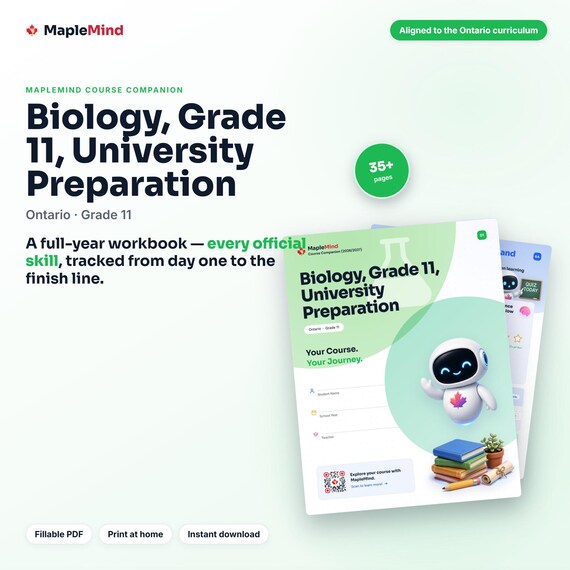
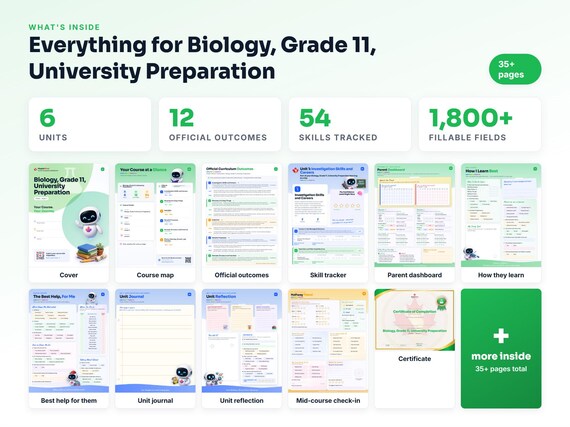
A Biology, Grade 11, University Preparation workbook worth keeping
Built from the same official curriculum as this page. Before and after each skill above, your student colours in how sure they feel — so the two of you can see, on one page, what's clicking and what needs another look. It's a quiet way to follow how the year is really going.
By June it's full of their own handwriting: units worked through, confidence grown, a mid-year check-in, notes from parent-teacher night, and a certificate at the end. Less a worksheet, more a record of the year worth keeping on the shelf.
Instant download · see every page, reviews and the full description · five or more workbooks are $2.99 each
What it looks like in the app



Common questions
Can MapleMind help me with Biology, Grade 11, University Preparation?
Yes. MapleMind's AI tutor covers all 54 skills in Ontario's Biology, Grade 11, University Preparation — you pick the exact skill, and the tutor teaches it step by step: a short lesson, a worked example, solving together, then a skill check to show it stuck.
Is MapleMind aligned to Ontario's official curriculum?
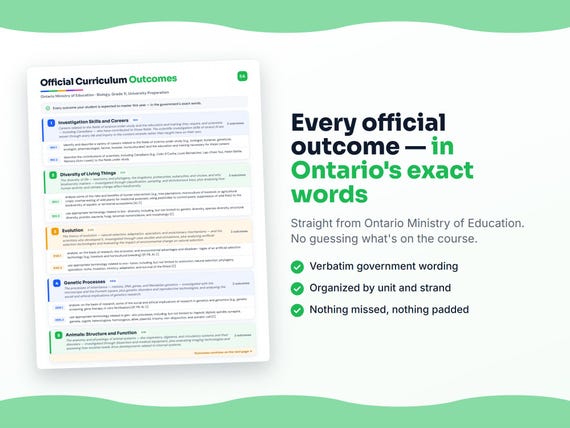
Yes. Every skill in this course maps to an official outcome code from Ontario's Grade 11 Science curriculum, and the ministry's own wording is quoted under each unit on this page — with the official government source linked so you can check it yourself.
What does MapleMind cost?
It's free to start — 5 tutoring chats and a practice quiz every day, no credit card. A Pro subscription ($9.99/month or $49.99/year CAD, 7-day free trial) unlocks unlimited tutoring, practice, and exam simulations.
What if I'm stuck on just one topic?
That's the point of skill-level tutoring: open Biology, Grade 11, University Preparation in the app, tap the exact skill from the list on this page, and the tutor teaches just that — no wading through lessons you don't need.
Does MapleMind work in French or other languages?
Yes — 14 languages, including French. Both the app and the tutor's explanations switch to the language you choose.
Where can I see the official Ontario curriculum for Biology, Grade 11, University Preparation?
The official source is linked on this page — Ontario's official science curriculum. The outline here follows it: every MapleMind skill carries its official outcome code, and the ministry's own wording is quoted under each unit.
Keep exploring
Ready when you are
Pick a skill from this page and see it taught properly — free, in the browser, in under a minute.