Get help with Physics, Grade 12, College Preparation
Most tutoring makes you sit through material you already know. MapleMind flips that: pick the exact skill that's causing trouble — any of the 80 below — and the tutor teaches just that one, step by step, as many times as it takes. Ask questions in plain words, any time of day, in English, French, or 12 other languages.
The official Ontario Physics, Grade 12, College Preparation curriculum
Ontario defines Physics, Grade 12, College Preparation by strands and outcomes. MapleMind teaches the same curriculum reorganized for one-skill-at-a-time tutoring — the table shows exactly where every official strand lands, and the ministry's own wording is quoted under each unit below.
Official source Ontario's official science curriculumRead it on the government site — dcp.edu.gov.on.ca ↗| Official strand | Outcomes | Where MapleMind teaches it |
|---|---|---|
| Strand A | 2 | Investigation Skills and Careers |
| Strand B | 17 | Motion and Its Applications |
| Strand C | 13 | Mechanical Systems |
| Strand D | 19 | Electricity and Magnetism |
| Strand E | 12 | Energy Transformations |
| Strand F | 15 | Hydraulic and Pneumatic Systems |
Every skill below, taught one on one.
 Try the first session free
How MapleMind teaches Physics, Grade 12, College Preparation — every unit, lesson, and skill
Every skill below runs as a short session: a plain-words lesson, a worked example, solving it together, then a five-question skill check that earns up to three stars. Guided Mode keeps it teaching instead of answer-handing — turning it off needs a parent's password.
Unit 1Investigation Skills and CareersOfficial strand · Strand A
Careers related to the applied physics fields under study and the education and training they require, and scientists — including Canadians — who have contributed to those fields. The scientific investigation skills of strand A1 are woven through every lab and hands-on build in the content strands rather than taught here on their own.
Careers in Applied Physics and the Trades
- Careers in applied physics and the tradessph4c.SPH4C.A2.1 — Identify and describe a variety of careers related to the fields of science under study and the education and training necessary for them.
Scientists and Their Contributions
- Scientists who contributed to physicssph4c.SPH4C.A2.2 — Describe the contributions of scientists, including Canadians, to the fields under study.
The official wording — 2 outcomes in this unit
- sph4c.SPH4C.A2.1
identify and describe a variety of careers re- lated to the fields of science under study (e.g., alternative energy advocate, sustainable energy technician, electrician, mechanic) and the edu- cation and training necessary for these careers
- sph4c.SPH4C.A2.2
describe the contributions of scientists, includ- ing Canadians (e.g., Elijah McCoy, Jaisel Vadgama, Gerald Vincent Bull, Elizabeth Cannon, Richard Marceau, Normand C. Beaulieu), to the fields under study
Unit 2Motion and Its ApplicationsOfficial strand · Strand B
Uniform and non-uniform linear motion and its everyday applications — distance, speed, acceleration, and net force — measured with distance–time and speed–time graphs and simple equations, plus analysing transportation and motion-tracking technologies and evaluating their impact.
Motion Technology and Society
- Analysing a transportation technologysph4c.SPH4C.B1.1 — Analyse the design and uses of a transportation technology.
- Evaluating a transportation technology's impactsph4c.SPH4C.B1.1 — Evaluate the social and environmental impact of a transportation technology, including its impact on risk behaviour and accident rates.
- Motion-tracking technologiessph4c.SPH4C.B1.2 — Analyse how technologies are used to track the motion of objects and outline the scientific knowledge gained.
Investigating Motion
- Motion terminologysph4c.SPH4C.B2.1 — Use appropriate terminology related to motion.
- Measuring distance and speedsph4c.SPH4C.B2.2 — Plan and conduct investigations to measure distance and speed for objects in uniform motion.
- Measuring accelerationsph4c.SPH4C.B2.3 — Plan and conduct investigations to measure constant acceleration for objects in one dimension.
- Distance–time graphssph4c.SPH4C.B2.4 — Draw distance–time graphs and use them to calculate average and instantaneous speed.
- Speed–time graphssph4c.SPH4C.B2.5 — Draw speed–time graphs and use them to calculate average acceleration and distance.
- Average-speed problemssph4c.SPH4C.B2.6 — Solve simple problems involving one-dimensional average speed, distance, and elapsed time using v_av = Δd/Δt.
- Average-acceleration problemssph4c.SPH4C.B2.7 — Solve simple problems involving one-dimensional average acceleration, change in speed, and elapsed time using a_av = Δv/Δt.
- Net force and acceleration inquirysph4c.SPH4C.B2.8 — Plan and conduct an inquiry to determine the relationship between the net force on an object and its acceleration.
- Free-body diagrams and net forcesph4c.SPH4C.B2.9 — Analyse the forces on an object and use free-body diagrams to determine net force and acceleration in one dimension.
- Measuring gravitational accelerationsph4c.SPH4C.B2.10 — Conduct an inquiry to measure gravitational acceleration and calculate the percentage error.
- Constant, instantaneous, and average speedsph4c.SPH4C.B3.1 — Distinguish between constant, instantaneous, and average speed, and give examples of each.
- Speed, distance, and time relationshipsph4c.SPH4C.B3.2 — Describe the relationship between one-dimensional average speed, distance, and elapsed time.
- Acceleration, speed change, and time relationshipsph4c.SPH4C.B3.3 — Describe the relationship between one-dimensional average acceleration, change in speed, and elapsed time.
- Newton's laws applied to motionsph4c.SPH4C.B3.4 — State Newton's laws and apply them to explain the motion of an object in one dimension.
- Acceleration and net unbalanced forcesph4c.SPH4C.B3.5 — Explain the relationship between the acceleration of an object and the net unbalanced force acting on it.
The official wording — 17 outcomes in this unit
- sph4c.SPH4C.B1.1
analyse the design and uses of a transportation technology
- sph4c.SPH4C.B1.2
analyse how technologies are used to track the motion of objects, and outline various kinds of scientific knowledge gained through the use of such technologies (e.g., data on animal popu- lations and migrations, on changes in ocean currents related to global warming, on the be- haviour of celestial objects) [AI, C]
- sph4c.SPH4C.B2.1
use appropriate terminology related to motion, including, but not limited to: distance, displace- ment, position, speed, acceleration, instantaneous, force, and net force [C]
- sph4c.SPH4C.B2.2
plan and conduct investigations to measure distance and speed for objects moving in one dimension in uniform motion [IP, PR]
- sph4c.SPH4C.B2.3
plan and conduct investigations to measure constant acceleration for objects moving in one dimension [IP, PR]
- sph4c.SPH4C.B2.4
draw distance–time graphs, and use the graphs to calculate average speed and instan- taneous speed of objects moving in one dimension [PR, AI, C]
- sph4c.SPH4C.B2.5
draw speed–time graphs, and use the graphs to calculate average acceleration and distance of objects moving in one dimension [PR, AI, C]
- sph4c.SPH4C.B2.6
solve simple problems involving one- dimensional average speed (v av ), distance (Δd), and elapsed time (Δt), using the algebraic equation v av = Δd/Δt [AI]
- sph4c.SPH4C.B2.7
solve simple problems involving one- dimensional average acceleration (a av ), change in speed (Δv), and elapsed time (Δt) using the algebraic equation a av = Δv/Δt [AI]
- sph4c.SPH4C.B2.8
plan and conduct an inquiry to determine the relationship between the net force acting on an object and its acceleration in one dimension [IP, PR, AI]
- sph4c.SPH4C.B2.9
analyse, in quantitative terms, the forces act- ing on an object, and use free-body diagrams to determine net force and acceleration of the ob- ject in one dimension [AI, C]
- sph4c.SPH4C.B2.10
conduct an inquiry to measure gravitational acceleration, and calculate the percentage error of the experimental value [PR, AI, C]
- sph4c.SPH4C.B3.1
distinguish between constant, instantaneous, and average speed, and give examples of each involving uniform and non-uniform motion
- sph4c.SPH4C.B3.2
describe the relationship between one- dimensional average speed (v av ), distance (Δd), and elapsed time (Δt)
- sph4c.SPH4C.B3.3
describe, in quantitative terms, the relationship between one-dimensional average acceleration (a av ), change in speed (Δv), and elapsed time (Δt)
- sph4c.SPH4C.B3.4
state Newton’s laws, and apply them quali- tatively and quantitatively to explain the motion of an object in one dimension
- sph4c.SPH4C.B3.5
explain the relationship between the acceler- ation of an object and the net unbalanced force acting on that object
Unit 3Mechanical SystemsOfficial strand · Strand C
Mechanical systems that use friction and applied forces — torque, work, coefficients of friction, simple and compound machines, and mechanical advantage — investigated by building and measuring machines, plus analysing friction in real systems and evaluating a mechanical system's effectiveness.
Mechanical Systems and Society
- Friction in mechanical systemssph4c.SPH4C.C1.1 — Analyse the advantages and disadvantages of friction within mechanical systems and the methods used to increase or reduce it.
- Effectiveness of a mechanical systemsph4c.SPH4C.C1.2 — Evaluate the effectiveness of a common mechanical system in addressing a social or environmental challenge.
Investigating Mechanical Systems
- Mechanical systems terminologysph4c.SPH4C.C2.1 — Use appropriate terminology related to mechanical systems.
- Forces and resulting motionsph4c.SPH4C.C2.2 — Analyse the forces acting on an object in one dimension and describe the resulting motion.
- Coefficient of friction inquirysph4c.SPH4C.C2.3 — Use an inquiry process to determine the factors affecting static and kinetic friction and the coefficient of friction.
- Force, distance, and torque in leverssph4c.SPH4C.C2.4 — Use an inquiry process to determine the relationships between force, distance, and torque for the load and effort arms of levers.
- Torque and lever problemssph4c.SPH4C.C2.5 — Solve problems involving torque, force, load-arm length, and effort-arm length for the three classes of levers.
- Machines and mechanical advantagesph4c.SPH4C.C2.6 — Investigate common machines with respect to input and output forces and mechanical advantage.
- Building a machinesph4c.SPH4C.C2.7 — Construct a simple or compound machine and determine its mechanical advantage.
- Simple machinessph4c.SPH4C.C3.1 — Identify and describe applications of various types of simple machines.
- Compound machines and biomechanical systemssph4c.SPH4C.C3.2 — Explain the operation and mechanical advantage of compound machines and biomechanical systems.
- Conditions for worksph4c.SPH4C.C3.3 — Explain, with reference to force and displacement, the conditions necessary for work to be done.
- Mechanical advantagesph4c.SPH4C.C3.4 — Explain the concept of mechanical advantage.
The official wording — 13 outcomes in this unit
- sph4c.SPH4C.C1.1
analyse advantages and disadvantages of friction within mechanical systems in real-world situations, as well as methods used to increase or reduce friction in these systems (e.g., advantages of, and methods for increasing, friction on the surface of car tires and the soles of hiking boots; disadvantages of, and methods for reducing, friction between moving parts of artificial joints) [AI, C]
- sph4c.SPH4C.C1.2
evaluate, on the basis of research, the effectiveness of a common mechanical system in addressing a social or environmental chal- lenge (e.g., prosthetic devices, bathtub lifts, high-efficiency heating and cooling systems) [IP, PR, AI, C]
- sph4c.SPH4C.C2.1
use appropriate terminology related to me- chanical systems, including, but not limited to: coefficients of friction, torque, mechanical advantage, work input, and work output [C]
- sph4c.SPH4C.C2.2
analyse, in qualitative and quantitative terms, the forces (e.g., gravitational, frictional, and normal forces; tension) acting on an object in one dimension, and describe the resulting motion of the object [AI, C]
- sph4c.SPH4C.C2.3
use an inquiry process to determine the factors affecting static and kinetic friction, and to de- termine the corresponding coefficient of friction between an everyday object and the surface with which it is in contact [PR, AI]
- sph4c.SPH4C.C2.4
use an inquiry process to determine the rela- tionships between force, distance, and torque for the load arm and effort arm of levers [IP, PR, AI]
- sph4c.SPH4C.C2.5
solve problems involving torque, force, load- arm length, and effort-arm length as they relate to the three classes of levers [AI]
- sph4c.SPH4C.C2.6
investigate, in quantitative terms, common machines (e.g., a bicycle, a can opener, a piano) with respect to input and output forces and mechanical advantage [PR]
- sph4c.SPH4C.C2.7
construct a simple or compound machine, and determine its mechanical advantage (e.g., a pulley, a mobile, a can crusher, a trebuchet) [PR, AI]
- sph4c.SPH4C.C3.1
identify and describe, in quantitative and qualitative terms, applications of various types of simple machines (e.g., wedges, screws, levers, pulleys, gears, wheels and axles)
- sph4c.SPH4C.C3.2
explain the operation and mechanical advan- tage of compound machines and biomechanical systems (e.g., block-and-tackle, winch, chain- and-sprocket systems; the human leg, arm)
- sph4c.SPH4C.C3.3
explain, with reference to force and displacement, the conditions necessary for work to be done
- sph4c.SPH4C.C3.4
explain the concept of mechanical advantage
Unit 4Electricity and MagnetismOfficial strand · Strand D
The basic principles of electricity and magnetism — DC circuits, Ohm's and Kirchhoff's laws, magnetic fields, the motor principle, and the DC motor — investigated by building circuits and devices, plus analysing electrical and electromagnetic technologies and evaluating their impact, with workplace electrical safety.
Electrical Technology and Society
- Impact of an electrical technologysph4c.SPH4C.D1.1 — Evaluate the impact on society and the environment of the evolution of an electrical technology.
- Benefit of an electromagnetic technologysph4c.SPH4C.D1.2 — Assess the impact of an electromagnetic technology used for the benefit of society or the environment.
Investigating Electricity and Magnetism
- Electricity and magnetism terminologysph4c.SPH4C.D2.1 — Use appropriate terminology related to electricity and magnetism.
- Building DC circuits to test Kirchhoff's lawssph4c.SPH4C.D2.2 — Construct real and simulated mixed DC circuits and analyse them to test Kirchhoff's laws.
- Analysing DC circuitssph4c.SPH4C.D2.3 — Analyse real or simulated DC circuits and circuit diagrams using Ohm's and Kirchhoff's laws.
- Mapping magnetic fieldssph4c.SPH4C.D2.4 — Conduct an inquiry to determine the magnetic fields produced by a permanent magnet, a straight conductor, and a solenoid, and illustrate the findings.
- Direction of a magnetic fieldsph4c.SPH4C.D2.5 — Conduct an inquiry to determine the direction of the magnetic field of a straight conductor or solenoid.
- Force on a current-carrying conductorsph4c.SPH4C.D2.6 — Conduct an inquiry to determine the direction of the forces on a straight current-carrying conductor in a uniform magnetic field.
- Building an electric devicesph4c.SPH4C.D2.7 — Construct, or deconstruct and explain the components of, a basic electric device.
- Series, parallel, and mixed circuitssph4c.SPH4C.D3.1 — Compare and contrast the behaviour and functions of series, parallel, and mixed DC circuits.
- Ohm's and Kirchhoff's lawssph4c.SPH4C.D3.2 — State Kirchhoff's and Ohm's laws and use them to explain current, potential difference, and resistance in mixed circuits.
- Electrical safetysph4c.SPH4C.D3.3 — Identify and explain safety precautions related to electrical circuits in the school, home, and workplace.
- Fields of magnets and electromagnetssph4c.SPH4C.D3.4 — Describe, with an illustration, the magnetic field produced by permanent magnets and electromagnets.
- Law of magnetic polessph4c.SPH4C.D3.5 — Explain the law of magnetic poles.
- Conventional current and electron flowsph4c.SPH4C.D3.6 — Distinguish between conventional current and electron flow.
- Oersted's principle and the right-hand rulesph4c.SPH4C.D3.7 — State Oersted's principle and apply the right-hand rule to explain the field direction of a conductor and solenoid.
- The motor principle and the right-hand rulesph4c.SPH4C.D3.8 — State the motor principle and use the right-hand rule to explain the force direction on a conductor.
- The DC electric motorsph4c.SPH4C.D3.9 — Explain, using diagrams, the components and operation of a DC electric motor.
- Direct and alternating currentsph4c.SPH4C.D3.10 — Compare and contrast direct and alternating current and describe situations in which each is used.
The official wording — 19 outcomes in this unit
- sph4c.SPH4C.D1.1
evaluate, on the basis of research, the impact on society and the environment of the evolution of an electrical technology (e.g., electric cars or buses, electric appliances) [IP, PR, AI, C]
- sph4c.SPH4C.D1.2
assess the impact of an electromagnetic tech- nology that is used for the benefit of society or the environment (e.g., devices for diagnosing and treating diseases, technologies for treating seeds to increase the rate of germination) [AI, C]
- sph4c.SPH4C.D2.1
use appropriate terminology related to electri- city and magnetism, including, but not limited to: direct current, alternating current, electrical potential difference, resistance, power, energy, permanent magnet, electromagnet, magnetic field, motor principle, and electric motor [C]
- sph4c.SPH4C.D2.2
construct real and simulated mixed direct current (DC) circuits (i.e., parallel, series, and mixed circuits), and analyse them in quantita- tive terms to test Kirchhoff’s laws [PR, AI]
- sph4c.SPH4C.D2.3
analyse, in quantitative terms, real or simu- lated DC circuits and circuit diagrams, using Ohm’s law and Kirchhoff’s laws [AI]
- sph4c.SPH4C.D2.4
conduct an inquiry to determine the magnetic fields produced by a permanent magnet, a straight current-carrying conductor, and a sol- enoid, and illustrate their findings [PR, AI, C]
- sph4c.SPH4C.D2.5
conduct an inquiry to determine the direction of the magnetic field of a straight current-carrying conductor or solenoid [PR, AI]
- sph4c.SPH4C.D2.6
conduct an inquiry to determine the direction of the forces on a straight current-carrying con- ductor that is placed in a uniform magnetic field [PR, AI]
- sph4c.SPH4C.D2.7
construct, or deconstruct and explain the components of, a basic electric device (e.g., a DC motor, a water-level detector) [PR, C]
- sph4c.SPH4C.D3.1
compare and contrast the behaviour and func- tions of series, parallel, and mixed DC circuits
- sph4c.SPH4C.D3.2
state Kirchhoff’s laws and Ohm’s law, and use them to explain, in quantitative terms, direct current, potential difference, and resistance in mixed circuit diagrams
- sph4c.SPH4C.D3.3
identify and explain safety precautions relat- ed to electrical circuits in the school, home, and workplace (e.g., the importance of turning off the current before performing electrical repairs; the reasons for grounding circuits; how to safely replace spent fuses; the use of double insulated tools and appliance circuit breakers)
- sph4c.SPH4C.D3.4
describe, with the aid of an illustration, the magnetic field produced by permanent mag- nets (bar and U-shaped) and electromagnets (straight conductor and solenoid)
- sph4c.SPH4C.D3.5
explain the law of magnetic poles
- sph4c.SPH4C.D3.6
distinguish between conventional current and electron flow
- sph4c.SPH4C.D3.7
state Oersted’s principle, and apply the right-hand rule to explain the direction of the magnetic field produced when electric current flows through a long, straight conductor and through a solenoid
- sph4c.SPH4C.D3.8
state the motor principle, and use the right- hand rule to explain the direction of the force experienced by a conductor
- sph4c.SPH4C.D3.9
explain, using diagrams, the components and operation of a DC electric motor
- sph4c.SPH4C.D3.10
compare and contrast direct current and alternating current (AC) in qualitative terms (e.g., the difference between DC and AC motors), and describe situations in which each is used
Unit 5Energy TransformationsOfficial strand · Strand E
Diverse forms of energy, energy transformations, and efficiency — investigated by building energy-transforming devices and applying the law of conservation of energy — plus analysing an energy-transformation technology, evaluating its impact, and proposing ways to improve its sustainability.
Energy Technology and Society
- Analysing an energy-transformation technologysph4c.SPH4C.E1.1 — Analyse an energy-transformation technology.
- Evaluating an energy technology's impactsph4c.SPH4C.E1.1 — Evaluate the impact on society and the environment of an energy-transformation technology.
- Improving energy sustainabilitysph4c.SPH4C.E1.2 — Propose a course of practical action to improve the sustainability of an energy-transformation technology.
Investigating Energy Transformations
- Energy terminologysph4c.SPH4C.E2.1 — Use appropriate terminology related to energy and energy transformations.
- Conservation of energy problemssph4c.SPH4C.E2.2 — Use the law of conservation of energy to solve problems involving gravitational potential, kinetic, and thermal energy.
- Simple energy-transformation devicesph4c.SPH4C.E2.3 — Construct a simple device that uses energy transformations and investigate transformations between potential and kinetic energy.
- Complex energy-transformation devicesph4c.SPH4C.E2.4 — Design and construct a complex device that integrates energy transformations and analyse its operation.
- Investigating a simple energy transformationsph4c.SPH4C.E2.5 — Investigate a simple energy transformation, explain the power and output, and calculate the energy.
- Types of energy and transformationssph4c.SPH4C.E3.1 — Describe and compare various types of energy and energy transformations.
- Energy transformations in a systemsph4c.SPH4C.E3.2 — Explain the energy transformations in a system using kinetic and potential energy, conservation, and efficiency.
- Operation of energy technologiessph4c.SPH4C.E3.3 — Describe, with diagrams, the operation of selected energy-transformation technologies.
- Efficiency of electricity-producing systemssph4c.SPH4C.E3.4 — Compare the efficiency of various systems that produce electricity using the law of conservation of energy.
- Renewable and non-renewable energysph4c.SPH4C.E3.5 — Describe renewable and non-renewable sources of energy and identify the strengths and weaknesses of each.
The official wording — 12 outcomes in this unit
- sph4c.SPH4C.E1.1
analyse an energy-transformation technology
- sph4c.SPH4C.E1.2
propose a course of practical action to improve the sustainability of an energy-transformation technology (e.g., solar panels, internal combustion engines, fuel cells, air conditioners) [PR, AI, C]
- sph4c.SPH4C.E2.1
use appropriate terminology related to energy and energy transformations, including, but not limited to: work, gravitational potential energy, kinetic energy, chemical energy, energy transforma- tions, and efficiency [C]
- sph4c.SPH4C.E2.2
use the law of conservation of energy to solve problems involving gravitational potential energy, kinetic energy, and thermal energy [AI]
- sph4c.SPH4C.E2.3
construct a simple device that makes use of energy transformations (e.g., a pendulum, a roller coaster), and use it to investigate transformations between gravitational potential energy and kinetic energy [PR]
- sph4c.SPH4C.E2.4
design and construct a complex device that integrates energy transformations (e.g., a mouse- trap vehicle, an “egg-drop” container, a wind turbine), and analyse its operation in qualitative and quantitative terms [IP, PR, AI]
- sph4c.SPH4C.E2.5
investigate a simple energy transformation (e.g., the use of an elastic band to propel a mini- ature car), explain the power and output, and calculate the energy [PR, AI, C]
- sph4c.SPH4C.E3.1
describe and compare various types of energy and energy transformations (e.g., transformations related to kinetic, sound, electric, chemical, poten- tial, mechanical, nuclear, and thermal energy)
- sph4c.SPH4C.E3.2
explain the energy transformations in a system (e.g., a toy, an amusement park ride, a skydiver suspended from a parachute), using principles related to kinetic energy, gravitational potential energy, conservation of energy, and efficiency
- sph4c.SPH4C.E3.3
describe, with the aid of diagrams, the operation of selected energy-transformation technologies (e.g., wind turbines, photoelectric cells, heat engines)
- sph4c.SPH4C.E3.4
compare the efficiency of various systems that produce electricity (e.g., wind farms, hydroelectric generators, solar panels), using the law of conservation of energy, and outlining the transformations, transmissions, and energy losses involved
- sph4c.SPH4C.E3.5
describe a variety of renewable and non- renewable sources of energy (e.g., solar energy, fossil fuels, hydroelectric energy, energy gener- ated from biomass), and identify the strengths and weaknesses of each
Unit 6Hydraulic and Pneumatic SystemsOfficial strand · Strand F
Fluid statics and dynamics and simple hydraulic and pneumatic systems — density, pressure, Pascal's and Bernoulli's principles, and fluid components — investigated by building fluid systems and testing the principles, plus analysing the development of hydraulic and pneumatic applications and assessing their effects.
Fluid Systems and Society
- Development of a hydraulic or pneumatic systemsph4c.SPH4C.F1.1 — Research the historical development of a pneumatic or hydraulic system, analyse the original design, and determine why it was developed and how it has been improved.
- Consequences of robotic systemssph4c.SPH4C.F1.2 — Analyse the social and economic consequences of using robotic systems for different kinds of operations.
Investigating Fluid Systems
- Fluid systems terminologysph4c.SPH4C.F2.1 — Use appropriate terminology related to hydraulic and pneumatic systems.
- Drawing fluid circuitssph4c.SPH4C.F2.2 — Draw simple hydraulic or pneumatic circuits.
- Static pressure head inquirysph4c.SPH4C.F2.3 — Use an inquiry process to determine factors affecting static pressure head in fluids and account for discrepancies.
- Demonstrating Pascal's principlesph4c.SPH4C.F2.4 — Conduct a laboratory inquiry or simulation to demonstrate Pascal's principle.
- Force, pressure, and volume inquirysph4c.SPH4C.F2.5 — Use an inquiry process to determine the relationships between force, area, pressure, volume, and time in a hydraulic or pneumatic system.
- Hydraulic and pneumatic problemssph4c.SPH4C.F2.6 — Solve problems involving force, area, pressure, volume, and time in hydraulic and pneumatic systems.
- Building a fluid systemsph4c.SPH4C.F2.7 — Design and construct a hydraulic or pneumatic system and evaluate it for mechanical advantage and efficiency.
- Demonstrating Bernoulli's principlesph4c.SPH4C.F2.8 — Conduct an inquiry to demonstrate Bernoulli's principle.
- Static pressure headsph4c.SPH4C.F3.1 — Identify factors affecting static pressure head, analyse it quantitatively, and explain its effects in liquids and gases.
- Pascal's principlesph4c.SPH4C.F3.2 — State Pascal's principle and explain its applications in the transmission of forces in fluid systems.
- Components of fluid systemssph4c.SPH4C.F3.3 — Describe common components used in hydraulic and pneumatic systems and explain their function.
- Laminar flow and designsph4c.SPH4C.F3.4 — Describe factors affecting laminar flow and explain how the design of an item or organism responds to them.
- Bernoulli's principlesph4c.SPH4C.F3.5 — State Bernoulli's principle and explain some of its applications.
The official wording — 15 outcomes in this unit
- sph4c.SPH4C.F1.1
research the historical development of a pneumatic or hydraulic system used in a specific technology (e.g., the hydraulic system in aircraft or other vehicles or in precision machining; the pneumatic system in an air motor or robotics), analyse the original design, and determine why the technology was developed and how it has been improved [IP, PR, AI, C]
- sph4c.SPH4C.F1.2
analyse some of the social and economic consequences of the use of robotic systems for different kinds of operations (e.g., in the manufac- turing of computers, for lifting and manoeuvring heavy objects on assembly lines, for handling hazardous materials, for activities under water and in space) [AI, C]
- sph4c.SPH4C.F2.1
use appropriate terminology related to hy- draulic and pneumatic systems, including, but not limited to: density, atmospheric pressure, abso- lute pressure, laminar flow, turbulent flow, static pressure, pressure, volume, and flow rate [C]
- sph4c.SPH4C.F2.2
draw simple hydraulic or pneumatic circuits [C]
- sph4c.SPH4C.F2.3
use an inquiry process to determine factors that affect the static pressure head in fluids, compare theoretical and empirical values, and account for discrepancies [IP, PR, AI]
- sph4c.SPH4C.F2.4
conduct a laboratory inquiry or computer simulation to demonstrate Pascal’s principle [PR]
- sph4c.SPH4C.F2.5
use an inquiry process to determine the relationships between force, area, pressure, volume, and time in a hydraulic or pneumatic system (e.g., a hydraulic bottle rocket, a two- cylinder circuit using small plastic syringes filled with air or water) [IP, PR, AI]
- sph4c.SPH4C.F2.6
solve problems related to the relationships between force, area, pressure, volume, and time in hydraulic and pneumatic systems (e.g., the force exerted on the wheel of a motor vehicle by the hydraulically operated brake pad; the time required for a robotic system to complete one cycle of operation) [AI]
- sph4c.SPH4C.F2.7
design and construct a hydraulic or pneumatic system (e.g., a braking system for a car, a clamp- ing device, a model of a crane), solving problems as they arise, and evaluate the system with respect to mechanical advantage and efficiency [IP, PR, AI]
- sph4c.SPH4C.F2.8
conduct an inquiry to demonstrate Bernoulli’s principle (e.g., using a wind tunnel or Venturi tube, suspending a table tennis ball in an air cur- rent, blowing between pieces of paper) [PR]
- sph4c.SPH4C.F3.1
identify factors affecting static pressure head (e.g., variations in Earth’s atmosphere), analyse static pressure head in quantitative terms, and explain its effects in liquids and gases
- sph4c.SPH4C.F3.2
state Pascal’s principle, and explain its applica- tions in the transmission of forces in fluid systems
- sph4c.SPH4C.F3.3
describe common components used in hydraulic and pneumatic systems (e.g., cylinders, valves, motors, fluids, hoses, connectors, pumps, reservoirs), and explain their function
- sph4c.SPH4C.F3.4
describe factors affecting laminar flow, and explain how the design of an item or organism (e.g., cars, boats, planes, turbine blades, propel- lers, golf balls, swimsuits, sharks) responds to these factors
- sph4c.SPH4C.F3.5
state Bernoulli’s principle, and explain some of its applications (e.g., spray atomizers, pro- pellers, spoilers on racing cars, turbine blades in jet engines)


Printable workbook · A keepsake of the year
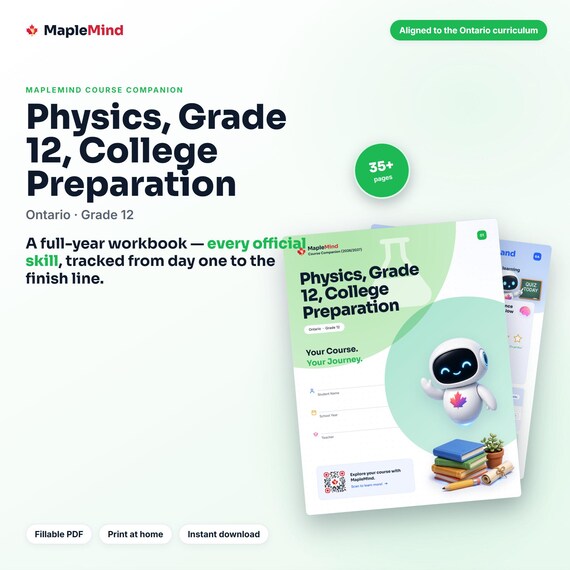
A Physics, Grade 12, College Preparation workbook worth keeping
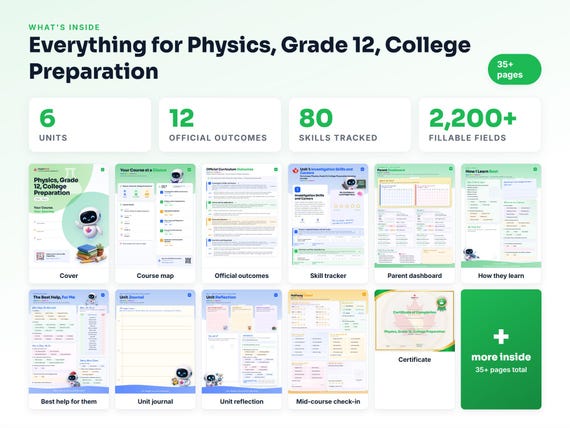
Built from the same official curriculum as this page. Before and after each skill above, your student colours in how sure they feel — so the two of you can see, on one page, what's clicking and what needs another look. It's a quiet way to follow how the year is really going.
By June it's full of their own handwriting: units worked through, confidence grown, a mid-year check-in, notes from parent-teacher night, and a certificate at the end. Less a worksheet, more a record of the year worth keeping on the shelf.
Instant download · see every page, reviews and the full description · five or more workbooks are $2.99 each
What it looks like in the app



Common questions
Can MapleMind help me with Physics, Grade 12, College Preparation?
Yes. MapleMind's AI tutor covers all 80 skills in Ontario's Physics, Grade 12, College Preparation — you pick the exact skill, and the tutor teaches it step by step: a short lesson, a worked example, solving together, then a skill check to show it stuck.
Is MapleMind aligned to Ontario's official curriculum?
Yes. Every skill in this course maps to an official outcome code from Ontario's Grade 12 Science curriculum, and the ministry's own wording is quoted under each unit on this page — with the official government source linked so you can check it yourself.
What does MapleMind cost?
It's free to start — 5 tutoring chats and a practice quiz every day, no credit card. A Pro subscription ($9.99/month or $49.99/year CAD, 7-day free trial) unlocks unlimited tutoring, practice, and exam simulations.
What if I'm stuck on just one topic?
That's the point of skill-level tutoring: open Physics, Grade 12, College Preparation in the app, tap the exact skill from the list on this page, and the tutor teaches just that — no wading through lessons you don't need.
Does MapleMind work in French or other languages?
Yes — 14 languages, including French. Both the app and the tutor's explanations switch to the language you choose.
Where can I see the official Ontario curriculum for Physics, Grade 12, College Preparation?
The official source is linked on this page — Ontario's official science curriculum. The outline here follows it: every MapleMind skill carries its official outcome code, and the ministry's own wording is quoted under each unit.
Keep exploring
Ready when you are
Pick a skill from this page and see it taught properly — free, in the browser, in under a minute.