Get help with Physics, Grade 11, University Preparation
Most tutoring makes you sit through material you already know. MapleMind flips that: pick the exact skill that's causing trouble — any of the 90 below — and the tutor teaches just that one, step by step, as many times as it takes. Ask questions in plain words, any time of day, in English, French, or 12 other languages.
The official Ontario Physics, Grade 11, University Preparation curriculum
Ontario defines Physics, Grade 11, University Preparation by strands and outcomes. MapleMind teaches the same curriculum reorganized for one-skill-at-a-time tutoring — the table shows exactly where every official strand lands, and the ministry's own wording is quoted under each unit below.
Official source Ontario's official science curriculumRead it on the government site — dcp.edu.gov.on.ca ↗| Official strand | Outcomes | Where MapleMind teaches it |
|---|---|---|
| Strand A | 2 | Investigation Skills and Careers |
| Strand B | 14 | Kinematics |
| Strand C | 12 | Forces |
| Strand D | 25 | Energy and Society |
| Strand E | 15 | Waves and Sound |
| Strand F | 19 | Electricity and Magnetism |
Every skill below, taught one on one.
 Try the first session free
How MapleMind teaches Physics, Grade 11, University Preparation — every unit, lesson, and skill
Every skill below runs as a short session: a plain-words lesson, a worked example, solving it together, then a five-question skill check that earns up to three stars. Guided Mode keeps it teaching instead of answer-handing — turning it off needs a parent's password.
Unit 1Investigation Skills and CareersOfficial strand · Strand A
Careers related to the fields of physics under study and the education and training they require, and scientists — including Canadians — who have contributed to those fields. The scientific investigation skills of strand A1 are woven through every lab and inquiry in the content strands rather than taught here on their own.
Careers in Physics
- Careers in physicssph3u.SPH3U.A2.1 — Identify and describe a variety of careers related to the fields of science under study and the education and training necessary for them.
Scientists and Their Contributions
- Scientists who contributed to physicssph3u.SPH3U.A2.2 — Describe the contributions of scientists, including Canadians, to the fields under study.
The official wording — 2 outcomes in this unit
- sph3u.SPH3U.A2.1
identify and describe a variety of careers related to the fields of science under study (e.g., theoretical physicist; communications, networks, and control systems professional; engineer; metallurgist) and the education and training necessary for these careers
- sph3u.SPH3U.A2.2
describe the contributions of scientists, including Canadians (e.g., Richard E. Taylor, Leonard T. Bruton, Willard S. Boyle, Martha Salcudean, Harriet Brooks, Louis Slotin), to the fields under study
Unit 2KinematicsOfficial strand · Strand B
Uniform and non-uniform linear motion in one and two dimensions — distance, position, displacement, speed, velocity, and acceleration — analysed with motion graphs, kinematic equations, vector diagrams, and projectile motion, plus analysing kinematics technologies and their societal and environmental impact.
Kinematics Technology and Society
- Analysing a kinematics technologysph3u.SPH3U.B1.1 — Analyse a technology that applies concepts related to kinematics.
- Impact of a kinematics technologysph3u.SPH3U.B1.2 — Assess the impact on society and the environment of a technology that applies concepts related to kinematics.
Investigating Motion
- Kinematics terminologysph3u.SPH3U.B2.1 — Use appropriate terminology related to kinematics.
- Motion graphs in one dimensionsph3u.SPH3U.B2.2 — Analyse and interpret position–time, velocity–time, and acceleration–time graphs of motion in one dimension.
- Deriving the kinematic equationssph3u.SPH3U.B2.3 — Use a velocity–time graph for constant acceleration to derive the average-velocity and displacement equations, and solve simple one-dimensional problems.
- Inquiry into linear motionsph3u.SPH3U.B2.4 — Conduct an inquiry into the uniform and non-uniform linear motion of an object.
- Distance, position, and displacementsph3u.SPH3U.B2.5 — Solve problems involving distance, position, and displacement.
- Inquiry into 1-D motion with vectorssph3u.SPH3U.B2.6 — Plan and conduct an inquiry into the motion of objects in one dimension, using vector diagrams and uniform acceleration equations.
- Linear motion problems in one and two dimensionssph3u.SPH3U.B2.7 — Solve problems involving uniform and non-uniform linear motion in one and two dimensions, using graphical analysis and algebraic equations.
- Projectile motion problemssph3u.SPH3U.B2.8 — Use kinematic equations to solve problems related to the horizontal and vertical components of projectile motion.
- Inquiry into projectile motionsph3u.SPH3U.B2.9 — Conduct an inquiry into projectile motion and analyse the relationship between the horizontal and vertical components.
- Constant, instantaneous, and averagesph3u.SPH3U.B3.1 — Distinguish between constant, instantaneous, and average with reference to speed, velocity, and acceleration.
- Scalar and vector quantitiessph3u.SPH3U.B3.2 — Distinguish between, and provide examples of, scalar and vector quantities as they relate to linear motion.
- Characteristics of projectile motionsph3u.SPH3U.B3.3 — Describe the characteristics and give examples of a projectile's motion in vertical and horizontal planes.
The official wording — 14 outcomes in this unit
- sph3u.SPH3U.B1.1
analyse, on the basis of research, a technology that applies concepts related to kinematics (e.g., devices used to measure speed in sports; rocket accelerators; motion-detecting sensors for security systems; speedometers in automobiles) [IP, PR, AI, C]
- sph3u.SPH3U.B1.2
assess the impact on society and the environ- ment of a technology that applies concepts related to kinematics (e.g., photo radar helps prevent vehicular accidents and reduces fuel consumption associated with excessive speeding) [AI, C]
- sph3u.SPH3U.B2.1
use appropriate terminology related to kinematics, including, but not limited to: time, distance, position, displacement, speed, velocity, and acceleration [C]
- sph3u.SPH3U.B2.2
analyse and interpret position–time, velocity– time, and acceleration–time graphs of motion in one dimension (e.g., use tangent slopes to create velocity–time graphs from position–time graphs and acceleration–time graphs from velocity–time graphs; use the area under the curve to create position–time graphs from velocity–time graphs and velocity–time graphs from acceleration–time graphs) [AI, C]
- sph3u.SPH3U.B2.3
use a velocity–time graph for constant accel- eration to derive the equation for average velocity [e.g., v av = (v 1 + v 2 )/2] and the equations for displacement [e.g., Δd = ((v 1 + v 2 )/2) Δt, Δd = v 1 Δt + ½ a (Δt2)], and solve simple problems in one dimension using these equations [AI]
- sph3u.SPH3U.B2.4
conduct an inquiry into the uniform and non-uniform linear motion of an object (e.g., use probeware to record the motion of a cart moving at a constant velocity or a constant acceleration; view a computer simulation of an object attaining terminal velocity; observe a video of a bouncing ball or a skydiver; observe the motion of a balloon with a small mass suspended from it) [PR]
- sph3u.SPH3U.B2.5
solve problems involving distance, position, and displacement (e.g., find total displacement using a scale vector diagram and vector com- ponents, and compare it to total distance travelled) [AI, C]
- sph3u.SPH3U.B2.6
plan and conduct an inquiry into the motion of objects in one dimension, using vector diagrams and uniform acceleration equations [IP, PR, C]
- sph3u.SPH3U.B2.7
solve problems involving uniform and non-uniform linear motion in one and two dimensions, using graphical analysis and algebraic equations [AI, C]
- sph3u.SPH3U.B2.8
use kinematic equations to solve problems related to the horizontal and vertical components of the motion of a projectile (e.g., a cannon ball shot horizontally off a cliff, a ball rolling off a table, a golf ball launched at a 45º angle to the horizontal) [AI, C]
- sph3u.SPH3U.B2.9
conduct an inquiry into the projectile motion of an object, and analyse, in qualitative and quantitative terms, the relationship between the horizontal and vertical components (e.g., airborne time, range, maximum height, horizontal velocity, vertical velocity) [PR, AI]
- sph3u.SPH3U.B3.1
distinguish between the terms constant, instantaneous, and average with reference to speed, velocity, and acceleration, and provide examples to illustrate each term
- sph3u.SPH3U.B3.2
distinguish between, and provide examples of, scalar and vector quantities as they relate to the description of uniform and non-uniform linear motion (e.g., time, distance, position, velocity, acceleration)
- sph3u.SPH3U.B3.3
describe the characteristics and give examples of a projectile’s motion in vertical and horizontal planes
Unit 3ForcesOfficial strand · Strand C
Dynamics and Newton's laws — net force, mass, acceleration, friction, gravity, and normal force — investigated with free-body diagrams, vector diagrams, and probeware, plus analysing and proposing improvements to force-based technologies and evaluating their societal and environmental impact.
Force Technology and Society
- Analysing a Newton's-laws technologysph3u.SPH3U.C1.1 — Analyse, with reference to Newton's laws, a technology that applies these laws.
- Improving a Newton's-laws technologysph3u.SPH3U.C1.1 — Propose ways to improve the performance of a technology that applies Newton's laws.
- Impact of force technologiessph3u.SPH3U.C1.2 — Evaluate the impact on society and the environment of technologies that use the principles of force.
Investigating Forces
- Forces terminologysph3u.SPH3U.C2.1 — Use appropriate terminology related to forces.
- Newton's laws inquiry with free-body diagramssph3u.SPH3U.C2.2 — Conduct an inquiry applying Newton's laws to analyse the forces on an object and use free-body diagrams to find net force and acceleration.
- Acceleration, net force, and mass inquirysph3u.SPH3U.C2.3 — Conduct an inquiry into the relationship between an object's acceleration and its net force and mass, and analyse the data.
- Friction and forces in one dimensionsph3u.SPH3U.C2.4 — Analyse the relationships between acceleration and applied forces including friction, and solve one-dimensional force problems using free-body diagrams and equations.
- Inquiry into forces in one dimensionsph3u.SPH3U.C2.5 — Plan and conduct an inquiry to analyse the effect of forces acting on objects in one dimension using vector and free-body diagrams and Newton's laws.
- Free fall and gravitysph3u.SPH3U.C2.6 — Analyse and solve problems involving the relationship between the force of gravity and acceleration for objects in free fall.
- Types of forces and their effectssph3u.SPH3U.C3.1 — Distinguish between, and provide examples of, different forces, and describe the effect of each on an object's velocity.
- Galileo, Newton, and the study of forcessph3u.SPH3U.C3.2 — Explain how the theories and discoveries of Galileo and Newton advanced knowledge of the effects of forces on motion.
- Newton's lawssph3u.SPH3U.C3.3 — State Newton's laws and apply them, in qualitative terms, to explain the effect of forces on objects.
- Mass, gravitational field, and force of gravitysph3u.SPH3U.C3.4 — Describe, in qualitative and quantitative terms, the relationships between mass, gravitational field strength, and the force of gravity.
The official wording — 12 outcomes in this unit
- sph3u.SPH3U.C1.1
analyse, with reference to Newton’s laws, a technology that applies these laws
- sph3u.SPH3U.C1.2
evaluate the impact on society and the environment of technologies that use the princi- ples of force (e.g., prosthetics, plastic car bodies) [AI, C]
- sph3u.SPH3U.C2.1
use appropriate terminology related to forces, including, but not limited to: mass, time, speed, velocity, acceleration, friction, gravity, normal force, and free-body diagrams [C]
- sph3u.SPH3U.C2.2
conduct an inquiry that applies Newton’s laws to analyse, in qualitative and quantitative terms, the forces acting on an object, and use free-body diagrams to determine the net force and the acceleration of the object [PR, AI, C]
- sph3u.SPH3U.C2.3
conduct an inquiry into the relationship between the acceleration of an object and its net force and mass (e.g., view a computer simulation of an object attaining terminal velocity; observe the motion of an object subject to friction; use electronic probes to observe the motion of an object being pulled across the floor), and analyse the resulting data [PR, AI]
- sph3u.SPH3U.C2.4
analyse the relationships between acceleration and applied forces such as the force of gravity, normal force, force of friction, coefficient of static friction, and coefficient of kinetic friction, and solve related problems involving forces in one dimension, using free-body diagrams and algebraic equations (e.g., use a drag sled to find the coefficient of friction between two surfaces) [AI, C]
- sph3u.SPH3U.C2.5
plan and conduct an inquiry to analyse the effect of forces acting on objects in one dimen- sion, using vector diagrams, free-body diagrams, and Newton’s laws [IP, PR, AI, C]
- sph3u.SPH3U.C2.6
analyse and solve problems involving the relationship between the force of gravity and acceleration for objects in free fall [AI]
- sph3u.SPH3U.C3.1
distinguish between, and provide examples of, different forces (e.g., friction, gravity, normal force), and describe the effect of each type of force on the velocity of an object
- sph3u.SPH3U.C3.2
explain how the theories and discoveries of Galileo and Newton advanced knowledge of the effects of forces on the motion of objects
- sph3u.SPH3U.C3.3
state Newton’s laws, and apply them, in qualitative terms, to explain the effect of forces acting on objects
- sph3u.SPH3U.C3.4
describe, in qualitative and quantitative terms, the relationships between mass, gravitational field strength, and force of gravity
Unit 4Energy and SocietyOfficial strand · Strand D
Energy transformations and the law of conservation of energy — work, power, efficiency, gravitational potential and kinetic energy, thermal energy and heat transfer, and nuclear energy — investigated with calorimeters, pendulums, and heating curves, plus analysing energy technologies and assessing their societal and environmental impact.
Energy Technology and Society
- Analysing a thermal-energy technologysph3u.SPH3U.D1.1 — Analyse, using the principles of energy transformations, a technology that transfers and transforms thermal energy.
- Impact of nuclear and thermal energy technologiessph3u.SPH3U.D1.2 — Assess how technologies related to nuclear, thermal, or geothermal energy affect society and the environment.
Investigating Energy and Heat
- Energy terminologysph3u.SPH3U.D2.1 — Use appropriate terminology related to energy transformations.
- Work, force, and displacementsph3u.SPH3U.D2.2 — Solve problems relating to work, force, and displacement along the line of force.
- Conservation of energy problemssph3u.SPH3U.D2.3 — Use the law of conservation of energy to solve problems involving work, gravitational potential, kinetic, and thermal energy.
- Investigating conservation of energysph3u.SPH3U.D2.4 — Plan and conduct inquiries into transformations between gravitational potential energy and kinetic energy to test the law of conservation of energy.
- Power, energy, and timesph3u.SPH3U.D2.5 — Solve problems involving the relationship between power, energy, and time.
- Power and work inquirysph3u.SPH3U.D2.6 — Conduct inquiries and solve problems involving the relationship between power and work.
- Efficiency of energy generationsph3u.SPH3U.D2.7 — Compare and contrast the input energy, useful output energy, and per cent efficiency of selected energy-generation methods.
- Mass–energy equivalencesph3u.SPH3U.D2.8 — Investigate the relationship between conservation of mass and conservation of energy, and solve problems using mass–energy equivalence.
- Specific heat capacity inquirysph3u.SPH3U.D2.9 — Conduct an inquiry to determine the specific heat capacity of a single substance and of two substances mixed together.
- Temperature change and change of statesph3u.SPH3U.D2.10 — Solve problems involving changes in temperature and changes of state using algebraic equations.
- Heating and cooling curvessph3u.SPH3U.D2.11 — Draw and analyse heating and cooling curves that show temperature changes and changes of state.
- Energy transfers and transformationssph3u.SPH3U.D3.1 — Describe a variety of energy transfers and transformations and explain them using the law of conservation of energy.
- Energy, work, and powersph3u.SPH3U.D3.2 — Explain the concepts of and interrelationships between energy, work, and power, and describe their units.
- Thermal, kinetic, and potential energy conceptssph3u.SPH3U.D3.3 — Explain thermal, kinetic, gravitational potential energy, heat, specific and latent heat, power, and efficiency, with examples and units.
- Efficiency and thermal-energy transfersph3u.SPH3U.D3.4 — Identify, qualitatively, the relationship between efficiency and thermal-energy transfer.
- Conditions for work to be donesph3u.SPH3U.D3.5 — Describe, with reference to force and displacement along the line of force, the conditions required for work to be done.
- Nuclear fission and fusionsph3u.SPH3U.D3.6 — Describe and compare nuclear fission and nuclear fusion.
- Energy transfer in changes of statesph3u.SPH3U.D3.7 — Explain, using the kinetic molecular theory, the energy transfer that occurs during changes of state.
- Conduction, convection, and radiationsph3u.SPH3U.D3.8 — Distinguish between and provide examples of conduction, convection, and radiation.
- Structure of nuclear isotopessph3u.SPH3U.D3.9 — Identify and describe the structure of common nuclear isotopes.
- Alpha, beta, and gamma radiationsph3u.SPH3U.D3.10 — Compare the characteristics and safety precautions of alpha particles, beta particles, and gamma rays.
- Radioactive half-lifesph3u.SPH3U.D3.11 — Explain radioactive half-life for a given radioisotope and describe its applications and their consequences.
- Energy in a nuclear power plantsph3u.SPH3U.D3.12 — Explain the energy transformations in a nuclear power plant with reference to the laws of thermodynamics.
The official wording — 25 outcomes in this unit
- sph3u.SPH3U.D1.1
analyse, using the principles of energy transformations, a technology that involves the transfer and transformation of thermal energy (e.g., a power station, an air conditioner, a fuel cell, a laser printer) [AI, C]
- sph3u.SPH3U.D1.2
assess, on the basis of research, how technol- ogies related to nuclear, thermal, or geothermal energy affect society and the environment (e.g., thermal regulating units, radiopharmaceuticals, dry-steam power plants, ground-source heat pumps) [IP, PR, AI, C]
- sph3u.SPH3U.D2.1
use appropriate terminology related to energy transformations, including, but not limited to: mechanical energy, gravitational potential energy, kinetic energy, work, power, fission, fusion, heat, heat capacity, temperature, and latent heat [C]
- sph3u.SPH3U.D2.2
solve problems relating to work, force, and displacement along the line of force [AI]
- sph3u.SPH3U.D2.3
use the law of conservation of energy to solve problems in simple situations involving work, gravitational potential energy, kinetic energy, and thermal energy and its transfer (heat) [AI]
- sph3u.SPH3U.D2.4
plan and conduct inquiries involving transformations between gravitational potential energy and kinetic energy (e.g., using a pendu- lum, a falling ball, an object rolling down a ramp) to test the law of conservation of energy [IP, PR]
- sph3u.SPH3U.D2.5
solve problems involving the relationship between power, energy, and time [AI]
- sph3u.SPH3U.D2.6
conduct inquiries and solve problems involving the relationship between power and work (e.g., the power of a student using different types of fitness equipment) [PR, AI]
- sph3u.SPH3U.D2.7
compare and contrast the input energy, useful output energy, and per cent efficiency of selected energy generation methods (e.g., hydroelectric, thermal, geothermal, nuclear fission, nuclear fusion, wind, solar) [AI, C]
- sph3u.SPH3U.D2.8
investigate the relationship between the con- cepts of conservation of mass and conservation of energy, and solve problems using the mass– energy equivalence [PR, AI]
- sph3u.SPH3U.D2.9
conduct an inquiry to determine the specific heat capacity of a single substance (e.g., alum- inum, iron, brass) and of two substances when they are mixed together (e.g., the heat lost by a sample of hot water and the heat gained by a sample of cold water when the two samples are mixed together) [PR]
- sph3u.SPH3U.D2.10
solve problems involving changes in tem- perature and changes of state, using algebraic equations (e.g., Q = mcΔT, Q = mL f , Q = mL v ) [AI, C]
- sph3u.SPH3U.D2.11
draw and analyse heating and cooling curves that show temperature changes and changes of state for various substances [AI, C]
- sph3u.SPH3U.D3.1
describe a variety of energy transfers and transformations, and explain them using the law of conservation of energy
- sph3u.SPH3U.D3.2
explain the concepts of and interrelationships between energy, work, and power, and identify and describe their related units
- sph3u.SPH3U.D3.3
explain the following concepts, giving examples of each, and identify their related units: thermal energy, kinetic energy, gravitational potential energy, heat, specific heat capacity, spe- cific latent heat, power, and efficiency
- sph3u.SPH3U.D3.4
identify, qualitatively, the relationship between efficiency and thermal energy transfer
- sph3u.SPH3U.D3.5
describe, with reference to force and dis- placement along the line of force, the conditions that are required for work to be done
- sph3u.SPH3U.D3.6
describe and compare nuclear fission and nuclear fusion
- sph3u.SPH3U.D3.7
explain, using the kinetic molecular theory, the energy transfer that occurs during changes of state
- sph3u.SPH3U.D3.8
distinguish between and provide examples of conduction, convection, and radiation
- sph3u.SPH3U.D3.9
identify and describe the structure of com- mon nuclear isotopes (e.g., hydrogen, deuterium, tritium)
- sph3u.SPH3U.D3.10
compare the characteristics of (e.g., mass, charge, speed, penetrating power, ionizing abil- ity) and safety precautions related to alpha particles, beta particles, and gamma rays
- sph3u.SPH3U.D3.11
explain radioactive half-life for a given radioisotope, and describe its applications and their consequences
- sph3u.SPH3U.D3.12
explain the energy transformations that occur within a nuclear power plant, with refer- ence to the laws of thermodynamics (e.g., nuclear fission results in the liberation of en- ergy, which is converted into thermal energy; the thermal energy is converted into electrical energy and waste heat, using a steam turbine)
Unit 5Waves and SoundOfficial strand · Strand E
The properties of mechanical waves and sound — longitudinal and transverse waves, frequency, wavelength, superposition, interference, standing waves, resonance, and the Doppler effect — investigated through wave and sound inquiries, plus analysing how waves and sound affect technology and society and assessing ways to reduce their negative effects.
Waves, Sound, and Society
- Waves in the design of structures and devicessph3u.SPH3U.E1.1 — Analyse how the properties of mechanical waves and sound influence the design of structures and technological devices.
- Analysing the negative impact of waves and soundsph3u.SPH3U.E1.2 — Analyse the negative impact that mechanical waves and/or sound can have on society and the environment.
- Assessing a noise-reduction technologysph3u.SPH3U.E1.2 — Assess the effectiveness of a technology intended to reduce the negative impact of mechanical waves and sound.
Investigating Waves and Sound
- Waves and sound terminologysph3u.SPH3U.E2.1 — Use appropriate terminology related to mechanical waves and sound.
- Investigating mechanical waves and interferencesph3u.SPH3U.E2.2 — Conduct laboratory inquiries or computer simulations involving mechanical waves and their interference.
- Determining the speed of wavessph3u.SPH3U.E2.3 — Plan and conduct inquiries to determine the speed of waves in a medium, compare theoretical and empirical values, and account for discrepancies.
- Wavelength, frequency, and speedsph3u.SPH3U.E2.4 — Investigate the relationship between the wavelength, frequency, and speed of a wave and solve related problems.
- The Doppler effectsph3u.SPH3U.E2.5 — Analyse the relationship between a moving source of sound and the change in frequency perceived by a stationary observer.
- Predicting and testing resonancesph3u.SPH3U.E2.6 — Predict the conditions needed to produce resonance in vibrating objects or air columns and test the predictions through inquiry.
- Analysing resonance and its usessph3u.SPH3U.E2.7 — Analyse the conditions required to produce resonance in vibrating objects and air columns and explain how resonance is used.
- Longitudinal and transverse wavessph3u.SPH3U.E3.1 — Distinguish between longitudinal and transverse waves in different media and provide examples of both.
- Components and conditions of resonancesph3u.SPH3U.E3.2 — Explain the components of resonance and identify the conditions required for resonance in vibrating objects and media.
- Superposition, standing waves, and beatssph3u.SPH3U.E3.3 — Explain and graphically illustrate the principle of superposition with respect to standing waves and beat frequencies.
- Properties of standing wavessph3u.SPH3U.E3.4 — Identify the properties of standing waves and explain the conditions required for them to occur in mechanical and sound waves.
- Speed of sound and the mediumsph3u.SPH3U.E3.5 — Explain the relationship between the speed of sound in various media and the particle nature of those media.
- Natural phenomena and wave propertiessph3u.SPH3U.E3.6 — Explain selected natural phenomena with reference to the characteristics and properties of waves.
The official wording — 15 outcomes in this unit
- sph3u.SPH3U.E1.1
analyse how properties of mechanical waves and sound influence the design of structures and technological devices (e.g., the acoustical design of a concert hall; the design of head- phones, hearing aids, musical instruments, wave pools) [AI, C]
- sph3u.SPH3U.E1.2
analyse the negative impact that mechanical waves and/or sound can have on society and the environment
- sph3u.SPH3U.E2.1
use appropriate terminology related to mechanical waves and sound, including, but not limited to: longitudinal wave, transverse wave, frequency, period, cycle, amplitude, phase, wavelength, velocity, superposition, constructive interference, destructive interference, standing waves, and resonance [C]
- sph3u.SPH3U.E2.2
conduct laboratory inquiries or computer simulations involving mechanical waves and their interference (e.g., using a mass oscillating on a spring, a mass oscillating on a pendulum, the oscillation in a string instrument) [PR]
- sph3u.SPH3U.E2.3
plan and conduct inquiries to determine the speed of waves in a medium (e.g., a vibrating air column, an oscillating string of a musical in- strument), compare theoretical and empirical values, and account for discrepancies [IP, PR,AI, C]
- sph3u.SPH3U.E2.4
investigate the relationship between the wavelength, frequency, and speed of a wave, and solve related problems [PR, AI]
- sph3u.SPH3U.E2.5
analyse the relationship between a moving source of sound and the change in frequency perceived by a stationary observer (i.e., the Doppler effect) [AI]
- sph3u.SPH3U.E2.6
predict the conditions needed to produce resonance in vibrating objects or air columns (e.g., in a wind instrument, a string instrument, a tuning fork), and test their predictions through inquiry [IP, PR, AI]
- sph3u.SPH3U.E2.7
analyse the conditions required to produce resonance in vibrating objects and/or in air col- umns (e.g., in a string instrument, a tuning fork, a wind instrument), and explain how resonance is used in a variety of situations (e.g., to produce different notes in musical instruments; to limit undesirable vibrations in suspension bridges; to design buildings so that they do not resonate at the frequencies produced by earthquakes) [AI, C]
- sph3u.SPH3U.E3.1
distinguish between longitudinal and transverse waves in different media, and provide examples of both types of waves
- sph3u.SPH3U.E3.2
explain the components of resonance, and identify the conditions required for resonance to occur in vibrating objects and in various media (e.g., with reference to a musical instrument, a child on a swing, the Tacoma Narrows Bridge)
- sph3u.SPH3U.E3.3
explain and graphically illustrate the principle of superposition with respect to standing waves and beat frequencies
- sph3u.SPH3U.E3.4
identify the properties of standing waves, and, for both mechanical and sound waves, explain the conditions required for standing waves to occur
- sph3u.SPH3U.E3.5
explain the relationship between the speed of sound in various media and the particle nature of the media (e.g., the speed of sound in solids, liquids, and gases; the speed of sound in warm and cold air)
- sph3u.SPH3U.E3.6
explain selected natural phenomena (e.g., echo location, or organisms that produce or receive infrasonic, audible, or ultrasonic sound) with reference to the characteristics and proper- ties of waves
Unit 6Electricity and MagnetismOfficial strand · Strand F
Magnetic fields and electric circuits — current, potential difference, resistance, Ohm's and Kirchhoff's laws, electromagnetic induction, and transformers — investigated by building circuits and mapping fields, plus analysing the impact of electrical energy production and electromagnetic technologies and proposing ways to improve sustainability.
Electrical Energy and Society
- Impact of electromagnetism technologiessph3u.SPH3U.F1.1 — Analyse the social and economic impact of technologies related to electromagnetism.
- Analysing electrical energy productionsph3u.SPH3U.F1.2 — Analyse the efficiency and environmental impact of one type of electrical energy production.
- Improving the sustainability of electrical energy productionsph3u.SPH3U.F1.2 — Propose ways to improve the sustainability of electrical energy production.
Investigating Electricity and Magnetism
- Electricity and magnetism terminologysph3u.SPH3U.F2.1 — Use appropriate terminology related to electricity and magnetism.
- Ohm's and Kirchhoff's laws in circuitssph3u.SPH3U.F2.2 — Analyse diagrams of series, parallel, and mixed circuits with reference to Ohm's law and Kirchhoff's laws.
- Building DC circuitssph3u.SPH3U.F2.3 — Design and build real or simulated mixed DC circuits and explain them with reference to current, potential difference, and resistance.
- Investigating magnetic fieldssph3u.SPH3U.F2.4 — Conduct an inquiry to identify the characteristics and properties of magnetic fields.
- Magnetic fields from currentssph3u.SPH3U.F2.5 — Investigate the magnetic fields produced by an electric current in a straight conductor and a solenoid.
- Transformer problemssph3u.SPH3U.F2.6 — Solve problems involving energy, power, potential difference, current, and the turns in a transformer's coils.
- Electromagnetic inductionsph3u.SPH3U.F2.7 — Investigate electromagnetic induction and use Lenz's law and the right-hand rule to explain the direction of the induced current.
- Building an electromagnetic devicesph3u.SPH3U.F2.8 — Construct a prototype of a device that uses the principles of electromagnetism, and test and refine it.
- Properties of magnetic fieldssph3u.SPH3U.F3.1 — Describe the properties of magnetic fields in permanent magnets and electromagnets.
- Right-hand rule for current fieldssph3u.SPH3U.F3.2 — Explain, by applying the right-hand rule, the direction of the magnetic field produced by a current in a conductor and a solenoid.
- Conventional current and electron flowsph3u.SPH3U.F3.3 — Distinguish between conventional current and electron flow in relation to the left- and right-hand rules.
- Laws of electromagnetismsph3u.SPH3U.F3.4 — Explain Ohm's, Kirchhoff's, Oersted's, the motor principle, Faraday's, and Lenz's laws in relation to electricity and magnetism.
- Production and interaction of magnetic fieldssph3u.SPH3U.F3.5 — Describe the production and interaction of magnetic fields using diagrams and the principles of electromagnetism.
- Electric motors and generatorssph3u.SPH3U.F3.6 — Explain the operation of an electric motor and a generator, including the roles of their components.
- AC, DC, and transmissionsph3u.SPH3U.F3.7 — Distinguish between alternating and direct current and explain why alternating current is used in transmission.
- Step-up and step-down transformerssph3u.SPH3U.F3.8 — Describe the components of step-up and step-down transformers and explain their operation using electric current and magnetic fields.
- Electrical safety precautionssph3u.SPH3U.F3.9 — Describe and explain safety precautions related to electrical circuits and higher transmission voltages.
The official wording — 19 outcomes in this unit
- sph3u.SPH3U.F1.1
analyse the social and economic impact of technologies related to electromagnetism (e.g., particle accelerators, mass spectrometers, magnetic levitation [maglev] trains, magnetic resonance imaging [MRI], electromagnetic pulses after nuclear explosions) [AI, C]
- sph3u.SPH3U.F1.2
analyse the efficiency and the environmental impact of one type of electrical energy production
- sph3u.SPH3U.F2.1
use appropriate terminology related to electri- city and magnetism, including, but not limited to: direct current, alternating current, conventional current, electron flow, electrical potential difference, electrical resistance, power, energy, step-up trans- former, and step-down transformer [C]
- sph3u.SPH3U.F2.2
analyse diagrams of series, parallel, and mixed circuits with reference to Ohm’s law (V = IR) and Kirchhoff’s laws [AI]
- sph3u.SPH3U.F2.3
design and build real or computer-simulated mixed direct current (DC) circuits, and explain the circuits with reference to direct current, potential difference, and resistance [PR, C]
- sph3u.SPH3U.F2.4
conduct an inquiry to identify the character- istics and properties of magnetic fields (e.g., using magnetic compasses, iron filings, and electric and magnetic field sensors) [PR]
- sph3u.SPH3U.F2.5
investigate, through laboratory inquiry or computer simulation, the magnetic fields produced by an electric current flowing through a long straight conductor and a solenoid (e.g., use sensors to map the magnetic field around a solenoid) [PR]
- sph3u.SPH3U.F2.6
solve problems involving energy, power, potential difference, current, and the number of turns in the primary and secondary coils of a transformer [AI]
- sph3u.SPH3U.F2.7
investigate electromagnetic induction, and, using Lenz’s law, the law of conservation of energy, and the right-hand rule, explain and illustrate the direction of the electric current induced by a changing magnetic field [PR, AI, C]
- sph3u.SPH3U.F2.8
construct a prototype of a device that uses the principles of electromagnetism (e.g., an electric bell, loudspeaker, ammeter, electric motor, electric generator), and test and refine their device [PR, AI]
- sph3u.SPH3U.F3.1
describe the properties of magnetic fields in permanent magnets and electromagnets (e.g., the three-dimensional nature of fields, continuous field lines, fields around current- carrying conductors and coils)
- sph3u.SPH3U.F3.2
explain, by applying the right-hand rule, the direction of the magnetic field produced when electric current flows through a long straight conductor and through a solenoid
- sph3u.SPH3U.F3.3
distinguish between conventional current and electron flow in relation to the left- and right-hand rules
- sph3u.SPH3U.F3.4
explain Ohm’s law, Kirchhoff’s laws, Oersted’s principle, the motor principle, Faraday’s law, and Lenz’s law in relation to electricity and magnetism
- sph3u.SPH3U.F3.5
describe the production and interaction of magnetic fields, using diagrams and the principles of electromagnetism (e.g., Oersted’s principle, the motor principle, Faraday’s law, Lenz’s law)
- sph3u.SPH3U.F3.6
explain the operation of an electric motor and a generator, including the roles of their respective components
- sph3u.SPH3U.F3.7
distinguish between alternating current (AC) and direct current, and explain why alternating current is presently used in the transmission of electrical energy
- sph3u.SPH3U.F3.8
describe the components of step-up and step-down transformers, and, using concepts and principles related to electric current and magnetic fields, explain the operation of these transformers
- sph3u.SPH3U.F3.9
describe and explain safety precautions (e.g., “call before you dig”, current-limiting outlets in bathrooms) related to electrical circuits and higher transmission voltages (e.g., with reference to transformer substations, buried cables, over- head power lines)
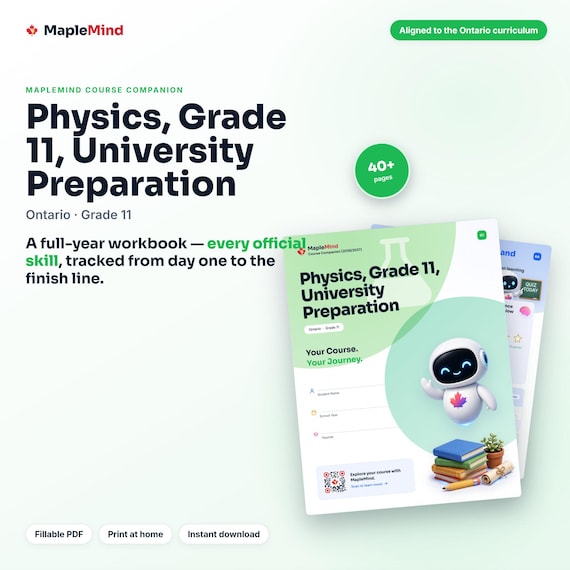


Printable workbook · A keepsake of the year
A Physics, Grade 11, University Preparation workbook worth keeping
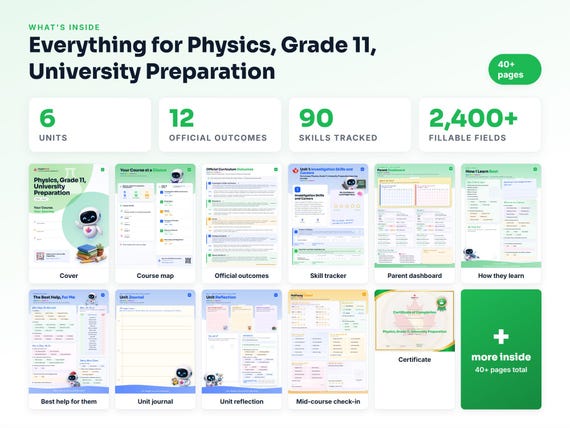
Built from the same official curriculum as this page. Before and after each skill above, your student colours in how sure they feel — so the two of you can see, on one page, what's clicking and what needs another look. It's a quiet way to follow how the year is really going.
By June it's full of their own handwriting: units worked through, confidence grown, a mid-year check-in, notes from parent-teacher night, and a certificate at the end. Less a worksheet, more a record of the year worth keeping on the shelf.
Instant download · see every page, reviews and the full description · five or more workbooks are $2.99 each
What it looks like in the app



Common questions
Can MapleMind help me with Physics, Grade 11, University Preparation?
Yes. MapleMind's AI tutor covers all 90 skills in Ontario's Physics, Grade 11, University Preparation — you pick the exact skill, and the tutor teaches it step by step: a short lesson, a worked example, solving together, then a skill check to show it stuck.
Is MapleMind aligned to Ontario's official curriculum?
Yes. Every skill in this course maps to an official outcome code from Ontario's Grade 11 Science curriculum, and the ministry's own wording is quoted under each unit on this page — with the official government source linked so you can check it yourself.
What does MapleMind cost?
It's free to start — 5 tutoring chats and a practice quiz every day, no credit card. A Pro subscription ($9.99/month or $49.99/year CAD, 7-day free trial) unlocks unlimited tutoring, practice, and exam simulations.
What if I'm stuck on just one topic?
That's the point of skill-level tutoring: open Physics, Grade 11, University Preparation in the app, tap the exact skill from the list on this page, and the tutor teaches just that — no wading through lessons you don't need.
Does MapleMind work in French or other languages?
Yes — 14 languages, including French. Both the app and the tutor's explanations switch to the language you choose.
Where can I see the official Ontario curriculum for Physics, Grade 11, University Preparation?
The official source is linked on this page — Ontario's official science curriculum. The outline here follows it: every MapleMind skill carries its official outcome code, and the ministry's own wording is quoted under each unit.
Keep exploring
Ready when you are
Pick a skill from this page and see it taught properly — free, in the browser, in under a minute.