Get help with Chemistry, Grade 12, College Preparation
Most tutoring makes you sit through material you already know. MapleMind flips that: pick the exact skill that's causing trouble — any of the 70 below — and the tutor teaches just that one, step by step, as many times as it takes. Ask questions in plain words, any time of day, in English, French, or 12 other languages.
The official Ontario Chemistry, Grade 12, College Preparation curriculum
Ontario defines Chemistry, Grade 12, College Preparation by strands and outcomes. MapleMind teaches the same curriculum reorganized for one-skill-at-a-time tutoring — the table shows exactly where every official strand lands, and the ministry's own wording is quoted under each unit below.
Official source Ontario's official science curriculumRead it on the government site — dcp.edu.gov.on.ca ↗| Official strand | Outcomes | Where MapleMind teaches it |
|---|---|---|
| Strand A | 2 | Investigation Skills and Careers |
| Strand B | 12 | Matter and Qualitative Analysis |
| Strand C | 17 | Organic Chemistry |
| Strand D | 9 | Electrochemistry |
| Strand E | 15 | Chemical Calculations |
| Strand F | 13 | Chemistry in the Environment |
Every skill below, taught one on one.
 Try the first session free
How MapleMind teaches Chemistry, Grade 12, College Preparation — every unit, lesson, and skill
Every skill below runs as a short session: a plain-words lesson, a worked example, solving it together, then a five-question skill check that earns up to three stars. Guided Mode keeps it teaching instead of answer-handing — turning it off needs a parent's password.
Unit 1Investigation Skills and CareersOfficial strand · Strand A
Careers related to the fields of science under study and the education and training they require, and scientists — including Canadians — who have contributed to those fields. The scientific investigation skills of strand A1 are woven through every lab and inquiry in the content strands rather than taught here on their own.
Careers in Applied Chemistry
- Careers in applied chemistrysch4c.SCH4C.A2.1 — Identify and describe a variety of careers related to the fields of science under study and the education and training necessary for them.
Scientists and Their Contributions
- Scientists who contributed to chemistrysch4c.SCH4C.A2.2 — Describe the contributions of scientists, including Canadians, to the fields under study.
The official wording — 2 outcomes in this unit
- sch4c.SCH4C.A2.1
identify and describe a variety of careers related to the fields of science under study (e.g., environmental technologist, pharmacy technician, electroplating technician, green building or renewable energy technician, veter- inary technician, biochemical technologist) and the education and training necessary for these careers
- sch4c.SCH4C.A2.2
describe the contributions of scientists, including Canadians (e.g., Jed Harrison, Louis Slotin, Paul Kebarle, James Robert Bolton, Brian Evans Conway, Lee Wilson), to the fields under study
Unit 2Matter and Qualitative AnalysisOfficial strand · Strand B
Identifying matter by hands-on qualitative analysis — flame tests, precipitation reactions, emission spectra, and solubility rules — plus evaluating the environmental effects of chemical substances and analysing practical applications of qualitative analysis.
Chemicals, the Environment, and Analysis
- Environmental effects of substancessch4c.SCH4C.B1.1 — Evaluate the risks and benefits to the environment of some commonly used chemical substances.
- Applications of qualitative analysissch4c.SCH4C.B1.2 — Analyse applications of qualitative analysis of matter in various fields.
Investigating Qualitative Analysis
- Qualitative analysis terminologysch4c.SCH4C.B2.1 — Use appropriate terminology related to qualitative analysis of matter.
- Solubility rules and net ionic equationssch4c.SCH4C.B2.2 — Use a table of solubility rules to write chemical equations and balanced net ionic equations.
- Precipitation and flame testssch4c.SCH4C.B2.3 — Investigate precipitation reactions and flame tests using qualitative analysis techniques.
- Identifying metal ions in an unknownsch4c.SCH4C.B2.4 — Conduct a qualitative analysis of an unknown sample to determine the presence of metal ions.
- Identifying a gas by emission spectrumsch4c.SCH4C.B2.5 — Identify an unknown gas sample by observing its emission spectrum and comparing to known gases.
- Predicting precipitatessch4c.SCH4C.B2.6 — Use a table of solubility rules to predict and identify a precipitate in a chemical reaction.
- Atomic number, mass number, and isotopessch4c.SCH4C.B3.1 — Explain the relationship between atomic number and mass number and the difference between isotopes and radioisotopes.
- Types of chemical reactionssch4c.SCH4C.B3.2 — Describe various types of chemical reactions.
- Procedures of qualitative analysissch4c.SCH4C.B3.3 — Explain the basic procedures used in qualitative analysis of elements and compounds.
- Flame tests, spectra, and quanta of energysch4c.SCH4C.B3.4 — Relate observations from flame tests and emission spectra to Bohr's concept of quanta of energy.
The official wording — 12 outcomes in this unit
- sch4c.SCH4C.B1.1
evaluate the risks and benefits to the en- vironment of some commonly used chemical substances (e.g., substances used in fireworks, fire extinguishers, “green” cleaning products) [AI, C]
- sch4c.SCH4C.B1.2
analyse, on the basis of research, applications of qualitative analysis of matter in various fields of endeavour (e.g., in law enforcement to detect drugs or identify counterfeit money; in the manufacture of food products) [IP, PR, AI, C]
- sch4c.SCH4C.B2.1
use appropriate terminology related to quali- tative analysis of matter, including, but not limited to: double displacement, precipitate, and energy level [C]
- sch4c.SCH4C.B2.2
use a table of solubility rules to write chemical equations for double displacement reactions and to write balanced net ionic equations for chemical reactions [AI, C]
- sch4c.SCH4C.B2.3
investigate precipitation reactions and flame tests, using qualitative analysis instruments, equipment, and techniques (e.g., gas discharge tubes, high-voltage electrical sources, spectro- scope, centrifuge) [PR, AI]
- sch4c.SCH4C.B2.4
conduct qualitative analyses of an unknown sample (e.g., a household or workplace chem- ical), using a flow chart and experimental procedures, including flame tests and precipita- tion reactions, to determine the presence of metal ions [PR, AI]
- sch4c.SCH4C.B2.5
identify an unknown gas sample (e.g., hydrogen, helium, neon) by observing its emis- sion spectrum and comparing it to the spectra of known gases [PR, AI]
- sch4c.SCH4C.B2.6
use a table of solubility rules to predict if a precipitate will form in a given chemical reaction, and identify the precipitate formed [AI]
- sch4c.SCH4C.B3.1
explain the relationship between the atomic number and the mass number of an element, and the difference between isotopes and radio- isotopes of an element
- sch4c.SCH4C.B3.2
describe various types of chemical reactions, including synthesis, decomposition, single dis- placement, and double displacement reactions
- sch4c.SCH4C.B3.3
explain basic procedures used in qualitative analysis of elements and compounds, including flame tests, precipitation reactions, and the ob- servation of emission spectra
- sch4c.SCH4C.B3.4
relate observations from investigations using flame tests and emission spectra to the concept of quanta of energy proposed by Neils Bohr
Unit 3Organic ChemistryOfficial strand · Strand C
The chemistry of everyday carbon compounds — functional groups, molecular models, distillation, combustion, and practical synthesis — plus evaluating the impact of products made from organic compounds and the dangers of organic solvents.
Organic Products in Everyday Life
- Products from organic compoundssch4c.SCH4C.C1.1 — Identify everyday products made from organic compounds and assess their benefits and health hazards.
- Environmental impact of an organic productsch4c.SCH4C.C1.2 — Research a useful product made from organic substances and assess its environmental impact.
Investigating Organic Compounds
- Organic chemistry terminologysch4c.SCH4C.C2.1 — Use appropriate terminology related to organic chemistry.
- Lewis structures of organic moleculessch4c.SCH4C.C2.2 — Draw Lewis structures to represent the covalent bonds in simple organic molecules.
- Molecular models of organic moleculessch4c.SCH4C.C2.3 — Build molecular models and create structural formulae for simple organic molecules.
- Properties of organic compoundssch4c.SCH4C.C2.4 — Conduct an inquiry to determine the physical and chemical properties of common organic compounds.
- Separation by distillationsch4c.SCH4C.C2.5 — Conduct an inquiry to demonstrate separation of a mixture of liquids by distillation.
- Products of combustionsch4c.SCH4C.C2.6 — Conduct an inquiry to identify some of the products of the combustion of a hydrocarbon and an alcohol.
- Synthesizing an organic compoundsch4c.SCH4C.C2.7 — Conduct an inquiry to synthesize a common organic compound.
- Predicting bond typesch4c.SCH4C.C2.8 — Predict the nature of a bond using the electronegativity values of atoms.
- The carbon atomsch4c.SCH4C.C3.1 — Describe the unique characteristics of the carbon atom in terms of covalent bonding.
- Functional groupssch4c.SCH4C.C3.2 — Identify the functional group structures that define common classes of organic compounds.
- Properties of oxygen- and nitrogen-containing moleculessch4c.SCH4C.C3.3 — Explain the general properties of molecules that contain oxygen or nitrogen.
- Describing organic reactionssch4c.SCH4C.C3.4 — Use structural formulae to describe some simple organic chemical reactions.
- Separating substances by physical propertiessch4c.SCH4C.C3.5 — Explain how the physical properties of a substance affect the processes used to separate organic substances.
- Naming hydrocarbons with IUPACsch4c.SCH4C.C3.6 — Identify the first ten hydrocarbons of the alkanes, alkenes, and alkynes by their names and structural formulae.
- Dangers of organic solventssch4c.SCH4C.C3.7 — Explain the dangers associated with the use of organic solvents and general precautions.
The official wording — 17 outcomes in this unit
- sch4c.SCH4C.C1.1
identify various materials and products used in everyday life that are made from organic compounds (e.g., synthetic fabrics, drugs, pesticides, cosmetics, organic solvents, car parts, artificial hearts), and assess the benefits of those products for society, as well as the health hazards they pose [AI, C]
- sch4c.SCH4C.C1.2
research a useful product made from one or more organic substances (e.g., CDs, made from crude oil), and assess the environmental impact of the production, use, and disposal of the product [IP, PR, AI, C]
- sch4c.SCH4C.C2.1
use appropriate terminology related to organic chemistry, including, but not limited to: electronegativity, covalent bond, and functional group [C]
- sch4c.SCH4C.C2.2
draw Lewis structures to represent the covalent bonds in some simple organic mol- ecules (e.g., CH 4 ) [AI, C]
- sch4c.SCH4C.C2.3
build molecular models of, and create structural formulae for, some simple organic molecules (e.g., methane, butane, ethyne) [PR, AI, C]
- sch4c.SCH4C.C2.4
conduct an inquiry to determine the physical and chemical properties of some common or- ganic compounds (e.g., solubility [in polar and non-polar solvents], conductivity, odour, com- bustibility) [PR, AI]
- sch4c.SCH4C.C2.5
conduct an inquiry to demonstrate separation of a mixture of liquids by distillation [PR]
- sch4c.SCH4C.C2.6
conduct an inquiry to identify some of the products of the combustion of a hydrocarbon and an alcohol [PR, AI]
- sch4c.SCH4C.C2.7
conduct an inquiry to synthesize a common organic compound (e.g., produce an ester, make soap) [PR]
- sch4c.SCH4C.C2.8
predict the nature of a bond (e.g., non-polar covalent or polar covalent), using the electro- negativity values of atoms (e.g., H 2 , Cl 2 , O 2 , H 2 O, CH 4 ,CH 3 OH) [AI]
- sch4c.SCH4C.C3.1
describe the unique characteristics of the carbon atom in terms of covalent bonding
- sch4c.SCH4C.C3.2
identify functional group structures that define common classes of organic compounds (e.g., alkenes, alkanes, alkynes, alcohols, alde- hydes, ketones, carboxylic acids, esters, amines)
- sch4c.SCH4C.C3.3
explain the general properties (e.g., polarity, solubility in water) of molecules that contain oxygen or nitrogen
- sch4c.SCH4C.C3.4
use structural formulae to describe some simple organic chemical reactions (e.g., addition, substitution, combustion)
- sch4c.SCH4C.C3.5
explain how the physical properties of a substance affect the processes used to separate organic chemical substances (e.g., distillation of crude oil, distillation of alcohols)
- sch4c.SCH4C.C3.6
identify the first ten hydrocarbons of the alkanes, the alkenes, and the alkynes by their names and structural formulae, using International Union of Pure and Applied Chemistry (IUPAC) nomenclature for alkanes, alkenes, and alkynes
- sch4c.SCH4C.C3.7
explain the dangers associated with the use of organic solvents (e.g., dry-cleaning compounds, paint thinners, glue solvents, nail polish remover), and some general precautions related to their use
Unit 4ElectrochemistryOfficial strand · Strand D
Oxidation-reduction in practice — galvanic cells, oxidation and reduction, and metal corrosion — investigated by building cells and testing corrosion, plus analysing electrochemical technologies and the causes of corrosion and assessing protection techniques.
Batteries, Corrosion, and the Environment
- Electrochemical technologiessch4c.SCH4C.D1.1 — Analyse a technological application based on the redox reaction that occurs in galvanic cells.
- Causes of metal corrosionsch4c.SCH4C.D1.2 — Analyse the causes of metal corrosion.
- Impact of corrosion protection techniquessch4c.SCH4C.D1.2 — Assess the environmental impact of techniques used to protect metals from corrosion.
Investigating Galvanic Cells and Corrosion
- Electrochemistry terminologysch4c.SCH4C.D2.1 — Use appropriate terminology related to electrochemistry.
- Building a galvanic cellsch4c.SCH4C.D2.2 — Build a galvanic cell and measure its voltage.
- Analysing galvanic cellssch4c.SCH4C.D2.3 — Analyse the processes in galvanic cells and draw labelled diagrams of them.
- Factors affecting corrosion ratesch4c.SCH4C.D2.4 — Design and conduct an inquiry to determine the factors that affect the rate of corrosion of a metal.
- Oxidation and reductionsch4c.SCH4C.D3.1 — Explain the concepts of oxidation and reduction in terms of the chemical changes during redox reactions.
- Components of a galvanic cellsch4c.SCH4C.D3.2 — Describe the components of a galvanic cell and explain how each functions.
- The corrosion reactionsch4c.SCH4C.D3.3 — Describe the chemical reaction that results in the corrosion of metal.
The official wording — 9 outcomes in this unit
- sch4c.SCH4C.D1.1
analyse, on the basis of research, a techno- logical application that is based on the oxidation-reduction (redox) reaction that occurs in galvanic cells (e.g., in cardiac pacemakers, batteries, electroplating) [IP, PR, AI, C]
- sch4c.SCH4C.D1.2
analyse, on the basis of research, the causes of metal corrosion, and assess the environmental impact of some techniques used to protect metals from corrosion (e.g., rustproofing, painting, cathodic protection, galvanization) [IP, PR, AI, C]
- sch4c.SCH4C.D2.1
use appropriate terminology related to electrochemistry, including, but not limited to: oxidation, anode, and electrolyte [C]
- sch4c.SCH4C.D2.2
build a galvanic cell and measure its voltage [PR, AI]
- sch4c.SCH4C.D2.3
analyse the processes in galvanic cells, and draw labelled diagrams of these cells to show the oxidation or reduction reaction that occurs in each of the half-cells, the direction of electron flow, the location of the electrodes, and the dir- ection of ion movement [AI, C]
- sch4c.SCH4C.D2.4
design and conduct an inquiry to determine the factors that affect rate of corrosion of a metal (e.g., stress on the metal, contact between two metals, surface oxide, the nature of the electrolyte, the nature of the metal) [IP, PR, AI]
- sch4c.SCH4C.D3.1
explain the concepts of oxidation and reduc- tion in terms of the chemical changes that occur during redox reactions
- sch4c.SCH4C.D3.2
describe the components of a galvanic cell, and explain how each component functions in a redox reaction
- sch4c.SCH4C.D3.3
describe the chemical reaction that results in the corrosion of metal
Unit 5Chemical CalculationsOfficial strand · Strand E
The mole and stoichiometry for practical work — molar mass, mole conversions, stoichiometric relationships, percentage yield, and preparing solutions — investigated through inquiry, plus analysing processes that use chemical calculations and assessing the importance of accuracy in medical and personal-care solutions.
Chemical Calculations in Work and Health
- Processes using chemical calculationssch4c.SCH4C.E1.1 — Analyse processes in the home, workplace, or environmental sector that require accurate chemical calculations.
- Accuracy in medical and personal-care solutionssch4c.SCH4C.E1.2 — Assess the importance of quantitative accuracy in the concentration of solutions used for medical or personal care.
Investigating the Mole and Stoichiometry
- Stoichiometry terminologysch4c.SCH4C.E2.1 — Use appropriate terminology related to stoichiometry.
- Calculating molar masssch4c.SCH4C.E2.2 — Calculate the molar mass of simple compounds with the aid of the periodic table.
- Converting particles, moles, and masssch4c.SCH4C.E2.3 — Convert the quantity of chemicals in simple reactions between particles, moles, and mass.
- Solving reaction variable problemssch4c.SCH4C.E2.4 — Solve problems involving relationships between quantity in moles, particles, mass, concentration, and volume.
- Stoichiometric relationships in equationssch4c.SCH4C.E2.5 — Solve problems involving stoichiometric relationships in balanced chemical equations.
- Determining percentage yieldsch4c.SCH4C.E2.6 — Conduct an inquiry to determine the actual, theoretical, and percentage yield of a reaction.
- Identifying changes in a reactionsch4c.SCH4C.E2.7 — Use qualitative observations to identify chemical changes, limiting reagents, and products in a reaction.
- Preparing aqueous solutionssch4c.SCH4C.E2.8 — Prepare aqueous solutions of given concentrations by dissolving a solute or diluting a concentrated solution.
- Avogadro's number and molar masssch4c.SCH4C.E3.1 — Describe the relationships between Avogadro's number, the mole concept, and molar mass.
- Experimental error and yieldsch4c.SCH4C.E3.2 — Describe possible sources of experimental error and explain how they affect percentage yield.
- Mole relationships in equationssch4c.SCH4C.E3.3 — Explain the relationships between the mole concept, coefficients, particles, and mass in balanced equations.
- Molar concentrationsch4c.SCH4C.E3.4 — Explain the concept of molar concentration of a solution using appropriate units.
- Limiting reagentssch4c.SCH4C.E3.5 — Explain the concept of a limiting reagent using examples from everyday chemical processes.
The official wording — 15 outcomes in this unit
- sch4c.SCH4C.E1.1
analyse processes in the home, the workplace, or the environmental sector that require an understanding of accurate chemical calculations (e.g., baking according to a recipe; manufacturing items such as fertilizer, paint, pharmaceuticals; testing water quality in a public pool) [AI, C]
- sch4c.SCH4C.E1.2
assess, on the basis of research, the importance of quantitative accuracy in the concentration of solutions used for medical purposes or personal care (e.g., cough syrup, intravenous solutions, sunscreen) [IP, PR, AI, C]
- sch4c.SCH4C.E2.1
use appropriate terminology related to stoi- chiometry, including, but not limited to: molar mass, molar concentration, percentage yield, and Avogadro’s number [C]
- sch4c.SCH4C.E2.2
calculate the molar mass of simple compounds with the aid of the periodic table [AI]
- sch4c.SCH4C.E2.3
convert the quantity of chemicals in simple chemical reactions from number of particles to number of moles and mass, using the mole concept [AI]
- sch4c.SCH4C.E2.4
solve problems involving relationships between the following variables in a chemical reaction: quantity in moles, number of particles, atomic mass, concentration of solution, and volume of solution [AI]
- sch4c.SCH4C.E2.5
solve problems involving stoichiometric re- lationships in balanced chemical equations [AI]
- sch4c.SCH4C.E2.6
conduct an inquiry to determine the actual yield, theoretical yield, and percentage yield of the products of a chemical reaction (e.g., a chemical reaction between steel wool and copper(II) sulfate solution), assess the effective- ness of the procedure, and suggest sources of experimental error [PR, AI]
- sch4c.SCH4C.E2.7
use qualitative observations of a chemical reaction to identify the chemical changes, presence of limiting reagents, and the products occurring in a chemical reaction (e.g., aluminum reacting with copper(II) chloride solution, steel wool reacting with oxygen) [PR, AI]
- sch4c.SCH4C.E2.8
prepare aqueous solutions of given concen- trations (e.g., concentrations expressed in grams per litre or moles per litre) by dissolving a solid solute in a solvent or by diluting a concentrated solution (e.g., a stock solution) [PR, AI]
- sch4c.SCH4C.E3.1
describe the relationships between Avogadro’s number, the mole concept, and the molar mass of any given substance
- sch4c.SCH4C.E3.2
describe some possible sources of experi- mental error in an investigation of a chemical reaction, and explain how the errors would affect the percentage yield of products of the reaction
- sch4c.SCH4C.E3.3
explain the relationships between the mole concept, the values of coefficients, the number of particles, and the mass of substances in bal- anced chemical equations
- sch4c.SCH4C.E3.4
explain the concept of molar concentration of a solution, using appropriate units of measure
- sch4c.SCH4C.E3.5
explain the concept of a limiting reagent in a chemical reaction, using examples of chemical processes from everyday life (e.g., synthesis of aspirin, synthesis of ammonia)
Unit 6Chemistry in the EnvironmentOfficial strand · Strand F
Chemical reactions in the environment — the atmosphere, acids and bases, acid rain, and water quality — investigated through titration and testing, plus evaluating government regulations and individual actions, proposing a personal action plan, and evaluating the importance of quantitative analysis.
Air, Water, and Environmental Action
- Evaluating air and water quality effortssch4c.SCH4C.F1.1 — Evaluate the effectiveness of government initiatives and individual actions intended to improve air and water quality.
- A personal action plansch4c.SCH4C.F1.1 — Propose a personal action plan to support efforts to improve air and water quality.
- Importance of quantitative analysissch4c.SCH4C.F1.2 — Evaluate the importance of quantitative chemical analysis in assessing air and water quality and how it contributes to responsibility.
Investigating Environmental Chemistry
- Environmental chemistry terminologysch4c.SCH4C.F2.1 — Use appropriate terminology related to chemical analysis and chemistry in the environment.
- Neutralization equationssch4c.SCH4C.F2.2 — Write balanced chemical equations for the neutralization of acids and bases.
- Acid-base titrationsch4c.SCH4C.F2.3 — Conduct an acid-base titration to determine the concentration of an acid or base.
- Testing water for inorganic substancessch4c.SCH4C.F2.4 — Conduct an inquiry to detect the presence of inorganic substances in water samples.
- Components of the atmospheresch4c.SCH4C.F3.1 — Identify the major and minor chemical components of Earth's atmosphere.
- Gases, particulates, and air qualitysch4c.SCH4C.F3.2 — Identify gases and particulates commonly found in the atmosphere and explain how they affect air quality.
- Arrhenius definition of acids and basessch4c.SCH4C.F3.3 — State and explain the Arrhenius definition of acids and bases.
- Strong and weak acids and basessch4c.SCH4C.F3.4 — Explain the difference between strong and weak acids and bases in terms of degree of ionization.
- Acid rainsch4c.SCH4C.F3.5 — Identify the gas emissions that contribute to acid precipitation and explain the steps in the formation of acid rain.
- Strength versus concentrationsch4c.SCH4C.F3.6 — Explain the difference between the concepts of strength and concentration for solutions of acids and bases.
- Substances dissolved in watersch4c.SCH4C.F3.7 — Identify inorganic substances that can be found dissolved in water from natural processes and human activities.
The official wording — 13 outcomes in this unit
- sch4c.SCH4C.F1.1
evaluate, on the basis of research, the effect- iveness of government initiatives or regulations (e.g., the Great Lakes Action Plan), and the actions of individuals (e.g., use of public trans- portation), intended to improve air and water quality, and propose a personal action plan to support these efforts [IP, PR, AI, C]
- sch4c.SCH4C.F1.2
evaluate the importance of quantitative chemical analysis in assessing air and water quality (e.g., the use of Environment Canada’s Air Quality Index to determine when smog advisories need to be issued; systems to monitor the quality of drinking water), and explain how these analyses contribute to environmental awareness and responsibility [AI, C]
- sch4c.SCH4C.F2.1
use appropriate terminology related to chemical analysis and chemistry in the environ- ment, including, but not limited to: ozone, hard water, titration, pH, ppm, and ppb [C]
- sch4c.SCH4C.F2.2
write balanced chemical equations to repre- sent the chemical reactions involved in the neutralization of acids and bases [AI, C]
- sch4c.SCH4C.F2.3
conduct an acid–base titration to determine the concentration of an acid or a base (e.g., the concentration of acetic acid in vinegar) [PR, AI]
- sch4c.SCH4C.F2.4
conduct an inquiry, using available technol- ogy (e.g., probewear) or chemical tests, to detect the presence of inorganic substances in various samples of water [PR, AI]
- sch4c.SCH4C.F3.1
identify major and minor chemical compon- ents of Earth’s atmosphere
- sch4c.SCH4C.F3.2
identify gases and particulates that are com- monly found in the atmosphere, and explain how they affect air quality (e.g., greenhouse gases, tropospheric and stratospheric ozone, carbon monoxide, chlorofluorocarbons, soot)
- sch4c.SCH4C.F3.3
state and explain the Arrhenius definition of acids and bases
- sch4c.SCH4C.F3.4
explain the difference between strong and weak acids, and between strong and weak bases, in terms of degree of ionization
- sch4c.SCH4C.F3.5
identify the gas emissions that are the major contributors to acid precipitation, and explain the steps in the formation of acid rain
- sch4c.SCH4C.F3.6
explain the difference between the concepts of strength and concentration when referring to solutions of acids and bases
- sch4c.SCH4C.F3.7
identify inorganic substances that can be found dissolved in water as a result of natural processes and human activities (e.g., hard water contains metal ions)

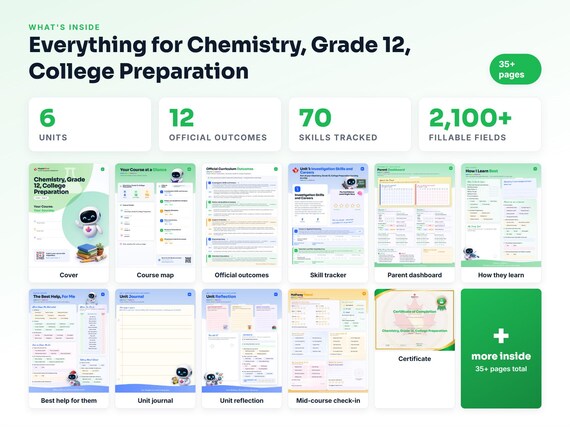


Printable workbook · A keepsake of the year
A Chemistry, Grade 12, College Preparation workbook worth keeping
Built from the same official curriculum as this page. Before and after each skill above, your student colours in how sure they feel — so the two of you can see, on one page, what's clicking and what needs another look. It's a quiet way to follow how the year is really going.
By June it's full of their own handwriting: units worked through, confidence grown, a mid-year check-in, notes from parent-teacher night, and a certificate at the end. Less a worksheet, more a record of the year worth keeping on the shelf.
Instant download · see every page, reviews and the full description · five or more workbooks are $2.99 each
What it looks like in the app


Common questions
Can MapleMind help me with Chemistry, Grade 12, College Preparation?
Yes. MapleMind's AI tutor covers all 70 skills in Ontario's Chemistry, Grade 12, College Preparation — you pick the exact skill, and the tutor teaches it step by step: a short lesson, a worked example, solving together, then a skill check to show it stuck.
Is MapleMind aligned to Ontario's official curriculum?
Yes. Every skill in this course maps to an official outcome code from Ontario's Grade 12 Science curriculum, and the ministry's own wording is quoted under each unit on this page — with the official government source linked so you can check it yourself.
What does MapleMind cost?
It's free to start — 5 tutoring chats and a practice quiz every day, no credit card. A Pro subscription ($9.99/month or $49.99/year CAD, 7-day free trial) unlocks unlimited tutoring, practice, and exam simulations.
What if I'm stuck on just one topic?
That's the point of skill-level tutoring: open Chemistry, Grade 12, College Preparation in the app, tap the exact skill from the list on this page, and the tutor teaches just that — no wading through lessons you don't need.
Does MapleMind work in French or other languages?
Yes — 14 languages, including French. Both the app and the tutor's explanations switch to the language you choose.
Where can I see the official Ontario curriculum for Chemistry, Grade 12, College Preparation?
The official source is linked on this page — Ontario's official science curriculum. The outline here follows it: every MapleMind skill carries its official outcome code, and the ministry's own wording is quoted under each unit.
Keep exploring
Ready when you are
Pick a skill from this page and see it taught properly — free, in the browser, in under a minute.