Get help with Science and Technology, Grade 7
Most tutoring makes you sit through material you already know. MapleMind flips that: pick the exact skill that's causing trouble — any of the 45 below — and the tutor teaches just that one, step by step, as many times as it takes. Ask questions in plain words, any time of day, in English, French, or 12 other languages.
The official Ontario Science and Technology, Grade 7 curriculum
Ontario defines Science and Technology, Grade 7 by strands and outcomes. MapleMind teaches the same curriculum reorganized for one-skill-at-a-time tutoring — the table shows exactly where every official strand lands, and the ministry's own wording is quoted under each unit below.
Official source Ontario's official science curriculumRead it on the government site — dcp.edu.gov.on.ca ↗| Official strand | Outcomes | Where MapleMind teaches it |
|---|---|---|
| Strand A | 4 | STEM Skills and Connections |
| Strand B | 11 | Interactions in the Environment |
| Strand C | 10 | Pure Substances and Mixtures |
| Strand D | 9 | Form and Function |
| Strand E | 10 | Heat in the Environment |
Every skill below, taught one on one.
 Try the first session free
How MapleMind teaches Science and Technology, Grade 7 — every unit, lesson, and skill
Every skill below runs as a short session: a plain-words lesson, a worked example, solving it together, then a five-question skill check that earns up to three stars. Guided Mode keeps it teaching instead of answer-handing — turning it off needs a parent's password.
Unit 1STEM Skills and ConnectionsOfficial strand · Strand A
Coding that involves planning and designing programs, thinking about how coding and emerging technologies such as artificial intelligence (including skilled trades) change everyday life, spotting science and technology in occupations and skilled trades, and analysing contributions from many communities.
Coding: Planning and Designing Programs
- Planning and designing programsA2.1 — Write and run code with a focus on planning and designing programs before coding them.
Coding, AI, and Skilled Trades
- How coding and AI affect life and skilled tradesA2.2 — Identify and describe how coding and emerging technologies such as artificial intelligence systems change everyday life, including in the skilled trades.
Science and Technology in Jobs and Trades
- Science and technology in occupations and skilled tradesA3.1 — Describe real uses of science and technology in various occupations, including skilled trades, and how they help solve real-world problems.
People Who Help Science Grow
- Analysing contributions from many communitiesA3.3 — Analyse how people from many different communities have contributed to science and technology.
The official wording — 4 outcomes in this unit
- A2.1
write and execute code in investigations and when modelling concepts, with a focus on planning and designing programs
- A2.2
identify and describe impacts of coding and of emerging technologies, such as artificial intelligence systems, on everyday life, including skilled trades
- A3.1
describe practical applications of science and technology concepts in various occupations, including skilled trades, and how these applications address real-world problems
- A3.3
analyse contributions to science and technology from various communities
Unit 2Interactions in the EnvironmentOfficial strand · Strand B
Ecosystems as networks of interactions, biotic and abiotic components, the roles of producers, consumers, and decomposers, energy transfer in food chains, cycling of matter, succession, and limiting factors — plus assessing the impact of human activities and technologies on the environment and Indigenous sustainability practices.
Humans, Technology, and the Environment
- Impact of technologies on the environmentB1.1 — Assess the impact of various technologies on the environment.
- Mitigating and enhancing human impactB1.2 — Assess the effectiveness of ways of mitigating negative and enhancing positive impacts of human activities on the environment.
- Indigenous practices and environmental sustainabilityB1.3 — Analyse how diverse First Nations, Métis, and Inuit practices and perspectives contribute to environmental sustainability.
Exploring Ecosystems
- Ecosystems as networks of interactionsB2.1 — Explain that an ecosystem is a network of interactions among living organisms and their environment.
- Biotic and abiotic componentsB2.2 — Identify biotic and abiotic components in an ecosystem and describe the interactions between them.
- Producers, consumers, and decomposersB2.3 — Describe the roles and relationships of producers, consumers, and decomposers within an ecosystem.
- Energy transfer in a food chainB2.4 — Describe the transfer of energy in a food chain, and explain the effects of altering any part of the chain.
- Cycling of matterB2.5 — Describe how matter is cycled within the environment, and explain how cycling of matter promotes sustainability.
- Primary and secondary successionB2.6 — Explain the differences between primary succession and secondary succession in ecosystems.
- Limiting factors in ecosystemsB2.7 — Explain how biotic and abiotic factors limit the number of organisms an ecosystem can sustain.
- Agriculture, harvesting, and ecosystem balanceB2.8 — Describe how different approaches to agriculture and harvesting food can impact an ecosystem, and identify strategies to maintain or restore balance.
The official wording — 11 outcomes in this unit
- B1.1
assess the impact of various technologies on the environment
- B1.2
assess the effectiveness of various ways of mitigating the negative and enhancing the positive impact of human activities on the environment
- B1.3
analyse how diverse First Nations, Métis, and Inuit practices and perspectives contribute to environmental sustainability
- B2.1
explain that an ecosystem is a network of interactions among living organisms and their environment
- B2.2
identify biotic and abiotic components in an ecosystem, and describe the interactions between them
- B2.3
describe roles and relationships between producers, consumers, and decomposers within an ecosystem
- B2.4
describe the transfer of energy in a food chain, and explain the effects of altering any part of the chain
- B2.5
describe how matter is cycled within the environment, and explain how the cycling of matter promotes sustainability
- B2.6
explain the differences between primary succession and secondary succession in ecosystems
- B2.7
explain how biotic and abiotic factors limit the number of organisms an ecosystem can sustain
- B2.8
describe how different approaches to agriculture and to harvesting food from the natural environment can impact an ecosystem, and identify strategies that can be used to maintain and/or restore balance to ecosystems
Unit 3Pure Substances and MixturesOfficial strand · Strand C
The particle theory of matter, pure substances versus mixtures, homogeneous and heterogeneous mixtures, solubility and rate of dissolving, saturated solutions, water as the universal solvent, separating mixtures, and elements and compounds as atoms — plus assessing the impacts of using and disposing of pure substances and separating mixtures.
Using and Separating Substances Responsibly
- Impacts of using and disposing of pure substancesC1.1 — Analyse the social and environmental impacts of using and disposing of pure substances found in technological devices, considering local and global perspectives.
- Impacts of industrial separation methodsC1.2 — Assess the environmental and social impacts of different industrial methods used to separate mixtures.
Exploring Pure Substances and Mixtures
- The particle theory of matterC2.1 — Show an understanding of the particle theory of matter.
- Pure substances versus mixturesC2.2 — Use particle theory to distinguish between pure substances and mixtures.
- Homogeneous and heterogeneous mixturesC2.3 — Distinguish between homogeneous and heterogeneous mixtures.
- Solubility and rate of dissolvingC2.4 — Use particle theory to describe how different factors affect the solubility of a substance and the rate at which it dissolves.
- Saturated and unsaturated solutionsC2.5 — Describe the concentration of a saturated solution in qualitative and quantitative terms, and differentiate saturated from unsaturated solutions.
- Water as the universal solventC2.6 — Explain why water is referred to as the universal solvent.
- Separating mixturesC2.7 — Explain various processes used to separate mixtures, including solutions, into their components, and identify some applications.
- Elements and compounds as atomsC2.8 — Describe pure substances as elements and compounds consisting of atoms and combinations of atoms.
The official wording — 10 outcomes in this unit
- C1.1
analyse the social and environment impacts of the use and disposal of pure substances found in technological devices, considering local and global perspectives
- C1.2
assess environmental and social impacts of different industrial methods used to separate mixtures
- C2.1
demonstrate an understanding of the particle theory of matter
- C2.2
use particle theory to distinguish between pure substances and mixtures
- C2.3
distinguish between homogenous and heterogenous mixtures
- C2.4
use the particle theory to describe how different factors affect the solubility of a substance and the rate at which it dissolves
- C2.5
describe the concentration of a saturated solution in both qualitative and quantitative terms, and differentiate between saturated and unsaturated solutions
- C2.6
explain why water is referred to as the universal solvent
- C2.7
explain various processes used to separate mixtures, including solutions, into their components, and identify some applications of these processes
- C2.8
describe pure substances as elements and compounds consisting of atoms and combinations of atoms
Unit 4Form and FunctionOfficial strand · Strand D
Classifying solid, frame, and shell structures, centre of gravity and stability, analysing forces on a structure, symmetry, structural failure, material suitability, and how professionals assess structural safety — plus evaluating factors in designing structures and ergonomic design.
Designing Structures for People
- Factors in designing and building structuresD1.1 — Evaluate environmental, social, and economic factors to consider when designing and building structures to meet specific needs.
- Ergonomic designD1.2 — Evaluate the impact of ergonomic design of tools, objects, and workspaces on health, safety, and efficiency, and describe changes to make in one's own spaces.
Exploring Form and Function
- Solid, frame, and shell structuresD2.1 — Classify structures as solid structures, frame structures, or shell structures.
- Centre of gravity and stabilityD2.2 — Describe ways in which the centre of gravity of a structure affects its stability.
- Analysing forces on a structureD2.3 — Identify the magnitude, direction, point of application, and plane of application of forces applied to a structure.
- Symmetry in structuresD2.4 — Describe the role of symmetry in structures and identify instances of symmetry in various structures.
- Why structures failD2.5 — Describe factors that can cause a structure to fail.
- Choosing suitable materialsD2.6 — Identify factors that determine the suitability of materials for manufacturing a product or constructing a structure.
- Assessing structural safetyD2.7 — Describe methods engineers and other professionals use to assess, improve, and maintain the safety of structures.
The official wording — 9 outcomes in this unit
- D1.1
evaluate environmental, social, and economic factors that should be considered when designing and building structures to meet specific needs for individuals and communities
- D1.2
evaluate the impact of the ergonomic design of various tools, objects, and work spaces on a user’s health, safety, and ability to work efficiently, and use this information to describe changes that could be made in their own spaces and activities
- D2.1
classify structures as solid structures, frame structures, or shell structures
- D2.2
describe ways in which the centre of gravity of a structure affects the structure’s stability
- D2.3
identify the magnitude, direction, point of application, and plane of application of the forces applied to a structure
- D2.4
describe the role of symmetry in structures, and identify instances of symmetry in various structures
- D2.5
describe factors that can cause a structure to fail
- D2.6
identify the factors that determine the suitability of materials for use in manufacturing a product or constructing a structure
- D2.7
describe methods engineers and other professionals use to assess, improve, and maintain the safety of structures
Unit 5Heat in the EnvironmentOfficial strand · Strand E
Using particle theory to explain heat and its effect on particles and volume, how heat is generated, and heat transfer by conduction, convection, and radiation, including the role of radiation and greenhouse gases — plus assessing heat-loss technologies and the impacts of renewable and non-renewable energy.
Heat, Technology, and Energy Sources
- Benefits of heat-loss technologiesE1.1 — Assess the social and environmental benefits of technologies that reduce heat loss or heat transfer.
- Impacts of renewable and non-renewable energyE1.2 — Analyse the social, economic, and environmental impacts, including climate change, of using non-renewable and renewable energy sources.
Exploring Heat
- Heat and the motion of particlesE2.1 — Use particle theory to explain how heat affects the motion of particles in a solid, a liquid, and a gas.
- How heat is generatedE2.2 — Show an understanding of various ways in which heat is generated.
- Heat and volume (thermal expansion)E2.3 — Use particle theory to explain the effects of heat on volume in solids, liquids, and gases, including during changes of state.
- Heat transfer by conductionE2.4 — Explain how heat is transmitted through conduction, and describe natural processes affected by conduction.
- Heat transfer by convectionE2.5 — Explain how heat is transmitted in liquids and gases through convection, and describe natural processes that depend on convection.
- Heat transfer by radiationE2.6 — Explain how heat is transmitted through radiation, and describe the effects of radiation from the Sun on different surfaces.
- Radiation and the heating of EarthE2.7 — Describe the role of radiation in heating and cooling Earth.
- Greenhouse gases and radiated heatE2.7 — Explain how greenhouse gases affect the transmission of radiated heat through the atmosphere.
- Sources of greenhouse gasesE2.8 — Identify common sources of greenhouse gases, including from human activity, and describe how humans can reduce emissions.
The official wording — 10 outcomes in this unit
- E1.1
assess the social and environmental benefits of technologies that reduce heat loss in enclosed spaces or heat transfer to surrounding spaces
- E1.2
analyse various social, economic, and environmental impacts, including impacts related to climate change, of using non-renewable and renewable sources of energy
- E2.1
use particle theory to explain how heat affects the motion of particles in a solid, a liquid, and a gas
- E2.2
demonstrate an understanding of various ways in which heat is generated
- E2.3
use particle theory to explain the effects of heat on volume in solids, liquids, and gases, including during changes of states of matter
- E2.4
explain how heat is transmitted through conduction, and describe natural processes that are affected by conduction
- E2.5
explain how heat is transmitted in liquids and gases through convection, and describe natural processes that depend on convection
- E2.6
explain how heat is transmitted through radiation, and describe the effects of radiation from the Sun on different kinds of surfaces
- E2.7
describe the role of radiation in heating and cooling Earth
- E2.8
identify common sources of greenhouse gases, including sources resulting from human activity, and describe how humans can reduce emissions of these gases

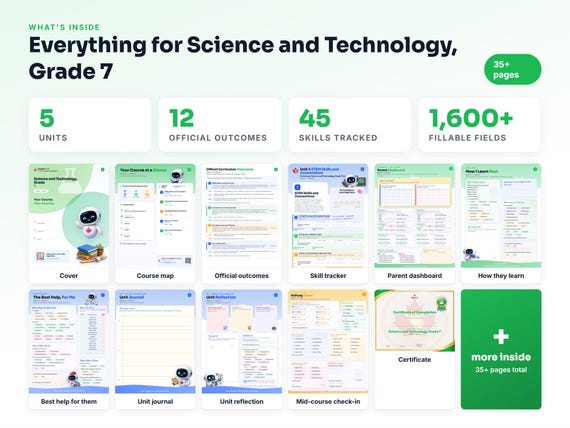
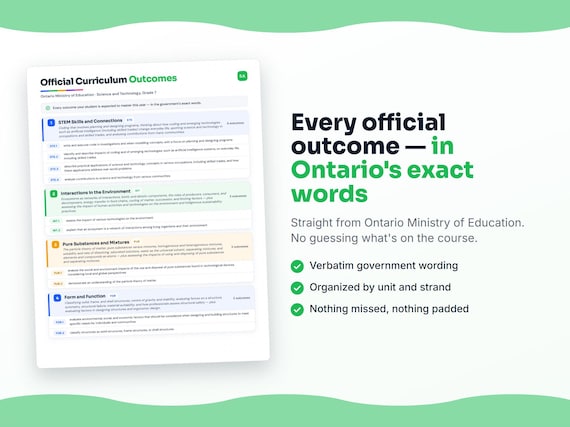
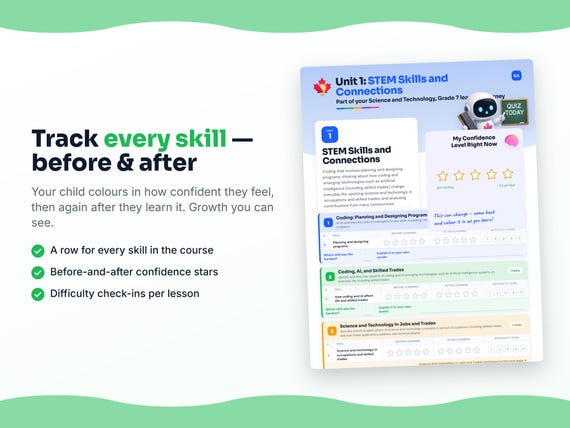
Printable workbook · A keepsake of the year
A Science and Technology, Grade 7 workbook worth keeping
Built from the same official curriculum as this page. Before and after each skill above, your student colours in how sure they feel — so the two of you can see, on one page, what's clicking and what needs another look. It's a quiet way to follow how the year is really going.
By June it's full of their own handwriting: units worked through, confidence grown, a mid-year check-in, notes from parent-teacher night, and a certificate at the end. Less a worksheet, more a record of the year worth keeping on the shelf.
Instant download · see every page, reviews and the full description · five or more workbooks are $2.99 each
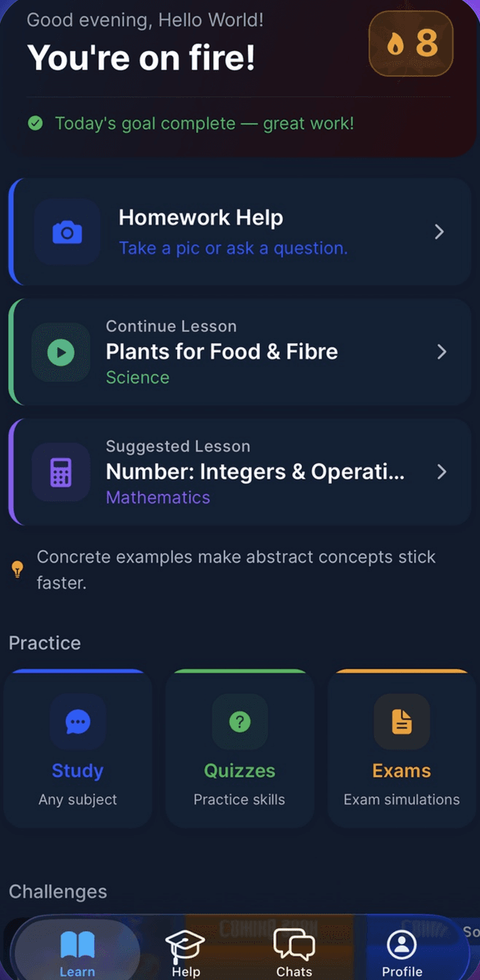
What it looks like in the app

Common questions
Can MapleMind help me with Science and Technology, Grade 7?
Yes. MapleMind's AI tutor covers all 45 skills in Ontario's Science and Technology, Grade 7 — you pick the exact skill, and the tutor teaches it step by step: a short lesson, a worked example, solving together, then a skill check to show it stuck.
Is MapleMind aligned to Ontario's official curriculum?
Yes. Every skill in this course maps to an official outcome code from Ontario's Grade 7 Science curriculum, and the ministry's own wording is quoted under each unit on this page — with the official government source linked so you can check it yourself.
What does MapleMind cost?
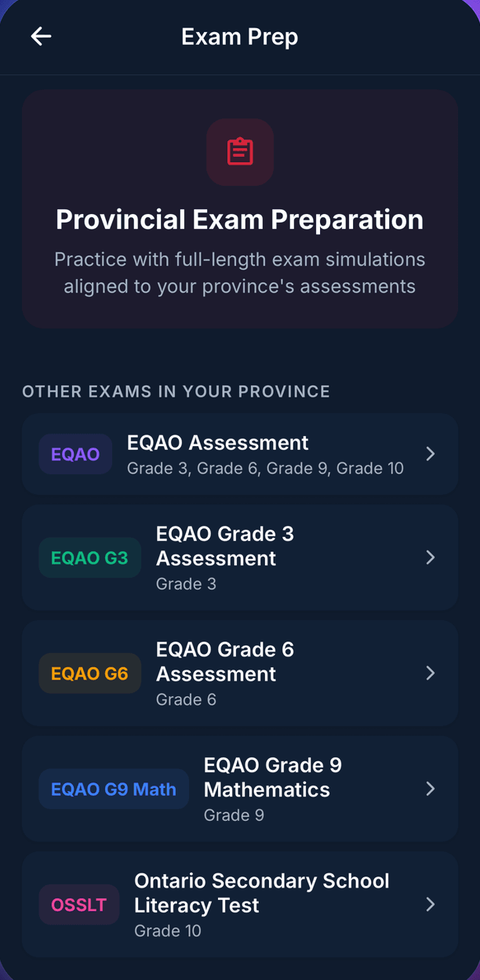
It's free to start — 5 tutoring chats and a practice quiz every day, no credit card. A Pro subscription ($9.99/month or $49.99/year CAD, 7-day free trial) unlocks unlimited tutoring, practice, and exam simulations.
What if I'm stuck on just one topic?
That's the point of skill-level tutoring: open Science and Technology, Grade 7 in the app, tap the exact skill from the list on this page, and the tutor teaches just that — no wading through lessons you don't need.
Does MapleMind work in French or other languages?
Yes — 14 languages, including French. Both the app and the tutor's explanations switch to the language you choose.
Where can I see the official Ontario curriculum for Science and Technology, Grade 7?
The official source is linked on this page — Ontario's official science curriculum. The outline here follows it: every MapleMind skill carries its official outcome code, and the ministry's own wording is quoted under each unit.
Keep exploring
Ready when you are
Pick a skill from this page and see it taught properly — free, in the browser, in under a minute.