Get help with Science and Technology, Grade 6
Most tutoring makes your child sit through material your child already knows. MapleMind flips that: pick the exact skill that's causing trouble — any of the 39 below — and the tutor teaches just that one, step by step, as many times as it takes. Ask questions in plain words, any time of day, in English, French, or 12 other languages.
The official Ontario Science and Technology, Grade 6 curriculum
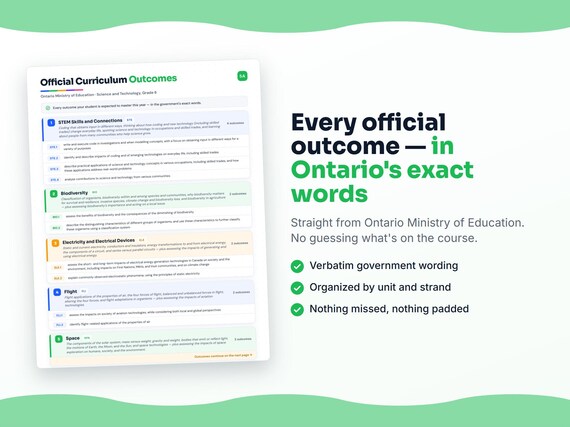
Ontario defines Science and Technology, Grade 6 by strands and outcomes. MapleMind teaches the same curriculum reorganized for one-skill-at-a-time tutoring — the table shows exactly where every official strand lands, and the ministry's own wording is quoted under each unit below.
Official source Ontario's official science curriculumRead it on the government site — dcp.edu.gov.on.ca ↗| Official strand | Outcomes | Where MapleMind teaches it |
|---|---|---|
| Strand A | 4 | STEM Skills and Connections |
| Strand B | 10 | Biodiversity |
| Strand C | 9 | Electricity and Electrical Devices |
| Strand D | 6 | Flight |
| Strand E | 9 | Space |
Every skill below, taught one on one.
 Try the first session free
How MapleMind teaches Science and Technology, Grade 6 — every unit, lesson, and skill
Every skill below runs as a short session: a plain-words lesson, a worked example, solving it together, then a five-question skill check that earns up to three stars. Guided Mode keeps it teaching instead of answer-handing — turning it off needs a parent's password.
Unit 1STEM Skills and ConnectionsOfficial strand · Strand A
Coding that obtains input in different ways, thinking about how coding and new technology (including skilled trades) change everyday life, spotting science and technology in occupations and skilled trades, and learning about people from many communities who help science grow.
Coding: Obtaining Input
- Coding to obtain inputA2.1 — Write and run code that obtains input in different ways for a variety of purposes.
Coding, New Technology, and Skilled Trades
- How coding and new technology affect life and skilled tradesA2.2 — Identify and describe how coding and new technology change everyday life, including in the skilled trades.
Science and Technology in Jobs and Trades
- Science and technology in occupations and skilled tradesA3.1 — Describe real uses of science and technology in various occupations, including skilled trades, and how they help solve real-world problems.
People Who Help Science Grow
- Learning about contributions from many communitiesA3.3 — Analyse and describe how people from many different communities have contributed to science and technology.
The official wording — 4 outcomes in this unit
- A2.1
write and execute code in investigations and when modelling concepts, with a focus on obtaining input in different ways for a variety of purposes
- A2.2
identify and describe impacts of coding and of emerging technologies on everyday life, including skilled trades
- A3.1
describe practical applications of science and technology concepts in various occupations, including skilled trades, and how these applications address real-world problems
- A3.3
analyse contributions to science and technology from various communities
Unit 2BiodiversityOfficial strand · Strand B
Classification of organisms, biodiversity within and among species and communities, why biodiversity matters for survival and resilience, invasive species, climate change and biodiversity loss, and biodiversity in agriculture — plus assessing biodiversity's importance and acting on a local issue.
Why Biodiversity Matters and How to Protect It
- Benefits and loss of biodiversityB1.1 — Assess the benefits of biodiversity and the consequences of biodiversity loss.
- Analysing a local biodiversity issueB1.2 — Analyse a local issue related to biodiversity, considering different perspectives.
- Planning and acting on a biodiversity issueB1.2 — Plan a course of action in response to a local biodiversity issue, and act on the plan.
Exploring Biodiversity
- Classifying organismsB2.1 — Describe the distinguishing characteristics of groups of organisms and use them to classify organisms with a classification system.
- What biodiversity isB2.2 — Show an understanding of biodiversity as the diversity of life on Earth — within species, among species, and among communities and habitats.
- Biodiversity within species and survivalB2.3 — Describe ways in which biodiversity within a species is essential for its survival.
- Biodiversity and community resilienceB2.4 — Describe ways in which biodiversity within and among communities is essential for maintaining their resilience.
- Interrelationships that sustain biodiversityB2.5 — Describe interrelationships within species, between species, and between species and their environment, and explain how these sustain biodiversity.
- Invasive species and biodiversityB2.6 — Explain how invasive species reduce biodiversity in local environments.
- Climate change and biodiversity lossB2.7 — Explain how climate change contributes to a loss of biodiversity, and describe the impact of this loss.
- Biodiversity and agricultureB2.8 — Describe the importance of biodiversity in supporting agriculture, including Indigenous agriculture around the world.
The official wording — 10 outcomes in this unit
- B1.1
assess the benefits of biodiversity and the consequences of the diminishing of biodiversity
- B1.2
analyse a local issue related to biodiversity while considering different perspectives
- B2.1
describe the distinguishing characteristics of different groups of organisms, and use these characteristics to further classify these organisms using a classification system
- B2.2
demonstrate an understanding of biodiversity as the diversity of life on Earth, including the diversity of organisms within species, among species in a community, and among communities and the habitats that support them
- B2.3
describe ways in which biodiversity within species is essential for their survival
- B2.4
describe ways in which biodiversity within and among communities is essential for maintaining the resilience of these communities
- B2.5
describe interrelationships within species, between species, and between species and their natural environment, and explain how these interrelationships sustain biodiversity
- B2.6
explain how invasive species reduce biodiversity in local environments
- B2.7
explain how climate change contributes to a loss of biodiversity, and describe the impact of this loss
- B2.8
describe the importance of biodiversity in supporting agriculture, including Indigenous agriculture around the world
Unit 3Electricity and Electrical DevicesOfficial strand · Strand C
Static and current electricity, conductors and insulators, energy transformations to and from electrical energy, the components of a circuit, and series versus parallel circuits — plus assessing the impacts of generating and using electrical energy.
Electricity, Society, and the Environment
- Impacts of generating electrical energyC1.1 — Assess the short- and long-term impacts of electrical energy generation technologies in Canada on society and the environment, including impacts on First Nations, Métis, and Inuit communities and on climate change.
- Using electrical energy responsiblyC1.2 — Assess choices that reduce personal use of electrical energy, and advocate for responsible use of electrical energy by the school community.
Exploring Electricity
- Static electricityC2.1 — Explain commonly observed electrostatic phenomena using the principles of static electricity.
- Current electricity vs static electricityC2.2 — Describe current electricity, and compare and contrast it with static electricity.
- Conductors and insulatorsC2.3 — Identify materials that are good conductors of electric current and materials that are good insulators.
- Transforming energy into electrical energyC2.4 — Describe how technologies transform various forms of energy into electrical energy.
- Transforming electrical energy into other formsC2.5 — Describe ways in which electrical energy is transformed into other forms of energy.
- Components of a circuitC2.6 — Explain the functions of the components of a simple electrical circuit.
- Series and parallel circuitsC2.7 — Distinguish between series and parallel circuits, and identify common uses of each type.
The official wording — 9 outcomes in this unit
- C1.1
assess the short- and long-term impacts of electrical energy generation technologies in Canada on society and the environment, including impacts on First Nations, Métis, and Inuit communities, and on climate change
- C1.2
assess choices that reduce personal use of electrical energy from both renewable and non-renewable sources, and advocate for the responsible use of electrical energy by the school community
- C2.1
explain commonly observed electrostatic phenomena, using the principles of static electricity
- C2.2
describe current electricity, and compare and contrast current electricity with static electricity
- C2.3
identify materials that are good conductors of electric current and materials that are good insulators
- C2.4
describe how technologies transform various forms of energy into electrical energy
- C2.5
describe ways in which electrical energy is transformed into other forms of energy
- C2.6
explain the functions of the components of a simple electrical circuit
- C2.7
distinguish between series and parallel circuits, and identify common uses of each type of circuit
Unit 4FlightOfficial strand · Strand D
Flight applications of the properties of air, the four forces of flight, balanced and unbalanced forces in flight, altering the four forces, and flight adaptations in organisms — plus assessing the impacts of aviation technologies.
Aviation and Its Impacts
- Impacts of aviation technologiesD1.1 — Assess the impacts on society of aviation technologies, considering both local and global perspectives.
Exploring Flight
- Properties of air used for flightD2.1 — Identify flight-related applications of the properties of air.
- The four forces of flightD2.2 — Describe the relationships between the four forces of flight — lift, weight, thrust, and drag — that make flight possible.
- Balanced and unbalanced forces in flightD2.3 — Describe ways in which flying machines and organisms use balanced and unbalanced forces to control flight.
- Altering the forces of flightD2.4 — Describe ways in which the four forces of flight can be altered.
- Flight adaptations in organismsD2.5 — Describe characteristics and adaptations that enable organisms to fly.
The official wording — 6 outcomes in this unit
- D1.1
assess the impacts on society of aviation technologies, while considering both local and global perspectives
- D2.1
identify flight-related applications of the properties of air
- D2.2
describe the relationships between the four forces of flight – lift, weight, thrust, and drag – that make flight possible
- D2.3
describe ways in which flying machines and various organisms use balanced and unbalanced forces to control their flight
- D2.4
describe ways in which the four forces of flight can be altered
- D2.5
describe characteristics and adaptations that enable organisms to fly
Unit 5SpaceOfficial strand · Strand E
The components of the solar system, mass versus weight, gravity and weight, bodies that emit or reflect light, the motions of Earth, the Moon, and the Sun, and space technologies — plus assessing the impacts of space exploration on humans, society, and the environment.
Humans and Space Exploration
- Conditions in space and human needsE1.1 — Analyse the impact of conditions in space on humans in space exploration, and explain how humans meet their needs in space.
- Space technology and understanding EarthE1.2 — Assess the role of space exploration technology in observing and understanding environmental changes on Earth, including climate change.
- Impacts of space explorationE1.3 — Evaluate the social and environmental impacts of space exploration, considering various perspectives.
Exploring Space
- Components of the solar systemE2.1 — Identify the components of the solar system and describe their main physical characteristics.
- Mass versus weightE2.2 — Distinguish between the concepts of mass and weight.
- Gravity and weightE2.3 — Describe the relationship between the force of gravity and the weight of a body.
- Bodies that emit or reflect lightE2.4 — Identify the types of bodies in space that emit light and those that reflect light.
- Motions of Earth, the Moon, and the SunE2.5 — Describe various effects of the relative positions and motions of Earth, the Moon, and the Sun.
- Technologies for space explorationE2.6 — Identify technologies used in space exploration and describe how innovations have contributed to our understanding of space.
The official wording — 9 outcomes in this unit
- E1.1
analyse the impact that conditions in space have on humans engaged in space exploration, and explain how humans meet their social, emotional, and physiological needs in space
- E1.2
assess the role of space exploration technology in observing and understanding environmental changes on Earth, including climate change
- E1.3
evaluate the social and environmental impacts of space exploration, while taking various perspectives into consideration
- E2.1
identify components of the solar system, including the Sun, Earth and other planets, natural satellites, comets, asteroids, and meteoroids, and describe their main physical characteristics
- E2.2
distinguish between the concepts of mass and weight
- E2.3
describe the relationship between the force of gravity and the weight of a body
- E2.4
identify the types of bodies in space that emit light and those that reflect light
- E2.5
describe various effects of the relative positions and motions of Earth, the Moon, and the Sun
- E2.6
identify various technologies used in space exploration, and describe how technological innovations have contributed to our understanding of space
Printable workbook · A keepsake of the year
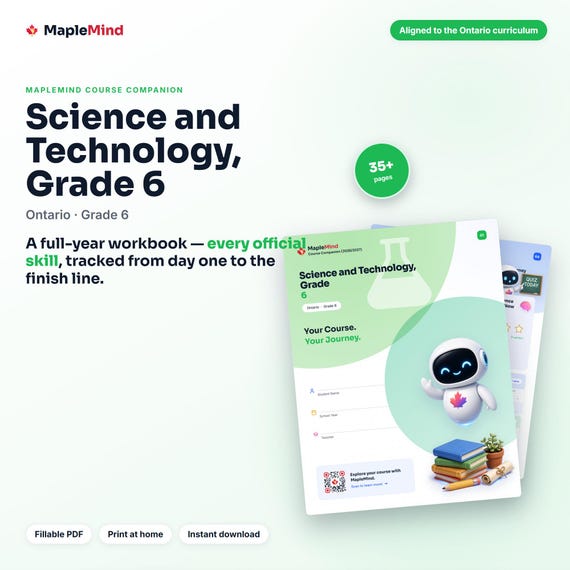
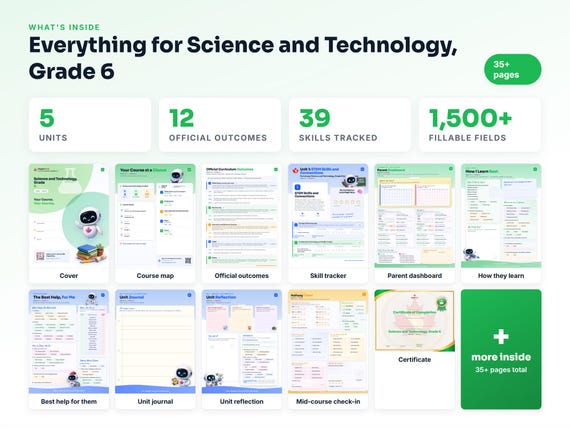
A Science and Technology, Grade 6 workbook worth keeping
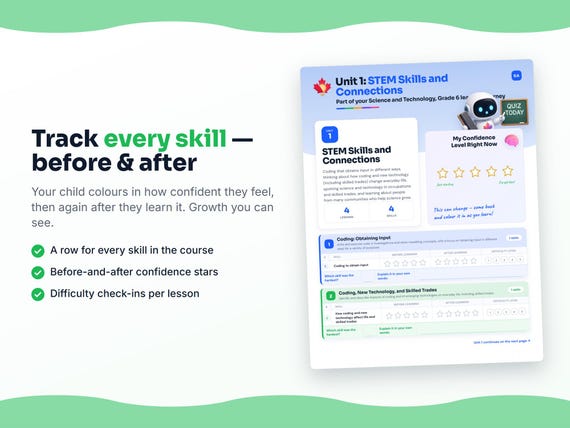
Built from the same official curriculum as this page. Before and after each skill above, your student colours in how sure they feel — so the two of you can see, on one page, what's clicking and what needs another look. It's a quiet way to follow how the year is really going.
By June it's full of their own handwriting: units worked through, confidence grown, a mid-year check-in, notes from parent-teacher night, and a certificate at the end. Less a worksheet, more a record of the year worth keeping on the shelf.
Instant download · see every page, reviews and the full description · five or more workbooks are $2.99 each
What it looks like in the app
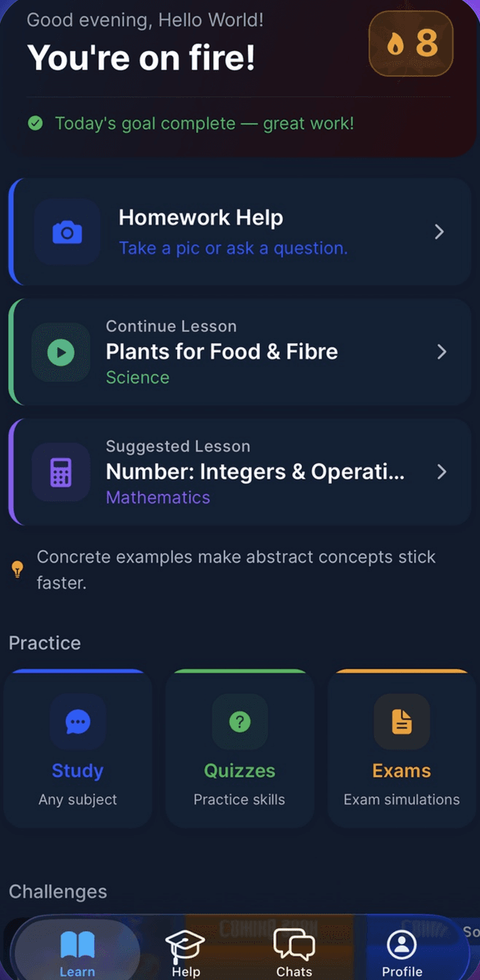
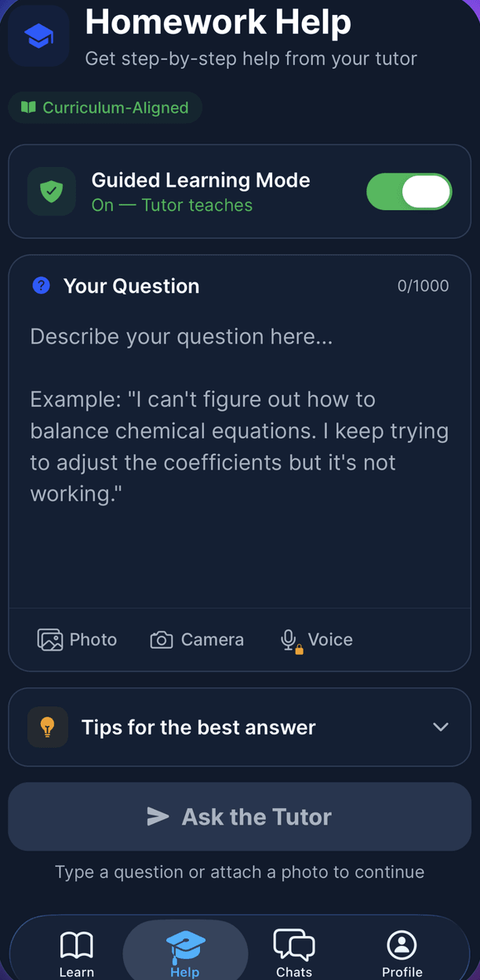
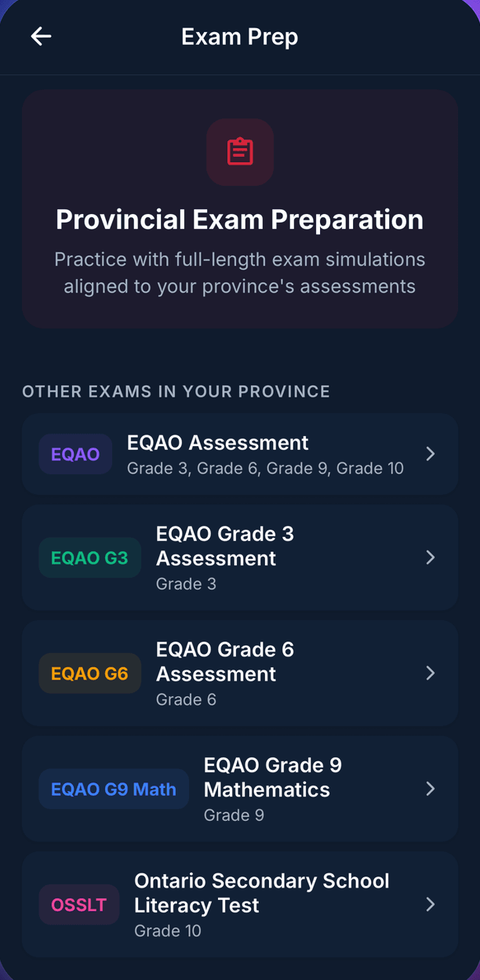
Common questions
Can MapleMind help my child with Science and Technology, Grade 6?
Yes. MapleMind's AI tutor covers all 39 skills in Ontario's Science and Technology, Grade 6 — your child picks the exact skill, and the tutor teaches it step by step: a short lesson, a worked example, solving together, then a skill check to show it stuck.
Is MapleMind aligned to Ontario's official curriculum?
Yes. Every skill in this course maps to an official outcome code from Ontario's Grade 6 Science curriculum, and the ministry's own wording is quoted under each unit on this page — with the official government source linked so you can check it yourself.
What does MapleMind cost?
It's free to start — 5 tutoring chats and a practice quiz every day, no credit card. A Pro subscription ($9.99/month or $49.99/year CAD, 7-day free trial) unlocks unlimited tutoring, practice, and exam simulations.
What if my child is stuck on just one topic?
That's the point of skill-level tutoring: open Science and Technology, Grade 6 in the app, tap the exact skill from the list on this page, and the tutor teaches just that — no wading through lessons your child doesn't need.
Does MapleMind work in French or other languages?
Yes — 14 languages, including French. Both the app and the tutor's explanations switch to the language your child chooses.
Where can I see the official Ontario curriculum for Science and Technology, Grade 6?
The official source is linked on this page — Ontario's official science curriculum. The outline here follows it: every MapleMind skill carries its official outcome code, and the ministry's own wording is quoted under each unit.
Keep exploring
Ready when you are
Pick a skill from this page and see it taught properly — free, in the browser, in under a minute.