Get help with Science and Technology, Grade 5
Most tutoring makes your child sit through material your child already knows. MapleMind flips that: pick the exact skill that's causing trouble — any of the 36 below — and the tutor teaches just that one, step by step, as many times as it takes. Ask questions in plain words, any time of day, in English, French, or 12 other languages.
The official Ontario Science and Technology, Grade 5 curriculum
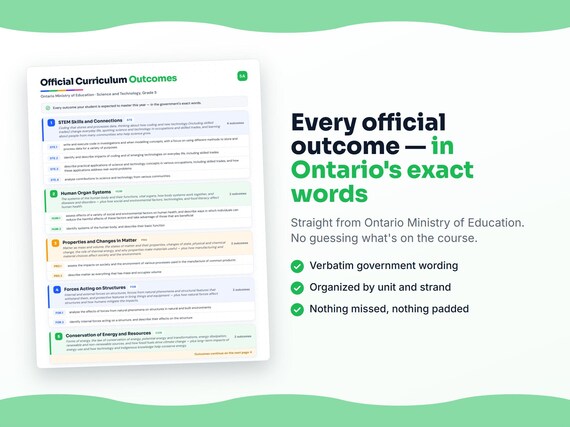
Ontario defines Science and Technology, Grade 5 by strands and outcomes. MapleMind teaches the same curriculum reorganized for one-skill-at-a-time tutoring — the table shows exactly where every official strand lands, and the ministry's own wording is quoted under each unit below.
Official source Ontario's official science curriculumRead it on the government site — dcp.edu.gov.on.ca ↗| Official strand | Outcomes | Where MapleMind teaches it |
|---|---|---|
| Strand A | 4 | STEM Skills and Connections |
| Strand B | 7 | Human Organ Systems |
| Strand C | 9 | Properties and Changes in Matter |
| Strand D | 7 | Forces Acting on Structures |
| Strand E | 9 | Conservation of Energy and Resources |
Every skill below, taught one on one.
 Try the first session free
How MapleMind teaches Science and Technology, Grade 5 — every unit, lesson, and skill
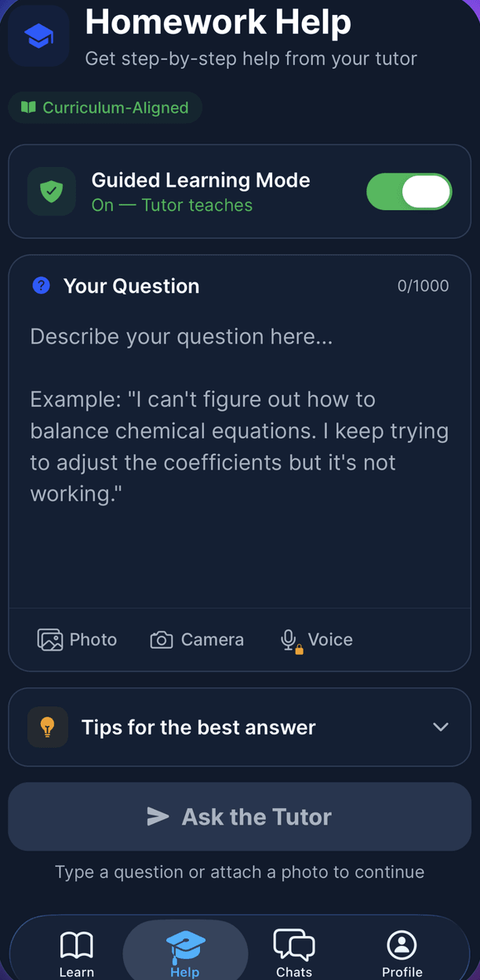
Every skill below runs as a short session: a plain-words lesson, a worked example, solving it together, then a five-question skill check that earns up to three stars. Guided Mode keeps it teaching instead of answer-handing — turning it off needs a parent's password.
Unit 1STEM Skills and ConnectionsOfficial strand · Strand A
Coding that stores and processes data, thinking about how coding and new technology (including skilled trades) change everyday life, spotting science and technology in occupations and skilled trades, and learning about people from many communities who help science grow.
Coding: Storing and Processing Data
- Coding to store and process dataA2.1 — Write and run code that uses different methods to store and process data for a variety of purposes.
Coding, New Technology, and Skilled Trades
- How coding and new technology affect life and skilled tradesA2.2 — Identify and describe how coding and new technology change everyday life, including in the skilled trades.
Science and Technology in Jobs and Trades
- Science and technology in occupations and skilled tradesA3.1 — Describe real uses of science and technology in various occupations, including skilled trades, and how they help solve real-world problems.
People Who Help Science Grow
- Learning about contributions from many communitiesA3.3 — Analyse and describe how people from many different communities have contributed to science and technology.
The official wording — 4 outcomes in this unit
- A2.1
write and execute code in investigations and when modelling concepts, with a focus on using different methods to store and process data for a variety of purposes
- A2.2
identify and describe impacts of coding and of emerging technologies on everyday life, including skilled trades
- A3.1
describe practical applications of science and technology concepts in various occupations, including skilled trades, and how these applications address real-world problems
- A3.3
analyse contributions to science and technology from various communities
Unit 2Human Organ SystemsOfficial strand · Strand B
The systems of the human body and their functions, vital organs, how body systems work together, and diseases and disorders — plus how social and environmental factors, technologies, and food literacy affect human health.
What Affects Our Health
- How technology affects our body systemsB1.2 — Evaluate the beneficial and harmful effects of various technologies on human health and body systems, considering different perspectives.
- Food literacy and healthB1.3 — Explain how food literacy can support decisions that affect physical and mental health.
Body Systems and Vital Organs
- Systems of the human bodyB2.1 — Identify systems of the human body and describe their basic function.
- Vital organs and their functionsB2.2 — Describe the basic structure and function of vital organs in various body systems.
- How body systems work togetherB2.3 — Describe interrelationships between human body systems.
- Diseases, disorders, and the systems they affectB2.4 — Identify various diseases and medical disorders and the organs or body systems they affect.
The official wording — 7 outcomes in this unit
- B1.1
assess effects of a variety of social and environmental factors on human health, and describe ways in which individuals can reduce the harmful effects of these factors and take advantage of those that are beneficial
- B1.2
evaluate beneficial and harmful effects of various technologies on human health and body systems, while taking different perspectives into consideration
- B1.3
explain how food literacy can support decisions that affect physical and mental health
- B2.1
identify systems of the human body, and describe their basic function
- B2.2
describe the basic structure and function of vital organs in various systems in the human body
- B2.3
describe interrelationships between human body systems
- B2.4
identify various diseases and medical disorders in humans and the organs and/or body system or systems that they affect
Unit 3Properties and Changes in MatterOfficial strand · Strand C
Matter as mass and volume, the states of matter and their properties, changes of state, physical and chemical change, the role of thermal energy, and why properties make materials useful — plus how manufacturing and material choices affect society and the environment.
Making Products and the Environment
- Impacts of manufacturing processesC1.1 — Assess the impacts on society and the environment of various processes used to manufacture common products.
- Material choices and reducing harmC1.2 — Assess how the materials used to make products affect the environment, and identify actions to reduce negative impacts.
Exploring Matter and Its Changes
- Matter has mass and takes up spaceC2.1 — Describe matter as everything that has mass and occupies volume.
- States of matter and their propertiesC2.2 — Identify the states of matter and describe the characteristics and properties of solids, liquids, and gases.
- Changes of stateC2.3 — Describe changes of state of matter observed at home, in the community, or in nature.
- Physical changeC2.4 — Describe physical changes as changes of state, volume, or form that do not create a new substance.
- Chemical changeC2.5 — Describe chemical changes as changes that create a new substance, and identify signs that a chemical change has occurred.
- Thermal energy and changes of stateC2.6 — Explain how changes of state occur when matter absorbs or releases thermal energy.
- Why properties make materials usefulC2.7 — Explain why the physical properties of solids, liquids, and gases make them useful for particular applications.
The official wording — 9 outcomes in this unit
- C1.1
assess the impacts on society and the environment of various processes used in the manufacture of common products
- C1.2
assess how the use of specific materials in the manufacture of common products affects the environment, and identify actions that society and individuals can take to mitigate negative impacts
- C2.1
describe matter as everything that has mass and occupies volume
- C2.2
identify the states of matter, and describe characteristics and properties of solids, liquids, and gases
- C2.3
describe changes of state of matter observed at home, in the community, or in the natural environment
- C2.4
describe physical changes in matter as changes of the state, volume, or form of the matter that do not result in the formation of a different substance
- C2.5
describe chemical changes in matter as changes that result in the formation of different substances, and identify signs that a chemical change has occurred
- C2.6
explain how changes of state can occur when matter absorbs or releases thermal energy
- C2.7
explain why specific physical properties of various solids, liquids, and gases make them useful for particular applications
Unit 4Forces Acting on StructuresOfficial strand · Strand D
Internal and external forces on structures, forces from natural phenomena and structural features that withstand them, and protective features in living things and equipment — plus how natural forces affect structures and how humans mitigate the impacts.
Nature's Forces on Structures
- Effects of natural forces on structuresD1.1 — Analyse the effects of forces from natural phenomena on structures in natural and built environments.
- How people protect structures from natural forcesD1.2 — Assess ways in which humans reduce the impacts of forces from natural phenomena on structures in different communities.
Forces Acting on Structures
- Internal forces on a structureD2.1 — Identify internal forces acting on a structure and describe their effects.
- External forces on a structureD2.2 — Identify external forces acting on a structure and describe their effects.
- Withstanding forces from natural phenomenaD2.3 — Describe forces from natural phenomena that can severely affect human-built structures, and identify features and materials that help structures withstand them.
- Protective features in animals and plantsD2.4 — Describe ways in which physical characteristics of animals and plants help protect them from harmful effects of forces.
- Protective equipment for humansD2.5 — Describe ways in which protective equipment helps protect humans from harmful effects of forces.
The official wording — 7 outcomes in this unit
- D1.1
analyse the effects of forces from natural phenomena on structures in natural and built environments
- D1.2
assess various ways in which humans mitigate impacts of forces from natural phenomena on structures in urban, rural, and remote communities
- D2.1
identify internal forces acting on a structure, and describe their effects on the structure
- D2.2
identify external forces acting on a structure, and describe their effects on the structure
- D2.3
describe forces resulting from natural phenomena that can have severe consequences for human-built structures, and identify structural features and materials that can allow such structures to withstand these forces
- D2.4
describe ways in which physical characteristics of various animal and plant species help to protect them from potentially harmful effects of forces
- D2.5
describe ways in which protective equipment helps to protect humans from potentially harmful effects of forces
Unit 5Conservation of Energy and ResourcesOfficial strand · Strand E
Forms of energy, the law of conservation of energy, potential energy and transformations, energy dissipation, renewable and non-renewable sources, and how fossil fuels drive climate change — plus long-term impacts of energy use and how technology and Indigenous knowledge help conserve energy.
Energy Use, Climate, and Conservation
- Long-term impacts of energy and resource useE1.1 — Analyse the long-term impacts of human energy and resource use on society and the environment, including climate change, and suggest ways to reduce them.
- Technology and energy consumptionE1.2 — Evaluate the effects of various technologies on energy consumption, and describe how people can use technology to reduce it.
- First Nations, Métis, and Inuit energy and resource knowledgeE1.3 — Analyse how First Nations, Métis, and Inuit communities use their knowledges and ways of knowing to conserve energy and resources.
Energy and Its Conservation
- Forms of energyE2.1 — Identify a variety of forms of energy and describe how each is used in everyday life.
- The law of conservation of energyE2.2 — Show an understanding of the law of conservation of energy: energy cannot be created or destroyed, only transformed from one form to another.
- Stored energy and transformationE2.3 — Describe how energy is stored as potential energy and transformed in a device or system.
- Energy dissipationE2.4 — Show an understanding that when energy is transformed, some may dissipate into the environment as heat, light, or sound.
- Renewable and non-renewable energy sourcesE2.5 — Identify renewable and non-renewable sources of energy.
- Fossil fuels and climate changeE2.6 — Explain how using energy from fossil fuels changes the atmosphere and contributes to climate change.
The official wording — 9 outcomes in this unit
- E1.1
analyse long-term impacts of human uses of energy and natural resources, on society and the environment, including climate change, and suggest ways to mitigate these impacts
- E1.2
evaluate effects of various technologies on energy consumption, and describe ways in which individuals can use technology to reduce energy consumption
- E1.3
analyse how First Nations, Métis, and Inuit communities use their knowledges and ways of knowing to conserve energy and resources
- E2.1
identify a variety of forms of energy, and describe how each form is used in everyday life
- E2.2
demonstrate an understanding of the law of conservation of energy, including how energy cannot be created or destroyed but can only be transformed from one form to another
- E2.3
describe how energy is stored as potential energy and transformed in a given device or system
- E2.4
demonstrate an understanding that when energy is transformed from one form to another, some energy may dissipate into the environment in the form of heat, light, and/or sound energy
- E2.5
identify renewable and non-renewable sources of energy
- E2.6
explain how the use of energy derived from fossil fuels changes the composition of the atmosphere and how these changes contribute to climate change

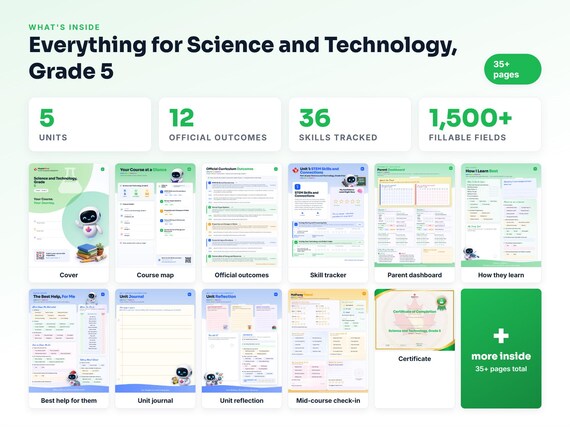
Printable workbook · A keepsake of the year
A Science and Technology, Grade 5 workbook worth keeping
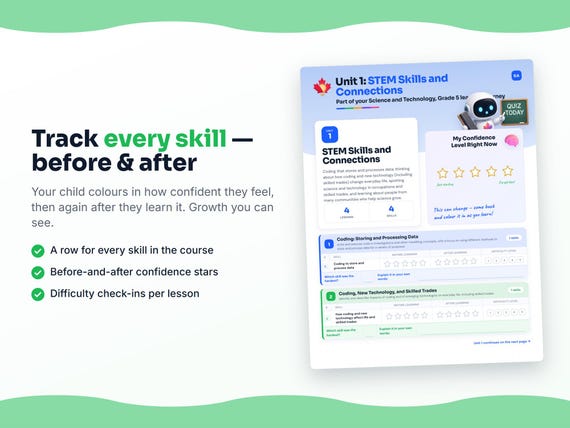
Built from the same official curriculum as this page. Before and after each skill above, your student colours in how sure they feel — so the two of you can see, on one page, what's clicking and what needs another look. It's a quiet way to follow how the year is really going.
By June it's full of their own handwriting: units worked through, confidence grown, a mid-year check-in, notes from parent-teacher night, and a certificate at the end. Less a worksheet, more a record of the year worth keeping on the shelf.
Instant download · see every page, reviews and the full description · five or more workbooks are $2.99 each
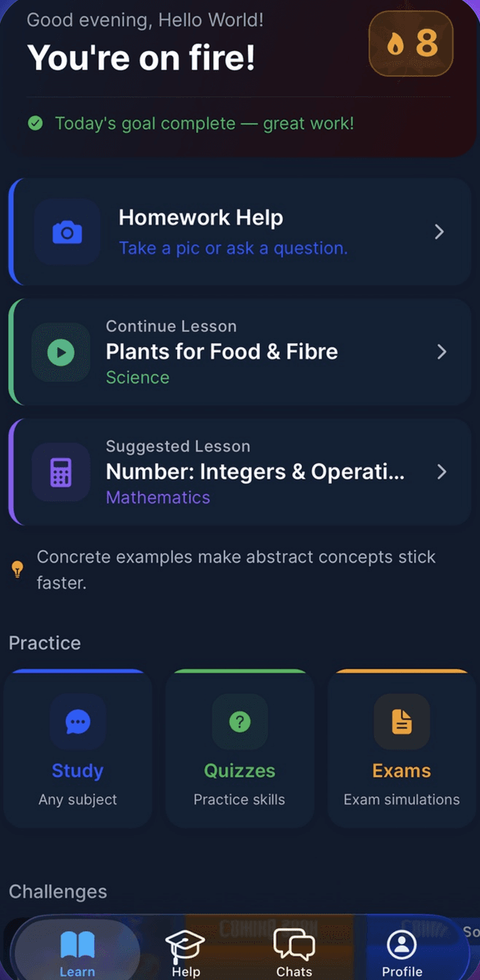
What it looks like in the app
Common questions
Can MapleMind help my child with Science and Technology, Grade 5?
Yes. MapleMind's AI tutor covers all 36 skills in Ontario's Science and Technology, Grade 5 — your child picks the exact skill, and the tutor teaches it step by step: a short lesson, a worked example, solving together, then a skill check to show it stuck.
Is MapleMind aligned to Ontario's official curriculum?
Yes. Every skill in this course maps to an official outcome code from Ontario's Grade 5 Science curriculum, and the ministry's own wording is quoted under each unit on this page — with the official government source linked so you can check it yourself.
What does MapleMind cost?
It's free to start — 5 tutoring chats and a practice quiz every day, no credit card. A Pro subscription ($9.99/month or $49.99/year CAD, 7-day free trial) unlocks unlimited tutoring, practice, and exam simulations.
What if my child is stuck on just one topic?
That's the point of skill-level tutoring: open Science and Technology, Grade 5 in the app, tap the exact skill from the list on this page, and the tutor teaches just that — no wading through lessons your child doesn't need.
Does MapleMind work in French or other languages?
Yes — 14 languages, including French. Both the app and the tutor's explanations switch to the language your child chooses.
Where can I see the official Ontario curriculum for Science and Technology, Grade 5?
The official source is linked on this page — Ontario's official science curriculum. The outline here follows it: every MapleMind skill carries its official outcome code, and the ministry's own wording is quoted under each unit.
Keep exploring
Ready when you are
Pick a skill from this page and see it taught properly — free, in the browser, in under a minute.