Ontario · For parents

What your child learns in Grade 7 in Ontario

Every subject, unit by unit, from Ontario’s curriculum: 234 skills in plain words.

Subjects
5
Skills
234
Provincial exams
None
Official curriculum
dcp.edu.gov.on.ca

Math in Grade 7

Mathematics, Grade 7

5 units · 53 skills

  1. Unit 1

    Number

    Expanded notation with powers of ten shows a number as an expression using addition, multiplication, and exponents, like 307 020 050 = 3 x 10^8 + 7 x 10^6 + 2 x 10^4 + 5 x 10.

    • Representing and comparing whole numbers to one billion using powers of ten
    • Identifying and representing perfect squares
    • Determining square roots of perfect squares
    15 more skills
    • Reading, representing, comparing, and ordering rational numbers, including negatives
    • Using equivalent fractions to simplify fractions
    • Generating fractions and decimals between any two quantities
    • Rounding decimals to the nearest tenth, hundredth, or whole number
    • Converting between fractions, decimals, and percents
    • Using order of operations to solve multi-step problems
    • Recalling commonly used percent, fraction, and decimal equivalents
    • Mental math: increasing and decreasing by a percent
    • Representing and solving addition and subtraction of integers
    • Adding and subtracting fractions, including by creating equivalent fractions
    • Determining the greatest common factor and lowest common multiple
    • Expressing repeated multiplication using exponential notation
    • Multiplying and dividing fractions by fractions
    • Multiplying and dividing decimals by decimals
    • Identifying proportional situations and applying proportional reasoning
  2. Unit 2

    Algebra

    A linear growing pattern has a constant rate (how much it grows each term) and an initial value (its starting value when the term number is zero).

    • Comparing patterns, including linear growing patterns by rate and initial value
    • Creating and translating patterns with whole and decimal numbers, using algebra for linear patterns
    • Determining pattern rules and solving for unknowns in linear growing patterns
    7 more skills
    • Creating patterns to show relationships among integers
    • Adding and subtracting monomials with a degree of 1
    • Evaluating algebraic expressions with whole and decimal numbers
    • Solving multi-term equations with whole and decimal numbers
    • Solving and graphing multi-term inequalities
    • Writing and running efficient code involving a defined count and/or sub-program
    • Reading and altering code involving a defined count and/or sub-program
  3. Unit 3

    Data

    When comparing categories of a large population, it's easier to compare relative amounts (percentages) than exact quantities.

    • Explaining why percentages represent data distribution
    • Collecting qualitative and quantitative data, organizing using percentages
    • Selecting and justifying a graph type, including circle graphs
    5 more skills
    • Creating an infographic using tables and circle graphs
    • Determining the impact of adding or removing data on central tendency
    • Analysing data in circle graphs and misleading graphs
    • Describing the difference between independent and dependent events
    • Comparing probabilities of two independent events and of two dependent events
  4. Unit 4

    Spatial Sense

    Cylinders have two parallel, congruent bases; prisms are a special type of cylinder with polygon bases; pyramids have one base with triangular faces meeting at an apex.

    • Describing and classifying cylinders, pyramids, and prisms by geometric properties
    • Drawing top, front, side, and perspective views using scales
    • Performing dilations and describing similarity
    8 more skills
    • Performing translations, reflections, and rotations on a Cartesian plane
    • Describing volume and capacity and relating millilitres to cubic centimetres
    • Solving perimeter, area, and volume problems requiring metric conversions
    • Using radius, diameter, and circumference relationships to explain the circumference formula
    • Constructing circles given radius, diameter, or circumference
    • Using radius, diameter, and area relationships to explain the area-of-a-circle formula
    • Representing cylinders as nets and determining their surface area
    • Determining the volume of a prism or cylinder from base area and height
  5. Unit 5

    Financial Literacy

    International currencies have different values compared to Canadian currency, and this relationship is expressed as an exchange rate.

    • Identifying and comparing exchange rates and converting foreign currencies
    • Identifying reliable sources of information for financial planning
    • Creating, tracking, and adjusting sample budgets for longer-term goals
    3 more skills
    • Identifying societal and personal factors influencing financial decisions
    • Explaining how interest rates impact savings, investments, and borrowing over time
    • Comparing interest rates and fees to determine the best financial option
Science in Grade 7

Science and Technology, Grade 7

5 units · 45 skills

  1. Unit 1

    STEM Skills and Connections

    Planning a program means deciding its steps, inputs, outputs, and logic before coding.

    • Planning and designing programs
    • How coding and AI affect life and skilled trades
    • Science and technology in occupations and skilled trades
    1 more skill
    • Analysing contributions from many communities
  2. Unit 2

    Interactions in the Environment

    Technologies can affect the environment in positive and negative ways.

    • Impact of technologies on the environment
    • Mitigating and enhancing human impact
    • Indigenous practices and environmental sustainability
    8 more skills
    • Ecosystems as networks of interactions
    • Biotic and abiotic components
    • Producers, consumers, and decomposers
    • Energy transfer in a food chain
    • Cycling of matter
    • Primary and secondary succession
    • Limiting factors in ecosystems
    • Agriculture, harvesting, and ecosystem balance
  3. Unit 3

    Pure Substances and Mixtures

    Technological devices contain pure substances (metals, elements) that are used and later disposed of.

    • Impacts of using and disposing of pure substances
    • Impacts of industrial separation methods
    • The particle theory of matter
    7 more skills
    • Pure substances versus mixtures
    • Homogeneous and heterogeneous mixtures
    • Solubility and rate of dissolving
    • Saturated and unsaturated solutions
    • Water as the universal solvent
    • Separating mixtures
    • Elements and compounds as atoms
  4. Unit 4

    Form and Function

    Designing a structure means weighing environmental, social, and economic factors.

    • Factors in designing and building structures
    • Ergonomic design
    • Solid, frame, and shell structures
    6 more skills
    • Centre of gravity and stability
    • Analysing forces on a structure
    • Symmetry in structures
    • Why structures fail
    • Choosing suitable materials
    • Assessing structural safety
  5. Unit 5

    Heat in the Environment

    Technologies like insulation, double glazing, and weatherstripping reduce heat loss or transfer.

    • Benefits of heat-loss technologies
    • Impacts of renewable and non-renewable energy
    • Heat and the motion of particles
    8 more skills
    • How heat is generated
    • Heat and volume (thermal expansion)
    • Heat transfer by conduction
    • Heat transfer by convection
    • Heat transfer by radiation
    • Radiation and the heating of Earth
    • Greenhouse gases and radiated heat
    • Sources of greenhouse gases

English in Grade 7

English (Language), Grade 7

4 units · 58 skills

  1. Unit 1

    Literacy Connections and Applications

    At Grade 7 you navigate online safely and manage your privacy, personal data, AND SECURITY.

    • Rights, responsibilities, and digital identity
    • Staying safe and protecting privacy online
    • Researching and spotting misinformation
    6 more skills
    • Reading and analyzing digital and media texts
    • How form, message, and audience connect
    • Using digital tools to solve real problems
    • Collaborating safely and respectfully online
    • Identity and belonging in diverse texts
    • Themes in First Nations, Métis, and Inuit cultures
  2. Unit 2

    Foundations of Language

    At Grade 7 you analyze effective listening skills in more demanding group discussions.

    • Active listening in discussions
    • Listening strategies before, during, and after
    • Speaking for purpose and audience
    10 more skills
    • Non-verbal communication strategies
    • Precise word choice when speaking
    • Morphology: reading and spelling with word parts
    • Building and using vocabulary
    • Reading fluently with expression
    • Complex sentences combining phrases and clauses
    • Indirect objects and predicate nouns/adjectives
    • Participles and adverbial phrases
    • Colons for quotations and semicolons
    • Commas with conjunctive adverbs; ellipses and dashes
  3. Unit 3

    Comprehension: Understanding and Responding to Texts

    At Grade 7 the texts are complex: you read and comprehend them using knowledge of words, grammar, cohesive ties, sentence structures, and background knowledge.

    • Reading and comprehending texts
    • Analyzing text forms and genres
    • Analyzing text patterns and features
    19 more skills
    • Analyzing visuals and design
    • Elements of style in texts
    • Narrator's point of view
    • Indigenous Storywork through First Nations, Métis, and Inuit texts
    • Using prior knowledge
    • Purposes for reading and choosing texts
    • Making predictions and posing questions
    • Monitoring comprehension
    • Connecting text ideas to self, texts, and world
    • Summarizing
    • Reflecting on comprehension strategies
    • Literary devices
    • Making inferences
    • Analyzing texts for ideas and information
    • Cultural elements in texts
    • Perspectives and bias
    • Topics such as diversity, inclusion, and accessibility
    • Influences on First Nations, Métis, and Inuit texts
    • Reflecting on critical thinking skills
  4. Unit 4

    Composition: Expressing Ideas and Creating Texts

    At Grade 7 you identify topic, purpose, and audience and ANALYZE why the chosen form, genre, and medium suit them.

    • Planning topic, purpose, and audience
    • Generating and developing ideas
    • Gathering information and citing sources
    11 more skills
    • Organizing and sequencing content
    • Reflecting on planning strategies
    • Drafting texts in various genres
    • Transcription: cursive and word processing
    • Establishing voice in writing
    • Point of view, perspective, and bias in own texts
    • Revising drafts
    • Editing drafts
    • Producing final texts
    • Publishing and presenting texts
    • Reflecting on publishing and presenting

French in Grade 7

Core French, Grade 7

4 units · 33 skills

  1. Unit 1

    Listening

    Grade 7 listening uses your knowledge of how different text types are structured to predict the content of a narrative or presentation.

    • Using listening strategies
    • Showing you understood
    • Interactive listening strategies
    4 more skills
    • Responding in short exchanges
    • Reflecting on my listening
    • French-speaking communities in Ontario
    • Noticing sociolinguistic conventions
  2. Unit 2

    Speaking

    Use and reuse familiar AND newly acquired phrases and sentences to state your needs and preferences.

    • Using speaking strategies
    • Producing short spoken messages
    • Speaking with fluency
    5 more skills
    • Speaking-interaction strategies
    • Taking part in spoken exchanges
    • Reflecting on my speaking
    • Speaking about French-speaking communities
    • Using sociolinguistic conventions
  3. Unit 3

    Reading

    You now draw on a VARIETY of strategies (predicting, cognates, context, rereading) across modelled, shared, and guided reading.

    • Using reading strategies
    • Reading for meaning
    • Reading with fluency
    6 more skills
    • Developing vocabulary
    • Purposes of text forms
    • Characteristics of text forms
    • Reflecting on my reading
    • Reading about French-speaking communities
    • Conventions in French texts
  4. Unit 4

    Writing

    Each form has a structure: an invitation names the occasion, date, time, place, dress, and how to RSVP.

    • Identifying purpose and audience
    • Writing in different forms
    • Applying language conventions
    6 more skills
    • Pre-writing: gathering ideas
    • Drafting and revising
    • Producing finished work: conventions
    • Reflecting on my writing
    • Writing about French-speaking communities
    • Conventions in my writing

Social studies in Grade 7

History and Geography, Grade 7

4 units · 45 skills

  1. Unit 1

    New France and British North America (1713-1800)

    Between 1713 and 1800, values and daily life differed sharply from today in gender roles, religion, living conditions, and political rights.

    • Life then and now (1713-1800)
    • Challenges and how people responded
    • Displacement in the period
    8 more skills
    • Key events and their significance
    • Treaties and wampum belts
    • Political and legal changes
    • Social and economic changes
    • Daily life in Indigenous communities
    • Daily life in newcomer communities
    • Significant interactions and institutions
    • Significant individuals and groups
  2. Unit 2

    Canada, 1800-1850: Conflict and Challenges

    Life varied across British and French forts, bush settlements, and First Nations reserves.

    • Social and political values, 1800-1850
    • Challenges and responses, 1800-1850
    • Displacement, 1800-1850
    6 more skills
    • Key events and trends
    • Treaties and wampum belts, 1800-1850
    • Political and legal changes
    • Social and economic changes
    • Significant interactions between groups
    • Significant individuals and groups
  3. Unit 3

    Physical Patterns in a Changing World

    People build dams, levees, dikes, terraces, and irrigation systems to manage water and farm difficult land.

    • Responses to the physical environment
    • Comparing perspectives on the environment
    • Which environments affect people most
    12 more skills
    • Same environment, different responses
    • Landforms and their locations
    • Processes that shape landforms
    • Reading topographical maps
    • Water bodies and systems
    • Processes that change water systems
    • Major climate regions
    • Processes that change climate patterns
    • Analysing and constructing climate graphs
    • Major natural vegetation regions
    • Processes that change vegetation
    • How physical features interact
  4. Unit 4

    Natural Resources around the World: Use and Sustainability

    A resource's location and accessibility shape how it is extracted or harvested.

    • Location, extraction, and use of resources
    • Resource use and sustainability by region
    • Efforts to preserve resources
    7 more skills
    • A personal plan for sustainable resource use
    • Renewable, non-renewable, and flow resources
    • How people use the natural environment
    • Effects of resource use
    • Perspectives on using resources
    • Responses to resource challenges
    • GIS maps of natural resources

MapleMind

See Grade 7 in MapleMind

Real screens from the app your child would use.

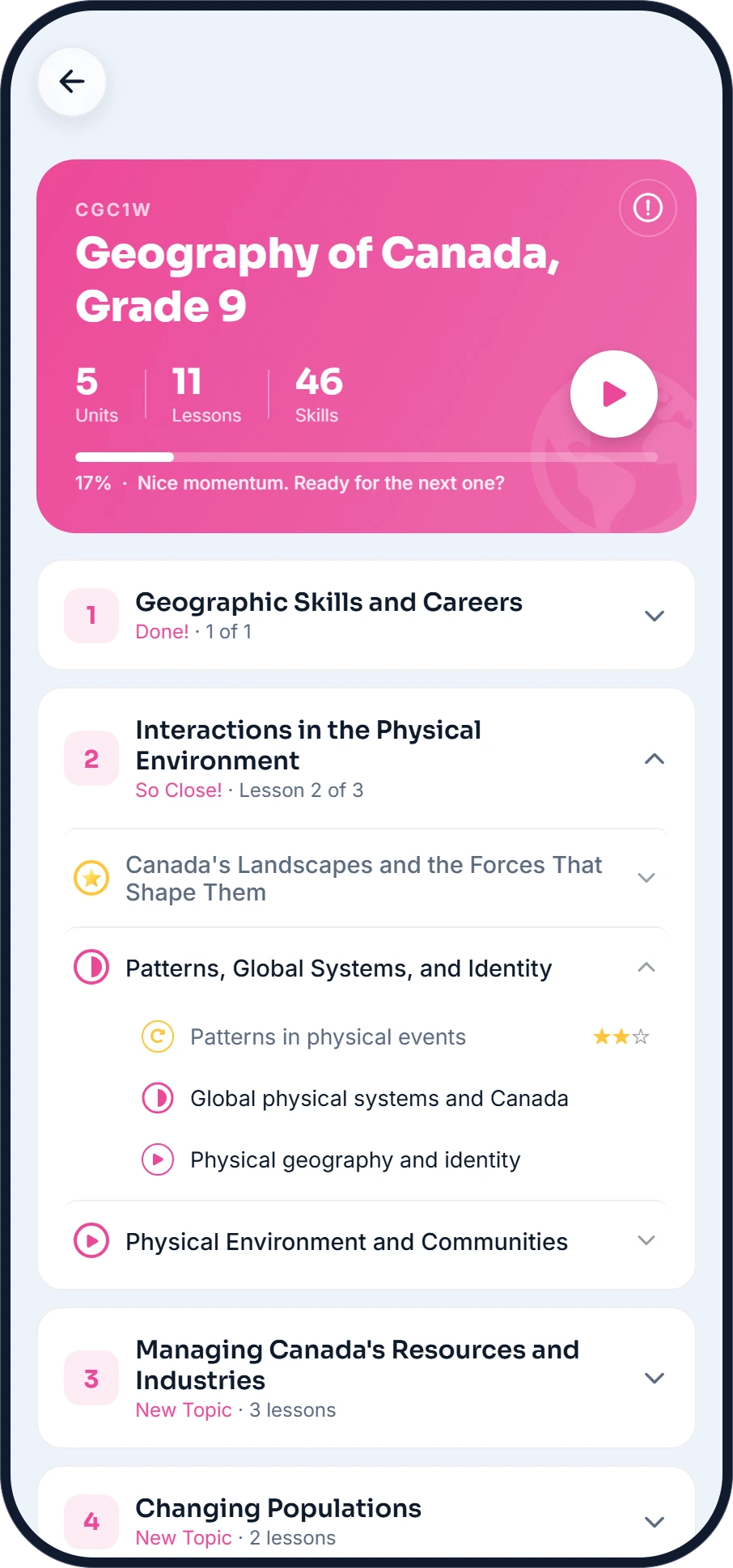
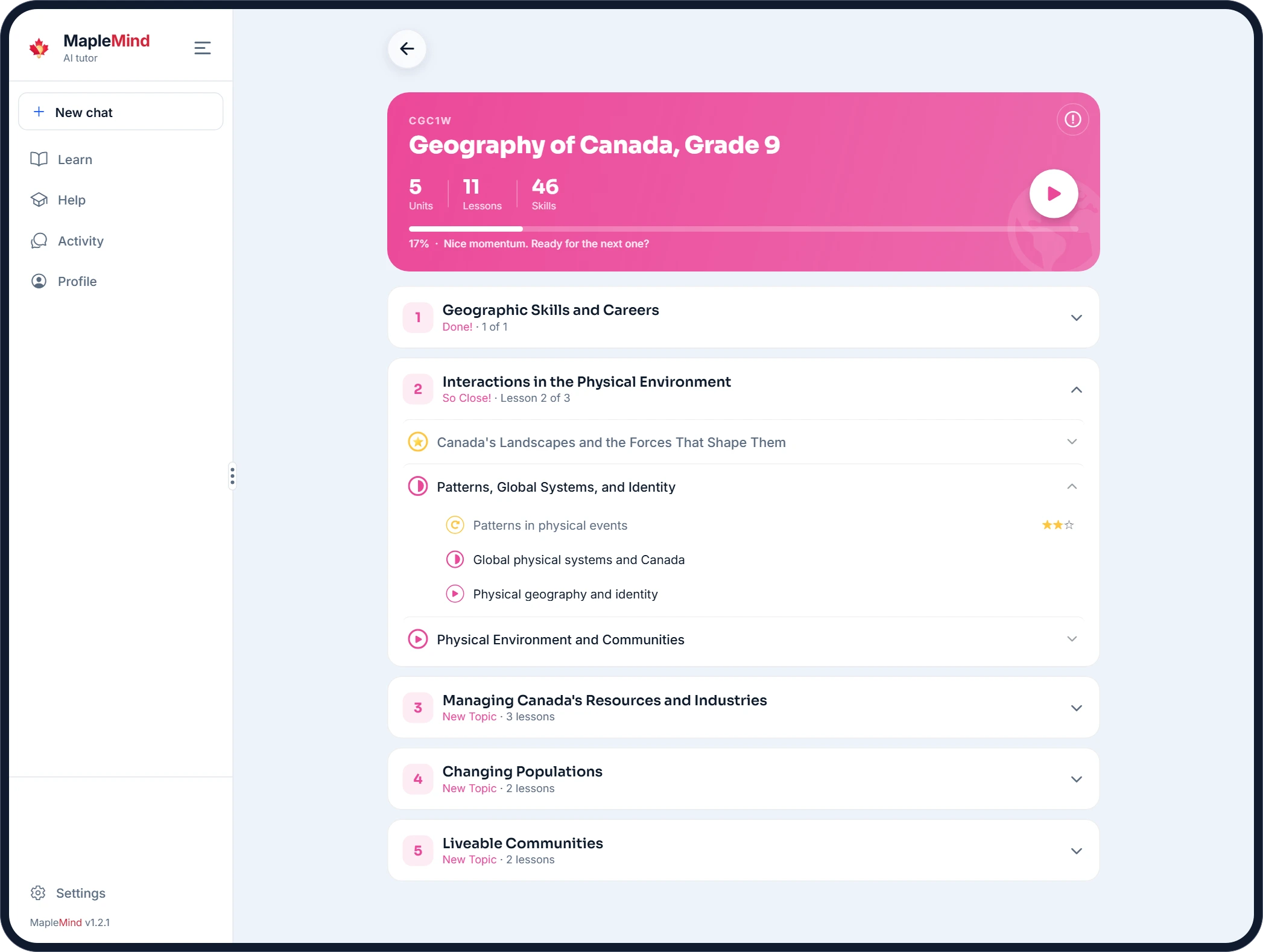
Geography of Canada, Grade 9 in MapleMind on a tablet: its units and lessons in order, a student partway through.Geography of Canada, Grade 9 in MapleMind on a phone: its units and lessons in order, a student partway through.
Their course, unit by unit, the way Ontario teaches it.Shown: Geography of Canada, Grade 9
Homework Help on a tablet: a photo of a worksheet, the tutor’s worked example of a two-step equation, and a question back to the student.Homework Help on a phone: a photo of a worksheet, the tutor’s worked example of a two-step equation, and a question back to the student.
Homework Help: they take a photo of the question, and the tutor works through it with them.
The Parent Dashboard on a tablet: a student’s days studied, streak, lessons, quiz average and recent activity.The Parent Dashboard on a phone: a student’s days studied, streak, lessons, quiz average and recent activity.
The Parent Dashboard: how each child’s week went, in lessons, quizzes and days studied.
A Grade 9 provincial mathematics exam on a tablet: a readiness score, the exam’s time and its next sitting.A Grade 9 provincial mathematics exam on a phone: a readiness score, the exam’s time and its next sitting.
A provincial exam: a practice sitting under the real time, and how ready they are.
The Learn tab on a tablet: a four-day streak, the week’s days, Homework Help, the next lesson and a review.The Learn tab on a phone: a four-day streak, the week’s days, Homework Help, the next lesson and a review.
The Learn tab: their week so far, and the next thing to do.

Help at home

Questions parents ask

What will my child learn in Grade 7 in Ontario?

Math: Mathematics, Grade 7. Science: Science and Technology, Grade 7. English: English (Language), Grade 7. French: Core French, Grade 7. Social studies: History and Geography, Grade 7. That’s 234 skills in all, from Ontario’s curriculum.

Does my child write a provincial exam in Grade 7?

No. Ontario has no provincial exam in Grade 7.

Where does this list come from?

From Ontario’s official curriculum, the documents its education ministry publishes for each course. Each skill here is one of their expectations, written in plain words.

Can MapleMind help my child in Grade 7?

Yes. Every course on this page is in MapleMind, with lessons, practice and a tutor that works through each step with them. A free account gets 30 messages and 4 activities a day.

Help with Grade 7, one skill at a time.

Every course on this page is in MapleMind, free with daily limits.