Ontario · For parents

What your child learns in Grade 9 in Ontario

Every subject, unit by unit, from Ontario’s curriculum: 235 skills in plain words.

Subjects
5
Skills
235
Provincial exams
1
Official curriculum
dcp.edu.gov.on.ca

Math in Grade 9

Mathematics, Grade 9 (De-streamed)

MTH1W · 5 units · 51 skills

  1. Unit 1

    Number

    Number concepts (number systems, proportional reasoning, ratios like the golden ratio) were developed and used by many different cultures throughout history, often for practical purposes like trade or design.

    • Telling the story of a number concept across cultures
    • Describing how subsets of a number system are defined
    • Comparing similarities and differences between number subsets
    11 more skills
    • Using patterns to explain the density of a number set
    • Using patterns to explain infinity and limit
    • Analysing how the sign and size of an exponent affects the value of a power
    • Using the exponent relationship to write scientific notation and evaluate powers
    • Analysing the relationships between exponents and operations with powers
    • Using the exponent laws to simplify numeric and algebraic expressions
    • Applying integers to describe location, direction, amount, and change
    • Applying unit fractions and their relationship to other fractional amounts
    • Explaining the effects of positive and negative signs on ratios, rates, fractions, and decimals
    • Solving problems with operations on positive and negative fractions and mixed numbers
    • Posing and solving problems involving rates, percentages, and proportions
  2. Unit 2

    Algebra

    Algebraic concepts like variables, patterns, and generalizing relationships have been developed and used by many cultures — from ancient Egyptian symbols for unknowns to weaving patterns encoded in punch cards.

    • Telling the story of an algebraic concept across cultures
    • Creating algebraic expressions from words, numbers, and visuals
    • Comparing expressions using concrete, numerical, graphical, and algebraic methods
    12 more skills
    • Simplifying algebraic expressions using properties of operations
    • Creating and solving equations, and verifying solutions
    • Using coding to demonstrate variables, parameters, equations, and inequalities
    • Creating code by decomposing a situation into computational steps
    • Reading code to predict its outcome and altering it for new situations
    • Comparing the shapes of linear and non-linear graphs to describe rates of change
    • Representing linear relations with materials, tables, graphs, and equations
    • Comparing two lines y = ax + b and interpreting their point of intersection
    • Comparing characteristics of graphs, tables of values, and equations
    • Graphing relations of the forms x=k, y=k, x+y=k, x-y=k, ax+by=k, xy=k and their inequalities
    • Translating, reflecting, and rotating lines y = ax
    • Determining a line’s equation from rate of change and initial value
  3. Unit 3

    Data

    Large amounts of data are collected in contexts like social media, online shopping, census data, fitness apps, and scientific research.

    • Describing implications of collecting, storing, and using large amounts of data
    • Representing and analysing single-variable data with quartiles and box plots
    • Creating a scatter plot to represent a relationship between two variables
    6 more skills
    • Determining correlation and testing regression models to make predictions
    • Describing the value of mathematical modelling in real life
    • Identifying a question of interest and the information needed to answer it
    • Creating a plan to collect data, identifying assumptions and what varies
    • Displaying and analysing data to build a mathematical model
    • Reporting how a model answers the question, its limitations, and what it predicts
  4. Unit 4

    Geometry and Measurement

    Geometric concepts (like the side-length relationship in right triangles) and measurement systems (like using a 'hand' to measure horse height) were developed and used by many cultures, often long before they were formally credited.

    • Telling the story of a geometric concept or measurement system across cultures
    • Creating and analysing designs using circle properties
    • Creating and analysing designs using triangle and angle properties
    5 more skills
    • Solving problems converting units within and between measurement systems
    • Showing how changing dimensions affects perimeter, area, surface area, and volume
    • Solving right-triangle side-length problems in real life and composite shapes
    • Applying the volume relationship between prisms and pyramids
    • Applying the volume relationship between cylinders and cones
  5. Unit 5

    Financial Literacy

    Financial situations can be systemic, current, or historical events at a global, national, local, or individual level.

    • Explaining how a past or current financial situation informs decisions
    • Using graphs to answer questions about appreciation and depreciation
    • Comparing how interest rate and calculation method affect overall cost
    2 more skills
    • Comparing how borrowing time and down payment amount affect overall cost
    • Modifying a budget to reflect changed circumstances, with a rationale
Science in Grade 9

Science, Grade 9 (De-streamed)

SNC1W · 5 units · 48 skills

  1. Unit 1

    STEM Skills and Connections

    WHMIS (Workplace Hazardous Materials Information System) is Canada's national standard for classifying and communicating the hazards of materials used in labs and workplaces.

    • WHMIS and safe practices for hands-on investigations
    • Designing an experiment or prototype for a STEM occupation
    • How innovations and AI affect society and careers
    3 more skills
    • Science in its economic, cultural, and social context
    • Scientific literacy on social and environmental issues
    • Contributions to science from various communities
  2. Unit 2

    Biology: Sustainable Ecosystems and the Impact of Human Activities

    Climate change alters temperature, precipitation, and extreme-weather patterns, which stresses ecosystems.

    • Climate-change impacts on ecosystem sustainability
    • Initiatives for combatting climate change
    • Personal and community solutions to climate-change impacts
    9 more skills
    • Climate-change impacts on communities in Canada
    • Sustainable practices and dynamic equilibrium
    • Interactions of the biosphere, hydrosphere, lithosphere, and atmosphere
    • Cycling of matter and flow of energy
    • Cellular respiration and photosynthesis
    • Factors and processes in ecosystem sustainability
    • Human activities and dynamic equilibrium
    • Indicators of climate change
    • Sustainable practices in agriculture
  3. Unit 3

    Chemistry: Exploring Matter

    Making, using, and disposing of a product uses elements and compounds and has social, environmental, and economic impacts.

    • Impacts of consumer-product life cycles
    • Impacts of emerging chemical technologies
    • Properties of matter and ecosystem equilibrium
    6 more skills
    • Atomic models and experimental evidence
    • Subatomic particles and the Bohr-Rutherford model
    • Periodic-table position and atomic structure
    • Patterns in the periodic table
    • Properties of elements and compounds
    • Structure and chemical formulas of compounds
  4. Unit 4

    Physics: Electrical Energy and Its Transfer

    Electricity is produced from sources like hydro, nuclear, wind, solar, and fossil fuels.

    • Benefits and challenges of electricity sources
    • Electricity's community impacts and sustainability
    • A plan of action for an energy issue
    9 more skills
    • Impacts of emerging electrical technologies
    • Behaviour of electric charges
    • Conductivity of materials
    • DC-circuit components and SI units
    • Deriving Ohm's law
    • Applying Ohm's law
    • Series and parallel circuits
    • Electricity versus electrical energy
    • Device efficiency and energy transformations
  5. Unit 5

    Earth and Space Science: The Solar System and the Universe

    Space observation and exploration have social, environmental, and economic impacts.

    • Impacts of space observation and exploration
    • Space technology and understanding Earth
    • Space innovations applied on Earth
    6 more skills
    • The Sun and its importance
    • The Sun's energy and natural phenomena
    • Evidence for the origin of the universe
    • Components of the solar system and universe
    • Quantifying distances in space
    • Causes of astronomical phenomena

English in Grade 9

English, Grade 9 (De-streamed)

ENL1W · 4 units · 56 skills

  1. Unit 1

    Literacy Connections and Applications

    A digital identity is the impression other people build from everything you post, share, and react to online — and it can outlast the moment.

    • Online rights, responsibilities, and your digital identity
    • Navigating online safely and protecting your privacy
    • Researching with a guard against misinformation
    6 more skills
    • Analyzing and creating digital and media texts
    • How form, message, context, and audience connect
    • Using digital tools to solve real problems
    • Collaborating online safely and respectfully
    • Identity, self, and belonging in diverse texts
    • Themes in First Nations, Metis, and Inuit cultures
  2. Unit 2

    Foundations of Language

    Active listening skills — paraphrasing, open-ended questions, relevant responses — prove you understood and push a discussion forward.

    • Effective listening skills for real conversations
    • Listening strategies to analyze what you hear
    • Speaking for a purpose and audience
    8 more skills
    • Oral and non-verbal communication strategies
    • Precise word choice and cohesive sentences when speaking
    • Reading and spelling complex words with morphology
    • Understanding and using a wide vocabulary flexibly
    • Reading complex texts fluently
    • Building complex sentences
    • Grammar and the functions of parts of speech
    • Capitalization and punctuation for clear meaning
  3. Unit 3

    Comprehension: Understanding and Responding to Texts

    Comprehension of complex texts draws on many systems at once: vocabulary, grammar, cohesive ties, and prior knowledge.

    • Comprehending complex texts
    • Analyzing text forms and genres
    • Text patterns and features in expository texts
    19 more skills
    • How images and visual design create meaning
    • Elements of style in texts
    • Analyzing narrator point of view
    • Making meaning through Indigenous Storywork
    • Using prior knowledge to understand new texts
    • Setting a purpose and selecting suitable texts
    • Predicting, questioning, and refining understanding
    • Monitoring and fixing comprehension
    • Connecting and comparing ideas across texts
    • Summarizing and synthesizing complex texts
    • Reflecting on comprehension strategies
    • Analyzing senior-level literary devices
    • Making local and global inferences
    • Assessing credibility and drawing conclusions
    • Analyzing cultural elements in texts
    • Analyzing perspectives and bias
    • Responding to topics like diversity and inclusion in texts
    • Comparing influences on First Nations, Metis, and Inuit texts
    • Reflecting on critical-thinking skills
  4. Unit 4

    Composition: Expressing Ideas and Creating Texts

    Topic, purpose, and audience are the compass of any text — settle them first and every later choice gets easier.

    • Choosing topic, purpose, audience, and form
    • Generating and developing ideas on complex topics
    • Gathering, synthesizing, and citing sources
    11 more skills
    • Classifying and sequencing content
    • Evaluating planning strategies and tools
    • Drafting complex texts in various genres
    • Touch-typing and word-processing fluently
    • Establishing an identifiable voice
    • Handling points of view and bias in your writing
    • Revising drafts for clarity, focus, and coherence
    • Editing and proofreading for accuracy and style
    • Producing polished final texts
    • Publishing, presenting, and evaluating choices
    • Reflecting on the creative process

French in Grade 9

Core French, Grade 9, Academic

FSF1D · 4 units · 34 skills

  1. Unit 1

    Listening

    Strategies work in three phases: before (activate prior knowledge, preview words to listen for), during (make inferences, take notes), and after (use a graphic organizer to organize ideas).

    • Using listening strategies
    • Showing you understood
    • Interactive listening strategies
    4 more skills
    • Responding in interactions
    • Reflecting on my listening
    • Hearing about Africa and Asia
    • Conventions you hear
  2. Unit 2

    Speaking

    Strategies include clarifying your purpose, outlining main ideas and supporting details, and keeping a personal lexicon of useful expressions.

    • Using speaking strategies
    • Producing spoken messages
    • Speaking with fluency
    6 more skills
    • Applying language structures
    • Speaking-interaction strategies
    • Taking part in spoken exchanges
    • Reflecting on my speaking
    • Speaking about Africa and Asia
    • Conventions when you speak
  3. Unit 3

    Reading

    Before reading you skim and predict; during, you question, visualize, and make connections; after, you confirm and summarize.

    • Using reading strategies
    • Reading for meaning
    • Reading with fluency
    6 more skills
    • Developing vocabulary
    • Purpose of text forms
    • Features and style
    • Reflecting on my reading
    • Reading about Africa and Asia
    • Conventions in French texts
  4. Unit 4

    Writing

    Purpose is WHY you write (to inform, persuade, express, request) and audience is WHO reads it.

    • Identifying purpose and audience
    • Writing in different forms
    • Applying language conventions
    6 more skills
    • Pre-writing: gathering ideas
    • Drafting and revising
    • Producing finished work
    • Reflecting on my writing
    • Writing about Africa and Asia
    • Conventions in my writing

Social studies in Grade 9

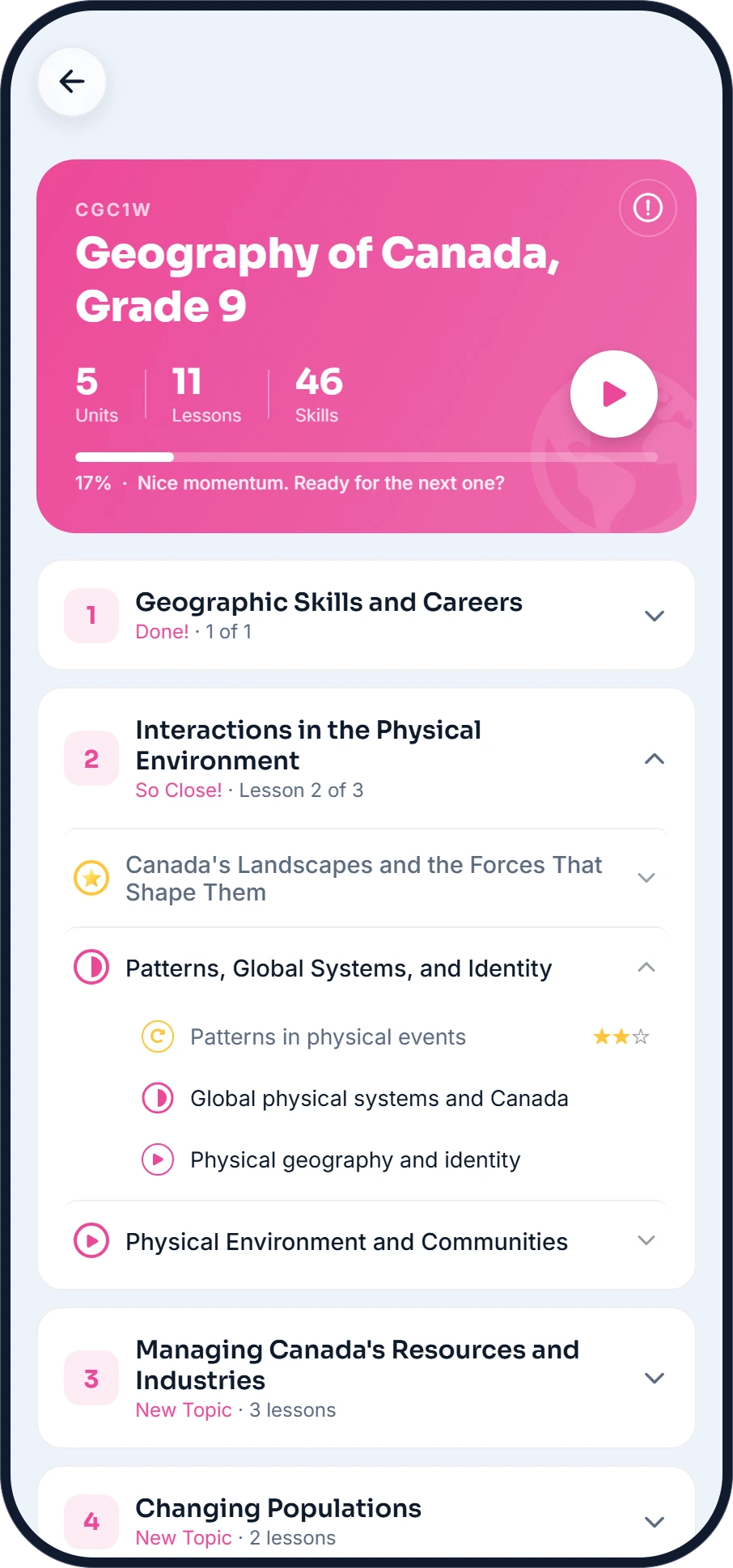
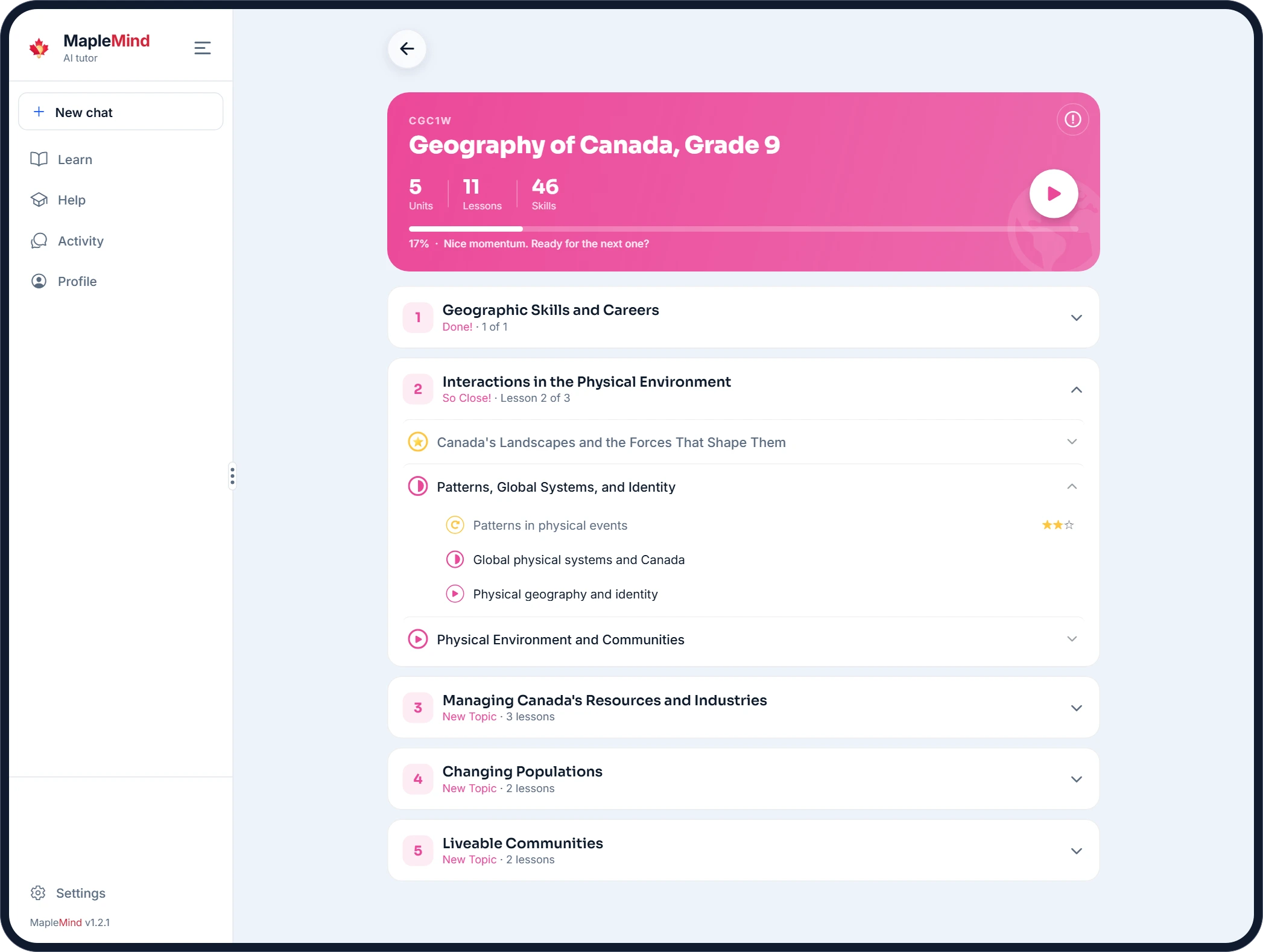
Geography of Canada, Grade 9

CGC1W · 5 units · 46 skills

  1. Unit 1

    Geographic Skills and Careers

    Geographic investigation builds transferable skills like research, mapping, and data analysis.

    • Skills geography builds
    • Discussing sensitive issues
    • Geography in the news
    1 more skill
    • Careers in geography
  2. Unit 2

    Interactions in the Physical Environment

    Canada has distinct landscapes and landforms — mountains, shields, plains, lowlands.

    • Canada's landscapes and landforms
    • Differentiating physical regions
    • Processes that shape the land
    8 more skills
    • Patterns in physical events
    • Global physical systems and Canada
    • Physical geography and identity
    • Land and human activity
    • Human impact on natural processes
    • Natural hazards and responses
    • Climate change consequences
    • How communities value the environment
  3. Unit 3

    Managing Canada's Resources and Industries

    Renewable resources replenish (forests, fish); non-renewable do not (oil, minerals).

    • Types of Canadian resources
    • Where resources are found
    • Extraction and clean energy
    10 more skills
    • Knowledge-based industries
    • What decides where industries locate
    • Industries and global connections
    • Careers in Canadian industries
    • Land tenure and reconciliation
    • Models of sustainable development
    • Sustainability issues
    • Strategies and their effectiveness
    • Who influences resource use
    • The life cycle of everyday products
  4. Unit 4

    Changing Populations

    Demographic characteristics include age, gender, ethnicity, and population growth.

    • Canada's demographic trends
    • Quality of life and well-being
    • Migration and immigration
    6 more skills
    • Settlement patterns and density
    • Comparing settlement worldwide
    • Effects of population change
    • Strategies for a changing population
    • Opportunities and challenges of growth
    • Global population issues and Canada
  5. Unit 5

    Liveable Communities

    Land uses include residential, commercial, industrial, agricultural, and recreational.

    • Types of land use
    • Environment's impact on land use
    • Forces that shape communities
    6 more skills
    • Urban growth and sprawl
    • Sustainable food systems
    • Sustainable transportation
    • Energy decisions and sustainability
    • Sustainable communities
    • Culturally informed community design

Provincial exams in Grade 9

MapleMind

See Grade 9 in MapleMind

Real screens from the app your child would use.

Geography of Canada, Grade 9 in MapleMind on a tablet: its units and lessons in order, a student partway through.Geography of Canada, Grade 9 in MapleMind on a phone: its units and lessons in order, a student partway through.
Their course, unit by unit, the way Ontario teaches it.Shown: Geography of Canada, Grade 9
Homework Help on a tablet: a photo of a worksheet, the tutor’s worked example of a two-step equation, and a question back to the student.Homework Help on a phone: a photo of a worksheet, the tutor’s worked example of a two-step equation, and a question back to the student.
Homework Help: they take a photo of the question, and the tutor works through it with them.
The Parent Dashboard on a tablet: a student’s days studied, streak, lessons, quiz average and recent activity.The Parent Dashboard on a phone: a student’s days studied, streak, lessons, quiz average and recent activity.
The Parent Dashboard: how each child’s week went, in lessons, quizzes and days studied.
A Grade 9 provincial mathematics exam on a tablet: a readiness score, the exam’s time and its next sitting.A Grade 9 provincial mathematics exam on a phone: a readiness score, the exam’s time and its next sitting.
A provincial exam: a practice sitting under the real time, and how ready they are.
The Learn tab on a tablet: a four-day streak, the week’s days, Homework Help, the next lesson and a review.The Learn tab on a phone: a four-day streak, the week’s days, Homework Help, the next lesson and a review.
The Learn tab: their week so far, and the next thing to do.

Help at home

Questions parents ask

What will my child learn in Grade 9 in Ontario?

Math: Mathematics, Grade 9 (De-streamed). Science: Science, Grade 9 (De-streamed). English: English, Grade 9 (De-streamed). French: Core French, Grade 9, Academic. Social studies: Geography of Canada, Grade 9. That’s 235 skills in all, from Ontario’s curriculum.

When is the EQAO Grade 9 Assessment of Mathematics?

It’s written January 12, 2027 to February 5, 2027, and June 8, 2027 to June 30, 2027.

Where does this list come from?

From Ontario’s official curriculum, the documents its education ministry publishes for each course. Each skill here is one of their expectations, written in plain words.

Can MapleMind help my child in Grade 9?

Yes. Every course on this page is in MapleMind, with lessons, practice and a tutor that works through each step with them. A free account gets 30 messages and 4 activities a day.

Help with Grade 9, one skill at a time.

Every course on this page is in MapleMind, free with daily limits.