Get help with English, Grade 9 (De-streamed)
Most tutoring makes you sit through material you already know. MapleMind flips that: pick the exact skill that's causing trouble — any of the 56 below — and the tutor teaches just that one, step by step, as many times as it takes. Ask questions in plain words, any time of day, in English, French, or 12 other languages.
The official Ontario English, Grade 9 (De-streamed) curriculum
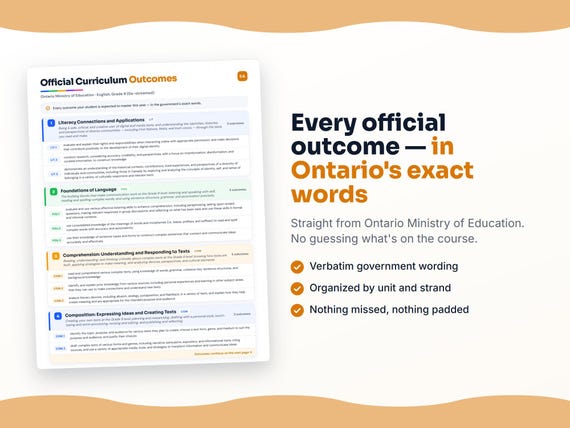
Ontario defines English, Grade 9 (De-streamed) by strands and outcomes. MapleMind teaches the same curriculum reorganized for one-skill-at-a-time tutoring — the table shows exactly where every official strand lands, and the ministry's own wording is quoted under each unit below.
Official source Ontario's official curriculumRead it on the government site — dcp.edu.gov.on.ca ↗| Official strand | Outcomes | Where MapleMind teaches it |
|---|---|---|
| Strand A | 9 | Literacy Connections and Applications |
| Strand B | 11 | Foundations of Language |
| Strand C | 22 | Comprehension: Understanding and Responding to Texts |
| Strand D | 14 | Composition: Expressing Ideas and Creating Texts |
Every skill below, taught one on one.
 Try the first session free
How MapleMind teaches English, Grade 9 (De-streamed) — every unit, lesson, and skill
Every skill below runs as a short session: a plain-words lesson, a worked example, solving it together, then a five-question skill check that earns up to three stars. Guided Mode keeps it teaching instead of answer-handing — turning it off needs a parent's password.
Unit 1Literacy Connections and ApplicationsOfficial strand · Strand A
Being a safe, critical, and creative user of digital and media texts, and understanding the identities, histories, and perspectives of diverse communities — including First Nations, Metis, and Inuit voices — through the texts you read and make.
Your Digital Self and Staying Safe Online
- Online rights, responsibilities, and your digital identityenl1w.A2.1 — Weigh your rights and responsibilities when you interact online, and make choices that build a positive digital identity for yourself and your communities.
Researching Well and Reading Media Critically
- Researching with a guard against misinformationenl1w.A2.3 — Conduct research while checking accuracy, credibility, and perspectives, watching for misinformation, disinformation, and curated information, and respecting legal and ethical rules.
- Analyzing and creating digital and media textsenl1w.A2.4 — Evaluate the forms, conventions, and techniques of digital and media texts and their impact on audiences, then apply that understanding when you analyze and create texts of your own.
- How form, message, context, and audience connectenl1w.A2.5 — Show how the form of a text, its message, its context, its intended and unintended audiences, and its purpose all shape one another.
- Using digital tools to solve real problemsenl1w.A2.6 — Select and use digital and media tools in a design process to tackle authentic, real-world problems by developing and proposing innovative solutions.
- Collaborating online safely and respectfullyenl1w.A2.7 — Communicate and collaborate with various communities online in a safe, respectful, responsible, and inclusive way, modelling cultural awareness with the people you work with.
Identity, Belonging, and First Nations, Metis, and Inuit Voices
- Identity, self, and belonging in diverse textsenl1w.A3.2 — Explore and analyze the concepts of identity, self, and sense of belonging by reading culturally responsive and relevant texts about the historical contexts, contributions, and lived experiences of diverse individuals and communities, including those in Canada.
- Themes in First Nations, Metis, and Inuit culturesenl1w.A3.3 — Analyze themes in First Nations, Metis, and Inuit cultures to understand the varied identities, perspectives, relationships, legacies, truths, and ways of knowing, being, and doing.
The official wording — 9 outcomes in this unit
- enl1w.A2.1
evaluate and explain their rights and responsibilities when interacting online with appropriate permission, and make decisions that contribute positively to the development of their digital identity
- enl1w.A2.2
demonstrate an understanding of how to navigate online environments safely, manage their privacy, personal data, and security, and interact in a way that supports their well-being
- enl1w.A2.3
conduct research, considering accuracy, credibility, and perspectives, with a focus on misinformation, disinformation, and curated information, to construct knowledge
- enl1w.A2.4
evaluate the use of the various forms, conventions, and techniques of digital and media texts, consider the impact on the audience, and apply this understanding when analyzing and creating texts
- enl1w.A2.5
demonstrate an understanding of the interrelationships between the form, message, and context of texts, the intended and unintended audience, and the purpose for production
- enl1w.A2.6
select and use appropriate digital and media tools to support the design process and address authentic, relevant, real-world problems by developing and proposing innovative solutions
- enl1w.A2.7
communicate and collaborate with various communities in a safe, respectful, responsible, and inclusive manner when using online platforms and environments, including digital and media tools, and demonstrate and model cultural awareness
- enl1w.A3.2
demonstrate an understanding of the historical contexts, contributions, lived experiences, and perspectives of a diversity of individuals and communities, including those in Canada, by exploring and analyzing the concepts of identity, self, and sense of belonging in a variety of culturally responsive and relevant texts
- enl1w.A3.3
analyze themes explored in First Nations, Métis, and Inuit cultures to demonstrate an understanding of the varied identities, perspectives, relationships, legacies, truths, and ways of knowing, being, and doing
Unit 2Foundations of LanguageOfficial strand · Strand B
The building blocks that make communication work at the Grade 9 level: listening and speaking with skill, reading and spelling complex words, and using sentence structure, grammar, and punctuation precisely.
Listening and Speaking with Skill
- Effective listening skills for real conversationsenl1w.B1.1 — Use effective listening skills — paraphrasing, asking open-ended questions, responding relevantly in group discussions, and reflecting on what was said — in formal and informal contexts for various purposes.
- Listening strategies to analyze what you hearenl1w.B1.2 — Select and use listening strategies before, during, and after listening to analyze and comprehend information communicated orally and non-verbally, seek clarification, and find relevant evidence to support a response.
- Speaking for a purpose and audienceenl1w.B1.3 — Analyze the purpose and audience for speaking in formal and informal contexts, and select and adapt speaking strategies to communicate clearly and coherently.
- Oral and non-verbal communication strategiesenl1w.B1.4 — Identify and use oral and non-verbal communication strategies — expression, gestures, body language — and evaluate and compare how effective they are, including how their use varies across cultures.
- Precise word choice and cohesive sentences when speakingenl1w.B1.5 — Use precise, descriptive word choice — including domain-specific vocabulary from various subjects — and cohesive, coherent sentences during formal and informal communication to support audience comprehension.
Reading and Spelling Complex Words
- Reading and spelling complex words with morphologyenl1w.B2.1 — Use consolidated knowledge of the meanings of words and morphemes — bases, prefixes, and suffixes — to read and spell complex words with accuracy and automaticity.
- Understanding and using a wide vocabulary flexiblyenl1w.B2.2 — Demonstrate understanding of a wide variety of words, acquire and use explicitly taught vocabulary flexibly across contexts including other subjects, and use morphological knowledge to analyze new words in context.
- Reading complex texts fluentlyenl1w.B2.3 — Read a variety of complex texts fluently — with accuracy and appropriate pacing to support comprehension — and adjust expression and intonation when reading aloud according to purpose.
Sentence Structure, Grammar, and Punctuation
- Building complex sentencesenl1w.B3.1 — Use knowledge of sentence types and forms to construct complex sentences that connect and communicate ideas accurately and effectively.
- Grammar and the functions of parts of speechenl1w.B3.2 — Demonstrate understanding of how parts of speech function in sentences, consolidate and refine grammar knowledge, and use it to support comprehension and communicate meaning clearly and precisely.
- Capitalization and punctuation for clear meaningenl1w.B3.3 — Use and refine understanding of the meaning and function of capitalization and punctuation to communicate meaning clearly and coherently, when reading and writing.
The official wording — 11 outcomes in this unit
- enl1w.B1.1
evaluate and use various effective listening skills to enhance comprehension, including paraphrasing, asking open-ended questions, making relevant responses in group discussions, and reflecting on what has been said, and use these skills in formal and informal contexts
- enl1w.B1.2
select and use a variety of listening strategies before, during, and after listening to analyze and comprehend information communicated orally and non-verbally, seek clarification, and identify relevant evidence to support a response
- enl1w.B1.3
analyze the purpose and audience for speaking in formal and informal contexts, and select and adapt speaking strategies to communicate clearly and coherently
- enl1w.B1.4
identify and use oral and non-verbal communication strategies, including expression, gestures, and body language, and evaluate and compare the effectiveness of these strategies in supporting understanding or communication, including how their use may vary across cultures
- enl1w.B1.5
use precise and descriptive word choice, including domain-specific vocabulary from various subjects, and cohesive and coherent sentences during formal and informal communication, to support audience comprehension
- enl1w.B2.1
use consolidated knowledge of the meanings of words and morphemes (i.e., bases, prefixes, and suffixes) to read and spell complex words with accuracy and automaticity
- enl1w.B2.2
demonstrate an understanding of a wide variety of words, acquire and use explicitly taught vocabulary flexibly in various contexts, including other subject areas, and use consolidated morphological knowledge to analyze and understand new words in context
- enl1w.B2.3
read a variety of complex texts fluently, with accuracy and appropriate pacing to support comprehension, and when reading aloud, adjust expression and intonation according to the purpose of reading
- enl1w.B3.1
use their knowledge of sentence types and forms to construct complex sentences that connect and communicate ideas accurately and effectively
- enl1w.B3.2
demonstrate an understanding of the functions of parts of speech in sentences, consolidate and refine their understanding of grammar, and use this knowledge to support comprehension and communicate meaning clearly and precisely
- enl1w.B3.3
use and refine their understanding of the meaning and function of capitalization and punctuation to communicate meaning clearly and coherently, when reading and writing
Unit 3Comprehension: Understanding and Responding to TextsOfficial strand · Strand C
Reading, understanding, and thinking critically about complex texts at the Grade 9 level: knowing how texts are built, applying strategies to make meaning, and analyzing devices, perspectives, and cultural elements.
How Complex Texts Are Built
- Comprehending complex textsenl1w.C1.1 — Read and comprehend various complex texts, using knowledge of words, grammar, cohesive ties, sentence structures, and background knowledge.
- Analyzing text forms and genresenl1w.C1.2 — Analyze and compare the characteristics of various text forms and genres, including cultural text forms, and give evidence for how they help communicate meaning.
- Text patterns and features in expository textsenl1w.C1.3 — Compare text patterns — such as compare-and-contrast in an expository essay — and text features — such as footnotes and copyright information — across text forms, and evaluate their importance in helping readers understand meaning.
- How images and visual design create meaningenl1w.C1.4 — Evaluate how images, graphics, and visual design create, communicate, and contribute to meaning in a variety of texts.
- Elements of style in textsenl1w.C1.5 — Identify elements of style in texts — including voice, word choice, word patterns, and sentence structure — and analyze how each helps create meaning and suits the text form and genre.
- Analyzing narrator point of viewenl1w.C1.6 — Analyze the narrator's point of view — including limited, omniscient, or unreliable — in a variety of texts, explain how it is communicated, and suggest alternative points of view with reasons.
- Making meaning through Indigenous Storyworkenl1w.C1.7 — Read, listen to, and view a wide variety of text forms by diverse First Nations, Metis, and Inuit creators to make meaning through Indigenous Storywork about their histories, cultures, relationships, communities, nations, and lived experiences.
Strategies for Making Meaning
- Using prior knowledge to understand new textsenl1w.C2.1 — Identify and explain prior knowledge from various sources — including personal experiences and learning in other subjects — that you can use to make connections and understand new texts.
- Setting a purpose and selecting suitable textsenl1w.C2.2 — Identify a variety of purposes for engaging with texts, select texts from diverse creators suited to those purposes, and explain why the selections are appropriate.
- Predicting, questioning, and refining understandingenl1w.C2.3 — Make predictions using background knowledge and textual information, pose questions to confirm or refute predictions, and revise or refine your understanding as you go.
- Monitoring and fixing comprehensionenl1w.C2.4 — Select suitable strategies — such as rereading, using the glossary, asking questions, and consulting references — to monitor and confirm understanding of complex texts and solve comprehension problems.
- Connecting and comparing ideas across textsenl1w.C2.5 — Connect, compare, and contrast the ideas expressed in texts with your own knowledge and lived experiences, the ideas in other texts, and the world around you.
- Summarizing and synthesizing complex textsenl1w.C2.6 — Summarize and synthesize the important ideas and supporting details in complex texts, and draw effective conclusions.
- Reflecting on comprehension strategiesenl1w.C2.7 — Explain and compare how various strategies — such as visualizing, predicting, summarizing, and connecting — have helped you comprehend texts, and set goals for future improvement.
Thinking Critically About Texts
- Analyzing senior-level literary devicesenl1w.C3.1 — Analyze literary devices — including allusion, analogy, juxtaposition, and flashback — in a variety of texts, and explain how they create meaning and suit the intended purpose and audience.
- Making local and global inferencesenl1w.C3.2 — Make local and global inferences, using explicit and implicit evidence, to explain and support your interpretations of various complex texts.
- Assessing credibility and drawing conclusionsenl1w.C3.3 — Analyze complex texts — including literary and informational texts — by assessing the credibility, reliability, and significance of information and formulating conclusions.
- Analyzing cultural elements in textsenl1w.C3.4 — Analyze cultural elements represented in texts — including norms, values, social hierarchy, pastimes, language, and taboos — by investigating their meanings, connecting them to your own experience and culture, and considering how they contribute to the text's meaning.
- Analyzing perspectives and biasenl1w.C3.5 — Analyze the explicit and implicit perspectives communicated in texts, evaluate any evidence that could show bias in those perspectives, and suggest ways to avoid such bias.
- Responding to topics like diversity and inclusion in textsenl1w.C3.6 — Explain how topics such as diversity, inclusion, and accessibility are addressed in texts, respond to the insights and messages conveyed, and consider the different positions presented.
- Comparing influences on First Nations, Metis, and Inuit textsenl1w.C3.7 — Compare how historical periods, cultural experiences, and socio-political conditions and events have influenced two or more texts created by First Nations, Metis, and Inuit individuals, communities, groups, or nations, and how they relate to current lived experiences.
- Reflecting on critical-thinking skillsenl1w.C3.8 — Assess the effectiveness of the critical-thinking skills you used when analyzing and evaluating texts, and set goals to improve their use.
The official wording — 22 outcomes in this unit
- enl1w.C1.1
read and comprehend various complex texts, using knowledge of words, grammar, cohesive ties, sentence structures, and background knowledge
- enl1w.C1.2
analyze and compare the characteristics of various text forms and genres, including cultural text forms, and provide evidence to explain how they help communicate meaning
- enl1w.C1.3
compare the text patterns, such as compare and contrast in an expository essay, and text features, such as footnotes and copyright information, associated with different text forms, including cultural texts, and evaluate their importance in helping readers, listeners, and viewers understand the meaning
- enl1w.C1.4
evaluate how images, graphics, and visual design create, communicate, and contribute to meaning in a variety of texts
- enl1w.C1.5
identify various elements of style in texts, including voice, word choice, word patterns, and sentence structure, and analyze how each element helps create meaning and is appropriate for the text form and genre
- enl1w.C1.6
analyze the narrator’s point of view, including limited, omniscient, or unreliable, in a variety of texts, explain how it is communicated, and suggest alternative points of view, giving reasons
- enl1w.C1.7
read, listen to, and view a wide variety of text forms by diverse First Nations, Métis, and Inuit creators to make meaning through Indigenous Storywork about First Nations, Métis, and Inuit histories, cultures, relationships, communities, groups, nations, and lived experiences
- enl1w.C2.1
identify and explain prior knowledge from various sources, including personal experiences and learning in other subject areas, that they can use to make connections and understand new texts
- enl1w.C2.2
identify a variety of purposes for engaging with texts, select texts from diverse creators that are suitable for the purposes, and explain why the selections are appropriate
- enl1w.C2.3
make predictions using background knowledge and textual information, pose questions to confirm or refute their predictions, and revise or refine their understanding as indicated
- enl1w.C2.4
select suitable strategies, such as rereading, using the glossary, asking questions, and consulting references and other resources, to monitor and confirm their understanding of complex texts and solve comprehension problems
- enl1w.C2.5
connect, compare, and contrast the ideas expressed in texts and their knowledges and lived experiences, the ideas in other texts, and the world around them
- enl1w.C2.6
summarize and synthesize the important ideas and supporting details in complex texts, and draw effective conclusions
- enl1w.C2.7
explain and compare how various strategies, such as visualizing, making predictions, summarizing, and connecting to their experiences, have helped them comprehend various texts, and set goals for future improvement
- enl1w.C3.1
analyze literary devices, including allusion, analogy, juxtaposition, and flashback, in a variety of texts, and explain how they help create meaning and are appropriate for the intended purpose and audience
- enl1w.C3.2
make local and global inferences, using explicit and implicit evidence, to explain and support their interpretations about various complex texts
- enl1w.C3.3
analyze complex texts, including literary and informational texts, by assessing the credibility, reliability, and significance of information and formulating conclusions
- enl1w.C3.4
analyze cultural elements that are represented in various texts, including, norms, values, social hierarchy, past times, language, and taboos, by investigating the meanings of these elements, making connections to their lived experience and culture, and considering how the inclusion of these elements contributes to the meaning of the text
- enl1w.C3.5
analyze explicit and implicit perspectives communicated in various texts, evaluate any evidence that could show bias in these perspectives, and suggest ways to avoid any such bias
- enl1w.C3.6
explain how various topics, such as diversity, inclusion, and accessibility, are addressed in texts, respond to the insights and messages conveyed, and different positions presented
- enl1w.C3.7
compare the ways in which historical periods, cultural experiences, and/or socio-political conditions and events have influenced two or more texts created by First Nations, Métis, and Inuit individuals, communities, groups, or nations, and how they relate to current lived experiences
- enl1w.C3.8
assess the effectiveness of the critical thinking skills they used when analyzing and evaluating various texts, and set goals to improve their use
Unit 4Composition: Expressing Ideas and Creating TextsOfficial strand · Strand D
Creating your own texts at the Grade 9 level: planning and researching, drafting with a personal style, touch-typing and word-processing, revising and editing, and publishing and reflecting.
Planning and Researching Your Texts
- Choosing topic, purpose, audience, and formenl1w.D1.1 — Identify the topic, purpose, and audience for texts you plan to create; choose a text form, genre, and medium to suit the purpose and audience; and justify your choices.
- Generating and developing ideas on complex topicsenl1w.D1.2 — Generate and develop ideas and details about complex topics — such as diversity, equity, and inclusion, and topics from other subjects — using a variety of strategies and drawing on resources including your own lived experiences.
- Gathering, synthesizing, and citing sourcesenl1w.D1.3 — Gather and synthesize information relevant to a topic using a variety of textual sources; evaluate the currency, quality, bias, and accuracy of information; verify source reliability; and check copyright and cite sources for content created by others.
- Classifying and sequencing contentenl1w.D1.4 — Classify and sequence ideas and collected information, selecting effective strategies and tools, and identify and organize relevant content while evaluating your choices of form, genre, and medium and considering alternatives.
- Evaluating planning strategies and toolsenl1w.D1.5 — Evaluate the strategies and tools you used to develop ideas and organize content, explain which were most helpful, and suggest steps for future improvement as a text creator.
Drafting, Voice, and Touch-Typing
- Drafting complex texts in various genresenl1w.D2.1 — Draft complex texts in various forms and genres — including narrative, persuasive, expository, and informational texts — citing sources, and use appropriate media, tools, and strategies to transform information and communicate ideas.
- Touch-typing and word-processing fluentlyenl1w.D2.2 — Write fluently with a personal style, touch type quickly and accurately, and select and use appropriate word-processing programs and tools to produce texts of various lengths and complexity.
- Establishing an identifiable voiceenl1w.D2.3 — Establish an identifiable voice in your texts, modifying language, style, and tone to suit the text's form, genre, audience, and purpose, and express your thoughts, feelings, and opinions clearly.
- Handling points of view and bias in your writingenl1w.D2.4 — Explain the explicit and implicit points of view, perspectives, and bias conveyed in your texts, evaluate how various audiences might respond, and suggest ways to acknowledge other perspectives.
- Revising drafts for clarity, focus, and coherenceenl1w.D2.5 — Revise the content, elements of style, patterns, and features of draft texts, adding, deleting, revising, and reorganizing sentences to improve clarity, focus, and coherence, using various strategies and selectively using feedback.
- Editing and proofreading for accuracy and styleenl1w.D2.6 — Edit draft texts to improve accuracy and style, checking for errors in spelling, punctuation, grammar, and format, and edit digital texts using word-processing software including spell- and grammar-checkers.
Publishing, Presenting, and Reflecting
- Producing polished final textsenl1w.D3.1 — Produce final texts using appropriate techniques and tools, including digital design and production tools, to achieve the intended effect.
- Publishing, presenting, and evaluating choicesenl1w.D3.2 — Publish and present texts you have created using various media and tools, and evaluate how your choices helped you communicate your intended message.
- Reflecting on the creative processenl1w.D3.3 — Evaluate the strategies and tools you found helpful when publishing and presenting texts, reflect on what you learned at each stage of the creative process, analyze how your texts address various topics, and suggest steps for future improvement as a text creator.
The official wording — 14 outcomes in this unit
- enl1w.D1.1
identify the topic, purpose, and audience for various texts they plan to create; choose a text form, genre, and medium to suit the purpose and audience, and justify their choices
- enl1w.D1.2
generate and develop ideas and details about complex topics, such as topics related to diversity, equity, and inclusion and to other subject areas, using a variety of strategies, and drawing on various resources, including their own lived experiences
- enl1w.D1.3
gather and synthesize information and content relevant to a topic, using a variety of textual sources and appropriate strategies; evaluate the currency, quality, bias, and accuracy of information; verify the reliability of sources; and check copyright and cite the sources for all content created by others
- enl1w.D1.4
classify and sequence ideas and collected information, selecting effective strategies and tools, and identify and organize relevant content, evaluating the choices of text form, genre, and medium, and considering alternatives
- enl1w.D1.5
evaluate the strategies and tools used to develop ideas and organize content for texts of the chosen forms, genres, and media, explain which were most helpful, and suggest steps for future improvement as a text creator
- enl1w.D2.1
draft complex texts of various forms and genres, including narrative, persuasive, expository, and informational texts, citing sources, and use a variety of appropriate media, tools, and strategies to transform information and communicate ideas
- enl1w.D2.2
write fluently, with a personal style, touch type quickly and accurately, and select and use appropriate word-processing programs and tools to produce texts of various lengths and complexity
- enl1w.D2.3
establish an identifiable voice in their texts, modifying language, style, and tone to suit the text’s form, genre, audience, and purpose, and express their thoughts, feelings, and opinions about the topic clearly
- enl1w.D2.4
explain the explicit and implicit points of view, perspectives, and bias conveyed in their texts, evaluate how various audiences might respond, and suggest ways to acknowledge other perspectives
- enl1w.D2.5
make revisions to the content, elements of style, patterns, and features of draft texts, and add, delete, revise, and reorganize sentences to improve clarity, focus, and coherence, using various strategies and seeking and selectively using feedback
- enl1w.D2.6
edit draft texts to improve accuracy and style, checking for errors in spelling, punctuation, grammar, and format; edit digital texts using word-processing software, including spell- and grammar-checkers
- enl1w.D3.1
produce final texts using appropriate techniques and tools, including digital design and production tools, to achieve the intended effect
- enl1w.D3.2
publish and present texts they have created, using various media and tools, and evaluate how their choices helped them communicate their intended message
- enl1w.D3.3
evaluate the strategies and tools they found helpful when publishing and presenting texts, reflect on what they learned at each stage of the creative process, analyze how their texts address various topics, and suggest steps for future improvement as a text creator
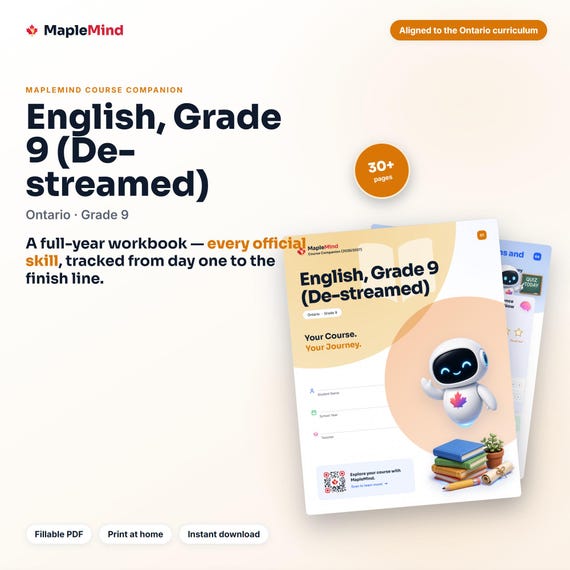
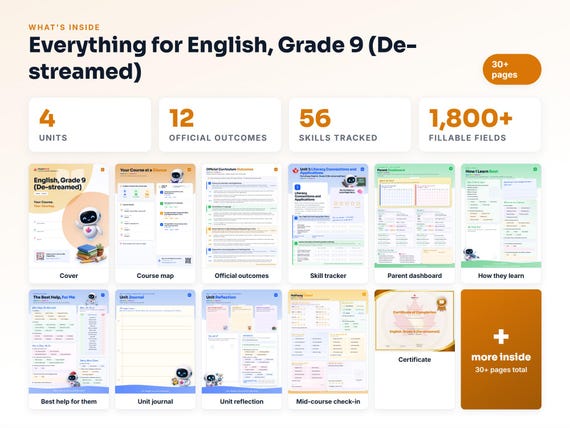
Printable workbook · A keepsake of the year
A English, Grade 9 (De-streamed) workbook worth keeping
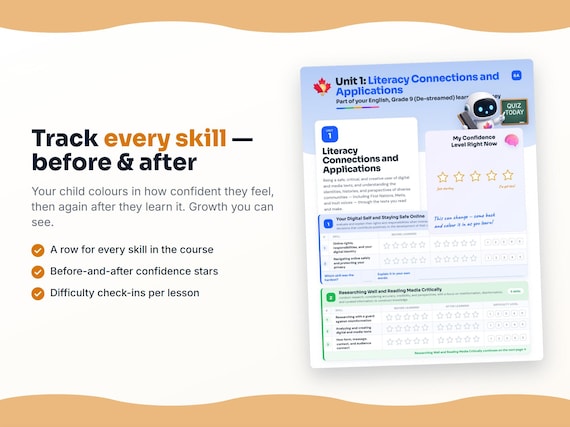
Built from the same official curriculum as this page. Before and after each skill above, your student colours in how sure they feel — so the two of you can see, on one page, what's clicking and what needs another look. It's a quiet way to follow how the year is really going.
By June it's full of their own handwriting: units worked through, confidence grown, a mid-year check-in, notes from parent-teacher night, and a certificate at the end. Less a worksheet, more a record of the year worth keeping on the shelf.
Instant download · see every page, reviews and the full description · five or more workbooks are $2.99 each
What it looks like in the app



Common questions
Can MapleMind help me with English, Grade 9 (De-streamed)?
Yes. MapleMind's AI tutor covers all 56 skills in Ontario's English, Grade 9 (De-streamed) — you pick the exact skill, and the tutor teaches it step by step: a short lesson, a worked example, solving together, then a skill check to show it stuck.
Is MapleMind aligned to Ontario's official curriculum?
Yes. Every skill in this course maps to an official outcome code from Ontario's Grade 9 English Language Arts curriculum, and the ministry's own wording is quoted under each unit on this page — with the official government source linked so you can check it yourself.
What does MapleMind cost?
It's free to start — 5 tutoring chats and a practice quiz every day, no credit card. A Pro subscription ($9.99/month or $49.99/year CAD, 7-day free trial) unlocks unlimited tutoring, practice, and exam simulations.
What if I'm stuck on just one topic?
That's the point of skill-level tutoring: open English, Grade 9 (De-streamed) in the app, tap the exact skill from the list on this page, and the tutor teaches just that — no wading through lessons you don't need.
Does MapleMind work in French or other languages?
Yes — 14 languages, including French. Both the app and the tutor's explanations switch to the language you choose.
Where can I see the official Ontario curriculum for English, Grade 9 (De-streamed)?
The official source is linked on this page — Ontario's official curriculum. The outline here follows it: every MapleMind skill carries its official outcome code, and the ministry's own wording is quoted under each unit.
Keep exploring
Ready when you are
Pick a skill from this page and see it taught properly — free, in the browser, in under a minute.