Get help with Geography of Canada, Grade 9
Most tutoring makes you sit through material you already know. MapleMind flips that: pick the exact skill that's causing trouble — any of the 46 below — and the tutor teaches just that one, step by step, as many times as it takes. Ask questions in plain words, any time of day, in English, French, or 12 other languages.
The official Ontario Geography of Canada, Grade 9 curriculum
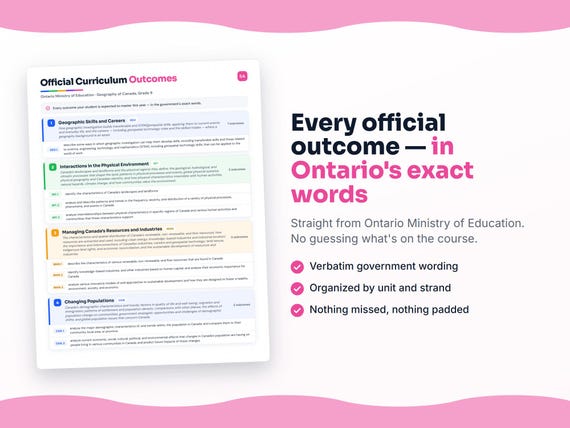
Ontario defines Geography of Canada, Grade 9 by strands and outcomes. MapleMind teaches the same curriculum reorganized for one-skill-at-a-time tutoring — the table shows exactly where every official strand lands, and the ministry's own wording is quoted under each unit below.
Official source Ontario's official curriculumRead it on the government site — dcp.edu.gov.on.ca ↗| Official strand | Outcomes | Where MapleMind teaches it |
|---|---|---|
| Strand A | 4 | Geographic Skills and Careers |
| Strand B | 10 | Interactions in the Physical Environment |
| Strand C | 13 | Managing Canada's Resources and Industries |
| Strand D | 9 | Changing Populations |
| Strand E | 9 | Liveable Communities |
Every skill below, taught one on one.
 Try the first session free
How MapleMind teaches Geography of Canada, Grade 9 — every unit, lesson, and skill
Every skill below runs as a short session: a plain-words lesson, a worked example, solving it together, then a five-question skill check that earns up to three stars. Guided Mode keeps it teaching instead of answer-handing — turning it off needs a parent's password.
Unit 1Geographic Skills and CareersOfficial strand · Strand A
How geographic investigation builds transferable and STEM/geospatial skills, applying them to current events and everyday life, and the careers — including geospatial technology roles and the skilled trades — where a geography background is an asset.
Skills and Careers in Geography
- Skills geography buildscgc1w.A2.1 — Describe ways geographic investigation helps develop transferable and STEM skills, including geospatial technology skills, that apply to work and everyday life.
- Discussing sensitive issuescgc1w.A2.2 — Apply communication skills that show consideration for diverse perspectives when discussing complex or sensitive geographic issues.
- Geography in the newscgc1w.A2.3 — Apply the concepts of geographic thinking when analysing current events involving geographic issues in Canada, to be an informed citizen.
- Careers in geographycgc1w.A2.4 — Identify careers, including geospatial technology careers and the skilled trades, in which a geography background is an asset.
The official wording — 4 outcomes in this unit
- cgc1w.A2.1
describe some ways in which geographic investigation can help them develop skills, including transferable skills and those related to science, engineering, technology, and mathematics (STEM), including geospatial technology skills, that can be applied to the world of work
- cgc1w.A2.2
apply communication skills, showing consideration for diverse perspectives and experiences, when engaging in discussion of complex geographic issues and sensitive topics
- cgc1w.A2.3
apply the concepts of geographic thinking when analyzing current events involving geographic issues within Canada in order to enhance their understanding of these issues and their role as informed citizens
- cgc1w.A2.4
identify some careers in which a geography background and related skills might be an asset, including in geospatial technology-related careers and within the skilled trades
Unit 2Interactions in the Physical EnvironmentOfficial strand · Strand B
Canada's landscapes and landforms and the physical regions they define; the geological, hydrological, and climatic processes that shape the land; patterns in physical processes and events; global physical systems; physical geography and Canadian identity; and how physical characteristics interrelate with human activities, natural hazards, climate change, and how communities value the environment.
Canada's Landscapes and the Forces That Shape Them
- Canada's landscapes and landformscgc1w.B1.1 — Identify the characteristics of Canada's landscapes and landforms.
- Differentiating physical regionscgc1w.B1.1 — Explain how landscape and landform characteristics can be used to differentiate Canada's physical regions.
- Processes that shape the landcgc1w.B1.2 — Analyse how geological, hydrological, and climatic processes formed and continue to shape Canada's landscape.
Patterns, Global Systems, and Identity
- Patterns in physical eventscgc1w.B1.3 — Analyse and describe patterns and trends in the frequency, severity, and distribution of physical processes and events in Canada.
- Global physical systems and Canadacgc1w.B1.4 — Analyse patterns and trends in global physical systems and assess their impact on physical events in Canada.
- Physical geography and identitycgc1w.B1.5 — Explain how features of Canada's physical geography contribute to Canadian identity, and analyse the significance of related symbols and images.
Physical Environment and Communities
- Land and human activitycgc1w.B2.1 — Analyse interrelationships between physical characteristics of Canadian regions and the human activities and communities they support.
- Human impact on natural processescgc1w.B2.2 — Explain how human activities can alter physical processes and affect natural events in Canada, including the local region.
- Natural hazards and responsescgc1w.B2.3 — Analyse the risks that physical processes and natural events, including disasters, present to Canadian communities, and assess responses.
- Climate change consequencescgc1w.B2.4 — Analyse consequences for Canada of changes in Earth's physical processes, including climate change, and assess mitigation and adaptation strategies.
- How communities value the environmentcgc1w.B2.5 — Analyse how various communities value Canada's natural environment and how their practices and perspectives influence its use and protection.
The official wording — 10 outcomes in this unit
- cgc1w.B1.1
identify the characteristics of Canada’s landscapes and landforms
- cgc1w.B1.2
analyze how geological, hydrological, and climatic processes formed, and continue to shape, Canada’s landscape
- cgc1w.B1.3
analyze and describe patterns and trends in the frequency, severity, and distribution of a variety of physical processes, phenomena, and events in Canada
- cgc1w.B1.4
analyze patterns and trends related to various global physical systems, and assess their impact on physical processes, phenomena, and events in Canada
- cgc1w.B1.5
explain how various features of Canada’s unique physical geography, including landscapes and landforms, can contribute to Canadian identity, and analyze the significance of the related symbols and images used in Canada and internationally
- cgc1w.B2.1
analyze interrelationships between physical characteristics in specific regions of Canada and various human activities and communities that these characteristics support
- cgc1w.B2.2
explain how human activities can alter physical processes and affect natural events and phenomena in Canada, including in their local region
- cgc1w.B2.3
analyze the risks that various physical processes and natural events, including disasters, present to communities in Canada, and assess ways of responding to these risks
- cgc1w.B2.4
analyze environmental, economic, social, and/or political consequences for Canada of changes in some of the Earth’s physical processes, including the impact of climate change, and assess local and regional mitigation and adaptation strategies
- cgc1w.B2.5
analyze how various communities value Canada’s natural environment, and how their practices and perspectives influence the use and protection of Canada’s natural environment
Unit 3Managing Canada's Resources and IndustriesOfficial strand · Strand C
The characteristics and spatial distribution of Canada's renewable, non-renewable, and flow resources; how resources are extracted and used, including clean energy; knowledge-based industries and industrial location; the importance and interconnections of Canadian industries; careers and geospatial technology; land tenure, Indigenous land rights, and economic reconciliation; and the sustainable development of resources and industries.
Canada's Resources and Where They Are
- Types of Canadian resourcescgc1w.C1.1 — Describe the characteristics of Canada's renewable, non-renewable, and flow resources.
- Where resources are foundcgc1w.C1.2 — Explain how the spatial distribution of key natural resources, including water, relates to Canada's physical geography.
- Extraction and clean energycgc1w.C1.3 — Analyse interrelationships between resource location, mode of extraction, and use, including clean energy and responsible resource development.
Industries and the Canadian Economy
- Knowledge-based industriescgc1w.C1.4 — Identify knowledge-based and human-capital industries and analyse their economic importance for Canada.
- What decides where industries locatecgc1w.C1.5 — Analyse the interrelationship between the main factors that determine where different industries locate in Canada.
- Industries and global connectionscgc1w.C1.6 — Assess the importance of different industries in the Canadian economy and analyse interconnections between Canadian and foreign industries.
- Careers in Canadian industriescgc1w.C1.7 — Identify careers in Canadian industries, including the marine, natural resource, and tourism sectors, and explain how geospatial technologies are an asset.
- Land tenure and reconciliationcgc1w.C1.8 — Explain forms of land tenure and ownership in Canada, including Indigenous land claims and rights, and examine the interplay with resource use and economic reconciliation.
Sustainable Resource Development
- Models of sustainable developmentcgc1w.C2.1 — Analyse innovative models of and approaches to sustainable development that foster a healthy environment, society, and economy.
- Sustainability issuescgc1w.C2.2 — Analyse issues related to the sustainable development of Canadian resources and industries from a variety of perspectives.
- Strategies and their effectivenesscgc1w.C2.3 — Describe strategies industries and governments have implemented to increase resource sustainability, and evaluate their effectiveness.
- Who influences resource usecgc1w.C2.4 — Analyse the influence of governments, industries, advocacy groups, community organizations, and individuals on sustainable resource development.
- The life cycle of everyday productscgc1w.C2.5 — Analyse sustainability issues across the resource extraction, production, distribution, consumption, and disposal of everyday products.
The official wording — 13 outcomes in this unit
- cgc1w.C1.1
describe the characteristics of various renewable, non-renewable, and flow resources that are found in Canada
- cgc1w.C1.2
explain how the spatial distribution of key natural resources, including water, in Canada is related to the physical geography of the country
- cgc1w.C1.3
analyze interrelationships between the location/accessibility and the mode of extraction/harvesting and use of various natural resources in Canada, including methods for clean energy production such as nuclear, wind, and solar
- cgc1w.C1.4
identify knowledge-based industries, and other industries based on human capital, and analyze their economic importance for Canada
- cgc1w.C1.5
analyze the interrelationship between the main factors that determine the location of sites for different types of industries in Canada
- cgc1w.C1.6
assess the importance of different industries in the Canadian economy, and analyze interconnections between Canadian industries and those of other countries
- cgc1w.C1.7
identify some careers in Canadian industries, including the marine sector, the natural resource sector, and tourism, and explain how the use and application of geospatial technologies is an asset in these careers
- cgc1w.C1.8
explain forms of land tenure and ownership in Canada, including Indigenous land claims and land rights, and examine the interplay between resource accessibility, extraction, and use in this country; Indigenous land rights; and economic reconciliation
- cgc1w.C2.1
analyze various innovative models of and approaches to sustainable development and how they are designed to foster a healthy environment, society, and economy
- cgc1w.C2.2
analyze issues related to the sustainable development of various resources and industries in Canada from a variety of perspectives
- cgc1w.C2.3
describe strategies that industries and governments have implemented to increase the sustainability of Canada’s natural resources, and evaluate their effectiveness from a variety of perspectives
- cgc1w.C2.4
analyze the influence of governments, industries, advocacy groups, local community organizations, and individuals on the sustainable development and use of selected natural resources in Canada
- cgc1w.C2.5
analyze issues related to sustainability, with a focus on the resources extracted for, and the production, distribution, consumption, and disposal of, a few products that people living in Canada use in their everyday lives
Unit 4Changing PopulationsOfficial strand · Strand D
Canada's demographic characteristics and trends; factors in quality of life and well-being; migration and immigration; patterns of settlement and population density; comparisons with other places; the effects of population change on communities; government strategies; opportunities and challenges of demographic shifts; and global population issues that concern Canada.
Canada's People: Demographics, Migration, and Settlement
- Canada's demographic trendscgc1w.D1.1 — Analyse the major demographic characteristics and trends of Canada's population and compare them to their own community or other regions.
- Quality of life and well-beingcgc1w.D1.2 — Analyse interrelationships between factors that contribute to quality of life and human well-being in Canada, using data analysis.
- Migration and immigrationcgc1w.D1.3 — Analyse trends in the migration of people within Canada and in immigration to Canada.
- Settlement patterns and densitycgc1w.D1.4 — Describe patterns of population settlement in Canada and assess factors determining population size, distribution, and density.
- Comparing settlement worldwidecgc1w.D1.5 — Compare settlement and population characteristics of Canadian communities with those elsewhere in Canada and the world.
Population Change and Global Issues
- Effects of population changecgc1w.D2.1 — Analyse current effects of population change on communities in Canada and predict future impacts.
- Strategies for a changing populationcgc1w.D2.2 — Evaluate strategies used by governments and organizations to address the needs of Canada's changing population.
- Opportunities and challenges of growthcgc1w.D2.3 — Describe how population growth and demographic shifts create opportunities and challenges for individuals and groups in Canadian communities.
- Global population issues and Canadacgc1w.D2.4 — Identify global population issues of concern to Canada and analyse the roles and actions of Canadian individuals, organizations, and governments.
The official wording — 9 outcomes in this unit
- cgc1w.D1.1
analyze the major demographic characteristics of, and trends within, the population in Canada, and compare them to their community, local area, or province
- cgc1w.D1.2
analyze interrelationships between factors that contribute to quality of life and human well-being in Canada, using a variety of skills, including data analysis
- cgc1w.D1.3
analyze trends in the migration of people within Canada and in immigration to Canada
- cgc1w.D1.4
describe patterns of population settlement in Canada, and assess the importance of various factors in determining population size, distribution, and density
- cgc1w.D1.5
compare settlement and population characteristics of selected communities in Canada with those in other parts of the country and the world
- cgc1w.D2.1
analyze current economic, social, cultural, political, and environmental effects that changes in Canada’s population are having on people living in various communities in Canada, and predict future impacts of these changes
- cgc1w.D2.2
evaluate various strategies used by governments and organizations to address the needs of Canada’s changing population
- cgc1w.D2.3
describe ways in which population growth and demographic shifts within communities in Canada can create opportunities and challenges for individuals and groups within those communities
- cgc1w.D2.4
identify global population issues that are of concern to people living in Canada, and analyze the roles of individuals, organizations, and governments in Canada, and the actions they take, in addressing those issues
Unit 5Liveable CommunitiesOfficial strand · Strand E
Land use in Canadian communities and how it affects them; the impact of the natural environment and climate change on land use and planning; economic, social, cultural, and political forces on communities; urban growth and sprawl; and the sustainability of food systems, transportation, energy, communities, and culturally informed community planning.
Land Use and Land-Use Planning
- Types of land usecgc1w.E1.1 — Analyse the characteristics of different land uses in Canadian communities and explain how they and their distribution affect those communities.
- Environment's impact on land usecgc1w.E1.2 — Analyse the impact of the natural environment and physical events, including climate change, on land use and land-use planning.
- Forces that shape communitiescgc1w.E1.3 — Analyse how economic, social, cultural, and political forces affect Canadian communities, including their land use and planning.
- Urban growth and sprawlcgc1w.E1.4 — Assess the impacts of urban sprawl and other urban growth on the environment and analyse strategies to control sprawl.
Building Sustainable Communities
- Sustainable food systemscgc1w.E2.1 — Analyse issues related to the sustainability of Canada's food system and strategies for managing them.
- Sustainable transportationcgc1w.E2.2 — Analyse existing and proposed transportation systems for sustainability and assess options for their future development.
- Energy decisions and sustainabilitycgc1w.E2.3 — Analyse the effects of government policies and individual decisions on energy consumption and production, and assess the implications for community sustainability.
- Sustainable communitiescgc1w.E2.4 — Analyse issues related to the social, environmental, and economic sustainability of Canadian communities and the strategies developed to address them.
- Culturally informed community designcgc1w.E2.5 — Analyse innovative methods and culturally informed design used in planning communities in Canada and worldwide to enhance sustainability.
The official wording — 9 outcomes in this unit
- cgc1w.E1.1
analyze the characteristics of different land uses in various communities in Canada, and explain how these characteristics and their spatial distribution affect those communities
- cgc1w.E1.2
analyze the impact of the natural environment and physical processes, phenomena, and events, including climate change, on land use in the built environment as well as on land-use planning
- cgc1w.E1.3
analyze some ways in which economic, social, cultural, and political forces affect various communities in Canada, including their land use and land-use planning
- cgc1w.E1.4
assess the impacts of urban sprawl, compact urban growth, and other types of urban growth on the natural and built environment, and analyze various strategies used to control urban sprawl and/or mitigate its effects
- cgc1w.E2.1
analyze issues related to the sustainability of Canada’s food system and strategies for managing and/or mitigating these issues
- cgc1w.E2.2
analyze existing and proposed transportation systems, locally, provincially, nationally, and internationally, with a focus on their sustainability, and assess options for their future development
- cgc1w.E2.3
analyze the effects of government policies and corporate and individual decisions on energy consumption and production, and assess the implications of these policies/decisions for the sustainability of communities in Canada
- cgc1w.E2.4
analyze issues related to the social, environmental, and economic sustainability of communities in Canada and various government and community-based strategies developed to address them
- cgc1w.E2.5
analyze innovative methods and practices being applied in the planning of communities in Canada and around the world that use culturally informed design elements to enhance the sustainability of these communities
Printable workbook · A keepsake of the year
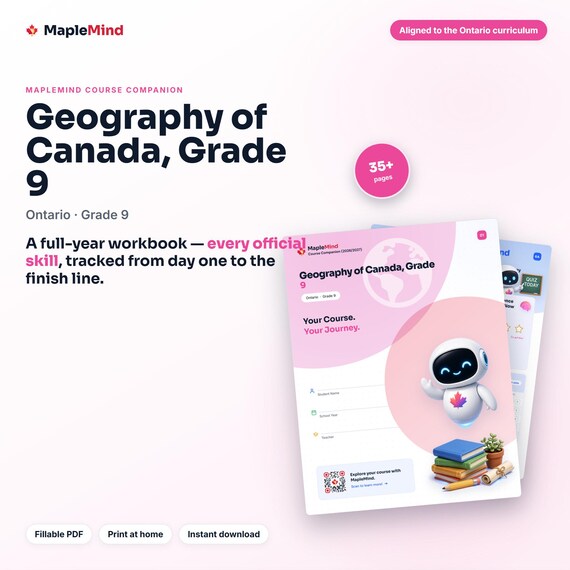
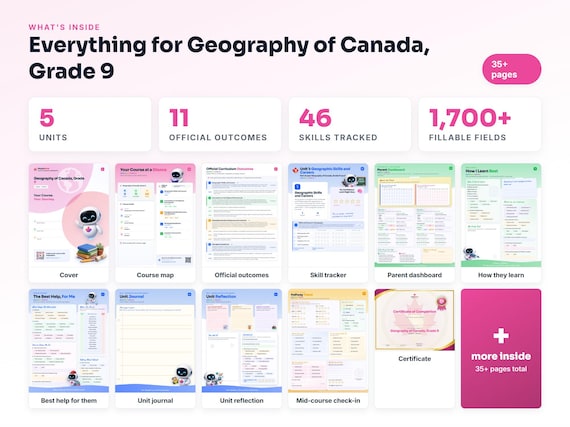
A Geography of Canada, Grade 9 workbook worth keeping
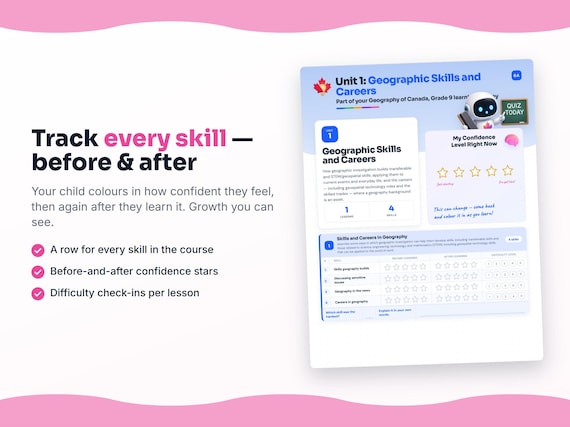
Built from the same official curriculum as this page. Before and after each skill above, your student colours in how sure they feel — so the two of you can see, on one page, what's clicking and what needs another look. It's a quiet way to follow how the year is really going.
By June it's full of their own handwriting: units worked through, confidence grown, a mid-year check-in, notes from parent-teacher night, and a certificate at the end. Less a worksheet, more a record of the year worth keeping on the shelf.
Instant download · see every page, reviews and the full description · five or more workbooks are $2.99 each
What it looks like in the app
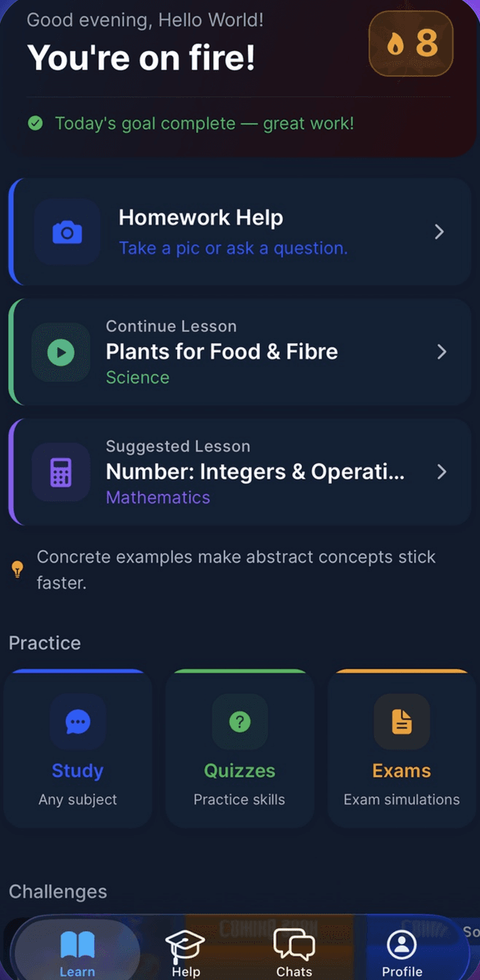

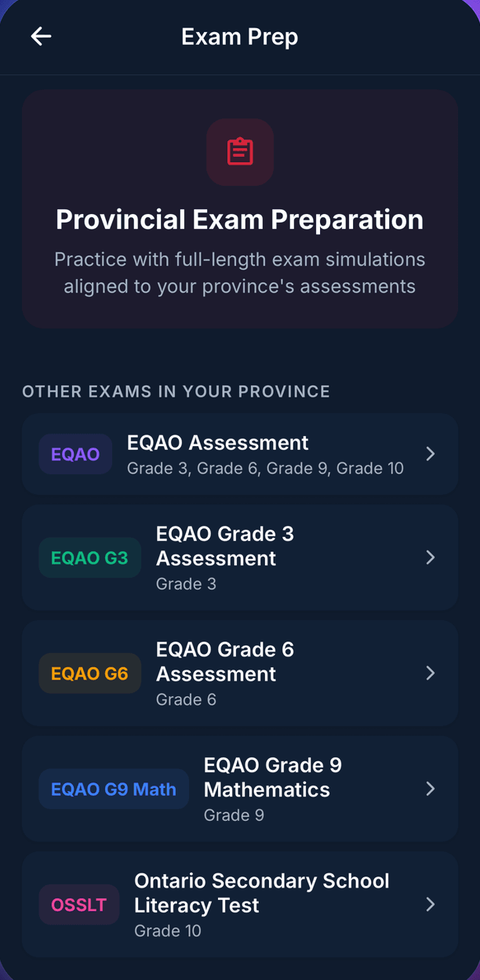
Common questions
Can MapleMind help me with Geography of Canada, Grade 9?
Yes. MapleMind's AI tutor covers all 46 skills in Ontario's Geography of Canada, Grade 9 — you pick the exact skill, and the tutor teaches it step by step: a short lesson, a worked example, solving together, then a skill check to show it stuck.
Is MapleMind aligned to Ontario's official curriculum?
Yes. Every skill in this course maps to an official outcome code from Ontario's Grade 9 Social Studies curriculum, and the ministry's own wording is quoted under each unit on this page — with the official government source linked so you can check it yourself.
What does MapleMind cost?
It's free to start — 5 tutoring chats and a practice quiz every day, no credit card. A Pro subscription ($9.99/month or $49.99/year CAD, 7-day free trial) unlocks unlimited tutoring, practice, and exam simulations.
What if I'm stuck on just one topic?
That's the point of skill-level tutoring: open Geography of Canada, Grade 9 in the app, tap the exact skill from the list on this page, and the tutor teaches just that — no wading through lessons you don't need.
Does MapleMind work in French or other languages?
Yes — 14 languages, including French. Both the app and the tutor's explanations switch to the language you choose.
Where can I see the official Ontario curriculum for Geography of Canada, Grade 9?
The official source is linked on this page — Ontario's official curriculum. The outline here follows it: every MapleMind skill carries its official outcome code, and the ministry's own wording is quoted under each unit.
Keep exploring
Ready when you are
Pick a skill from this page and see it taught properly — free, in the browser, in under a minute.