Get help with Civics and Citizenship, Grade 10
Most tutoring makes you sit through material you already know. MapleMind flips that: pick the exact skill that's causing trouble — any of the 32 below — and the tutor teaches just that one, step by step, as many times as it takes. Ask questions in plain words, any time of day, in English, French, or 12 other languages.
The official Ontario Civics and Citizenship, Grade 10 curriculum
Ontario defines Civics and Citizenship, Grade 10 by strands and outcomes. MapleMind teaches the same curriculum reorganized for one-skill-at-a-time tutoring — the table shows exactly where every official strand lands, and the ministry's own wording is quoted under each unit below.
Official source Ontario's official curriculumRead it on the government site — dcp.edu.gov.on.ca ↗| Official strand | Outcomes | Where MapleMind teaches it |
|---|---|---|
| Strand A | 4 | Civic Skills and Careers |
| Strand B | 19 | Civic Awareness |
| Strand C | 8 | Civic Engagement and Action |
Every skill below, taught one on one.
 Try the first session free
How MapleMind teaches Civics and Citizenship, Grade 10 — every unit, lesson, and skill
Every skill below runs as a short session: a plain-words lesson, a worked example, solving it together, then a five-question skill check that earns up to three stars. Guided Mode keeps it teaching instead of answer-handing — turning it off needs a parent's password.
Unit 1Civic Skills and CareersOfficial strand · Strand A
How political inquiry builds transferable skills, applying communication skills to sensitive civic issues, using political thinking on current events, and identifying careers where civics and citizenship education is an asset.
Skills and Careers in Civics
- Skills civics buildschv2o.A2.1 — Describe ways political inquiry helps develop transferable skills and skills related to the citizenship education framework that apply to work and everyday life.
- Discussing civic issueschv2o.A2.2 — Apply communication skills that show consideration for diverse perspectives when discussing complex civic issues and sensitive topics, including political processes.
- Politics in the newschv2o.A2.3 — Apply the concepts of political thinking when analysing current events and issues involving local, national, and global communities.
- Careers in civicschv2o.A2.4 — Identify careers in which civics and citizenship education might be useful.
The official wording — 4 outcomes in this unit
- chv2o.A2.1
describe some ways in which political inquiry can help them develop skills, including transferable skills and skills related to the citizenship education framework, that can be applied to the world of work and/or to everyday life
- chv2o.A2.2
apply communication skills, showing consideration for diverse perspectives and experiences, when engaging in discussion of complex civic issues and sensitive topics, including those related to political processes
- chv2o.A2.3
apply the concepts of political thinking when analysing current events and issues involving local, national, and global communities
- chv2o.A2.4
identify some careers in which civics and citizenship education might be useful
Unit 2Civic AwarenessOfficial strand · Strand B
Beliefs and values of democratic citizenship in Canada and how they relate to civic issues and action; the roles and responsibilities of institutions, structures, and positions in Canadian and Indigenous governance, treaties, and Crown-Indigenous relations; and the rights and responsibilities of citizenship in Canada and globally and how they are protected or infringed.
Beliefs and Values of Democratic Citizenship
- Civic issues and perspectiveschv2o.B1.1 — Describe civic issues of local, national, and global significance and compare the perspectives of different groups on them.
- Fundamental democratic valueschv2o.B1.2 — Describe fundamental beliefs and values of democratic citizenship in Canada — democracy, human rights, freedom, the rule of law — their historical foundations, and how they are reflected in citizen actions.
- Foreign influence on democracychv2o.B1.3 — Analyse the methods and influence of foreign actors on democratic values, elections, and political discourse in Canada, including through social media.
- Why civic action matterschv2o.B1.4 — Explain why it is important for people to engage in civic action and identify reasons individuals and groups have engaged in it, using historical and current examples.
- Taking a civic positionchv2o.B1.5 — Communicate their own position on issues of civic importance and explain how it is influenced by their beliefs and values.
Governance, Institutions, and Processes
- Canada's political partieschv2o.B2.1 — Identify the political parties in Canada and their position on the political compass.
- How party values shape perspectiveschv2o.B2.1 — Explain objectively how the beliefs and values that underpin Canada's parties may affect their perspectives on and approaches to civic issues.
- The levels of governmentchv2o.B2.2 — Explain the roles and responsibilities of Canada's two orders of government, plus territorial, municipal, and Indigenous governments, and key positions within each.
- Indigenous governance and treatieschv2o.B2.3 — Describe Indigenous governing systems and structures, how they interact with other governments, and how treaties and Crown-Indigenous relations affect a region of Ontario or Canada.
- The three branches of governmentchv2o.B2.4 — Describe the functions of the three branches of government in Canada and how they can affect political, economic, and social stability.
- Revenue and budgetschv2o.B2.5 — Describe how different levels of government raise revenue and explain how budgets address short-term needs and long-term plans.
- How laws are madechv2o.B2.6 — Describe the process for amending an existing law or passing a new law federally and provincially.
- How groups influence policychv2o.B2.7 — Explain how domestic, foreign, and international groups and institutions influence government policy, and how policy affects people's lives and the economy.
- Elections and forming governmentchv2o.B2.8 — Describe Canada's form of government and demonstrate an understanding of the electoral process and how governments are formed.
Rights and Responsibilities of Citizenship
- The Charter and constitutional documentschv2o.B3.1 — Analyse key constitutional documents and the rights and freedoms they protect, including the Charter, and how foundational historical documents shaped Canada's Constitution.
- Responsibilities of citizenshipchv2o.B3.2 — Analyse key responsibilities associated with Canadian citizenship.
- Exercising rights for changechv2o.B3.3 — Explain how people living in Canada can exercise their rights and freedoms to effect positive social change.
- The judicial system and rightschv2o.B3.4 — Explain how the judicial system and other institutions affect the rights of individuals and the public good in Canada.
- Global citizenshipchv2o.B3.5 — Analyse rights and responsibilities of citizenship in a global context, including those related to international conventions, laws, and institutions.
- Human rights violations and responseschv2o.B3.6 — Identify examples of human rights violations around the world and assess the effectiveness of responses to them.
The official wording — 19 outcomes in this unit
- chv2o.B1.1
describe some civic issues of local, national, and/or global significance, and compare the perspectives of different groups on selected issues
- chv2o.B1.2
describe fundamental beliefs and values associated with democratic citizenship in Canada, including democracy, human rights, freedom, and the rule of law, identifying some of their key historical foundations, and explain ways in which these beliefs and values are reflected in citizen actions
- chv2o.B1.3
analyse the methods and influence of foreign actors on democratic values in Canada, elections, and political discourse, including through the use of social media
- chv2o.B1.4
explain why it is important for people to engage in civic action, and identify various reasons why individuals and groups have engaged, and continue to engage, in such action, using both historical and current examples
- chv2o.B1.5
communicate their own position on some issues of civic importance at the local, national, and/or global level, explaining how their position is influenced by their beliefs/values
- chv2o.B2.1
identify the political parties in Canada and their position on the political compass
- chv2o.B2.2
explain, with reference to issues of civic importance, the roles and responsibilities of the two orders of government in Canada (federal and provincial),1 as well as of territorial, municipal, and Indigenous governments, and of key positions within each
- chv2o.B2.3
describe Indigenous governing systems and structures, both those created by the Indian Act and those that predate or exist alongside the Act, and how they interact with the federal, provincial, territorial, and municipal governments of Canada, and explain how treaties, Crown-Indigenous relations, and/or Indigenous claims to sovereignty affect a region of their choice in Ontario or Canada
- chv2o.B2.4
describe, with reference to federal, provincial, and territorial governments, the functions of the three branches of government in Canada (i.e., executive, legislative, judicial) and the roles/responsibilities of key positions within governments, and explain how the branches can affect political, economic, and social stability in Canada
- chv2o.B2.5
describe some of the ways in which different levels of government in Canada raise revenue, and explain how budgets can be designed by governments to address both short-term needs and long-term plans
- chv2o.B2.6
describe the process for amending an existing law or passing a new law federally and provincially
- chv2o.B2.7
explain, with reference to issues of civic importance, including economic issues, how various domestic, foreign, and international groups and institutions can influence government policy, and describe ways in which government policy affects individuals’ lives and the economy
- chv2o.B2.8
describe Canada’s form of government, and demonstrate an understanding of the electoral process and the formation of governments in Canada
- chv2o.B3.1
analyse key constitutional documents and rights and freedoms of Canadians established and protected by these documents, including the Canadian Charter of Rights and Freedoms, and how foundational historical documents, including the Magna Carta, the British North America Act, 1867 (now titled Constitution Act, 1867), and the Canadian Bill of Rights, informed and helped shape Canada’s Constitution
- chv2o.B3.2
analyse key responsibilities associated with Canadian citizenship
- chv2o.B3.3
explain how people living in Canada can exercise their rights and freedoms in order to effect positive social change
- chv2o.B3.4
explain how the judicial system and other institutions and/or organizations affect the rights of individuals and the public good in Canada
- chv2o.B3.5
analyse rights and responsibilities of citizenship within a global context, including those related to international conventions, laws, and/or institutions
- chv2o.B3.6
identify examples of human rights violations around the world, and assess the effectiveness of responses to such violations
Unit 3Civic Engagement and ActionOfficial strand · Strand C
The significance of civic contributions and how actions contribute to the common good; how beliefs, values, and perspectives are represented in communities; national pride and commemoration; accessing civic information and voicing opinions; youth service opportunities; and analysing a personal civic issue and proposing and assessing methods to create positive change.
Contributions and the Common Good
- The significance of civic contributionschv2o.C1.1 — Assess the significance, in Canada and internationally, of the civic contributions of individuals and organizations.
- Actions for the common goodchv2o.C1.2 — Explain how various actions can contribute to the common good at the local, national, and global level.
- Representation in communitieschv2o.C1.3 — Analyse how beliefs, values, and perspectives are represented in communities and assess whether they are equitably represented.
- National pride and commemorationchv2o.C1.4 — Describe the importance of taking pride in one's country and analyse the significance of commemorating important events, people, and symbols in Canada.
- Accessing civic informationchv2o.C1.5 — Explain ways people can access civic information using digital literacy and critical thinking, and assess how individuals can voice and influence opinions, including through social media.
- Youth service opportunitieschv2o.C1.6 — Identify service opportunities for youth in their communities that develop service, leadership, and commitment.
Taking Civic Action
- Analysing a civic issue you care aboutchv2o.C2.1 — Analyse a civic issue of personal interest, including how it is viewed by different groups.
- Proposing and assessing actionchv2o.C2.2 — Propose different courses of action to address a civic issue and create positive change, and assess the merits and effectiveness of each.
The official wording — 8 outcomes in this unit
- chv2o.C1.1
assess the significance, both in Canada and internationally, of the civic contributions of some individuals and organizations
- chv2o.C1.2
explain how various actions can contribute to the common good at the local, national, and/or global level
- chv2o.C1.3
analyse ways in which various beliefs, values, and perspectives are represented in their communities, and assess whether they are equitably represented and/or valued
- chv2o.C1.4
describe the importance of taking pride in one’s country, and analyse the significance of commemorating and recognizing important events, issues, people, and/or symbols in Canada, as well as the methods by which they are recognized
- chv2o.C1.5
explain various ways in which people can access information about civic matters, highlighting the importance of applying related digital literacy and critical-thinking skills, and assess the effectiveness of ways in which individuals can voice their opinions and influence others’ opinions on these matters, including through social media
- chv2o.C1.6
identify various service opportunities available for youth within their local and/or broader communities that allow them to develop a sense of service, leadership, and commitment to their communities and to Canada
- chv2o.C2.1
analyse a civic issue of personal interest, including how it is viewed by different groups
- chv2o.C2.2
propose different courses of action to address a specific civic issue in order to create positive change in their communities, and assess the merits and effectiveness of each
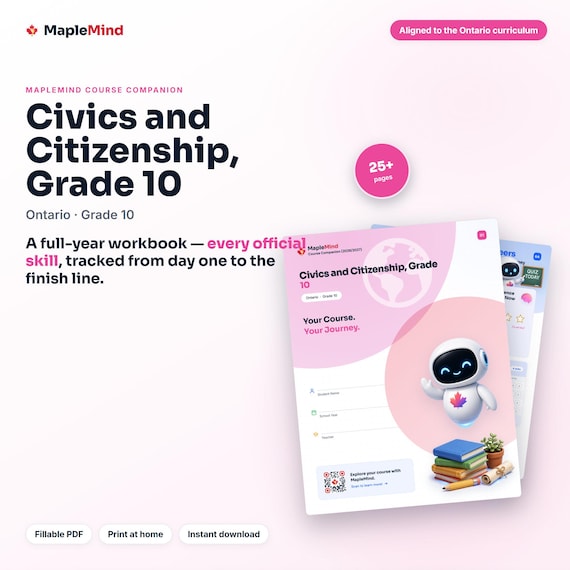
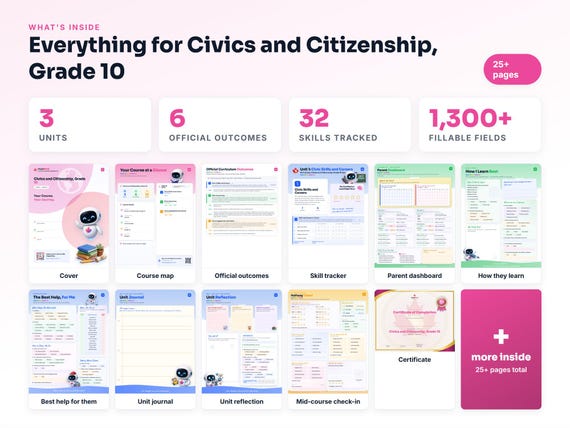
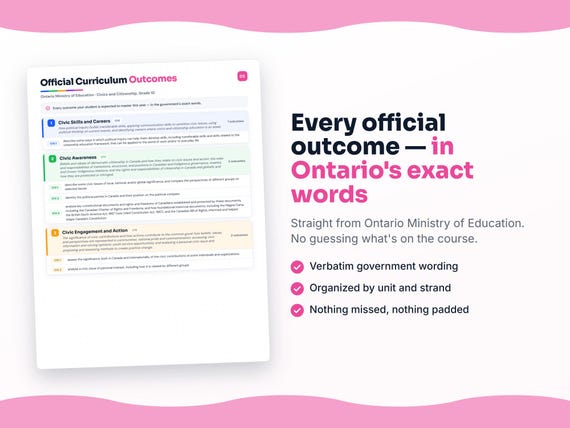
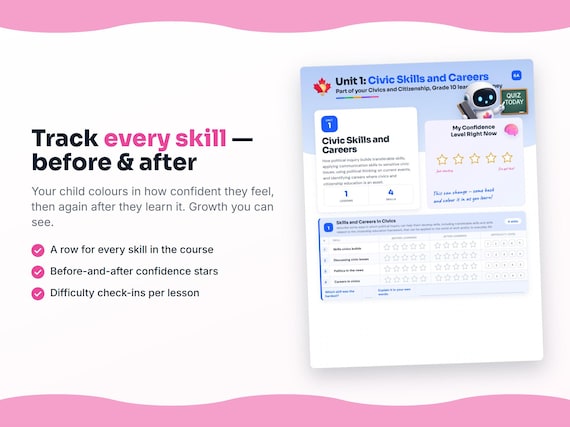
Printable workbook · A keepsake of the year
A Civics and Citizenship, Grade 10 workbook worth keeping
Built from the same official curriculum as this page. Before and after each skill above, your student colours in how sure they feel — so the two of you can see, on one page, what's clicking and what needs another look. It's a quiet way to follow how the year is really going.
By June it's full of their own handwriting: units worked through, confidence grown, a mid-year check-in, notes from parent-teacher night, and a certificate at the end. Less a worksheet, more a record of the year worth keeping on the shelf.
Instant download · see every page, reviews and the full description · five or more workbooks are $2.99 each
What it looks like in the app



Common questions
Can MapleMind help me with Civics and Citizenship, Grade 10?
Yes. MapleMind's AI tutor covers all 32 skills in Ontario's Civics and Citizenship, Grade 10 — you pick the exact skill, and the tutor teaches it step by step: a short lesson, a worked example, solving together, then a skill check to show it stuck.
Is MapleMind aligned to Ontario's official curriculum?
Yes. Every skill in this course maps to an official outcome code from Ontario's Grade 10 Social Studies curriculum, and the ministry's own wording is quoted under each unit on this page — with the official government source linked so you can check it yourself.
What does MapleMind cost?
It's free to start — 5 tutoring chats and a practice quiz every day, no credit card. A Pro subscription ($9.99/month or $49.99/year CAD, 7-day free trial) unlocks unlimited tutoring, practice, and exam simulations.
What if I'm stuck on just one topic?
That's the point of skill-level tutoring: open Civics and Citizenship, Grade 10 in the app, tap the exact skill from the list on this page, and the tutor teaches just that — no wading through lessons you don't need.
Does MapleMind work in French or other languages?
Yes — 14 languages, including French. Both the app and the tutor's explanations switch to the language you choose.
Where can I see the official Ontario curriculum for Civics and Citizenship, Grade 10?
The official source is linked on this page — Ontario's official curriculum. The outline here follows it: every MapleMind skill carries its official outcome code, and the ministry's own wording is quoted under each unit.
Keep exploring
Ready when you are
Pick a skill from this page and see it taught properly — free, in the browser, in under a minute.