Get help with Understanding Canadian Law, Grade 11 (University/College Preparation)
Most tutoring makes you sit through material you already know. MapleMind flips that: pick the exact skill that's causing trouble — any of the 63 below — and the tutor teaches just that one, step by step, as many times as it takes. Ask questions in plain words, any time of day, in English, French, or 12 other languages.
The official Ontario Understanding Canadian Law, Grade 11 (University/College Preparation) curriculum
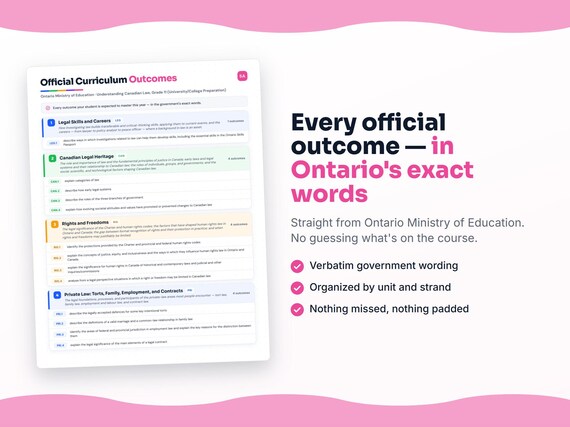
Ontario defines Understanding Canadian Law, Grade 11 (University/College Preparation) by strands and outcomes. MapleMind teaches the same curriculum reorganized for one-skill-at-a-time tutoring — the table shows exactly where every official strand lands, and the ministry's own wording is quoted under each unit below.
Official source Ontario's official curriculumRead it on the government site — dcp.edu.gov.on.ca ↗| Official strand | Outcomes | Where MapleMind teaches it |
|---|---|---|
| Strand A | 4 | Legal Skills and Careers |
| Strand B | 14 | Canadian Legal Heritage |
| Strand C | 12 | Rights and Freedoms |
| Strand D | 17 | Private Law: Torts, Family, Employment, and Contracts |
| Strand E | 15 | Criminal Law and the Justice System |
Every skill below, taught one on one.
 Try the first session free
How MapleMind teaches Understanding Canadian Law, Grade 11 (University/College Preparation) — every unit, lesson, and skill
Every skill below runs as a short session: a plain-words lesson, a worked example, solving it together, then a five-question skill check that earns up to three stars. Guided Mode keeps it teaching instead of answer-handing — turning it off needs a parent's password.
Unit 1Legal Skills and CareersOfficial strand · Strand A
How investigating law builds transferable and critical-thinking skills, applying them to current events, and the careers — from lawyer to policy analyst to peace officer — where a background in law is an asset.
Skills and Careers in Law
- Skills the study of law buildsclu3m.A2.1 — Describe ways investigations related to law help develop transferable skills — including the essential skills in the Ontario Skills Passport — that apply to postsecondary study, work, and everyday life.
- Thinking like a legal reasonerclu3m.A2.2 — Apply, in everyday contexts, the skills and work habits developed through the study of law — critical-thinking, reasoning to draw inferences from evidence, and oral communication.
- Legal issues in the newsclu3m.A2.3 — Use the concepts of legal thinking when analysing current events related to legal issues, to enhance understanding and one's role as an informed citizen.
- Careers in lawclu3m.A2.4 — Identify careers in which a law background might be useful — police or peace officer, lawyer, paralegal, court reporter, policy analyst, journalist.
The official wording — 4 outcomes in this unit
- clu3m.A2.1
describe ways in which investigations related to law can help them develop skills, including the essential skills in the Ontario Skills Passport
- clu3m.A2.2
apply in everyday contexts skills and work habits developed through and relevant to the study of law
- clu3m.A2.3
use the concepts of legal thinking when analysing current events related to legal issues
- clu3m.A2.4
identify careers in which a law background might be useful
Unit 2Canadian Legal HeritageOfficial strand · Strand B
The role and importance of law and the fundamental principles of justice in Canada; early laws and legal systems and their relationship to Canadian law; the roles of individuals, groups, and governments; and the social, scientific, and technological factors shaping Canadian law.
The Role of Law and the Principles of Justice
- Categories and role of lawclu3m.B1.1 — Explain categories of law — public versus private, substantive versus procedural — areas of law such as criminal, constitutional, and tort, and the role of law in Canadian society.
- Foundational principles of justice: rule of law, parliamentary supremacy, precedent, equalityclu3m.B1.2 — Explain the foundational principles that structure the Canadian legal system: the rule of law, parliamentary supremacy, the principle of equality before the law, and the rule of judicial precedent, and their significance in the legal system.
- Principles protecting the accused: presumption of innocence, habeas corpus, degrees of liabilityclu3m.B1.2 — Explain the principles that protect an accused person in Canada's legal system: the presumption of innocence, the right of habeas corpus, and the elements used to establish degrees of liability (intent, recklessness, negligence, mens rea, actus reus), and their significance in the legal system.
- The structure of the courtsclu3m.B1.3 — Describe the structure of the Canadian court system, including the function and status of each court within the hierarchy of the legal system.
Early Legal Systems and Their Legacy
- Early legal systems and Canadian lawclu3m.B2.1 — Describe how early legal systems — the Code of Hammurabi, Mosaic law, Roman law, First Nations customs, the Magna Carta — have influenced Canadian law.
- Roman law and civil codesclu3m.B2.2 — Explain the relationship between Roman law and codes of law developed from it — the Code of Justinian, the Napoleonic Code, and the Quebec Civil Code.
- Past legislation and the Constitutionclu3m.B2.3 — Analyse how legislation of the past — the Royal Proclamation of 1763, the Quebec Act 1774, the British North America Act 1867, the Statute of Westminster 1931 — influenced Canada's Constitution of 1982.
Individuals, Groups, and Government in Canadian Law
- The three branches of governmentclu3m.B3.1 — Describe the roles of the three branches of government — executive, legislative, judicial — in the Canadian legal system and how those roles are interrelated.
- Key aspects of the Constitutionclu3m.B3.2 — Explain the legal significance of key aspects of the Canadian Constitution — the division of powers, the Charter of Rights and Freedoms, the amending formula, and the recognition of Aboriginal rights.
- The Charter and the judiciaryclu3m.B3.3 — Analyse the impact of the Canadian Charter of Rights and Freedoms on the role and influence of the judiciary in Canada's legal system.
- Roles and responsibilities in the justice systemclu3m.B3.4 — Identify the roles and responsibilities of various individuals and groups within the Canadian justice system, from individuals' duty to know the law to governments' obligation to protect citizens.
Social, Scientific, and Technological Forces on Law
- Societal values and legal changeclu3m.B4.1 — Explain how evolving societal attitudes and values have promoted or prevented changes to Canadian law — in areas such as marriage, capital punishment, and environmental protection.
- Law's response to science and technologyclu3m.B4.2 — Evaluate the responsiveness of Canadian legislation to societal issues — privacy, intellectual property — raised by developments in science and technology.
- People who changed the lawclu3m.B4.3 — Explain how the points of view and issues associated with diverse individuals and groups — Tommy Douglas, the Famous Five, Cindy Blackstock — have influenced the development of law in Canada.
- Aboriginal rights: legislation and landmark casesclu3m.B4.4 — Describe how legislation and recent landmark cases relating to First Nations, Métis, and Inuit peoples — R. v. Sparrow, Delgamuukw, Tsilhqot'in Nation — have influenced the interpretation of Aboriginal rights in Canada.
The official wording — 14 outcomes in this unit
- clu3m.B1.1
explain categories of law
- clu3m.B1.2
explain the fundamental principles of justice in Canada and their significance in the legal system, including the rule of law, parliamentary supremacy, the presumption of innocence, the principle of equality before the law, the right of habeas corpus, elements in establishing degrees of liability (e.g., intent, recklessness, negligence, mens rea, actus reus), and the rule of judicial precedent
- clu3m.B1.3
describe the structure of the Canadian court system, including the function and status of each court within the hierarchy of the legal system
- clu3m.B2.1
describe how early legal systems
- clu3m.B2.2
explain the relationship between Roman law and codes of law developed from it
- clu3m.B2.3
analyse how legislation of the past
- clu3m.B3.1
describe the roles of the three branches of government
- clu3m.B3.2
explain the legal significance of some key aspects of the Canadian Constitution
- clu3m.B3.3
analyse the impact of the Canadian Charter of Rights and Freedoms on the role and influence of the judiciary in Canada’s legal system
- clu3m.B3.4
identify the roles and responsibilities of various individuals and groups within the Canadian justice system
- clu3m.B4.1
explain how evolving societal attitudes and values have promoted or prevented changes to Canadian law
- clu3m.B4.2
evaluate the responsiveness of Canadian legislation to societal issues
- clu3m.B4.3
explain how points of view and issues associated with diverse groups and individuals
- clu3m.B4.4
describe how legislation and recent land- mark cases relating to First Nations, Métis, and Inuit peoples have influenced the circum- stances of Aboriginal people and the interpretation of Aboriginal rights in Canada
Unit 3Rights and FreedomsOfficial strand · Strand C
The legal significance of the Charter and human rights codes; the factors that have shaped human rights law in Ontario and Canada; the gap between formal recognition of rights and their protection in practice; and when rights and freedoms may justifiably be limited.
The Charter and Human Rights Codes
- Charter and human rights code protectionsclu3m.C1.1 — Identify the protections provided by the Charter and provincial and federal human rights codes — freedom of religion and expression, mobility, equality, democratic rights — and explain their significance.
- Barriers to human rightsclu3m.C1.2 — Describe historical and contemporary barriers to the equal enjoyment of human rights in Canada — residential schools, the Indian Act, unequal voting rights — and the laws intended to help overcome them.
- Resolving human rights complaintsclu3m.C1.3 — Describe the legal instruments and procedures available for resolving complaints about human rights violations under the Ontario Human Rights Code, the Charter, and the Canadian Human Rights Act — tribunals, commissions, Charter challenges.
How Human Rights Law Developed
- Justice, equity, and inclusivenessclu3m.C2.1 — Explain the concepts of justice, equity, and inclusiveness and the ways they influence human rights law in Ontario and Canada — through procedural fairness and equal access to justice.
- People who built human rights lawclu3m.C2.3 — Analyse and describe how the actions of individuals and groups — Viola Desmond, Henry Morgentaler, the Canadian Civil Liberties Association — have contributed to the development of human rights law in Canada.
- Landmark human rights casesclu3m.C2.4 — Analyse landmark cases related to human rights law in Canada — the Persons Case, Rodriguez v. British Columbia, Roncarelli v. Duplessis — and assess their significance.
Rights in Practice and Their Limits
- Laws, inquiries, and rights in practiceclu3m.C3.1 — Explain the significance for human rights of historical and contemporary laws and inquiries/commissions — the War Measures Act, the Truth and Reconciliation Commission, Chinese Head Taxes.
- The Charter vs earlier rights protectionsclu3m.C3.2 — Assess from a legal perspective the differences between the rights protections entrenched in the Constitution Act, 1982, and the rights protection afforded by earlier legislation such as the Canadian Bill of Rights.
- Balancing minority and majority rightsclu3m.C3.3 — Explain how human rights legislation and the courts attempt to balance minority and majority rights — through reasonable accommodation and minority-language education rights.
When Rights May Be Limited
- Situations where rights may be limitedclu3m.C4.1 — Analyse from a legal perspective situations in which a right or freedom may be limited in Canadian law — with reference to sections 1 and 33 of the Charter and anti-terrorism legislation.
- Evaluating arguments for limiting rightsclu3m.C4.2 — Evaluate the legal arguments used to justify laws limiting individual rights and freedoms — such as laws against hate promotion — or institutional and police powers.
The official wording — 12 outcomes in this unit
- clu3m.C1.1
identify the protections provided by the Charter and provincial and federal human rights codes
- clu3m.C1.2
describe historical and contemporary barriers to the equal enjoyment of human rights in Canada
- clu3m.C1.3
describe the legal instruments and procedures available for resolving complaints regarding human rights violations
- clu3m.C2.1
explain the concepts of justice, equity, and inclusiveness and the ways in which they influence human rights law in Ontario and Canada
- clu3m.C2.2
analyse how various social factors have contributed to change over time in Canadian human rights law
- clu3m.C2.3
analyse and describe how the actions of various individuals and groups have contributed to the development of human rights law in Canada
- clu3m.C2.4
analyse landmark cases related to human rights law in Canada and assess their significance
- clu3m.C3.1
explain the significance for human rights in Canada of historical and contemporary laws and judicial and other inquiries/commissions
- clu3m.C3.2
assess from a legal perspective the differences between the rights protections entrenched in the Constitution Act, 1982, and the rights protection afforded by earlier legislation such as the Canadian Bill of Rights
- clu3m.C3.3
explain how human rights legislation and the courts attempt to balance minority and majority rights
- clu3m.C4.1
analyse from a legal perspective situations in which a right or freedom may be limited in Canadian law
- clu3m.C4.2
evaluate the legal arguments used to justify laws limiting individual rights and freedoms
Unit 4Private Law: Torts, Family, Employment, and ContractsOfficial strand · Strand D
The legal foundations, processes, and participants of the private-law areas most people encounter — tort law, family law, employment and labour law, and contract law.
Tort Law: Civil Wrongs and Remedies
- Torts and their defencesclu3m.D1.1 — Describe the legally accepted defences for key intentional torts — assault and battery, invasion of privacy — and unintentional torts such as negligence and medical malpractice.
- Settling civil disputesclu3m.D1.2 — Explain the function of the legal processes — statement of claim, examination for discovery, burden of proof — courts, and alternative procedures such as mediation involved in settling civil disputes, and the remedies available.
- Participants in a civil disputeclu3m.D1.3 — Describe the legal status and function of specific individuals and groups who may participate in a civil law dispute — plaintiff, defendant, judge, arbitrator, mediator, jury, witnesses.
- Legal reasoning in tort decisionsclu3m.D1.4 — Explain the legal reasoning behind various legal decisions involving torts — such as product liability (Liebeck v. McDonald's) or accommodation cases.
Family Law: Marriage, Divorce, and Rights
- Marriage and common-law relationshipsclu3m.D2.1 — Describe the definitions of a valid marriage and a common-law relationship in family law, as established by law and court rulings, and explain their legal implications — including rulings like Halpern v. Attorney General and the Civil Marriage Act, 2005.
- Dissolving a marriageclu3m.D2.2 — Explain the legal differences in the ways a marriage can be dissolved — separation, divorce, annulment, death of a spouse — and the procedures for resolving disputes arising from each.
- Rights on dissolutionclu3m.D2.3 — Explain the differences between the legal rights of married spouses and common-law partners in Ontario upon dissolution — property division, alimony, child custody and support.
- How family law has changedclu3m.D2.4 — Analyse how changing societal values and legal decisions have promoted or prevented changes in family law in Canada — in the definition of marriage, reproductive rights, and adoption.
Employment and Labour Law
- Federal and provincial jurisdiction in employment lawclu3m.D3.1 — Identify the areas of federal and provincial jurisdiction in employment law and explain the key reasons for the distinction between them.
- Employment law versus labour lawclu3m.D3.2 — Explain the difference in Canadian law between 'employment law' and 'labour law'.
- Protecting employees' rightsclu3m.D3.3 — Describe issues related to the protection of employees' rights — worker safety, harassment, migrant workers — and the legal avenues for adjudicating disputes, such as the Employment Standards Act and the Workplace Safety and Insurance Board.
- Roles in employment lawclu3m.D3.4 — Analyse from a legal perspective the roles and responsibilities of employers, employees, and governments in employment law.
- Labour negotiations and labour lawclu3m.D3.5 — Analyse issues related to contract negotiations between employers and organized labour, and how these issues have influenced the development of labour law in Canada.
Contract Law
- Elements of a legal contractclu3m.D4.1 — Explain the legal significance of the main elements of a legal contract — consent, offer and acceptance, and consideration.
- Parties to a contractclu3m.D4.2 — Explain from a legal perspective the roles and responsibilities of each of the parties involved in a contract.
- Breach of contractclu3m.D4.3 — Explain from a legal perspective the types of penalties or damages that may be awarded in an action for breach of contract.
- Everyday contracts and changeclu3m.D4.4 — Explain the legal implications of various types of contracts — mobile phone contracts, loan agreements, credit card agreements — and describe ways contract law may need to update for changing conditions.
The official wording — 17 outcomes in this unit
- clu3m.D1.1
describe the legally accepted defences for some key intentional torts
- clu3m.D1.2
explain the function of the various legal processes
- clu3m.D1.3
describe the legal status and/or function of specific individuals and groups that may be participants in a civil law dispute
- clu3m.D1.4
explain the legal reasoning behind various legal decisions involving torts
- clu3m.D2.1
describe the definitions of a valid marriage and a common-law relationship in family law
- clu3m.D2.2
explain the legal differences in the ways a marriage can be dissolved
- clu3m.D2.3
explain the differences between the legal rights of married spouses and the rights of common-law partners in Ontario upon the dissolution of the marriage or common-law partnership
- clu3m.D2.4
analyse how changing societal values and legal decisions have promoted or prevented changes in family law in Canada
- clu3m.D3.1
identify the areas of federal and provincial jurisdiction in employment law and explain the key reasons for the distinction between them
- clu3m.D3.2
explain the difference in Canadian law between “employment law” and “labour law”
- clu3m.D3.3
describe issues related to the protection of employees’ rights
- clu3m.D3.4
analyse from a legal perspective the roles and responsibilities of employers, employees, and governments in employment law
- clu3m.D3.5
analyse issues related to contract negotiations between employers and organized labour
- clu3m.D4.1
explain the legal significance of the main elements of a legal contract
- clu3m.D4.2
explain from a legal perspective the roles and responsibilities of each of the parties involved in a contract
- clu3m.D4.3
explain from a legal perspective the types of penalties that may be imposed or damages that may be awarded in an action for breach of contract
- clu3m.D4.4
explain the legal implications of various types of contracts
Unit 5Criminal Law and the Justice SystemOfficial strand · Strand E
The foundational concepts of criminal law; the structures, roles, and processes of the criminal justice system; whether that system delivers even-handed justice; and the factors shaping the development of Canadian criminal law.
Foundations of Criminal Law
- Elements and types of crimeclu3m.E1.1 — Explain the legal meaning of key terms describing the elements of a crime — mens rea, actus reus — and different types of crime, such as indictable, summary, and hybrid offences.
- Offences in the Criminal Codeclu3m.E1.2 — Describe some summary and indictable offences identified in the Criminal Code of Canada, and their related penalties.
- Youth criminal justiceclu3m.E1.3 — Explain the philosophical principles and legal reasoning underlying the laws dealing with youth crime — the ages of criminal responsibility and the objectives of the Youth Criminal Justice Act.
The Criminal Justice System at Work
- Bringing an accused to trialclu3m.E2.1 — Describe the requirements associated with bringing an accused person to trial — protocols for legal search and arrest, collection of evidence, and pre-trial release — including variations by the nature of the alleged crime.
- The criminal trial and its participantsclu3m.E2.2 — Describe the processes and roles of key participants in a criminal trial — Crown prosecutor, defence lawyer, jury selection, disclosure of evidence, verdict — and explain how the elements relate.
- Sentencing options and their purposesclu3m.E2.3 — Explain how various sentencing options — anger-management programs, house arrest, community service, healing circles — are related to the purpose of the sentence, such as rehabilitation or deterrence.
- Appeals in criminal casesclu3m.E2.4 — Describe the legal reasons/grounds for granting an appeal in criminal cases — mistake of fact, mistake of law — and the available avenues for an appeal.
- Sentencing young offendersclu3m.E2.5 — Describe the sentencing options for young people who contravene youth criminal law — sentencing under the Youth Criminal Justice Act, alternative sentencing, adult sentences — and the factors that influence which option is chosen.
Does the System Deliver Justice?
- Protecting rights in the justice systemclu3m.E3.1 — Assess from a legal perspective how well the rights of various parties — victims, the accused, the convicted — are protected in the Canadian criminal justice system.
- The purposes of sentencing and prisonsclu3m.E3.2 — Identify the purposes of sentencing — deterrence, retribution, rehabilitation, protection of society — and assess the effectiveness of the Canadian prison system in achieving them.
- Challenges facing law enforcementclu3m.E3.3 — Identify contemporary and emerging challenges people face in dealing with law enforcement, including those police face — cybercrime, cultural bias, use of force — and evaluate the ability to respond.
- Media and perceptions of justiceclu3m.E3.4 — Analyse how the media — social media, news, films, television — influence society's perceptions and expectations of the criminal justice system.
How Criminal Law Has Developed
- Defences that became acceptedclu3m.E4.1 — Identify defences that, over time, have become legally accepted under Canadian criminal law — automatism, battered spouse syndrome, self-defence, duress — and explain the factors influencing their acceptance.
- Who shaped criminal lawclu3m.E4.2 — Assess from a legal perspective how various individuals, groups, and cases — Robert Latimer, the Assembly of First Nations, R. v. Lavallee — have influenced the development of Canadian criminal law.
- Charter challenges to the Criminal Codeclu3m.E4.3 — Assess the significance of cases where Charter rights have been invoked to change provisions of the Criminal Code — R. v. Oakes, R. v. Morgentaler.
The official wording — 15 outcomes in this unit
- clu3m.E1.1
explain the legal meaning of key terms used to describe the elements of a crime
- clu3m.E1.2
describe some summary and indictable offences identified in the Criminal Code of Canada, and their related penalties
- clu3m.E1.3
explain the philosophical principles and legal reasoning underlying the laws dealing with youth crime and the administration of justice for youth in Canada
- clu3m.E2.1
describe the requirements associated with the process of bringing an accused person to trial
- clu3m.E2.2
describe the processes and the roles of key participants involved in a criminal trial
- clu3m.E2.3
explain how various sentencing options
- clu3m.E2.4
describe the legal reasons/grounds for grant- ing an appeal in criminal cases
- clu3m.E2.5
describe the sentencing options for young people who contravene the existing youth criminal law
- clu3m.E3.1
assess from a legal perspective how well the rights of various parties are protected in the Canadian criminal justice system
- clu3m.E3.2
identify the purposes of sentencing
- clu3m.E3.3
identify some contemporary and emerging challenges that people face in dealing with law enforcement
- clu3m.E3.4
analyse how the media
- clu3m.E4.1
identify defences that, over time, have become legally accepted under Canadian criminal law
- clu3m.E4.2
assess, from a legal perspective, how various individuals, groups, and cases have influenced the development of Canadian criminal law
- clu3m.E4.3
assess the significance of cases in which legal rights guaranteed under the Canadian Charter of Rights and Freedoms have been invoked in an effort to change the provisions of the Criminal Code of Canada
Printable workbook · A keepsake of the year
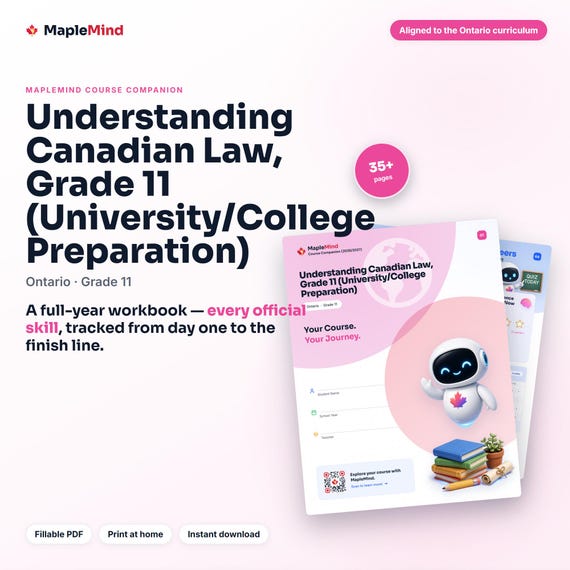
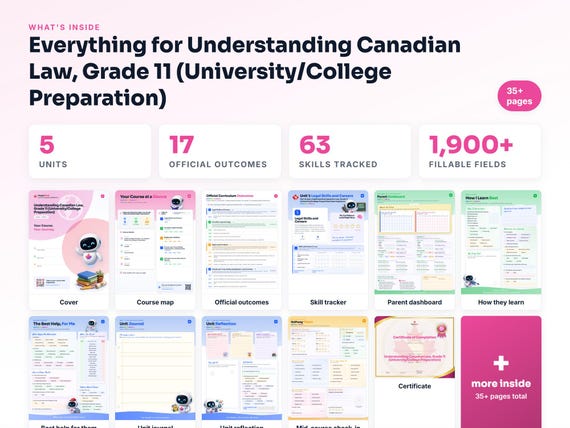
A Understanding Canadian Law, Grade 11 (University/College Preparation) workbook worth keeping
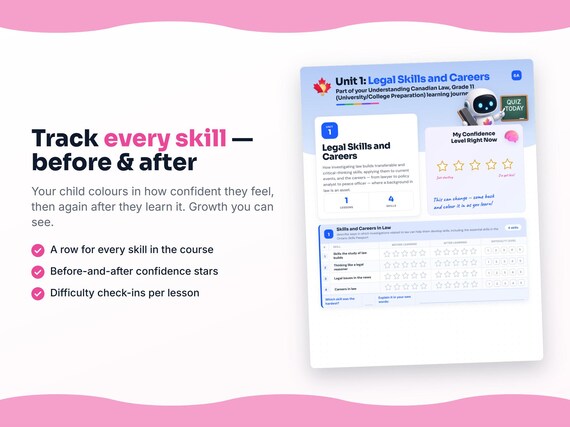
Built from the same official curriculum as this page. Before and after each skill above, your student colours in how sure they feel — so the two of you can see, on one page, what's clicking and what needs another look. It's a quiet way to follow how the year is really going.
By June it's full of their own handwriting: units worked through, confidence grown, a mid-year check-in, notes from parent-teacher night, and a certificate at the end. Less a worksheet, more a record of the year worth keeping on the shelf.
Instant download · see every page, reviews and the full description · five or more workbooks are $2.99 each
What it looks like in the app



Common questions
Can MapleMind help me with Understanding Canadian Law, Grade 11 (University/College Preparation)?
Yes. MapleMind's AI tutor covers all 63 skills in Ontario's Understanding Canadian Law, Grade 11 (University/College Preparation) — you pick the exact skill, and the tutor teaches it step by step: a short lesson, a worked example, solving together, then a skill check to show it stuck.
Is MapleMind aligned to Ontario's official curriculum?
Yes. Every skill in this course maps to an official outcome code from Ontario's Grade 11 Social Studies curriculum, and the ministry's own wording is quoted under each unit on this page — with the official government source linked so you can check it yourself.
What does MapleMind cost?
It's free to start — 5 tutoring chats and a practice quiz every day, no credit card. A Pro subscription ($9.99/month or $49.99/year CAD, 7-day free trial) unlocks unlimited tutoring, practice, and exam simulations.
What if I'm stuck on just one topic?
That's the point of skill-level tutoring: open Understanding Canadian Law, Grade 11 (University/College Preparation) in the app, tap the exact skill from the list on this page, and the tutor teaches just that — no wading through lessons you don't need.
Does MapleMind work in French or other languages?
Yes — 14 languages, including French. Both the app and the tutor's explanations switch to the language you choose.
Where can I see the official Ontario curriculum for Understanding Canadian Law, Grade 11 (University/College Preparation)?
The official source is linked on this page — Ontario's official curriculum. The outline here follows it: every MapleMind skill carries its official outcome code, and the ministry's own wording is quoted under each unit.
Keep exploring
Ready when you are
Pick a skill from this page and see it taught properly — free, in the browser, in under a minute.