Get help with World History since the Fifteenth Century, Grade 12 (College Preparation)
Most tutoring makes you sit through material you already know. MapleMind flips that: pick the exact skill that's causing trouble — any of the 50 below — and the tutor teaches just that one, step by step, as many times as it takes. Ask questions in plain words, any time of day, in English, French, or 12 other languages.
The official Ontario World History since the Fifteenth Century, Grade 12 (College Preparation) curriculum
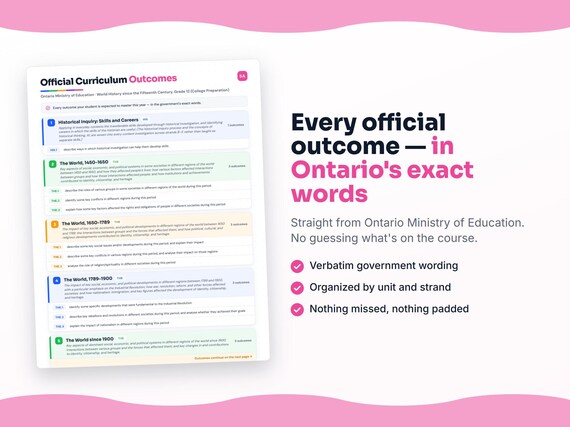
Ontario defines World History since the Fifteenth Century, Grade 12 (College Preparation) by strands and outcomes. MapleMind teaches the same curriculum reorganized for one-skill-at-a-time tutoring — the table shows exactly where every official strand lands, and the ministry's own wording is quoted under each unit below.
Official source Ontario's official curriculumRead it on the government site — dcp.edu.gov.on.ca ↗| Official strand | Outcomes | Where MapleMind teaches it |
|---|---|---|
| Strand A | 4 | Historical Inquiry: Skills and Careers |
| Strand B | 12 | The World, 1450–1650 |
| Strand C | 11 | The World, 1650–1789 |
| Strand D | 12 | The World, 1789–1900 |
| Strand E | 11 | The World since 1900 |
Every skill below, taught one on one.
 Try the first session free
How MapleMind teaches World History since the Fifteenth Century, Grade 12 (College Preparation) — every unit, lesson, and skill
Every skill below runs as a short session: a plain-words lesson, a worked example, solving it together, then a five-question skill check that earns up to three stars. Guided Mode keeps it teaching instead of answer-handing — turning it off needs a parent's password.
Unit 1Historical Inquiry: Skills and CareersOfficial strand · Strand A
Applying in everyday contexts the transferable skills developed through historical investigation, and identifying careers in which the skills of the historian are useful. (The historical inquiry process and the concepts of historical thinking, A1, are woven into every content investigation across strands B–E rather than taught as separate skills.)
Skills and Careers in History
- Transferable skills from historical investigationchy4c.A2.1 — Describe ways historical investigation helps develop transferable skills, including the essential skills in the Ontario Skills Passport.
- Applying skills and work habitschy4c.A2.2 — Apply in everyday contexts the skills and work habits developed through historical investigation.
- Analysing current issues as an informed citizenchy4c.A2.3 — Apply the knowledge and skills of world history since the fifteenth century when analysing current social, economic, and political issues.
- Careers where the historian's skills are usefulchy4c.A2.4 — Identify some careers in which the skills learned in history might be useful.
The official wording — 4 outcomes in this unit
- chy4c.A2.1
describe ways in which historical investigation can help them develop skills
- chy4c.A2.2
apply in everyday contexts skills and work habits developed through historical investigation
- chy4c.A2.3
apply the knowledge and skills developed in the study of world history since the fifteenth century when analysing current social, economic, and/or political issues
- chy4c.A2.4
identify some careers in which the skills learned in history might be useful
Unit 2The World, 1450–1650Official strand · Strand B
Key aspects of social, economic, and political systems in some societies in different regions of the world between 1450 and 1650, and how they affected people's lives; how various factors affected interactions between groups and how those interactions affected people; and how institutions and achievements contributed to identity, citizenship, and heritage.
How People Lived, 1450–1650
- Roles of groups and daily lifechy4c.B1.1 — Describe the roles of various groups in some societies during this period, and explain how these roles affected people's daily lives and the functioning of these societies.
- Science and technology and its impactchy4c.B1.2 — Describe significant developments in science and/or technology during this period, and analyse their impact.
- Economic systems and people's liveschy4c.B1.3 — Describe key aspects of economic systems in some societies during this period, and analyse their impact on people's lives.
- Comparing political systemschy4c.B1.4 — Describe political systems in some societies during this period, highlighting key similarities and differences.
Contact and Its Impact on People, 1450–1650
- Conflicts and their impact on peoplechy4c.B2.1 — Identify key conflicts in different regions during this period, and analyse their impact on the lives of people in these regions.
- Developments in warfarechy4c.B2.2 — Describe developments related to warfare during this period, and explain their impact.
- Cooperation and people's liveschy4c.B2.3 — Analyse the impact of key instances of social, political, and/or economic cooperation on the lives of people in different regions during this period.
- Religion as a shaping forcechy4c.B2.4 — Explain the importance of religion/spirituality as a force in shaping various communities during this period.
- Exploration and colonialism and people's liveschy4c.B2.5 — Explain how exploration and colonialism affected the lives of people in different societies during this period.
Rights, Art, and Identity, 1450–1650
- Factors affecting rights and obligationschy4c.B3.1 — Explain how key factors affected the rights and obligations of people in different societies during this period.
- Artistic achievements and identitychy4c.B3.2 — Describe significant artistic achievements in different societies during this period, and explain how they contributed to identity and/or heritage.
- Significant individuals and heritagechy4c.B3.3 — Describe how significant individuals from different societies contributed to the identity and/or heritage of their societies during this period.
The official wording — 12 outcomes in this unit
- chy4c.B1.1
describe the roles of various groups in some societies in different regions of the world during this period
- chy4c.B1.2
describe some significant developments in science and/or technology during this period
- chy4c.B1.3
describe key aspects of economic systems in some societies in different regions during this period
- chy4c.B1.4
describe political systems in some societies in different parts of the world during this period, highlighting key similarities and differences in those systems
- chy4c.B2.1
identify some key conflicts in different regions during this period
- chy4c.B2.2
describe some developments related to warfare during this period
- chy4c.B2.3
analyse the impact of some key instances of social, political, and/or economic cooperation on the lives of people in different regions during this period
- chy4c.B2.4
explain the importance of religion/spiritual- ity as a force in shaping various communities during this period
- chy4c.B2.5
explain how exploration and colonialism affected the lives of people in different societies during this period
- chy4c.B3.1
explain how some key factors affected the rights and obligations of people in different societies during this period
- chy4c.B3.2
describe some significant artistic achieve- ments in different societies during this period
- chy4c.B3.3
describe how some significant individuals from different societies contributed to the identity and/or heritage of their societies during this period
Unit 3The World, 1650–1789Official strand · Strand C
The impact of key social, economic, and political developments in different regions of the world between 1650 and 1789; the interactions between groups and the forces that affected them; and how political, cultural, and religious developments contributed to identity, citizenship, and heritage.
Developments and Their Impact, 1650–1789
- Science and technology and its impactchy4c.C1.2 — Identify significant developments in science and/or technology during this period, and analyse their impact.
- The economic effects of colonialismchy4c.C1.3 — Explain key economic effects of colonialism during this period.
- How political systems changedchy4c.C1.4 — Describe political systems in different societies during this period and, where applicable, how they changed from earlier times.
Interactions and Forces, 1650–1789
- Conflicts and their impactchy4c.C2.1 — Describe key conflicts in various regions during this period, and analyse their impact on those regions.
- Relationships between groupschy4c.C2.2 — Analyse relationships between specific groups within different societies during this period.
- Roles in the slave tradechy4c.C2.3 — Describe the roles played by different groups in the slave trade during this period, and explain the social conditions that allowed slavery to exist.
- Consequences of colonization for Indigenous peoplechy4c.C2.4 — Describe the intended and unintended consequences of exploration and colonization for Indigenous people during this period.
Religion, Art, and Identity, 1650–1789
- Religion and identitychy4c.C3.1 — Analyse the role of religion/spirituality in different societies during this period, including how it contributed to identity and/or heritage.
- Art reflecting societychy4c.C3.2 — Explain how artistic achievements during this period reflected the societies in which they occurred.
- Political figures and identitychy4c.C3.3 — Explain the contributions of key political figures from different societies to the development of identity, citizenship, and/or heritage in their societies.
The official wording — 11 outcomes in this unit
- chy4c.C1.1
describe some key social issues and/or developments during this period, and explain their impact
- chy4c.C1.2
identify some significant developments in science and/or technology during this period
- chy4c.C1.3
explain some of the key economic effects of colonialism during this period
- chy4c.C1.4
describe political systems in different societies during this period and, where applicable, how they changed from earlier times
- chy4c.C2.1
describe some key conflicts in various regions during this period, and analyse their impact on those regions
- chy4c.C2.2
analyse relationships between specific groups within different societies during this period
- chy4c.C2.3
describe the roles played by different groups in the slave trade during this period
- chy4c.C2.4
describe some of the intended and unintended consequences of exploration and colonization for indigenous people during this period
- chy4c.C3.1
analyse the role of religion/spirituality in different societies during this period
- chy4c.C3.2
explain how some artistic achievements during this period reflected the societies in which they occurred
- chy4c.C3.3
explain the contributions of some key political figures from different societies to the development of identity, citizenship, and/or
Unit 4The World, 1789–1900Official strand · Strand D
The impact of key social, economic, and political developments in different regions between 1789 and 1900, with a particular emphasis on the Industrial Revolution; how war, revolution, reform, and other forces affected societies; and how nationalism, immigration, and key figures affected the development of identity, citizenship, and heritage.
The Industrial Age and Its Impact
- The Industrial Revolution and its consequenceschy4c.D1.1 — Identify developments fundamental to the Industrial Revolution, and explain key social, economic, and political consequences of large-scale industrialization.
- Science and technology and its significancechy4c.D1.2 — Describe major developments/achievements in science and/or technology during this period, and explain their significance for various groups.
- Political events and their impactchy4c.D1.3 — Identify key political events and/or developments in different regions during this period, and analyse their impact.
War, Revolution, and Reform, 1789–1900
- Rebellions and revolutionschy4c.D2.1 — Describe key rebellions and revolutions in different societies during this period, and analyse whether they achieved their goals.
- Issues underlying warschy4c.D2.2 — Describe key issues underlying significant wars in different regions during this period.
- Reform movements and their goalschy4c.D2.3 — Identify reform movements that developed during this period, and explain their goals.
- Religion and spiritualitychy4c.D2.4 — Explain key issues and/or developments relating to religion/spirituality in different societies during this period.
- Gender roles and relationschy4c.D2.5 — Describe gender roles and relations in different societies during this period and ways in which they were challenged or reinforced.
Nationalism, Immigration, and Identity, 1789–1900
- The impact of nationalismchy4c.D3.1 — Explain the impact of nationalism in different regions during this period.
- Immigration trends and their significancechy4c.D3.2 — Describe key trends in global immigration during this period, and explain the significance of immigration for identity, citizenship, and/or heritage.
- Individuals in the arts and identitychy4c.D3.3 — Describe the contributions of significant individuals in the arts to the development of identity, citizenship, and/or heritage during this period.
- Political figures and identitychy4c.D3.4 — Describe the contribution of significant political figures in different societies to the development of identity and/or citizenship during this period.
The official wording — 12 outcomes in this unit
- chy4c.D1.1
identify some specific developments that were fundamental to the Industrial Revolution
- chy4c.D1.2
describe some major developments/achieve- ments in science and/or technology during this period
- chy4c.D1.3
identify some key political events and/or developments in different regions during this period, and analyse their impact
- chy4c.D2.1
describe key rebellions and revolutions in different societies during this period, and analyse whether they achieved their goals
- chy4c.D2.2
describe key issues underlying some significant wars in different regions during this period
- chy4c.D2.3
identify some reform movements that developed during this period, and explain their goals
- chy4c.D2.4
explain key issues and/or developments relating to religion/spirituality in different societies during this period
- chy4c.D2.5
describe gender roles and relations in different societies during this period and ways in which such roles/relations were being challenged or reinforced
- chy4c.D3.1
explain the impact of nationalism in different regions during this period
- chy4c.D3.2
describe key trends in global immigration during this period
- chy4c.D3.3
describe the contributions of some significant individuals in the arts to the development of identity, citizenship, and/or heritage of different communities during this period
- chy4c.D3.4
describe the contribution of some significant political figures in different societies to the development of identity and/or citizenship during this period
Unit 5The World since 1900Official strand · Strand E
Key aspects of dominant social, economic, and political systems in different regions of the world since 1900; interactions between various groups and the forces that affected them; and key changes in and contributions to identity, citizenship, and heritage.
Systems of the Modern World since 1900
- Science and technology and its impactchy4c.E1.2 — Identify significant developments in science and/or technology during this period, and analyse their impact on people's lives.
- Economic systems and their impactchy4c.E1.3 — Describe dominant economic systems and key economic policies in different regions during this period, and analyse their impact.
- Forms of government and ideologieschy4c.E1.4 — Describe forms of government in different countries during this period, and explain how they were influenced by political beliefs and/or ideologies.
Conflict, Cooperation, and Globalization since 1900
- Global and regional conflictschy4c.E2.1 — Describe key causes and consequences of major global and regional conflicts during this period.
- Individuals and groups in conflictchy4c.E2.2 — Explain how the actions of significant individuals and groups contributed to conflicts in different countries and/or regions during this period.
- Interactions between diverse groupschy4c.E2.3 — Describe significant interactions between diverse groups during this period, including those marked by violence or deprivation of rights and those marked by cooperation.
- Colonization, decolonization, and globalizationchy4c.E2.4 — Explain significant developments related to colonization, decolonization, and globalization during this period, with a focus on their impact on different groups or societies.
Rights, Women, and Culture since 1900
- Contributions to human rightschy4c.E3.1 — Assess the contributions of individuals and groups to the evolution of human rights in different regions during this period.
- The changing roles and status of womenchy4c.E3.2 — Analyse key aspects of the social, political, and/or economic roles and status of women in different societies during this period, focusing on whether they stayed the same or changed.
- Cultural trends and heritagechy4c.E3.3 — Describe significant cultural trends and developments during this period, and explain their contribution to regional and/or global heritage and/or identity.
The official wording — 11 outcomes in this unit
- chy4c.E1.1
describe some key social trends and/or developments in different regions of the world during this period, and explain their impact
- chy4c.E1.2
identify some significant developments in science and/or technology during this period
- chy4c.E1.3
describe dominant economic systems and some key economic policies in different regions during this period, and analyse their impact
- chy4c.E1.4
describe forms of government in different countries during this period
- chy4c.E2.1
describe key causes and consequences of some major global and regional conflicts during this period
- chy4c.E2.2
explain how the actions of some significant individuals and groups contributed to conflicts in different countries and/or regions during this period
- chy4c.E2.3
describe some significant interactions between diverse groups during this period
- chy4c.E2.4
explain some significant developments related to colonization, decolonization, and globalization during this period
- chy4c.E3.1
assess the contributions of some individuals and groups to the evolution of human rights in different regions during this period
- chy4c.E3.2
analyse some key aspects of the social, political, and/or economic roles and status of women in different societies during this period
- chy4c.E3.3
describe some significant cultural trends and developments during this period, and explain their contribution to regional and/or global heritage and/or identity
Printable workbook · A keepsake of the year
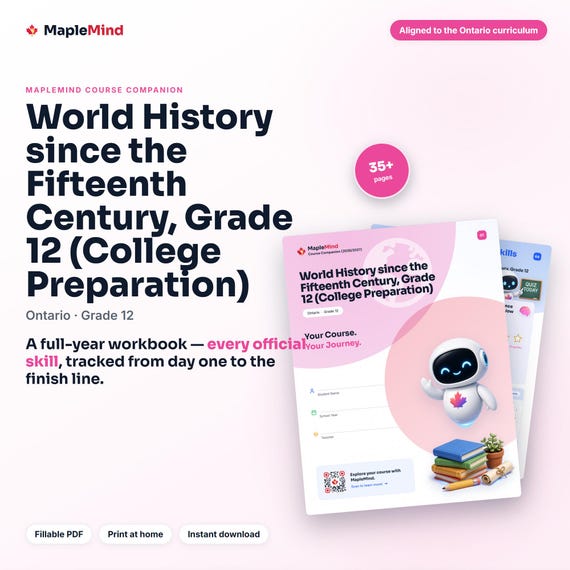
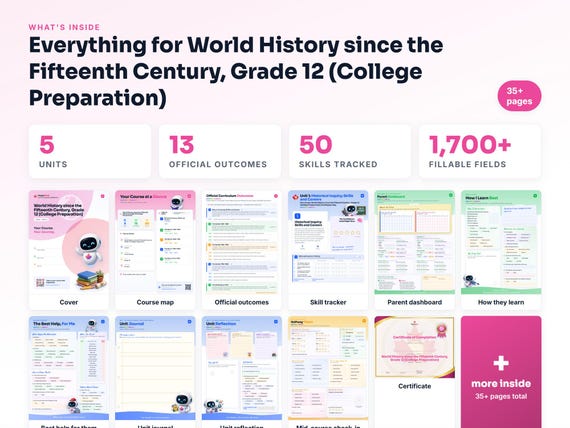
A World History since the Fifteenth Century, Grade 12 (College Preparation) workbook worth keeping
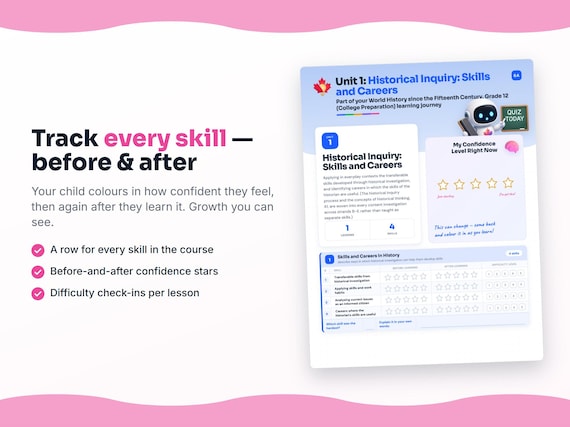
Built from the same official curriculum as this page. Before and after each skill above, your student colours in how sure they feel — so the two of you can see, on one page, what's clicking and what needs another look. It's a quiet way to follow how the year is really going.
By June it's full of their own handwriting: units worked through, confidence grown, a mid-year check-in, notes from parent-teacher night, and a certificate at the end. Less a worksheet, more a record of the year worth keeping on the shelf.
Instant download · see every page, reviews and the full description · five or more workbooks are $2.99 each
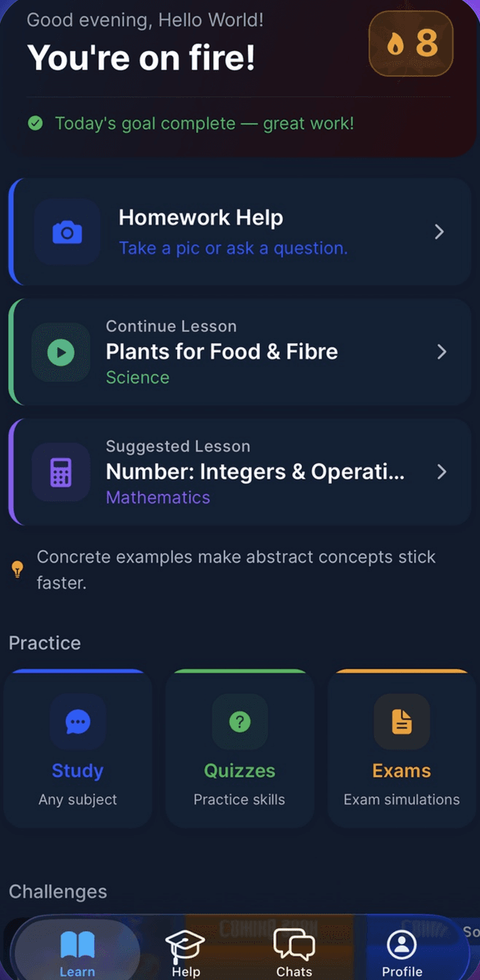
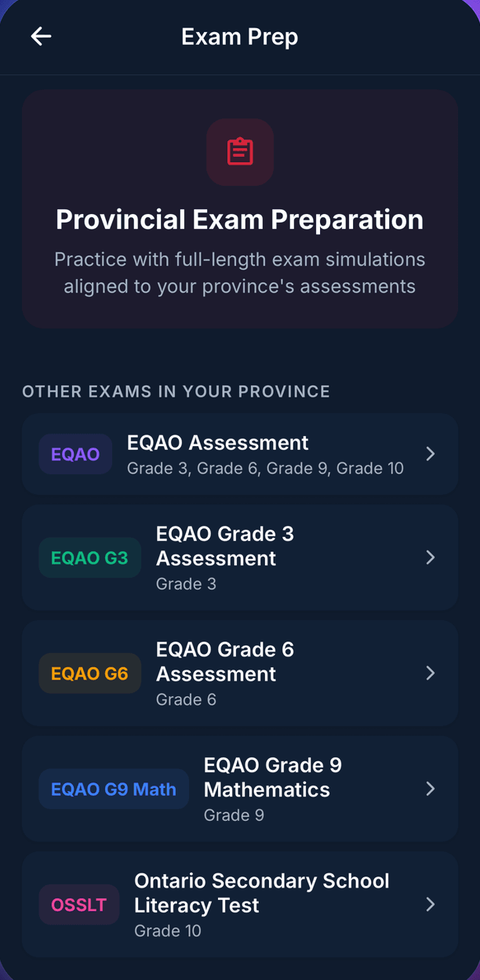
What it looks like in the app

Common questions
Can MapleMind help me with World History since the Fifteenth Century, Grade 12 (College Preparation)?
Yes. MapleMind's AI tutor covers all 50 skills in Ontario's World History since the Fifteenth Century, Grade 12 (College Preparation) — you pick the exact skill, and the tutor teaches it step by step: a short lesson, a worked example, solving together, then a skill check to show it stuck.
Is MapleMind aligned to Ontario's official curriculum?
Yes. Every skill in this course maps to an official outcome code from Ontario's Grade 12 Social Studies curriculum, and the ministry's own wording is quoted under each unit on this page — with the official government source linked so you can check it yourself.
What does MapleMind cost?
It's free to start — 5 tutoring chats and a practice quiz every day, no credit card. A Pro subscription ($9.99/month or $49.99/year CAD, 7-day free trial) unlocks unlimited tutoring, practice, and exam simulations.
What if I'm stuck on just one topic?
That's the point of skill-level tutoring: open World History since the Fifteenth Century, Grade 12 (College Preparation) in the app, tap the exact skill from the list on this page, and the tutor teaches just that — no wading through lessons you don't need.
Does MapleMind work in French or other languages?
Yes — 14 languages, including French. Both the app and the tutor's explanations switch to the language you choose.
Where can I see the official Ontario curriculum for World History since the Fifteenth Century, Grade 12 (College Preparation)?
The official source is linked on this page — Ontario's official curriculum. The outline here follows it: every MapleMind skill carries its official outcome code, and the ministry's own wording is quoted under each unit.
Keep exploring
Ready when you are
Pick a skill from this page and see it taught properly — free, in the browser, in under a minute.