Get help with Canadian and International Law, Grade 12 (University Preparation)
Most tutoring makes you sit through material you already know. MapleMind flips that: pick the exact skill that's causing trouble — any of the 56 below — and the tutor teaches just that one, step by step, as many times as it takes. Ask questions in plain words, any time of day, in English, French, or 12 other languages.
The official Ontario Canadian and International Law, Grade 12 (University Preparation) curriculum
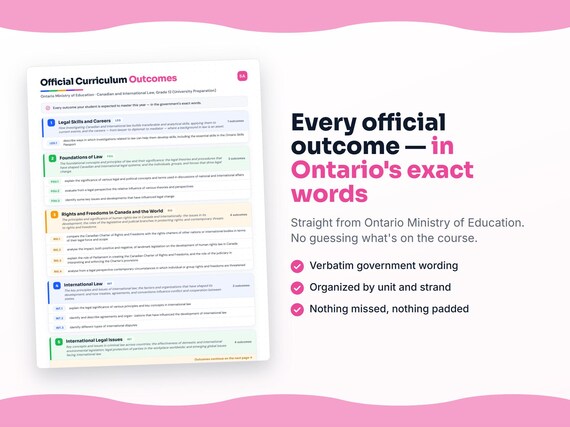
Ontario defines Canadian and International Law, Grade 12 (University Preparation) by strands and outcomes. MapleMind teaches the same curriculum reorganized for one-skill-at-a-time tutoring — the table shows exactly where every official strand lands, and the ministry's own wording is quoted under each unit below.
Official source Ontario's official curriculumRead it on the government site — dcp.edu.gov.on.ca ↗| Official strand | Outcomes | Where MapleMind teaches it |
|---|---|---|
| Strand A | 4 | Legal Skills and Careers |
| Strand B | 11 | Foundations of Law |
| Strand C | 14 | Rights and Freedoms in Canada and the World |
| Strand D | 10 | International Law |
| Strand E | 17 | International Legal Issues |
Every skill below, taught one on one.
 Try the first session free
How MapleMind teaches Canadian and International Law, Grade 12 (University Preparation) — every unit, lesson, and skill
Every skill below runs as a short session: a plain-words lesson, a worked example, solving it together, then a five-question skill check that earns up to three stars. Guided Mode keeps it teaching instead of answer-handing — turning it off needs a parent's password.
Unit 1Legal Skills and CareersOfficial strand · Strand A
How investigating Canadian and international law builds transferable and analytical skills, applying them to current events, and the careers — from lawyer to diplomat to mediator — where a background in law is an asset.
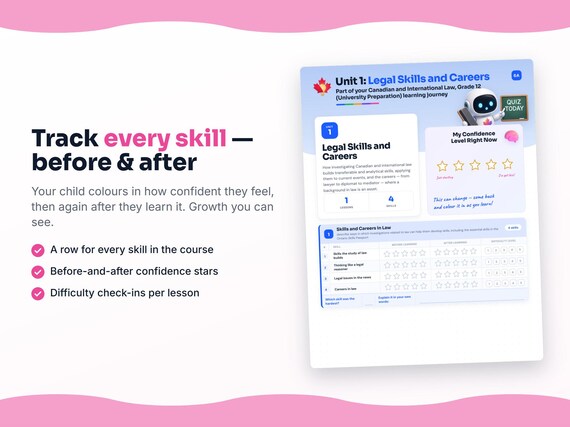
Skills and Careers in Law
- Skills the study of law buildscln4u.A2.1 — Describe ways investigations related to law help develop transferable skills — including the essential skills in the Ontario Skills Passport — that apply to postsecondary study, work, and everyday life.
- Thinking like a legal reasonercln4u.A2.2 — Apply, in everyday contexts, the skills and work habits developed through the study of law — critical thinking to evaluate arguments and reasoning to draw inferences from evidence.
- Legal issues in the newscln4u.A2.3 — Use the concepts of legal thinking when analysing current events related to legal issues, to enhance understanding and one's role as an informed citizen.
- Careers in lawcln4u.A2.4 — Identify careers in which a law background might be useful — lawyer, negotiator, mediator, diplomat, non-governmental organization staff member.
The official wording — 4 outcomes in this unit
- cln4u.A2.1
describe ways in which investigations related to law can help them develop skills, including the essential skills in the Ontario Skills Passport
- cln4u.A2.2
apply in everyday contexts skills and work habits developed through and relevant to the study of law
- cln4u.A2.3
use the concepts of legal thinking when analysing current events related to legal issues
- cln4u.A2.4
identify careers in which a law background might be useful
Unit 2Foundations of LawOfficial strand · Strand B
The foundational concepts and principles of law and their significance; the legal theories and procedures that have shaped Canadian and international legal systems; and the individuals, groups, and forces that drive legal change.
Foundational Concepts and Principles
- Key legal and political conceptscln4u.B1.1 — Explain the significance of various legal and political concepts and terms used in discussions of national and international affairs — democracy, rule of law, sovereignty, jurisdiction, parliamentary supremacy.
- Non-legal influences on lawcln4u.B1.2 — Explain how various non-legal influences — religion, philosophy, history, customs, changing values — have affected and continue to affect laws, legal thinking, and judgements.
- Distinctions and areas of lawcln4u.B1.3 — Explain the distinctions between domestic and international law, substantive and procedural law, public and civil law, and various areas of law such as tort, family, and constitutional law.
- How law affects everyday lifecln4u.B1.4 — Explain how different types of law affect people's everyday lives — public law such as criminal and constitutional; civil law such as tort, family, employment, and contract.
Legal Theories and Procedures
- Legal theories and perspectivescln4u.B2.1 — Evaluate from a legal perspective the relative influence of various theories and perspectives — natural law, positive law, legal realism, feminist theory, critical race theory, Indigenous perspectives — on the interpretation and administration of laws.
- Theories of criminal behaviourcln4u.B2.2 — Explain from a legal perspective how various physiological, psychological, and sociological theories of criminal behaviour — Lombroso, Durkheim, Merton, Freud — have influenced criminal law.
- Systems for adjudicating disputescln4u.B2.3 — Explain various historical and contemporary methods and systems for adjudicating legal questions — trial by ordeal, adversarial versus inquisitorial systems, Indigenous sentencing circles, the International Court of Justice.
- Advocating for legal reformcln4u.B2.4 — Assess the relative effectiveness of various legal or political means used by individuals and groups to advocate for legal reform — lobbying, voting, court challenges, civil disobedience, social media campaigns.
Influences on Legal Change
- Issues that drive legal changecln4u.B3.1 — Identify some key issues and developments that have influenced legal change — technological developments, national and international events, disasters, media campaigns — and explain how they promoted or prevented change.
- Reformers and their reasonscln4u.B3.3 — Explain the reasons of various individuals and groups for seeking legal reform — Viola Desmond, Sandra Lovelace, Aung San Suu Kyi, the Assembly of First Nations, Amnesty International — and assess the significance of reforms achieved.
The official wording — 11 outcomes in this unit
- cln4u.B1.1
explain the significance of various legal and political concepts and terms used in discussions of national and international affairs
- cln4u.B1.2
explain how various non-legal influences have affected and/or continue to affect laws, legal thinking, and judgements
- cln4u.B1.3
explain the distinctions between domestic and international law, substantive and procedural law, public and civil law, and various areas of law
- cln4u.B1.4
explain how different types of law affect people’s everyday lives
- cln4u.B2.1
evaluate from a legal perspective the relative influence of various theories and perspectives
- cln4u.B2.2
explain from a legal perspective how various physiological, psychological, and sociological theories of criminal behaviour
- cln4u.B2.3
explain various historical and contemporary methods and systems for adjudicating legal questions
- cln4u.B2.4
assess the relative effectiveness of various legal or political means used by individuals and groups to advocate for legal reform
- cln4u.B3.1
identify some key issues and developments that have influenced legal change
- cln4u.B3.2
explain how evolving social attitudes, values, and circumstances have promoted or prevented changes in various areas of Canadian and international law over time
- cln4u.B3.3
explain the reasons of various individuals and groups for seeking legal reform
Unit 3Rights and Freedoms in Canada and the WorldOfficial strand · Strand C
The principles and significance of human rights law in Canada and internationally; the issues in its development; the roles of the legislative and judicial branches in protecting rights; and contemporary threats to rights and freedoms.
The Principles of Human Rights Law
- Comparing rights charterscln4u.C1.1 — Compare the Canadian Charter of Rights and Freedoms with the rights charters of other nations or international bodies in terms of their legal force and scope.
- Charter rights and responsibilitiescln4u.C1.2 — Identify the rights and freedoms protected by the Charter and their corresponding responsibilities — such as the right to trial by jury and the responsibility to serve on a jury — and explain their implications.
- International human rights treatiescln4u.C1.3 — Explain the legal implications of a country's signing of internationally recognized human rights treaties and conventions — the Universal Declaration of Human Rights, the Convention on the Rights of the Child, the Geneva Conventions.
The Development of Human Rights Law
- Landmark rights legislationcln4u.C2.1 — Analyse the impact, both positive and negative, of landmark legislation on the development of human rights law in Canada — the Indian Act, the Canadian Bill of Rights, the Charter.
- Progress in removing barrierscln4u.C2.2 — Evaluate progress in removing historical and contemporary barriers to equal rights for individuals and groups, in Canada and internationally — barriers of class, race, gender, ability, and poverty.
- Addressing human rights violationscln4u.C2.3 — Analyse various issues associated with addressing human rights violations, with reference to past and present examples in Canada and around the world — the Holocaust, residential schools, apartheid, Africville.
- Strengthening rights protectioncln4u.C2.4 — Analyse the contributions of individuals and groups to strengthening protection for human rights in Canada and internationally — Nelson Mandela, Louise Arbour, Amnesty International, Human Rights Watch.
Protecting Rights: Legislature and Judiciary
- Parliament, the courts, and the Chartercln4u.C3.1 — Explain the role of Parliament in creating the Charter and the role of the judiciary in interpreting and enforcing its provisions.
- How people protect their rightscln4u.C3.2 — Compare from a legal perspective various ways people living in Canada can act to protect their rights — complaints to the ombudsman, litigation, petitions, voting, media campaigns.
- Justifying limits on rightscln4u.C3.3 — Explain from a legal perspective — with reference to Charter sections 1 and 33 — why it may or may not be justifiable to limit individual or collective rights and freedoms in some situations, as in R. v. Keegstra or R. v. Oakes.
- Rights protection across countriescln4u.C3.4 — Compare the roles of different branches of government in creating, interpreting, and enforcing legislation affecting human rights in various countries — counter-terrorism laws in the UK, US, and Canada.
Contemporary Issues in Human Rights
- Contemporary threats to rightscln4u.C4.1 — Analyse from a legal perspective contemporary circumstances in which individual or group rights and freedoms are threatened or limited — loss of privacy due to cybercrime, travel security checks.
- Workers' rights across jurisdictionscln4u.C4.2 — Compare from a legal perspective the rights and protections — workplace safety, pay equity, unionization — for various kinds of workers in Canadian and non-Canadian jurisdictions.
- Rights and the environmentcln4u.C4.3 — Assess the strengths and weaknesses of current laws for protecting the rights of individuals and groups — such as Indigenous peoples — from the impact of human activities that change the natural environment.
The official wording — 14 outcomes in this unit
- cln4u.C1.1
compare the Canadian Charter of Rights and Freedoms with the rights charters of other nations or international bodies in terms of their legal force and scope
- cln4u.C1.2
identify the rights and freedoms protected by the Canadian Charter of Rights and Freedoms, and their corresponding responsibilities or obligations
- cln4u.C1.3
explain the legal implications of a country’s signing of various internationally recognized treaties and conventions related to the protection of human rights
- cln4u.C2.1
analyse the impact, both positive and negative, of landmark legislation on the development of human rights law in Canada
- cln4u.C2.2
evaluate progress in removing historical and contemporary barriers to the enjoyment of equal rights by various individuals and groups
- cln4u.C2.3
analyse various issues associated with addressing human rights violations
- cln4u.C2.4
analyse the contributions of various individ- uals and groups to strengthening protection for human rights in Canada and internationally
- cln4u.C3.1
explain the role of Parliament in creating the Canadian Charter of Rights and Freedoms, and the role of the judiciary in interpreting and enforcing the Charter’s provisions
- cln4u.C3.2
compare from a legal perspective various ways in which people living in Canada can act to protect their rights
- cln4u.C3.3
explain from a legal perspective
- cln4u.C3.4
compare the roles of different branches of government
- cln4u.C4.1
analyse from a legal perspective contemporary circumstances in which individual or group rights and freedoms are threatened
- cln4u.C4.2
compare from a legal perspective the rights and protections
- cln4u.C4.3
assess the strengths and weaknesses of current laws for protecting the rights of individuals and various groups
Unit 4International LawOfficial strand · Strand D
The key principles and issues of international law; the factors and organizations that have shaped its development; and how treaties, agreements, and conventions influence conflict and cooperation between states.
Principles of International Law
- Principles and concepts of international lawcln4u.D1.1 — Explain the legal significance of various principles and key concepts in international law — the rule of law, diplomatic immunity, collective security, national sovereignty, customary and treaty law.
- Challenges in making treatiescln4u.D1.2 — Describe various challenges that face sovereign states in creating, ratifying, and implementing international treaties — divergent interests in foreign policy, equity, and territorial claims.
- Types of international crimescln4u.D1.3 — Identify and define various types of international crimes — crimes against humanity, war crimes, genocide, human trafficking, money laundering.
How International Law Developed
- Agreements that shaped international lawcln4u.D2.1 — Identify and describe agreements and organizations that have influenced the development of international law — the Treaty of Westphalia, the League of Nations, the United Nations, the Geneva Convention.
- International organizations and courtscln4u.D2.2 — Explain, using historical and contemporary examples, the roles of international organizations and courts — the UN, the International Court of Justice, the International Criminal Court — including the scope of their legal mandate.
International Conflict and Cooperation
- Resolving international disputescln4u.D3.1 — Identify different types of international disputes — treaty violations, boundary disputes, resource access — and compare the strengths and weaknesses of peaceful and non-peaceful methods of resolving them.
- The ICJ and ICC comparedcln4u.D3.2 — Compare the legal mandate in enforcing international law of the International Court of Justice — adjudicating disputes between states — with that of the International Criminal Court, which prosecutes individuals for crimes like genocide.
- Canadian and international perspectivescln4u.D3.3 — Compare Canadian and international perspectives on global issues addressed in international treaties and agreements — human rights, environmental protection, collective security, trade barriers.
- Domestic laws that violate international rightscln4u.D3.4 — Analyse examples of domestic laws and practices that violate or have violated human rights protected under international law — apartheid in South Africa, anti-LGBT laws, use of child soldiers.
- Canada's record on alliances and treatiescln4u.D3.5 — Analyse Canada's record of supporting or not supporting various alliances, agreements, and treaties under international law — NATO, NAFTA, UN human rights conventions.
The official wording — 10 outcomes in this unit
- cln4u.D1.1
explain the legal significance of various principles and key concepts in international law
- cln4u.D1.2
describe various challenges that face sovereign states in creating, ratifying, and implementing international treaties
- cln4u.D1.3
identify and define various types of inter- national crimes
- cln4u.D2.1
identify and describe agreements and organ- izations that have influenced the development of international law
- cln4u.D2.2
explain, using historical and contemporary examples, the roles of various international organizations and courts
- cln4u.D3.1
identify different types of international disputes
- cln4u.D3.2
compare the legal mandate in the enforcement of international law of the International Court of Justice
- cln4u.D3.3
compare Canadian and international perspectives on global issues
- cln4u.D3.4
analyse examples of domestic laws and practices that violate or have violated human rights protected under international law or conventions
- cln4u.D3.5
analyse Canada’s record of supporting or not supporting various alliances, agreements, and treaties under international law
Unit 5International Legal IssuesOfficial strand · Strand E
Key concepts and issues in criminal law across countries; the effectiveness of domestic and international environmental legislation; legal protection of parties in the workplace worldwide; and emerging global issues facing international law.
Criminal Law Across Countries
- Morality and definitions of crimecln4u.E1.1 — Analyse from a legal perspective the concept of morality and differing definitions of certain criminal offences in the domestic law of various countries — homicide, assisted suicide, hate crimes, computer crimes.
- Bringing an accused to trialcln4u.E1.2 — Describe the key steps in the legal process of bringing an accused to trial in Canada and in international contexts, and explain the legal reasons for each step.
- International intervention in crimescln4u.E1.3 — Assess from a legal perspective the strengths and weaknesses of arguments for and against interventions by the international community in crimes against people of a particular region or ethnicity — the Rwanda and Darfur genocides.
- Enforcing law across borderscln4u.E1.4 — Compare the activities of domestic and international organizations that enforce law or monitor justice systems — Interpol, Human Rights Watch — and identify where their roles might conflict.
- Legal power across borderscln4u.E1.5 — Describe ways in which countries exercise legal power outside their own borders — 'no-fly' lists, diplomatic immunity — and ways they cooperate or do not cooperate through extradition.
- Sentencing across countriescln4u.E1.6 — Analyse the relationship between the principles and purposes of sentencing — parity, proportionality — and the penalties imposed in the criminal justice systems of various countries, including capital punishment.
Environmental Law, Domestic and International
- Purposes of environmental lawcln4u.E2.1 — Explain the purposes of environmental protection laws and the considerations influencing how such laws are framed — national sovereignty, sustainable development, the polluter-pays principle, intergenerational equity.
- Who develops and enforces environmental lawcln4u.E2.2 — Describe from a legal perspective the role of various individuals and groups in developing and enforcing environmental protection laws — Maude Barlow, Environmental Defence, the Sierra Club, Indigenous groups.
- Opposition to environmental agreementscln4u.E2.4 — Assess the validity of reasons put forward by various stakeholders for opposing environmental protection agreements — claims that such laws are unnecessary, ineffective, or not economically viable.
- Environmental protection agreementscln4u.E2.5 — Describe the purpose and actual or potential effects of single-country and international environmental protection agreements — the Montreal Protocol, the Kyoto Protocol, the UN Framework Convention on Climate Change.
Workplace Law and Emerging Global Issues
- Governments and workplace lawcln4u.E3.1 — Explain the role of governments, in Canada and internationally, in developing laws relating to labour and the workplace, and identify key components of existing laws — the Canada Labour Code, the Employment Standards Act.
- Parties in workplace lawcln4u.E3.2 — Analyse and describe the relationships between the key parties affected by laws regarding workplace behaviour and standards, in Canada and internationally — employees, employers, unions, corporations, governments.
- Workplace safety and labour law violationscln4u.E3.3 — Explain the legal issues raised by various violations of Canadian and/or international workplace safety codes and labour laws — the 2010 BP Deepwater Horizon disaster, use of child labour.
Emerging Global Issues in International Law
- Technology and the administration of justicecln4u.E4.1 — Analyse from a legal perspective how technological advances — in communications, surveillance, medical science — may challenge or support the administration of justice, in Canada and internationally.
- International economic organizationscln4u.E4.2 — Analyse from a legal perspective the advantages and disadvantages of participation in international economic organizations and agreements — the World Trade Organization, the European Union, NAFTA.
- International agreements and rightscln4u.E4.3 — Evaluate the strengths and weaknesses of international agreements in protecting various rights and freedoms — the rights of women, children, and Indigenous people; religious and animal rights.
The official wording — 17 outcomes in this unit
- cln4u.E1.1
analyse from a legal perspective the concept of morality as well as differing definitions of certain criminal offences in the domestic law of various countries
- cln4u.E1.2
describe the key steps in the legal process of bringing an accused to trial in Canada and in international contexts
- cln4u.E1.3
assess from a legal perspective the strengths and weaknesses of arguments for and against interventions by the international community
- cln4u.E1.4
compare the activities of some organizations, both domestic and international, that enforce law
- cln4u.E1.5
describe ways in which countries exercise legal power outside their own borders
- cln4u.E1.6
analyse the relationship between the principles and purposes of sentencing
- cln4u.E2.1
explain the purposes of environmental protection laws
- cln4u.E2.2
describe from a legal perspective the role of various individuals and groups in developing and enforcing environmental protection laws
- cln4u.E2.3
analyse from a legal perspective the strengths and weaknesses of international laws to protect key natural resources held in common around the world
- cln4u.E2.4
assess the validity of reasons put forward by various stakeholders for opposing various environmental protection agreements
- cln4u.E2.5
describe the purpose and actual or potential effects of various single-country and multilat- eral/international environmental protection agreements
- cln4u.E3.1
explain the role of governments, in Canada and internationally, in developing laws relating to labour and the workplace
- cln4u.E3.2
analyse and describe the relationships between the key parties affected by laws regarding behaviour and standards in the workplace
- cln4u.E3.3
explain the legal issues raised by various violations of Canadian and/or international
- cln4u.E4.1
analyse from a legal perspective how various technological advances
- cln4u.E4.2
analyse from a legal perspective the advan- tages and/or disadvantages of participation in international economic organizations and agreements
- cln4u.E4.3
evaluate the strengths and weaknesses of international agreements in protecting various rights and freedoms
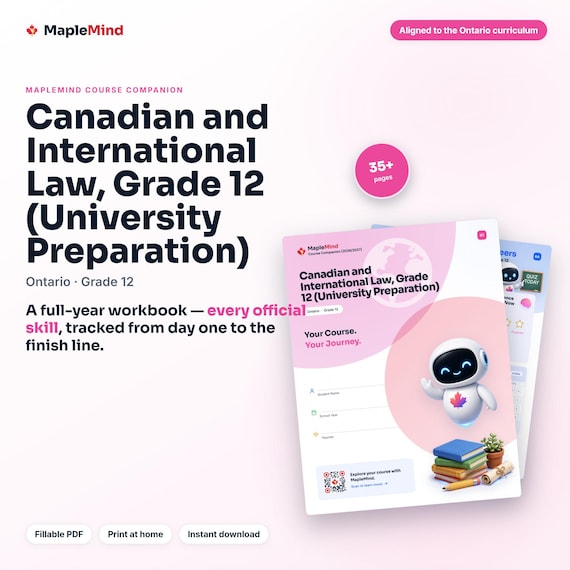
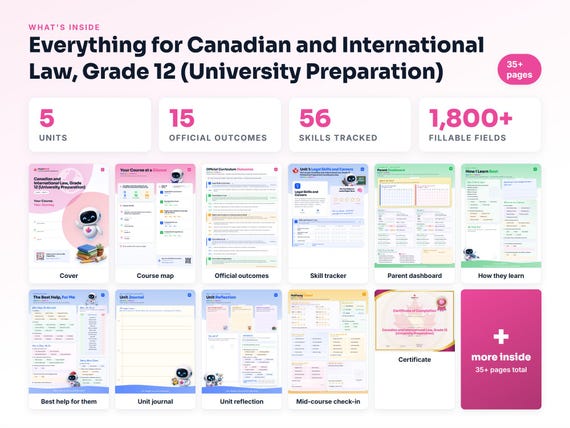
Printable workbook · A keepsake of the year
A Canadian and International Law, Grade 12 (University Preparation) workbook worth keeping
Built from the same official curriculum as this page. Before and after each skill above, your student colours in how sure they feel — so the two of you can see, on one page, what's clicking and what needs another look. It's a quiet way to follow how the year is really going.
By June it's full of their own handwriting: units worked through, confidence grown, a mid-year check-in, notes from parent-teacher night, and a certificate at the end. Less a worksheet, more a record of the year worth keeping on the shelf.
Instant download · see every page, reviews and the full description · five or more workbooks are $2.99 each
What it looks like in the app



Common questions
Can MapleMind help me with Canadian and International Law, Grade 12 (University Preparation)?
Yes. MapleMind's AI tutor covers all 56 skills in Ontario's Canadian and International Law, Grade 12 (University Preparation) — you pick the exact skill, and the tutor teaches it step by step: a short lesson, a worked example, solving together, then a skill check to show it stuck.
Is MapleMind aligned to Ontario's official curriculum?
Yes. Every skill in this course maps to an official outcome code from Ontario's Grade 12 Social Studies curriculum, and the ministry's own wording is quoted under each unit on this page — with the official government source linked so you can check it yourself.
What does MapleMind cost?
It's free to start — 5 tutoring chats and a practice quiz every day, no credit card. A Pro subscription ($9.99/month or $49.99/year CAD, 7-day free trial) unlocks unlimited tutoring, practice, and exam simulations.
What if I'm stuck on just one topic?
That's the point of skill-level tutoring: open Canadian and International Law, Grade 12 (University Preparation) in the app, tap the exact skill from the list on this page, and the tutor teaches just that — no wading through lessons you don't need.
Does MapleMind work in French or other languages?
Yes — 14 languages, including French. Both the app and the tutor's explanations switch to the language you choose.
Where can I see the official Ontario curriculum for Canadian and International Law, Grade 12 (University Preparation)?
The official source is linked on this page — Ontario's official curriculum. The outline here follows it: every MapleMind skill carries its official outcome code, and the ministry's own wording is quoted under each unit.
Keep exploring
Ready when you are
Pick a skill from this page and see it taught properly — free, in the browser, in under a minute.