Get help with World Issues: A Geographic Analysis, Grade 12 (University Preparation)
Most tutoring makes you sit through material you already know. MapleMind flips that: pick the exact skill that's causing trouble — any of the 43 below — and the tutor teaches just that one, step by step, as many times as it takes. Ask questions in plain words, any time of day, in English, French, or 12 other languages.
The official Ontario World Issues: A Geographic Analysis, Grade 12 (University Preparation) curriculum
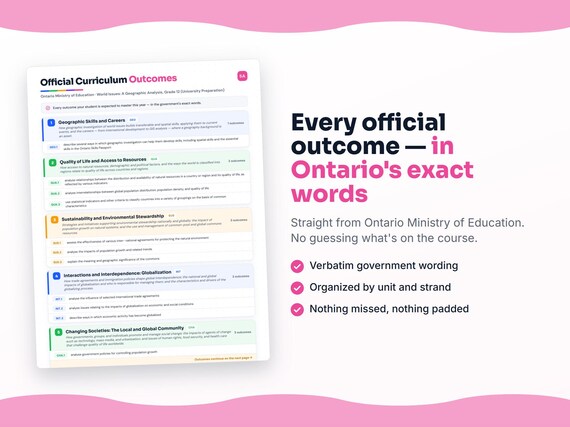
Ontario defines World Issues: A Geographic Analysis, Grade 12 (University Preparation) by strands and outcomes. MapleMind teaches the same curriculum reorganized for one-skill-at-a-time tutoring — the table shows exactly where every official strand lands, and the ministry's own wording is quoted under each unit below.
Official source Ontario's official curriculumRead it on the government site — dcp.edu.gov.on.ca ↗| Official strand | Outcomes | Where MapleMind teaches it |
|---|---|---|
| Strand A | 4 | Geographic Skills and Careers |
| Strand B | 9 | Quality of Life and Access to Resources |
| Strand C | 10 | Sustainability and Environmental Stewardship |
| Strand D | 9 | Interactions and Interdependence: Globalization |
| Strand E | 11 | Changing Societies: The Local and Global Community |
Every skill below, taught one on one.
 Try the first session free
How MapleMind teaches World Issues: A Geographic Analysis, Grade 12 (University Preparation) — every unit, lesson, and skill
Every skill below runs as a short session: a plain-words lesson, a worked example, solving it together, then a five-question skill check that earns up to three stars. Guided Mode keeps it teaching instead of answer-handing — turning it off needs a parent's password.
Unit 1Geographic Skills and CareersOfficial strand · Strand A
How geographic investigation of world issues builds transferable and spatial skills, applying them to current events, and the careers — from international development to GIS analysis — where a geography background is an asset.
Skills and Careers in Geographic Analysis
- Skills geographic analysis buildscgw4u.A2.1 — Describe ways geographic investigation helps develop transferable and spatial skills — including the essential skills in the Ontario Skills Passport — that apply to work and everyday life.
- Working like a geographercgw4u.A2.2 — Apply, in everyday contexts, the skills and work habits developed through geographic investigation, such as considering multiple perspectives and using data to support an idea.
- World issues in the newscgw4u.A2.3 — Apply the concepts of geographic thinking — spatial significance, patterns and trends, interrelationships, geographic perspective — when analysing current events involving geographic issues.
- Careers in geographycgw4u.A2.4 — Identify careers — such as international development aid worker, policy analyst, GIS specialist, or environmental assessment officer — in which a geography background is an asset.
The official wording — 4 outcomes in this unit
- cgw4u.A2.1
describe several ways in which geographic investigation can help them develop skills, including spatial skills and the essential skills in the Ontario Skills Passport
- cgw4u.A2.2
apply in everyday contexts skills and work habits developed through geographic investigation
- cgw4u.A2.3
apply the concepts of geographic thinking when analysing current events involving geographic issues
- cgw4u.A2.4
identify some careers in which a geography background might be an asset
Unit 2Quality of Life and Access to ResourcesOfficial strand · Strand B
How access to natural resources, demographic and political factors, and the ways the world is classified into regions relate to quality of life across countries and regions.
Resources, Conflict, and Quality of Life
- Resources and quality-of-life indicatorscgw4u.B1.1 — Analyse relationships between the distribution and availability of natural resources in a country or region and its quality of life, as reflected by indicators such as life expectancy, infant mortality, and per capita income.
- Resources and conflictcgw4u.B1.2 — Assess relationships between disparities in the distribution or quality of resources — land, water, energy — and social or political conflicts.
- The ethics of resource controlcgw4u.B1.3 — Analyse ethical issues relating to the control and development of natural resources and the distribution of economic benefits from resource exploitation.
Population, Politics, and Quality of Life
- Population distribution and quality of lifecgw4u.B2.1 — Analyse interrelationships between global population distribution, population density, and quality of life.
- Migration and quality of lifecgw4u.B2.2 — Analyse interrelationships between population migration — international, internal, refugees — and quality of life.
- Policies of the past and inequalitycgw4u.B2.3 — Assess the effects of past and present political and economic policies — colonialism, boundary changes, trade and development agreements — on inequality.
Classifying the World into Regions
- Classifying countries with indicatorscgw4u.B3.1 — Use statistical indicators and other criteria — GDP, per capita income, literacy rate, life expectancy — to classify countries into groupings based on common characteristics.
- The limits of classificationcgw4u.B3.2 — Evaluate particular indicators or characteristics used to classify countries, and analyse the advantages and disadvantages of their use.
- Classification applied to global issuescgw4u.B3.3 — Apply statistical indicators and regional classification systems to the analysis of current global issues.
The official wording — 9 outcomes in this unit
- cgw4u.B1.1
analyse relationships between the distribution and availability of natural resources in a country or region and its quality of life, as reflected by various indicators
- cgw4u.B1.2
assess relationships between disparities in the distribution or quality of resources
- cgw4u.B1.3
analyse ethical issues relating to the control and development of natural resources and the distribution of economic benefits from resource exploitation
- cgw4u.B2.1
analyse interrelationships between global population distribution, population density, and quality of life
- cgw4u.B2.2
analyse interrelationships between population migration
- cgw4u.B2.3
assess the effects of past and present political and economic policies on inequality
- cgw4u.B3.1
use statistical indicators and other criteria to classify countries into a variety of groupings on the basis of common characteristics
- cgw4u.B3.2
evaluate particular indicators or characteristics that are used to classify countries, and analyse the advantages and disadvantages of their use
- cgw4u.B3.3
apply statistical indicators and regional classification systems to the analysis of current global issues
Unit 3Sustainability and Environmental StewardshipOfficial strand · Strand C
Strategies and initiatives supporting environmental stewardship nationally and globally; the impact of population growth on natural systems; and the use and management of common-pool and global commons resources.
Protecting the Environment: Agreements and Initiatives
- International environmental agreementscgw4u.C1.1 — Assess the effectiveness of international agreements — the UN Framework Convention on Climate Change, the Kyoto Protocol, the Montreal Protocol — for protecting the natural environment.
- Who is responsible for the environmentcgw4u.C1.2 — Analyse the roles and responsibilities of international organizations, governments, and companies with respect to the protection of the natural environment.
- Values, beliefs, and public opinioncgw4u.C1.3 — Analyse the influence of the values and beliefs of individuals and groups — environmental NGOs, business advocacy groups, First Nations, Inuit, and Métis people — in shaping public opinion about environmental sustainability.
- National sustainability policiescgw4u.C1.4 — Analyse the effectiveness of policies, programs, and initiatives in various countries — polluter-pay policies, carbon taxes, emission trading — in enhancing sustainability.
- Local sustainability initiativescgw4u.C1.5 — Assess the effectiveness of local sustainability initiatives — hazardous waste programs, community gardens, green roofs, Earth Hour — in building sustainable communities.
Population Growth and the Limits of the Earth
- Population growth and the environmentcgw4u.C2.1 — Analyse the impacts of population growth and related trends — urbanization, migration, increased travel — on the natural environment.
- Theories of carrying capacitycgw4u.C2.2 — Analyse theories relating to the impact of global population growth on the carrying capacity of the earth — the Gaia hypothesis, I=PAT, limits to growth, the demographic transition model.
Managing the Commons
- The commons and the global commonscgw4u.C3.1 — Explain the meaning and geographic significance of the commons — common-pool resources such as water, fish, and forests — and the global commons — the atmosphere, oceans, outer space, and Antarctica.
- Human impact on the commonscgw4u.C3.2 — Analyse the impacts of human activities on the commons — overfishing, atmospheric pollution, water pollution, water depletion.
- Managing the commonscgw4u.C3.3 — Analyse issues relating to the management of the commons.
The official wording — 10 outcomes in this unit
- cgw4u.C1.1
assess the effectiveness of various inter- national agreements for protecting the natural environment
- cgw4u.C1.2
analyse the roles and responsibilities of international organizations, governments, and companies with respect to the protection of the natural environment
- cgw4u.C1.3
analyse the influence of the values and beliefs of individuals and groups
- cgw4u.C1.4
analyse the effectiveness of policies, programs, and initiatives in various countries in enhancing sustainability
- cgw4u.C1.5
assess the effectiveness of local sustainability initiatives in building sustainable communities
- cgw4u.C2.1
analyse the impacts of population growth and related trends
- cgw4u.C2.2
analyse theories relating to the impact of global population growth on the carrying capacity of the earth
- cgw4u.C3.1
explain the meaning and geographic significance of the commons
- cgw4u.C3.2
analyse the impacts of human activities on the commons
- cgw4u.C3.3
analyse issues relating to the management of the commons
Unit 4Interactions and Interdependence: GlobalizationOfficial strand · Strand D
How trade agreements and immigration policies shape global interdependence; the national and global impacts of globalization and who is responsible for managing them; and the characteristics and drivers of the globalizing process.
Trade, Immigration, and a Connected World
- Trade agreements and interdependencecgw4u.D1.1 — Analyse the influence of selected international trade agreements — such as CETA between Canada and the EU — on global interdependence and the well-being of participating countries.
- Immigration and interdependencecgw4u.D1.2 — Analyse the influence of immigration on global interdependence and on individual countries, and assess the role of national immigration policies in managing population change.
The Impacts of Globalization and Who Manages Them
- Impacts on economies and the environmentcgw4u.D2.1 — Analyse issues relating to the impacts of globalization on economic and social conditions in developing and developed countries and on the environment.
- Globalization and connections between countriescgw4u.D2.2 — Analyse the impacts of globalization on individual countries and on the interrelationships between countries, including increased interdependence and the internationalization of local conflicts.
- The responsibility of consumerscgw4u.D2.3 — Assess the responsibility of consumers for moderating the impacts associated with globalization, and describe ways this could be done — buying fair-trade, boycotting exploitive products, supporting NGOs.
- The responsibility of governments and businessescgw4u.D2.4 — Assess the responsibilities of governments and businesses for managing the impacts of globalization, and describe ways this could be done — national laws, the ILO, codes of conduct.
What Globalization Is and What Drives It
- The globalization of economic activitycgw4u.D3.1 — Describe ways in which economic activity has become globalized — integration of national economies, outsourcing, and the dominance of multinational corporations.
- What drives the globalized economycgw4u.D3.2 — Analyse factors that have influenced the trend towards a globalized economy — trade agreements, consumerism, low wages abroad, advances in communications and transportation.
- The globalization of culturecgw4u.D3.3 — Describe the globalization of culture — the growing similarity of everyday life across countries — and analyse the factors, such as communications technology and migration, that contribute to it.
The official wording — 9 outcomes in this unit
- cgw4u.D1.1
analyse the influence of selected international trade agreements
- cgw4u.D1.2
analyse the influence of immigration on global interdependence and on individual countries
- cgw4u.D2.1
analyse issues relating to the impacts of globalization on economic and social conditions
- cgw4u.D2.2
analyse the impacts of globalization on indi- vidual countries and on the interrelationships between countries
- cgw4u.D2.3
assess the responsibility of consumers for moderating economic, social, and environmental impacts associated with globalization
- cgw4u.D2.4
assess the responsibilities of governments and businesses for managing economic, en- vironmental, and social impacts associated with globalization
- cgw4u.D3.1
describe ways in which economic activity has become globalized
- cgw4u.D3.2
analyse factors that have influenced the trend towards a globalized economy
- cgw4u.D3.3
describe the globalization of culture
Unit 5Changing Societies: The Local and Global CommunityOfficial strand · Strand E
How governments, groups, and individuals promote and manage social change; the impacts of agents of change such as technology, mass media, and urbanization; and issues of human rights, food security, and health care that challenge quality of life worldwide.
Governments, Aid, and Individuals as Agents of Change
- Government population policiescgw4u.E1.1 — Analyse government policies for controlling population growth — such as China's one-child policy or incentives to raise birth rates — and assess their impacts.
- International aidcgw4u.E1.2 — Assess the effectiveness of various international aid policies, programs, and practices — food aid, development aid, infrastructure projects, debt relief — in improving quality of life in developing countries.
- Individuals as global citizenscgw4u.E1.3 — Assess the contributions of individuals to advancing human rights and improving quality of life, and assess the roles and responsibilities of individuals as global citizens in solving issues of global concern.
- State security and human rightscgw4u.E1.4 — Describe how governments protect the security of the state — border security, defence, intelligence, collective security — and analyse issues relating to changing national security needs and human rights.
Technology, Media, and Cities as Agents of Change
- Technology as an agent of changecgw4u.E2.1 — Explain the impact of technology as an agent of change, and describe ways technology could be used to bring about beneficial change in the future.
- Urbanization as an agent of changecgw4u.E2.3 — Analyse the role of urbanization as an agent of social, economic, and environmental change.
Human Rights, Food, and Health Challenges
- Ethnic tension and crimes against humanitycgw4u.E3.1 — Analyse relationships between ethnic and/or religious tensions and crimes against humanity by governments or armed opposition groups, such as in Rwanda or the former Yugoslavia.
- Protecting human rights globallycgw4u.E3.2 — Assess the responsibility of governments and international bodies for the promotion and protection of human rights.
- The rights of women and childrencgw4u.E3.3 — Analyse issues relating to the rights of women and children — child labour, access to education, economic independence — and assess the effectiveness of programs and organizations addressing them.
- Food security and safetycgw4u.E3.4 — Analyse challenges relating to food security and safety, and assess ways of responding to these challenges.
The official wording — 11 outcomes in this unit
- cgw4u.E1.1
analyse government policies for controlling population growth
- cgw4u.E1.2
assess the effectiveness of various inter- national aid policies, programs, and practices
- cgw4u.E1.3
assess the contributions of various individuals to advancing human rights and improving the quality of life in various countries
- cgw4u.E1.4
describe how governments protect the security of the state
- cgw4u.E2.1
explain the impact of technology as an agent of change
- cgw4u.E2.2
analyse the influence of mass media, including the Internet, on social and political change
- cgw4u.E2.3
analyse the role of urbanization as an agent of social, economic, and environmental change
- cgw4u.E3.1
analyse relationships between ethnic and/or religious tensions and crimes against humanity by governments or armed opposition groups
- cgw4u.E3.2
assess the responsibility of governments and international bodies for the promotion and protection of human rights
- cgw4u.E3.3
analyse issues relating to the rights of women and children
- cgw4u.E3.4
analyse challenges relating to food security and safety, and assess ways of responding to these challenges
Printable workbook · A keepsake of the year
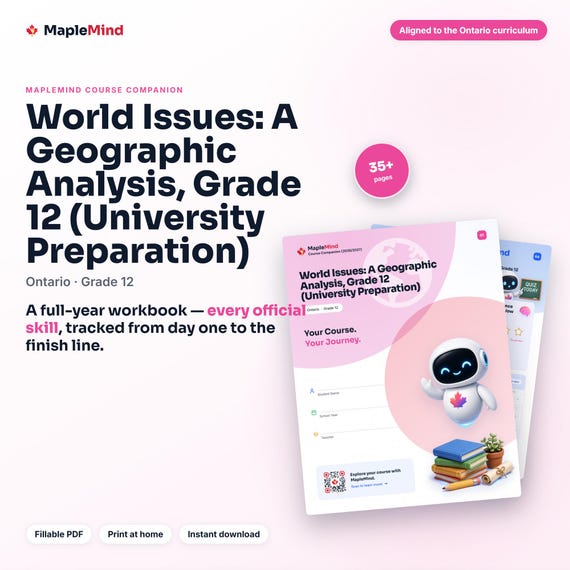
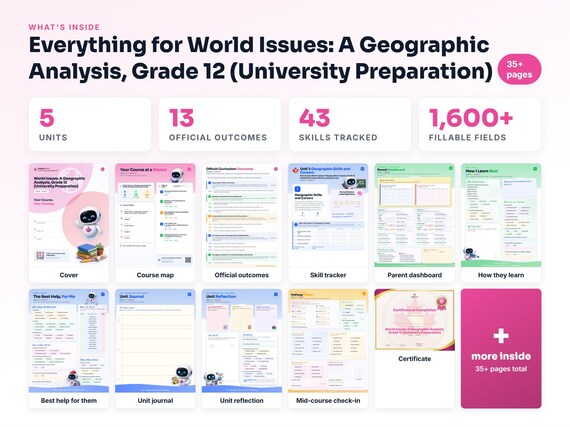
A World Issues: A Geographic Analysis, Grade 12 (University Preparation) workbook worth keeping
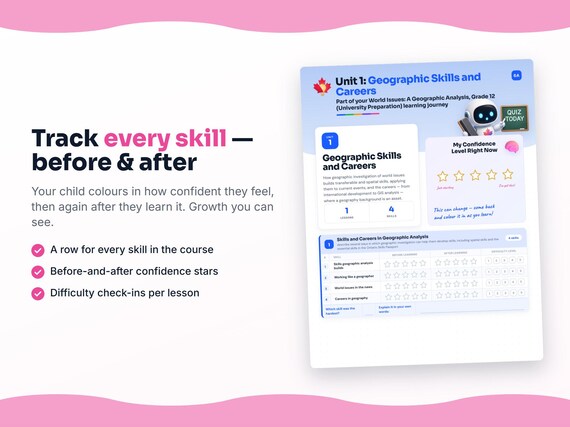
Built from the same official curriculum as this page. Before and after each skill above, your student colours in how sure they feel — so the two of you can see, on one page, what's clicking and what needs another look. It's a quiet way to follow how the year is really going.
By June it's full of their own handwriting: units worked through, confidence grown, a mid-year check-in, notes from parent-teacher night, and a certificate at the end. Less a worksheet, more a record of the year worth keeping on the shelf.
Instant download · see every page, reviews and the full description · five or more workbooks are $2.99 each
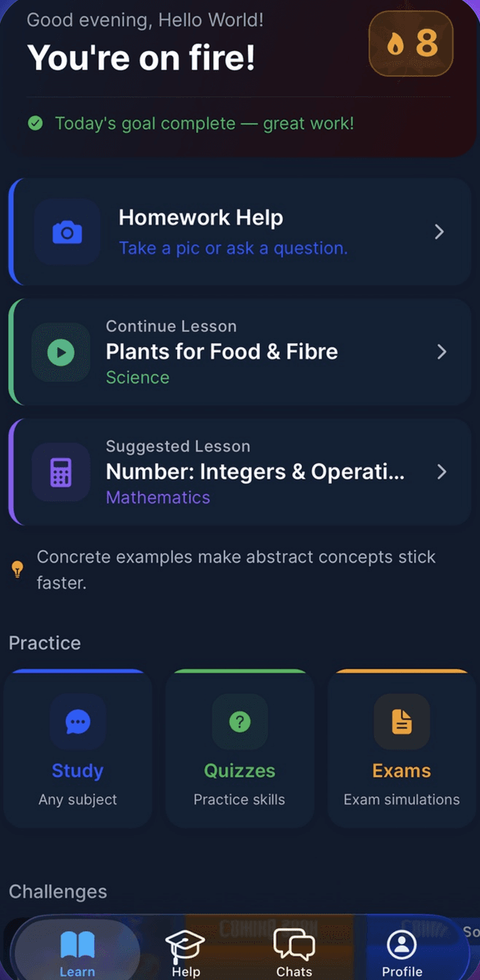
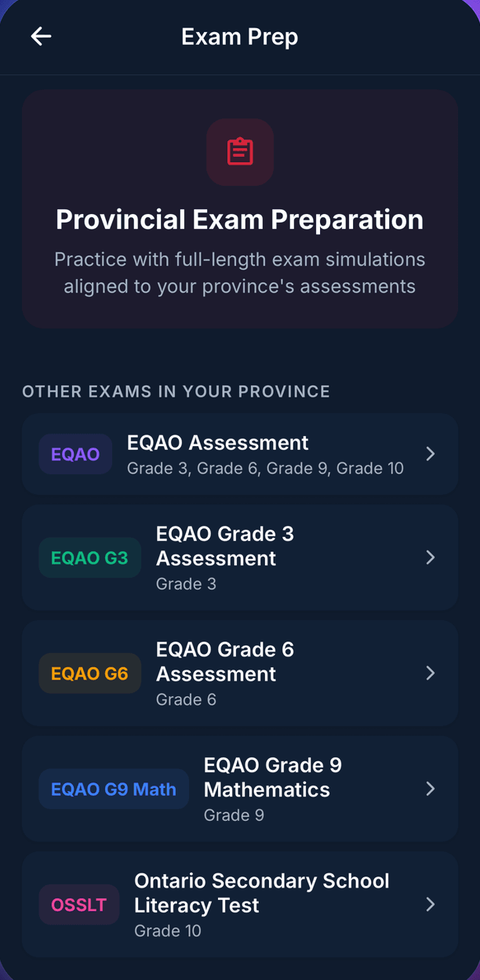
What it looks like in the app

Common questions
Can MapleMind help me with World Issues: A Geographic Analysis, Grade 12 (University Preparation)?
Yes. MapleMind's AI tutor covers all 43 skills in Ontario's World Issues: A Geographic Analysis, Grade 12 (University Preparation) — you pick the exact skill, and the tutor teaches it step by step: a short lesson, a worked example, solving together, then a skill check to show it stuck.
Is MapleMind aligned to Ontario's official curriculum?
Yes. Every skill in this course maps to an official outcome code from Ontario's Grade 12 Social Studies curriculum, and the ministry's own wording is quoted under each unit on this page — with the official government source linked so you can check it yourself.
What does MapleMind cost?
It's free to start — 5 tutoring chats and a practice quiz every day, no credit card. A Pro subscription ($9.99/month or $49.99/year CAD, 7-day free trial) unlocks unlimited tutoring, practice, and exam simulations.
What if I'm stuck on just one topic?
That's the point of skill-level tutoring: open World Issues: A Geographic Analysis, Grade 12 (University Preparation) in the app, tap the exact skill from the list on this page, and the tutor teaches just that — no wading through lessons you don't need.
Does MapleMind work in French or other languages?
Yes — 14 languages, including French. Both the app and the tutor's explanations switch to the language you choose.
Where can I see the official Ontario curriculum for World Issues: A Geographic Analysis, Grade 12 (University Preparation)?
The official source is linked on this page — Ontario's official curriculum. The outline here follows it: every MapleMind skill carries its official outcome code, and the ministry's own wording is quoted under each unit.
Keep exploring
Ready when you are
Pick a skill from this page and see it taught properly — free, in the browser, in under a minute.