Newfoundland & Labrador · For parents

What your child learns in Grade 10 in Newfoundland & Labrador

Every subject, unit by unit, from Newfoundland & Labrador’s curriculum: 250 skills in plain words.

Subjects
5
Skills
250
Provincial exams
None
Official curriculum
gov.nl.ca

Math in Grade 10

2 courses. Choose the one your child takes.

Mathematics 1201 (Academic)

5 units · 42 skills

  1. Unit 1

    Roots and Powers

    The index of a radical names the root: index 2 = square root, index 3 = cube root.

    • The meaning of a radical's index
    • Rational exponents as radicals
    • Applying the exponent laws
    7 more skills
    • Finding errors in power simplifications
    • Perfect squares and perfect cubes
    • Finding square roots and cube roots
    • Prime factors, GCF and LCM
    • Mixed and entire radicals
    • Rational and irrational numbers
    • Estimating and ordering irrational numbers
  2. Unit 2

    Factors and Products

    An area model splits each binomial along a side of a rectangle; the four sub-areas are the partial products.

    • Binomials as an area model
    • Multiplying polynomials symbolically
    • Explaining and checking multiplication strategies
    3 more skills
    • Common factors and the factor-multiply link
    • Factoring trinomials
    • The difference of squares
  3. Unit 3

    Relations and Functions

    The shape of a graph reflects how a quantity changes over time or with another quantity.

    • Situations and graphs
    • Representing relations
    • Deciding whether a relation is a function
    14 more skills
    • Domain and range
    • Recognizing linear relations
    • Slope as rise over run
    • Interpreting slope and its sign
    • Drawing lines and parallel/perpendicular
    • Intercepts of a linear relation
    • Graphing from slope-intercept, general, and slope-point form
    • Comparing and converting forms
    • Writing the equation of a line
    • Linear functions in function notation
    • Evaluating linear functions
    • Modelling with a system of equations
    • Solving systems graphically
    • Solving systems algebraically
  4. Unit 4

    Measurement

    Surface area is the total area of all faces or surfaces of a solid.

    • Surface area of 3-D objects
    • Volume and volume relationships
    • Spheres and composite objects
    3 more skills
    • Referents and estimating linear measure
    • Measuring and personal strategies
    • Converting within and between SI and imperial
  5. Unit 5

    Trigonometry

    For an acute angle, the sides are the hypotenuse, the opposite, and the adjacent.

    • The primary trigonometric ratios
    • Finding missing sides and angles
    • Solving problems with trig and Pythagoras
Mathematics 1202

4 units · 32 skills

  1. Unit 1

    Consumerism and Getting Paid

    Unit price lets you compare different package sizes.

    • Unit price and best buy
    • Percent increase and decrease
    • Exchanging currency
    4 more skills
    • Methods of earning income
    • Hours worked and gross pay
    • From gross pay to net pay
    • Commission and combined pay
  2. Unit 2

    Formulas

    A formula relates several quantities.

    • Applying and rearranging a formula
    • Checking and equivalent formulas
  3. Unit 3

    Measuring Length, Area, and Angles

    SI units scale by powers of ten.

    • The SI system
    • The imperial system
    • Converting SI and imperial units
    18 more skills
    • Converting within a system
    • Fractions in imperial measurement
    • Measuring and estimating length
    • Solving linear measurement problems
    • Finding midpoints
    • Estimating and converting area
    • Area and surface-area problems
    • Area formulas and surface area
    • Angle pairs and relationships
    • Parallel lines and a transversal
    • Angle problems and perpendicular planes
    • Measuring and drawing angles
    • Replicating and bisecting angles
    • Understanding the Pythagorean theorem
    • Using the Pythagorean theorem
    • Pythagorean problem solving
    • Similar polygons
    • Similar right triangles
  4. Unit 4

    Trigonometry

    Each ratio compares two sides of a right triangle for an angle.

    • Sine, cosine, and tangent ratios
    • Solving right triangles with trig

Science in Grade 10

Science 1206

3 units · 27 skills

  1. Unit 1

    Earth and Space Science

    A heat sink is something that can absorb and store a large amount of thermal energy without changing temperature very much.

    • The hydrosphere and atmosphere as heat sinks
    • Heat transfer in the water cycle
    • Heat transfer and air and water currents
    2 more skills
    • Heat transfer and weather systems
    • Analyzing weather data to forecast
  2. Unit 2

    Physical Science

    Ionic compounds form between metals and non-metals; their formulas balance the positive and negative ion charges to zero.

    • Naming and writing chemical formulas
    • Balancing equations and conservation of mass
    • Classifying reactions by type
    11 more skills
    • Classifying acids, bases, and salts
    • Neutralization reactions
    • Factors that affect reaction rate
    • The variables of motion
    • Displacement, velocity, and time
    • Graphing uniform motion
    • Instantaneous and average velocity
    • Graphing non-uniform motion
    • Velocity, time, and acceleration
    • WHMIS and safe handling of lab materials
    • Displaying data in graphs and tables
  3. Unit 3

    Life Science

    An ecosystem's character is shaped by its abiotic conditions — climate, temperature, rainfall, and soil.

    • Similar ecosystems in different places
    • Population equilibrium and resource limits
    • Cycling of matter through an ecosystem
    5 more skills
    • Soil composition and fertility
    • Bioaccumulation through the food chain
    • Impact of external factors on an ecosystem
    • Biodiversity and sustainability
    • Short-term stress and long-term change

English in Grade 10

3 courses. Choose the one your child takes.

English Language Arts 1201 (Academic)

3 units · 19 skills

  1. Unit 1

    Speaking and Listening

    Academic discussion tests ideas — you probe, extend, and refine claims, not just exchange them.

    • Strategies for effective informal communication
    • Advocating a point of view with evidence
    • Questioning to elaborate, clarify, and qualify
    5 more skills
    • Social conventions and cues for purpose and audience
    • Active listening to analyze ideas and information
    • Refining presentation skills in formal contexts
    • How spoken language influences thoughts and opinions
    • Critical listening for reasoning, bias, and reliability
  2. Unit 2

    Reading and Viewing

    Academic readers choose demanding texts deliberately — matching form (essay, poem, article) to an analytical purpose.

    • Engaging with text forms and selecting for purpose
    • Strategies for meaning and comprehension of texts
    • How literary and language devices convey meaning
    3 more skills
    • Critically analyzing texts
    • Justifying points of view through connections
    • How media and visual devices convey meaning
  3. Unit 3

    Writing and Representing

    Academic inquiry runs from a focused question through planned research to a supported conclusion.

    • Approaches and strategies in inquiry and research
    • Evaluating sources for legitimacy and reliability
    • Citing researched information with academic integrity
    2 more skills
    • Creating texts for purposes and audiences
    • Demand and process writing with the six traits

English Language Arts 1202 (Applied)

3 units · 19 skills

  1. Unit 1

    Speaking and Listening

    Everyday communication works when your point is clear, on-topic, and easy for a listener to act on.

    • Strategies for effective informal communication
    • Advocating a point of view with evidence
    • Questioning to elaborate, clarify, and qualify
    5 more skills
    • Social conventions and cues for purpose and audience
    • Active listening to analyze ideas and information
    • Refining presentation skills in formal contexts
    • How spoken language influences thoughts and opinions
    • Critical listening for reasoning, bias, and reliability
  2. Unit 2

    Reading and Viewing

    Everyday reading means choosing the text that gets the job done — a manual, a form, a website, an article.

    • Engaging with text forms and selecting for purpose
    • Strategies for meaning and comprehension of texts
    • How literary and language devices convey meaning
    3 more skills
    • Critically analyzing texts
    • Justifying points of view through connections
    • How media and visual devices convey meaning
  3. Unit 3

    Writing and Representing

    Research works when you know what you're looking for, where to look, and how to keep track of what you find.

    • Approaches and strategies in inquiry and research
    • Evaluating sources for legitimacy and reliability
    • Citing researched information with integrity
    2 more skills
    • Creating texts for purposes and audiences
    • Demand and process writing with the six traits

Literacy 1204

3 units · 23 skills

  1. Unit 1

    Reading and Viewing

    Wide reading across many texts steadily builds background knowledge.

    • Building broader general knowledge from texts
    • Gathering information on a specific topic
    • Making connections to information
    10 more skills
    • Recognizing purpose and audience in texts
    • Using comprehension strategies to build meaning
    • Using text features, conventions, and structures
    • Building vocabulary for specific topics
    • Solving unfamiliar words
    • Setting topics and questions for inquiry
    • Planning how to find answers
    • Expanding topics and questions
    • Comparing related ideas
    • Recognizing the need to question information
  2. Unit 2

    Speaking and Listening

    Appropriate expression matches the setting, audience, and purpose.

    • Expressing ideas appropriately for the situation
    • Expressing ideas clearly
    • Justifying reasoning for opinions
    3 more skills
    • Listening actively to others' ideas
    • Showing empathy and encouragement
    • Considering the impact of how you communicate
  3. Unit 3

    Writing and Representing

    Features (headings, lists, captions) help a reader navigate what you write.

    • Using features and structures to create texts
    • Creating texts with others and on your own
    • Creating texts to organize yourself
    1 more skill
    • Creating texts that meet specific purposes

French in Grade 10

Core French 1200

5 units · 40 skills

  1. Unit 1

    Oral Production

    1200 stays in personal, familiar contexts - your home, school, town.

    • Identifying in familiar contexts
    • Describing in familiar contexts
    • Desires, tastes, and point of view
    3 more skills
    • Expressing agreement and disagreement
    • Speaking with fluency and accuracy
    • Oral presentation strategies
  2. Unit 2

    Oral Interaction (Speaking and Listening)

    Listen for the gist first - who, what, where.

    • Main ideas in oral texts
    • Specific details in oral texts
    • Asking a variety of questions
    7 more skills
    • Answering a variety of questions
    • Exchanging about interests and daily life
    • Exchanging opinions on familiar topics
    • Exchanging information about experiences
    • Asking for and giving simple directions
    • Fluency and accuracy in exchanges
    • Presentation strategies in interaction
  3. Unit 3

    Reading and Viewing

    Titles, headings, and images signal the main idea.

    • Main idea in written and visual texts
    • Supporting details in texts
    • Extracting information for a task
    5 more skills
    • Following written instructions
    • Using reading strategies
    • Reading with accuracy and precision
    • Responding to simple texts
    • Agreeing and disagreeing with ideas in texts
  4. Unit 4

    Writing and Representing

    Start from a familiar topic - yourself, your family, your interests.

    • Creating short simple texts
    • Completing personal texts
    • Using the writing process
    6 more skills
    • Writing with precision and accuracy
    • Completing and publishing a text
    • Culture in writing: holidays, presence, and figures
    • A francophone presence in Canada
    • Well-known francophones and their contributions
    • Responding through writing and representing
  5. Unit 5

    Appreciation of Language and Cultural Diversity

    In Canada: Quebec, Acadie, Ontario, the West, and Newfoundland's Port-au-Port.

    • Identifying francophone populations
    • Describing francophone populations
    • Well-known francophones and contributions
    4 more skills
    • Holidays in one's own culture
    • Holidays in francophone cultures
    • Comparing local and francophone celebrations
    • Influence of other cultures on personal interests

Social studies in Grade 10

2 courses. Choose the one your child takes.

Social Studies 1201 (Academic)

4 units · 25 skills

  1. Unit 1

    Social Studies Concepts and Skills - 1. Civic Engagement

    Canadian democracy rests on evolving ideals we should not take for granted.

    • The principles of Canadian democracy
  2. Unit 2

    Social Studies Concepts and Skills - 2. Inquiry and Research

    Supported opinions rest on factual evidence, judged for quantity and quality.

    • Evidence, comparison, and causation
    • Significance, perspective, and value judgements
    • Framing questions and gathering information
    1 more skill
    • Interpreting information and arguing conclusions
  3. Unit 3

    Civics - 3. Citizenship, Power, and Governance

    Power is the ability to bring about change or maintain the status quo.

    • Power and privilege
    • Activism and social justice
    • The significance of rights
    7 more skills
    • The challenges of the common good
    • How government is organized in Canada
    • How ideology influences politics
    • The importance of voting
    • Fundamental justice
    • How the Canadian judicial system works
    • How ideas of justice change over time
  4. Unit 4

    Economics - 4. Individuals, Societies, and Economic Decisions

    We can maximize the use of resources by making informed decisions for the most benefit.

    • Scarcity and rational decision-making
    • Trade-offs and consequences
    • Competition in the marketplace
    7 more skills
    • Demand, supply, and equilibrium
    • Changes in demand and supply
    • Elasticity
    • Specialization and trade
    • The benefits and challenges of global trade
    • How government provides services
    • Promoting economic growth and stability

Social Studies 1202 (Applied)

4 units · 23 skills

  1. Unit 1

    Social Studies Concepts and Skills - 1. Civic Engagement

    Democracy gives Canadians freedoms that many people around the world do not have.

    • The principles of Canadian democracy
  2. Unit 2

    Social Studies Concepts and Skills - 2. Inquiry and Research

    Checking evidence helps you tell facts from opinions.

    • Using the tools of analysis
    • The inquiry process
  3. Unit 3

    Civics - 3. Citizenship, Power, and Governance

    Power is the ability to make change or keep things the same.

    • Power and privilege
    • Activism and social justice
    • The significance of rights
    7 more skills
    • The challenges of the common good
    • How government is organized in Canada
    • The role of public policy
    • The importance of voting
    • Fundamental justice
    • How the courts work
    • How ideas of justice change
  4. Unit 4

    Economics - 4. Individuals, Societies, and Economic Decisions

    We can make the most of our resources by making informed choices.

    • Scarcity and making decisions
    • Trade-offs and consequences
    • Competition in the marketplace
    7 more skills
    • Demand, supply, and price
    • Changes in demand and supply
    • Elasticity
    • Specialization and trade
    • The benefits and challenges of global trade
    • How government provides services
    • Supporting economic growth and stability

MapleMind

See Grade 10 in MapleMind

Real screens from the app your child would use.

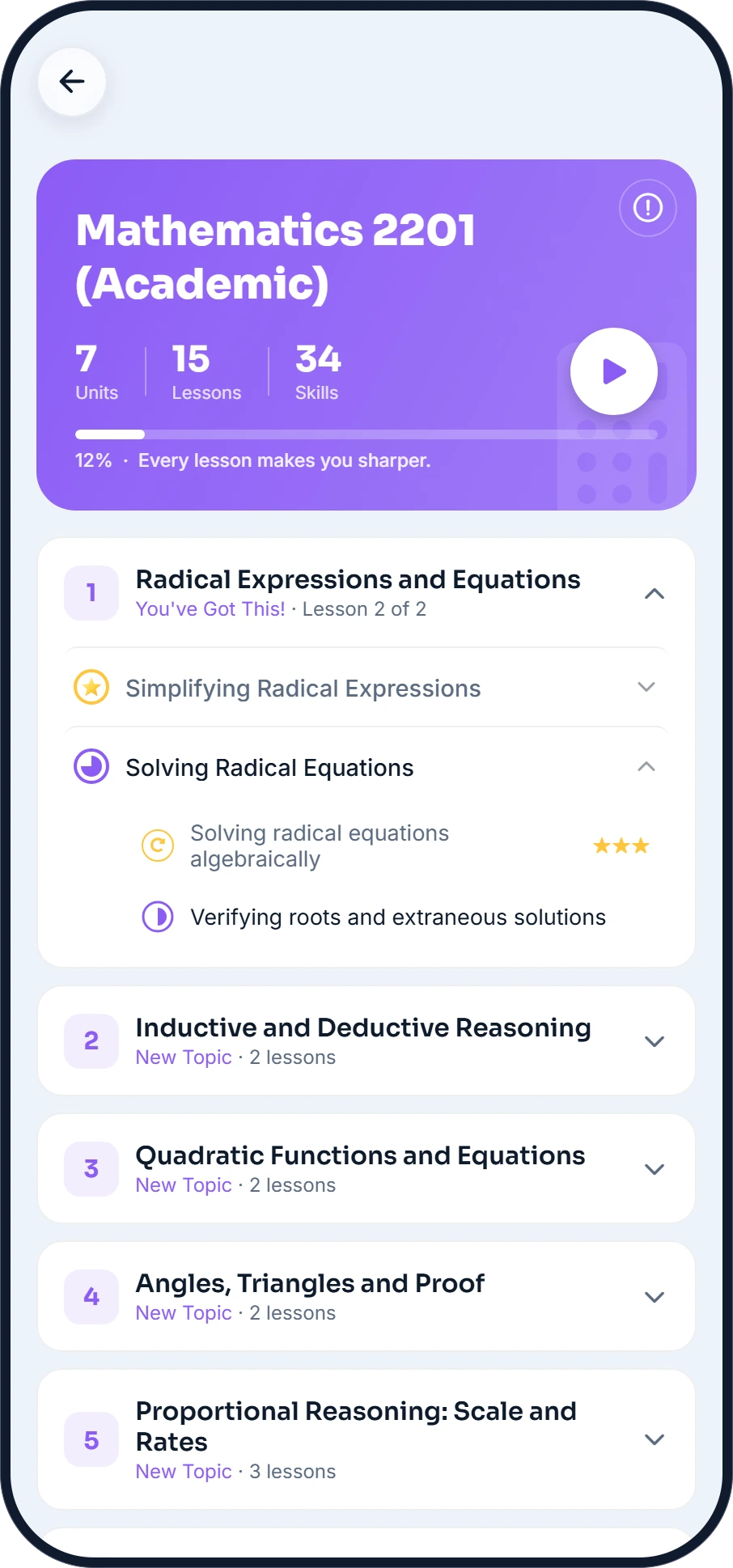
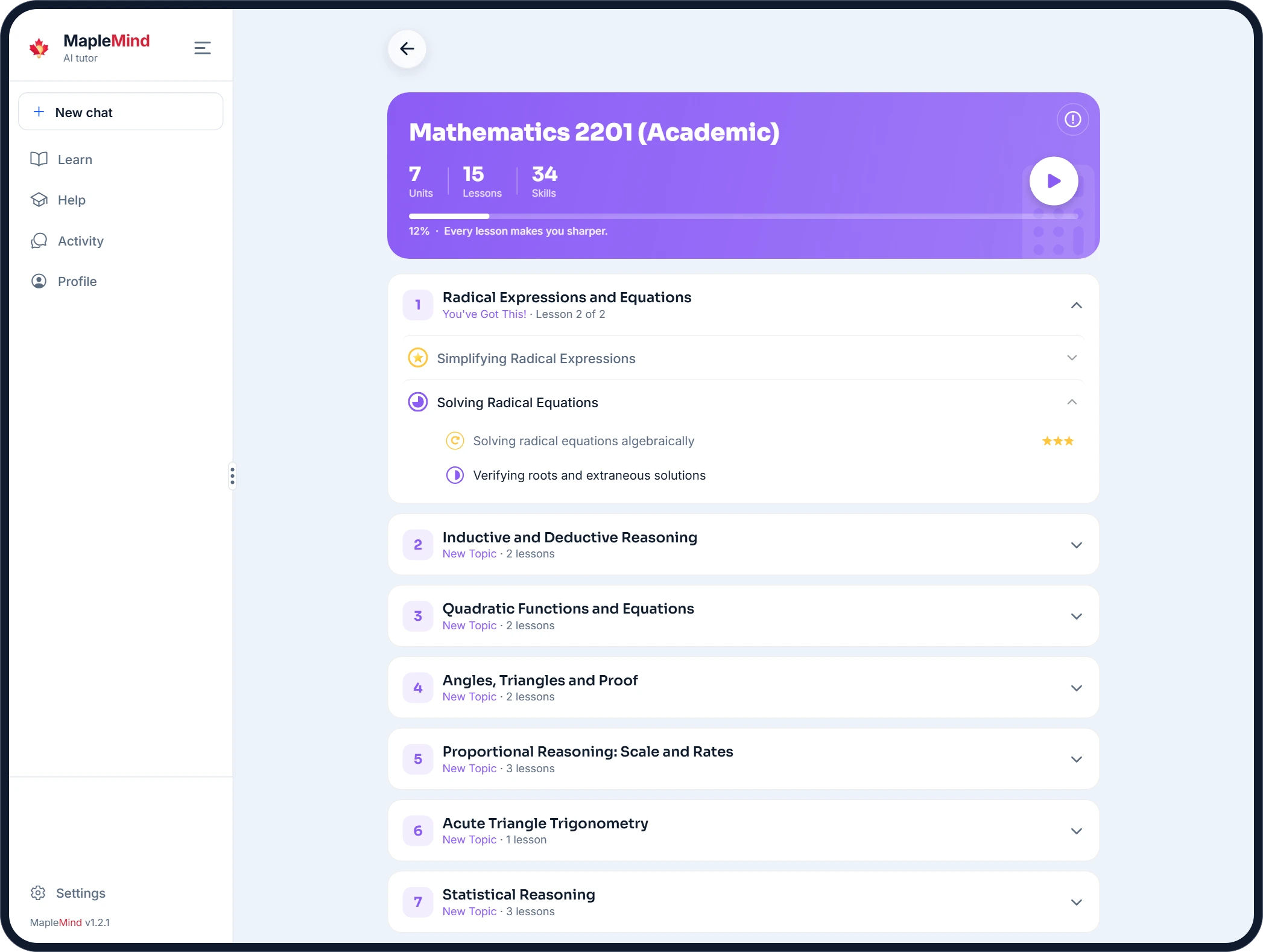
Mathematics 2201 (Academic) in MapleMind on a tablet: its units and lessons in order, a student partway through.Mathematics 2201 (Academic) in MapleMind on a phone: its units and lessons in order, a student partway through.
Their course, unit by unit, the way Newfoundland & Labrador teaches it.Shown: Mathematics 2201 (Academic)
Homework Help on a tablet: a photo of a worksheet, the tutor’s worked example of a two-step equation, and a question back to the student.Homework Help on a phone: a photo of a worksheet, the tutor’s worked example of a two-step equation, and a question back to the student.
Homework Help: they take a photo of the question, and the tutor works through it with them.
The Parent Dashboard on a tablet: a student’s days studied, streak, lessons, quiz average and recent activity.The Parent Dashboard on a phone: a student’s days studied, streak, lessons, quiz average and recent activity.
The Parent Dashboard: how each child’s week went, in lessons, quizzes and days studied.
A Grade 9 provincial mathematics exam on a tablet: a readiness score, the exam’s time and its next sitting.A Grade 9 provincial mathematics exam on a phone: a readiness score, the exam’s time and its next sitting.
A provincial exam: a practice sitting under the real time, and how ready they are.
The Learn tab on a tablet: a four-day streak, the week’s days, Homework Help, the next lesson and a review.The Learn tab on a phone: a four-day streak, the week’s days, Homework Help, the next lesson and a review.
The Learn tab: their week so far, and the next thing to do.

Help at home

Questions parents ask

What will my child learn in Grade 10 in Newfoundland & Labrador?

Math: Mathematics 1201 (Academic) and Mathematics 1202. Science: Science 1206. English: English Language Arts 1201 (Academic), English Language Arts 1202 (Applied) and Literacy 1204. French: Core French 1200. Social studies: Social Studies 1201 (Academic) and Social Studies 1202 (Applied). That’s 250 skills in all, from Newfoundland & Labrador’s curriculum.

Does my child write a provincial exam in Grade 10?

No. Newfoundland & Labrador has no provincial exam in Grade 10.

Where does this list come from?

From Newfoundland & Labrador’s official curriculum, the documents its education ministry publishes for each course. Each skill here is one of their expectations, written in plain words.

Can MapleMind help my child in Grade 10?

Yes. Every course on this page is in MapleMind, with lessons, practice and a tutor that works through each step with them. A free account gets 30 messages and 4 activities a day.

Help with Grade 10, one skill at a time.

Every course on this page is in MapleMind, free with daily limits.