Get help with Mathematics 1202
Most tutoring makes you sit through material you already know. MapleMind flips that: pick the exact skill that's causing trouble — any of the 32 below — and the tutor teaches just that one, step by step, as many times as it takes. Ask questions in plain words, any time of day, in English, French, or 12 other languages.
The official Newfoundland and Labrador Mathematics 1202 curriculum
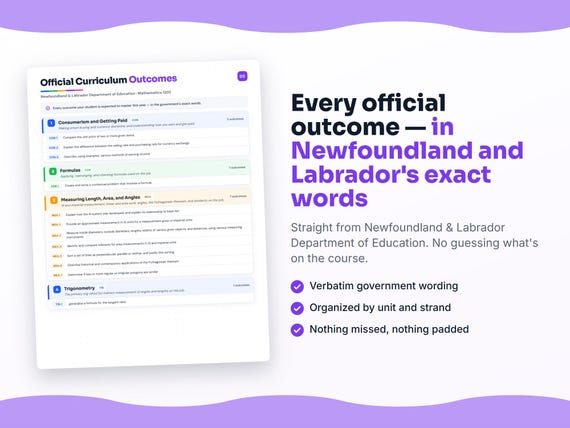
Newfoundland and Labrador defines Mathematics 1202 by strands and outcomes. MapleMind teaches the same curriculum reorganized for one-skill-at-a-time tutoring — the table shows exactly where every official strand lands, and the ministry's own wording is quoted under each unit below.
Official source Newfoundland and Labrador's official curriculumRead it on the government site — gov.nl.ca ↗| Official strand | Outcomes | Where MapleMind teaches it |
|---|---|---|
| Strand N | 7 | Consumerism and Getting Paid |
| PAR | 2 | Formulas |
| SAS | 23 | Measuring Length, Area, and Angles · Trigonometry |
Every skill below, taught one on one.
 Try the first session free
How MapleMind teaches Mathematics 1202 — every unit, lesson, and skill
Every skill below runs as a short session: a plain-words lesson, a worked example, solving it together, then a five-question skill check that earns up to three stars. Guided Mode keeps it teaching instead of answer-handing — turning it off needs a parent's password.
Unit 1Consumerism and Getting PaidOfficial strand · Strand N
Making smart buying and currency decisions, and understanding how you earn and get paid.
Best Buys and Promotions
- Unit price and best buyN.1.1 — Compare the unit price of items, see through sales-promotion techniques, and solve best-buy problems considering cost, quality, and quantity.
- Percent increase and decreaseN.1.4 — Determine the percent increase or decrease between an original and a new price.
Currency Exchange
- Exchanging currencyN.1.5 — Explain the difference between the selling and purchasing rates, convert between Canadian and foreign currency using rates and tables, and solve exchange problems with proportional reasoning.
Ways of Earning Income
- Methods of earning incomeN.1.9 — Describe various methods of earning income, list jobs that use each, and describe the advantages and disadvantages of a given method.
- Hours worked and gross payN.1.11 — Determine total time worked in decimal form from a schedule, and calculate gross pay from a base wage with tips, overtime, or commission, running what-if changes in pay.
- From gross pay to net payN.1.15 — Explain why gross and net pay differ, determine CPP, EI, and income tax deductions, and calculate net pay after all deductions, correcting errors in a pay solution.
- Commission and combined payN.1.18 — Determine gross pay for earnings from a base wage plus commission or a single commission rate.
The official wording — 7 outcomes in this unit
- N.1.1
Compare the unit price of two or more given items
- N.1.4
Determine the percent increase or decrease for a given original and new price
- N.1.5
Explain the difference between the selling rate and purchasing rate for currency exchange
- N.1.9
Describe, using examples, various methods of earning income
- N.1.11
Determine in decimal form, from a time schedule, the total time worked in hours and minutes
- N.1.15
Explain why gross pay and net pay are not the same
- N.1.18
Determine gross pay for earnings acquired by: base wage, plus commission single commission rate
Unit 2FormulasOfficial strand · PAR
Applying, rearranging, and checking formulas used on the job.
Using Formulas on the Job
- Applying and rearranging a formulaPAR.2.1 — Create and solve problems using a formula, apply a formula with and without rearranging it, and describe how a formula is used in a trade.
- Checking and equivalent formulasPAR.2.5 — Identify and correct errors in a formula solution, and explain and verify why different forms of the same formula are equivalent.
The official wording — 2 outcomes in this unit
- PAR.2.1
Create and solve a contextual problem that involves a formula
- PAR.2.5
Identify and correct errors in a solution to a problem that involves a formula
Unit 3Measuring Length, Area, and AnglesOfficial strand · SAS
SI and imperial measurement, linear and area work, angles, the Pythagorean theorem, and similarity on the job.
SI and Imperial Systems
- The SI systemSAS.3.1 — Explain how the SI system was developed and its base-ten relationship, match prefixes to powers of ten, and explain how and why decimals are used in SI.
- The imperial systemSAS.3.8 — Explain how the imperial system was developed, compare the American and British imperial systems, identify imperial contexts, and explain how and why fractions are used in imperial measurement.
Converting Between Systems
- Converting SI and imperial unitsSAS.3.5 — Give approximate SI and imperial equivalents and convert linear measurements between SI and imperial systems using proportional reasoning and formulas.
- Converting within a systemSAS.3.7 — Write a linear measurement in one SI unit as another SI unit, and one imperial unit as another imperial unit.
- Fractions in imperial measurementSAS.3.15 — Provide an example of a situation in which a fractional linear measurement would be divided by a fraction, as used in imperial trade measurement.
Linear Measurement
- Measuring and estimating lengthSAS.3.16 — Measure diameters, lengths, and distances with various instruments, and use referents to estimate linear measurements and object dimensions.
- Solving linear measurement problemsSAS.3.20 — Solve linear measurement problems including perimeter and circumference, choose the operation, find midpoints, and judge whether a solution is reasonable.
- Finding midpointsSAS.3.22 — Determine, using a variety of strategies, the midpoint of a linear measurement such as length, width, height, diagonal, or diameter of a 3-D object, and explain the strategies.
Area Measurement
- Estimating and converting areaSAS.3.24 — Compare SI and imperial area referents, estimate areas of regular, composite, and irregular shapes using grids, convert square units within each system, and judge reasonableness.
- Area and surface-area problemsSAS.3.31 — Solve area problems for regular, composite, and irregular shapes, and explain the effect of changing a dimension on the area and perimeter of rectangles.
- Area formulas and surface areaSAS.3.32 — Solve problems using area formulas for regular, composite, and irregular shapes including circles, and determine the surface area of right cylinders and cones.
Angles and Parallel Lines
- Angle pairs and relationshipsSAS.3.35 — Sort lines as parallel, perpendicular, or neither, and describe complementary, supplementary, and adjacent angles.
- Parallel lines and a transversalSAS.3.38 — Name the angle pairs formed by parallel lines and a transversal, explain and use their relationships to find angle measures, and explain why the relationships need parallel lines.
- Angle problems and perpendicular planesSAS.3.42 — Determine whether lines or planes are perpendicular or parallel and describe the strategy, and solve contextual problems involving angles formed by parallel lines and a transversal.
- Measuring and drawing anglesSAS.3.44 — Measure angles with a protractor in various orientations, draw and describe acute, right, obtuse, straight, and reflex angles, and estimate angles using referent angles.
- Replicating and bisecting anglesSAS.3.50 — Explain and illustrate how angles can be replicated with tools, replicate angles with and without technology, and bisect an angle using various methods.
The Pythagorean Theorem
- Understanding the Pythagorean theoremSAS.3.53 — Describe applications of the Pythagorean theorem, explain and illustrate why it applies only to right triangles, and verify it with examples and counterexamples.
- Using the Pythagorean theoremSAS.3.56 — Use the Pythagorean theorem to test whether a triangle is right, and explain the 3-4-5 ratio for checking square corners and rectangles.
- Pythagorean problem solvingSAS.3.59 — Solve real problems using the Pythagorean theorem to find an unknown distance or length.
Similar Polygons
- Similar polygonsSAS.3.60 — Determine whether polygons are similar, explain why two given polygons are not similar, solve similarity problems, and draw a polygon similar to a given one.
- Similar right trianglesSAS.3.61 — Explain why two right triangles that share an acute angle are similar, and explain the relationship between the corresponding sides of polygons with equal corresponding angles.
The official wording — 21 outcomes in this unit
- SAS.3.1
Explain how the SI system was developed, and explain its relationship to base ten
- SAS.3.8
Explain how the imperial system was developed
- SAS.3.5
Provide an approximate measurement in SI units for a measurement given in imperial units
- SAS.3.7
Write a given linear measurement expressed in one SI unit in another SI unit
- SAS.3.15
Provide an example of a situation in which a fractional linear measurement would be divided by a fraction
- SAS.3.16
Measure inside diameters, outside diameters, lengths, widths of various given objects, and distances, using various measuring instruments
- SAS.3.20
Solve a linear measurement problem including perimeter, circumference, and length
- SAS.3.22
Determine, using a variety of strategies, the midpoint of a linear measurement such as length, width, height, depth, diagonal and diameter of a 3-D object, and explain the strategies
- SAS.3.24
Identify and compare referents for area measurements in SI and imperial units
- SAS.3.31
Solve a contextual problem that involves the area of a regular, a composite or an irregular 2-D shape
- SAS.3.32
Solve a problem, using formulas for determining the areas of regular, composite and irregular 2-D shapes, including circles
- SAS.3.35
Sort a set of lines as perpendicular, parallel or neither, and justify this sorting
- SAS.3.38
Identify and name pairs of angles formed by parallel lines and a transversal
- SAS.3.42
Determine if lines or planes are perpendicular or parallel
- SAS.3.44
Measure, using a protractor, angles in various orientations
- SAS.3.50
Explain and illustrate how angles can be replicated in a variety of ways
- SAS.3.53
Describe historical and contemporary applications of the Pythagorean theorem
- SAS.3.56
Determine if a given triangle is a right triangle, using the Pythagorean theorem
- SAS.3.59
Solve a problem, using the Pythagorean theorem
- SAS.3.60
Determine if two or more regular or irregular polygons are similar
- SAS.3.61
Explain why two right triangles with a shared acute angle are similar
Unit 4TrigonometryOfficial strand · SAS
The primary trig ratios for indirect measurement of angles and lengths on the job.
The Primary Trigonometric Ratios
- Sine, cosine, and tangent ratiosSAS.5.1 — Show that the tangent, sine, and cosine ratios are constant for a given acute angle across right triangles, and generalize the formulas for each ratio.
- Solving right triangles with trigSAS.5.4 — Identify where trig ratios support indirect measurement, solve right-triangle problems using the primary ratios, and judge whether a solution is reasonable.
The official wording — 2 outcomes in this unit
- SAS.5.1
generalize a formula for the tangent ratio
- SAS.5.4
Identify situations where the trigonometric ratios are used for indirect measurement of angles and lengths
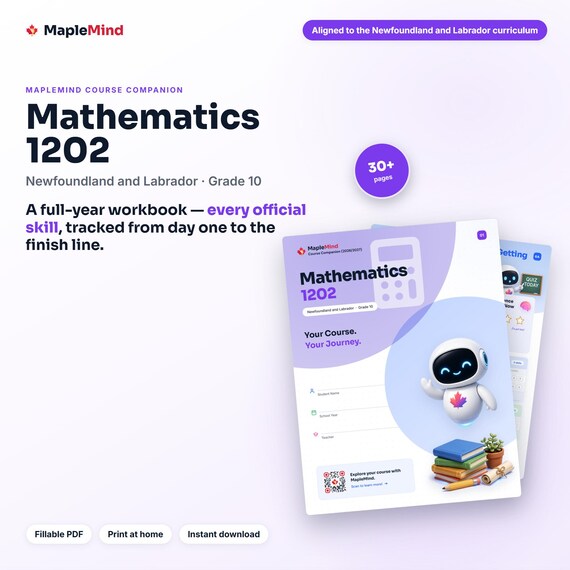
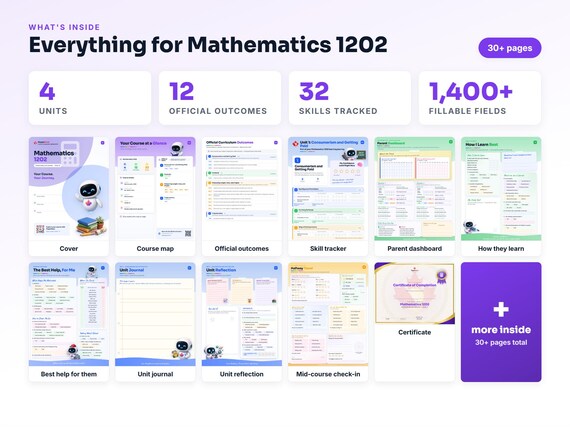

Printable workbook · A keepsake of the year
A Mathematics 1202 workbook worth keeping
Built from the same official curriculum as this page. Before and after each skill above, your student colours in how sure they feel — so the two of you can see, on one page, what's clicking and what needs another look. It's a quiet way to follow how the year is really going.
By June it's full of their own handwriting: units worked through, confidence grown, a mid-year check-in, notes from parent-teacher night, and a certificate at the end. Less a worksheet, more a record of the year worth keeping on the shelf.
Instant download · see every page, reviews and the full description · five or more workbooks are $2.99 each
What it looks like in the app



Common questions
Can MapleMind help me with Mathematics 1202?
Yes. MapleMind's AI tutor covers all 32 skills in Newfoundland and Labrador's Mathematics 1202 — you pick the exact skill, and the tutor teaches it step by step: a short lesson, a worked example, solving together, then a skill check to show it stuck.
Is MapleMind aligned to Newfoundland and Labrador's official curriculum?
Yes. Every skill in this course maps to an official outcome code from Newfoundland and Labrador's Grade 10 Mathematics curriculum, and the ministry's own wording is quoted under each unit on this page — with the official government source linked so you can check it yourself.
What does MapleMind cost?
It's free to start — 5 tutoring chats and a practice quiz every day, no credit card. A Pro subscription ($9.99/month or $49.99/year CAD, 7-day free trial) unlocks unlimited tutoring, practice, and exam simulations.
What if I'm stuck on just one topic?
That's the point of skill-level tutoring: open Mathematics 1202 in the app, tap the exact skill from the list on this page, and the tutor teaches just that — no wading through lessons you don't need.
Does MapleMind work in French or other languages?
Yes — 14 languages, including French. Both the app and the tutor's explanations switch to the language you choose.
Where can I see the official Newfoundland and Labrador curriculum for Mathematics 1202?
The official source is linked on this page — Newfoundland and Labrador's official curriculum. The outline here follows it: every MapleMind skill carries its official outcome code, and the ministry's own wording is quoted under each unit.
Keep exploring
Ready when you are
Pick a skill from this page and see it taught properly — free, in the browser, in under a minute.