Newfoundland & Labrador · For parents

What your child learns in Grade 5 in Newfoundland & Labrador

Every subject, unit by unit, from Newfoundland & Labrador’s curriculum: 140 skills in plain words.

Subjects
5
Skills
140
Provincial exams
None
Official curriculum
gov.nl.ca

Math in Grade 5

Mathematics, Grade 5

11 units · 46 skills

  1. Unit 1

    Large Numbers

    Large numbers appear in sports, populations, and prices.

    • Large numbers in media
  2. Unit 2

    Representing Whole Numbers

    Numbers to a million have ones, thousands, and millions periods.

    • Writing numbers to a million
    • Meaning of digits and expanded notation
  3. Unit 3

    Fractions and Decimals

    Equivalent fractions name the same amount.

    • Making equivalent fractions
    • Comparing and ordering fractions
    • Tenths, hundredths, and thousandths
    4 more skills
    • Decimal place value and representation
    • Ordering decimals
    • Fractions and decimals
    • Rounding decimals
  4. Unit 4

    Multiplication and Division

    Zero groups of anything is zero.

    • Multiplying and dividing with zero
    • Two-digit multiplication with models
    • Multiplying near multiples of ten
    7 more skills
    • Dividing with models and strategies
    • Interpreting the remainder
    • Solving multiplication and division problems
    • Mental multiplication strategies
    • Recalling multiplication and division facts
    • Estimation strategies
    • Front-end rounding
  5. Unit 5

    Decimal Operations

    Estimating first tells us about where the point goes.

    • Estimating and placing the decimal point
    • Adding and subtracting decimals to thousandths
  6. Unit 6

    Patterns

    A pattern rule can be written as an expression.

    • Describing patterns with expressions
    • Predicting and solving with patterns
  7. Unit 7

    Equations

    A letter variable stands for the unknown number.

    • Writing equations with a variable
    • Solving single-variable equations
  8. Unit 8

    Measurement

    10 mm make 1 cm and 1000 mm make 1 m.

    • Relating metric length units
    • Referents for metric lengths
    • Referents for cubic and capacity units
    4 more skills
    • Area and perimeter relationships
    • Volume of prisms
    • Capacity in litres and millilitres
    • Greatest area for a perimeter
  9. Unit 9

    Geometry and Transformations

    Parallel sides never meet; perpendicular sides meet at a right angle.

    • Parallel and perpendicular sides
    • Sorting quadrilaterals
    • Drawing shapes with described sides
    4 more skills
    • Parallel and perpendicular edges and faces
    • Describing transformations
    • Performing transformations
    • Rotating shapes and predicting results
  10. Unit 10

    Data

    First-hand data we collect ourselves.

    • First-hand and second-hand data
    • Double bar graphs
    • Double bar graphs in media
  11. Unit 11

    Probability

    Events can be impossible, possible, or certain.

    • Describing likelihood
    • Conducting probability experiments
    • Designing comparative experiments

Science in Grade 5

Science, Grade 5

3 units · 28 skills

  1. Unit 1

    Earth and Space Science

    Weather is described by several measurements taken together.

    • Describing weather with measurements
    • Properties of air
    • The Sun drives the weather
    3 more skills
    • The water cycle
    • Predicting local weather
    • Weather systems
  2. Unit 2

    Physical Science

    A force is a push or a pull.

    • Different kinds of forces
    • Forces near and far
    • How much force
    11 more skills
    • Friction
    • Simple machines make lifting easier
    • Levers
    • Wheels, axles, and rollers
    • Pulleys
    • States and properties of materials
    • Physical changes
    • Materials that make new substances
    • Does mass change?
    • Reversible and irreversible changes
    • Where materials come from
  3. Unit 3

    Life Science

    A body system is a group of organs that work together to do a job.

    • How body systems meet our needs
    • Bones, muscles, and nerves working together
    • The respiratory system
    5 more skills
    • The digestive and excretory systems
    • The circulatory system
    • The skin and the body's defences
    • Growth and puberty
    • Keeping the body healthy

English in Grade 5

English Language Arts, Grade 5

3 units · 37 skills

  1. Unit 1

    Speaking and Listening

    Evidence can be a fact, example, or experience that supports your idea.

    • Expressing ideas with supporting evidence
    • Using active listening strategies
    • Asking and answering questions to extend thinking
    6 more skills
    • Engaging in collaborative discussions
    • Using effective presentation skills
    • Analyzing a presentation's impact on the audience
    • Deciding whether you agree with a speaker
    • Using non-verbal communication sensitive to others
    • Using inclusive oral language
  2. Unit 2

    Reading and Viewing

    Cueing systems are sources of information readers use: meaning, structure (grammar), and visual (letters/sounds).

    • Using cueing systems to construct meaning
    • Selecting appropriate texts
    • Developing proficient reading and viewing
    17 more skills
    • Explaining how text structures help meaning
    • Explaining how text features help understanding
    • Using a variety of comprehension strategies
    • Reflecting on themselves as readers
    • Creating an inquiry question to gather information
    • Selecting information from sources
    • Interpreting relevant information
    • Organizing relevant information
    • Evaluating information
    • Sharing relevant information
    • Extending understanding by responding personally
    • Quoting from text to support thinking
    • Asking critical questions of text
    • Analyzing intended messages in texts
    • Discussing alternative points of view
    • Analyzing how language influences thinking
    • Recognizing that social action can bring change
  3. Unit 3

    Writing and Representing

    Proficient writing has clear ideas, organization, and correct conventions.

    • Developing proficient writing and representing
    • Creating texts that represent who you are
    • Creating texts for wide audiences and purposes
    5 more skills
    • Creating texts in various forms and genres
    • Creating texts using the writing process
    • Collaborating with others during text creation
    • Using language conventions appropriately
    • Reflecting on themselves as writers

French in Grade 5

Core French, Grade 5

3 units · 12 skills

  1. Unit 1

    Oral Communication

    Elaborate = stretch a message with 'et' (and) or 'parce que' (because).

    • Elaborating on simple messages
    • Strategies for short conversations
    • Understanding and responding to spoken texts
    6 more skills
    • Starting real conversations
    • Explaining how you feel
    • Describing with some detail
    • Talking about daily life and experiences
    • Preferences on many topics
    • Identifying French cultures around you
  2. Unit 2

    Reading and Viewing

    Read in phrases for a natural flow.

    • Reading short, simple texts
    • Understanding and responding to texts
  3. Unit 3

    Written Communication

    Grade 5 moves from labels/captions to a few connected written sentences.

    • Planning and creating written texts

Social studies in Grade 5

Social Studies, Grade 5

5 units · 17 skills

  1. Unit 1

    Social Studies Concepts and Skills - 1. Integrated Concepts and Process Skills (ICPS)

    Complex questions do not have simple answers.

    • Inquiry and issues analysis
    • Forms of analysis and habits of mind
  2. Unit 2

    History - 2. Individuals, Societies, and Economic Decisions

    All societies must decide how to meet needs and wants.

    • Decisions to meet needs and wants
    • Social structure and who made decisions
  3. Unit 3

    History - 3. Interdependence

    We locate a society using location and place concepts.

    • Locating a medieval society
    • Social structure, lifestyles, and environment
  4. Unit 4

    History - 4. People, Place, and Environment

    Location asks 'Where is it?'; place asks 'What is it like?'.

    • Locating an ancient society
    • How geographic features shaped development
    • Human-environmental interactions
    2 more skills
    • Diversity and naming First Nation and Inuit peoples
    • Adapting to the environment
  5. Unit 5

    History - 5. Time, Continuity, and Change

    Primary sources, written and oral, are the basis of our knowledge of the past.

    • Primary sources, archaeologists, and historians
    • The challenges of writing history
    • Locating settler societies
    3 more skills
    • Why settlers came and how they lived
    • Beneficial and devastating consequences of contact
    • Comparing past and present societies

MapleMind

See Grade 5 in MapleMind

Real screens from the app your child would use.

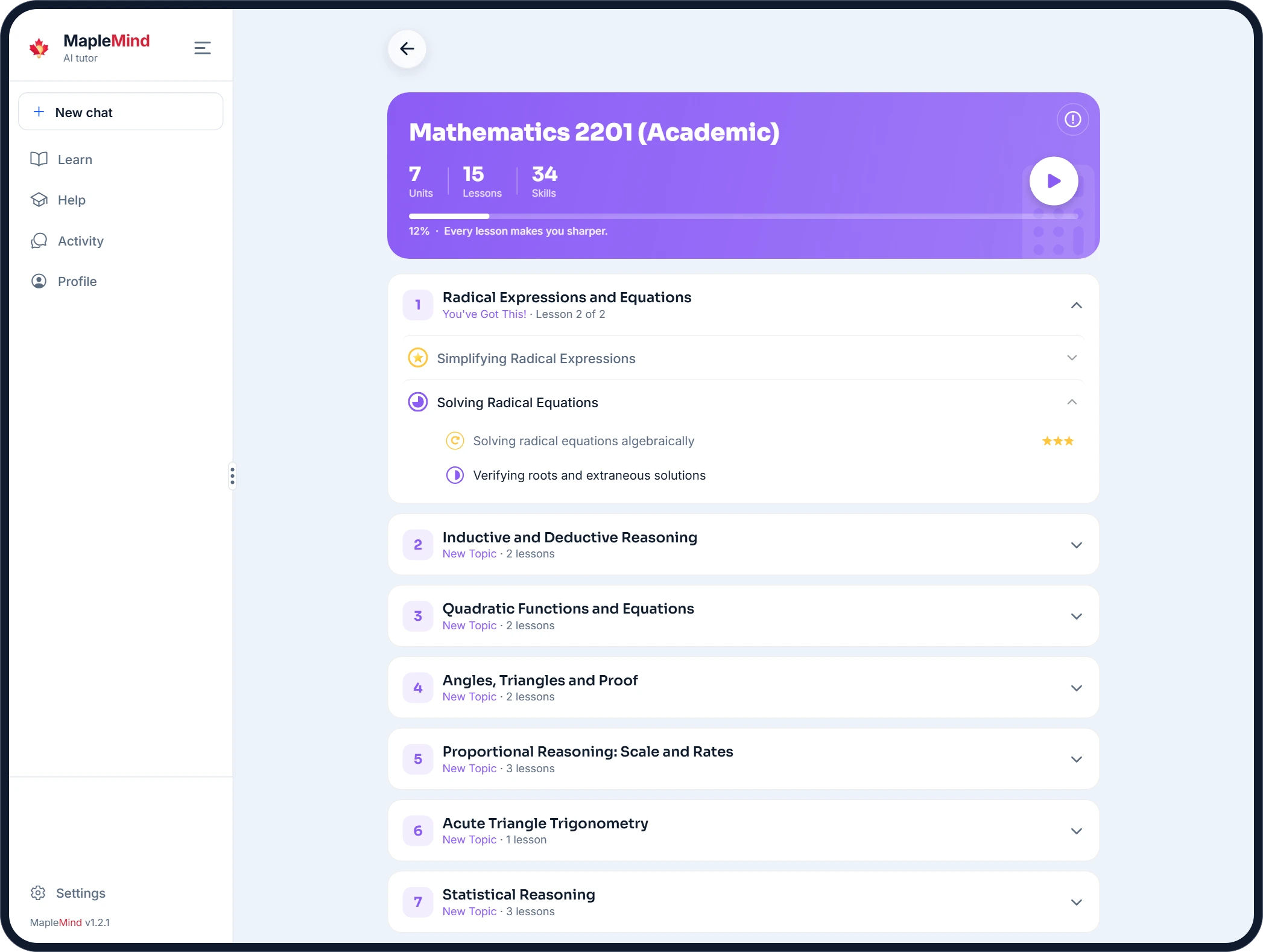
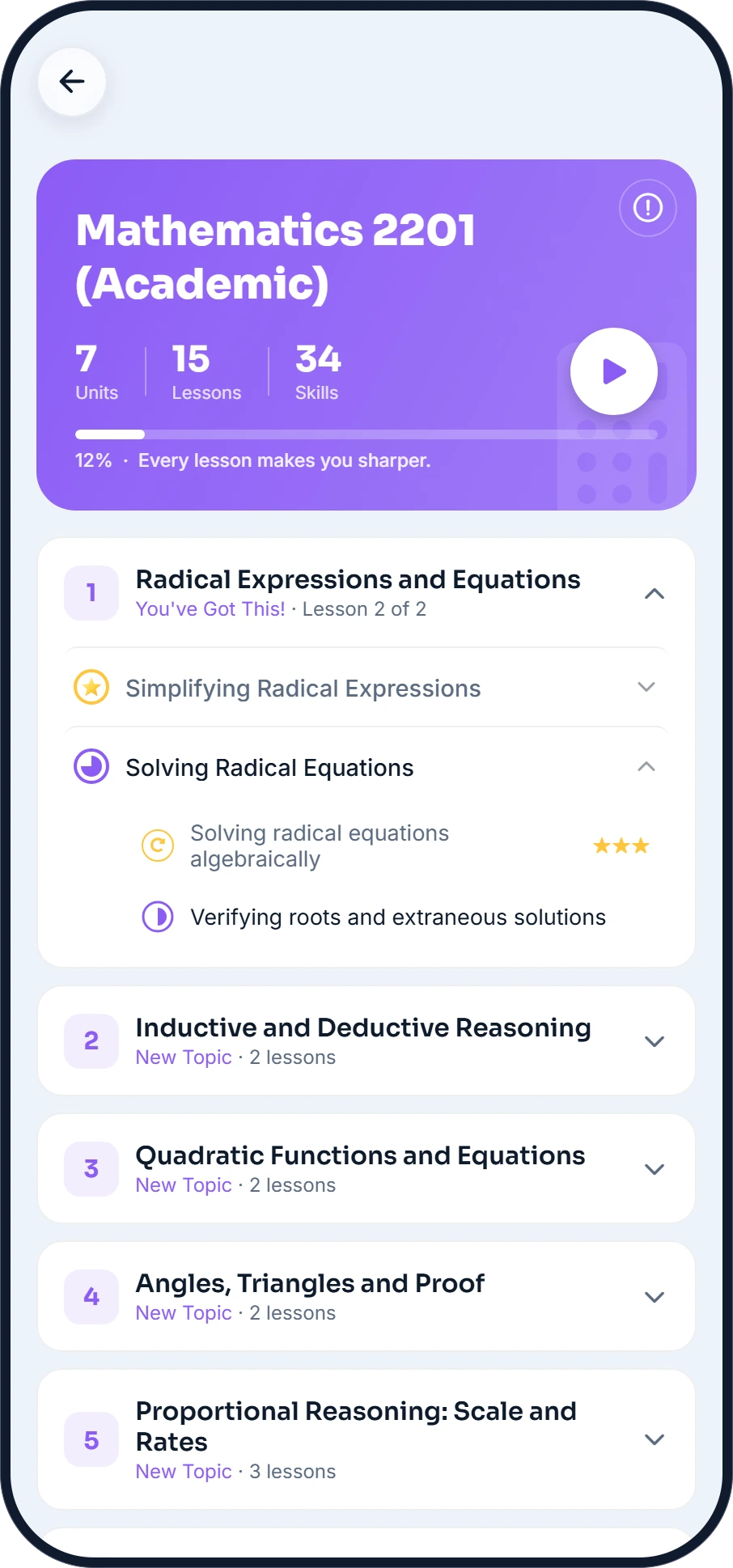
Mathematics 2201 (Academic) in MapleMind on a tablet: its units and lessons in order, a student partway through.Mathematics 2201 (Academic) in MapleMind on a phone: its units and lessons in order, a student partway through.
Their course, unit by unit, the way Newfoundland & Labrador teaches it.Shown: Mathematics 2201 (Academic)
Homework Help on a tablet: a photo of a worksheet, the tutor’s worked example of a two-step equation, and a question back to the student.Homework Help on a phone: a photo of a worksheet, the tutor’s worked example of a two-step equation, and a question back to the student.
Homework Help: they take a photo of the question, and the tutor works through it with them.
The Parent Dashboard on a tablet: a student’s days studied, streak, lessons, quiz average and recent activity.The Parent Dashboard on a phone: a student’s days studied, streak, lessons, quiz average and recent activity.
The Parent Dashboard: how each child’s week went, in lessons, quizzes and days studied.
A Grade 9 provincial mathematics exam on a tablet: a readiness score, the exam’s time and its next sitting.A Grade 9 provincial mathematics exam on a phone: a readiness score, the exam’s time and its next sitting.
A provincial exam: a practice sitting under the real time, and how ready they are.
The Learn tab on a tablet: a four-day streak, the week’s days, Homework Help, the next lesson and a review.The Learn tab on a phone: a four-day streak, the week’s days, Homework Help, the next lesson and a review.
The Learn tab: their week so far, and the next thing to do.

Help at home

Questions parents ask

What will my child learn in Grade 5 in Newfoundland & Labrador?

Math: Mathematics, Grade 5. Science: Science, Grade 5. English: English Language Arts, Grade 5. French: Core French, Grade 5. Social studies: Social Studies, Grade 5. That’s 140 skills in all, from Newfoundland & Labrador’s curriculum.

Does my child write a provincial exam in Grade 5?

No. Newfoundland & Labrador has no provincial exam in Grade 5.

Where does this list come from?

From Newfoundland & Labrador’s official curriculum, the documents its education ministry publishes for each course. Each skill here is one of their expectations, written in plain words.

Can MapleMind help my child in Grade 5?

Yes. Every course on this page is in MapleMind, with lessons, practice and a tutor that works through each step with them. A free account gets 30 messages and 4 activities a day.

Help with Grade 5, one skill at a time.

Every course on this page is in MapleMind, free with daily limits.