Newfoundland & Labrador · For parents

What your child learns in Grade 7 in Newfoundland & Labrador

Every subject, unit by unit, from Newfoundland & Labrador’s curriculum: 136 skills in plain words.

Subjects
5
Skills
136
Provincial exams
None
Official curriculum
gov.nl.ca

Math in Grade 7

Mathematics, Grade 7

9 units · 40 skills

  1. Unit 1

    Fractions, Decimals, and Percent

    Equivalent fractions help place unlike denominators.

    • Positioning fractions on a number line
    • Ordering fractions, decimals, and whole numbers
    • Percent as a fraction and a decimal
    2 more skills
    • Terminating and repeating decimals
    • Writing decimals as fractions
  2. Unit 2

    Divisibility

    Divisibility rules test if a number divides evenly.

    • Divisibility rules and factors
  3. Unit 3

    Operations with Decimals, Fractions, and Integers

    Front-end estimation uses the leading digits.

    • Front-end estimation with decimals
    • Adding and subtracting decimals
    • Multiplying and dividing decimals
    6 more skills
    • Solving percent problems
    • Adding fractions and finding common denominators
    • Adding and subtracting unlike fractions
    • Adding and subtracting mixed numbers
    • Adding integers
    • Subtracting integers
  4. Unit 4

    Linear Relations

    A variable stands for the step number.

    • Representing patterns with expressions and equations
    • Linear relations in context
    • Making tables of values
    1 more skill
    • Graphing linear relations
  5. Unit 5

    Variables and Linear Equations

    Doing the same to both sides keeps an equation true.

    • Preserving equality
    • Variables, expressions, and equations
    • Solving one-step equations
    2 more skills
    • Modelling two-step equations
    • Solving two-step equations
  6. Unit 6

    Area and Circles

    A parallelogram can be cut and rearranged into a rectangle.

    • Area of a parallelogram
    • Area of a triangle
    • Radius, diameter, and central angles
    2 more skills
    • Circumference, diameter, and pi
    • Area of a circle
  7. Unit 7

    Geometry and the Coordinate Plane

    Parallel segments never meet; perpendicular segments meet at a right angle.

    • Parallel, perpendicular, and bisectors
    • Constructing parallels, perpendiculars, and bisectors
    • Plotting in four quadrants
    2 more skills
    • Movements, distances, and shapes on the plane
    • Transformations on the coordinate plane
  8. Unit 8

    Data Analysis

    A circle graph shows each part as a percent of the whole.

    • Reading and creating circle graphs
    • Mean, median, mode, and range
    • Outliers and their effect
  9. Unit 9

    Probability

    Probability compares favourable outcomes to all outcomes.

    • Probability of a single outcome
    • Independent events and sample space
    • Probability of two independent events
Science in Grade 7

Science, Grade 7

4 units · 28 skills

  1. Unit 1

    Life Science: Interactions Within Ecosystems

    Biotic factors are the living parts of an ecosystem: plants, animals, fungi, and microorganisms.

    • Biotic and abiotic factors
    • Interactions in an ecosystem
    • Producers, consumers, and decomposers
    3 more skills
    • Energy flow in food chains and webs
    • Recycling matter in ecosystems
    • How ecosystems change over time
  2. Unit 2

    Physical Science: Heat

    Temperature is measured with a thermometer.

    • Measuring temperature
    • Temperature and moving particles
    • How states react to temperature
    3 more skills
    • Changes of state
    • How heat moves
    • How much heat materials hold
  3. Unit 3

    Physical Science: Mixtures and Solutions

    A pure substance is made of only one kind of particle.

    • Pure substances and mixtures
    • Heterogeneous and homogeneous mixtures
    • Dissolving
    4 more skills
    • Concentration of solutions
    • Solubility
    • Separating a mixture's parts
    • Everyday separation techniques
  4. Unit 4

    Earth/Space Science: Earth's Crust

    Minerals are natural, solid building blocks of rocks.

    • Classifying minerals
    • Classifying rocks
    • Studying Earth's crust
    6 more skills
    • Earthquakes and volcanoes
    • Where earthquakes and volcanoes occur
    • How mountains form
    • Geological time
    • From rock to soil
    • Classifying soil types

English in Grade 7

English Language Arts, Grade 7

3 units · 36 skills

  1. Unit 1

    Speaking and Listening

    A discussion runs on other people's ideas — one voice alone cannot generate or sustain it.

    • Recognizing that discussion needs others' contributions
    • Asking questions about others' ideas
    • Responding to clarify and elaborate
    9 more skills
    • Expressing a point of view with support
    • Listening for main ideas and supporting details
    • Practising strategies for effective talk
    • Assessing when to clarify or elaborate
    • Identifying effective speaking strategies
    • Demonstrating active speaking and listening
    • Expressing ideas with sensitivity and respect
    • Recognizing bias and attitudes in oral language
    • Awareness that oral language can influence and manipulate
  2. Unit 2

    Reading and Viewing

    Good readers choose texts on purpose — for a need or an interest.

    • Selecting texts for needs and interests
    • Exploring how text features create meaning
    • Identifying reading and viewing strategies
    10 more skills
    • Identifying topics and questions for inquiry
    • Recognizing the need for reliable information
    • Locating and selecting information
    • Experimenting with inquiry strategies
    • Explaining personal responses with support
    • Recognizing that texts can be biased
    • Recognizing the need to question a text
    • Exploring the tools text creators use
    • Describing how form and structure affect meaning
    • Awareness that values influence critical response
  3. Unit 3

    Writing and Representing

    Language learners try many strategies — drafting, mapping, talking ideas out.

    • Experimenting with strategies as a language learner
    • Writing to extend, explore, and reflect on ideas
    • Identifying strategies and describing growth
    8 more skills
    • Experimenting with stylistic effects
    • Creating a range of texts
    • Experimenting with forms and styles for purpose and audience
    • Using feedback to inform future work
    • Using strategies to create varied texts
    • Using the conventions of written language
    • Using technology to communicate
    • Committing to the process of creating texts

French in Grade 7

Core French, Grade 7

3 units · 11 skills

  1. Unit 1

    Oral Communication

    Grade 7 focuses on PURPOSE: why you are speaking shapes what you say.

    • Messages for various purposes
    • Structured and spontaneous conversations
    • Understanding and responding to oral texts
    5 more skills
    • Engaging in real conversations
    • Acknowledging others' feelings
    • Describing in novel situations
    • Sharing preferences, ideas, and opinions
    • Describing francophone cultures
  2. Unit 2

    Reading and Viewing

    Grade 7 texts are a bit longer and less repetitive.

    • Reading short texts
    • Applying reading strategies
  3. Unit 3

    Written Communication

    Grade 7 writing serves a clear purpose (inform, invite, persuade).

    • Planning and creating written texts

Social studies in Grade 7

Social Studies, Grade 7

6 units · 21 skills

  1. Unit 1

    Civics - 1. Citizenship, Power, and Governance

    Empowerment is having power or influence over one's own life and circumstances.

    • The general concept of empowerment
    • The extent of empowerment up to 1920
  2. Unit 2

    Economics - 2. Individuals, Societies, and Economic Decisions

    Economic resources are a form of power.

    • How economics empowers or disempowers
    • How commodities of empowerment changed
    • Trends impacting future economic empowerment
    1 more skill
    • Impact of the Industrial Revolution on workers
  3. Unit 3

    Politics - 3. Citizenship, Power, and Governance

    Responsible government means leaders are accountable to elected representatives.

    • Responsible government and empowerment
    • Perspectives and factors leading to Confederation
    • Was Confederation democratic?
    2 more skills
    • Canada's political structure after Confederation
    • Events leading Canada toward independence
  4. Unit 4

    Anthropology - 4. Culture and Diversity

    Several distinct Indigenous peoples lived in Atlantic Canada during this period.

    • Indigenous peoples and their way of life
    • The impact of policies, treaties, and the Indian Act
    • Immigrant groups' struggle for empowerment
  5. Unit 5

    Sociology - 5. Time, Continuity, and Change

    British North America in the mid-1800s was home to diverse peoples.

    • Everyday life for diverse peoples in the mid-1800s
    • Everyday life at the turn of the 20th century
    • Women's empowerment through social reform
  6. Unit 6

    History - 6. Time, Continuity, and Change

    In the 1870s-80s Canada expanded and created new provinces.

    • Expansion's effect on people and regions
    • The Northwest Rebellion and perspectives on Louis Riel
    • Causes of WWI and Canada's participation
    1 more skill
    • The impact of WWI on Canada and its people

MapleMind

See Grade 7 in MapleMind

Real screens from the app your child would use.

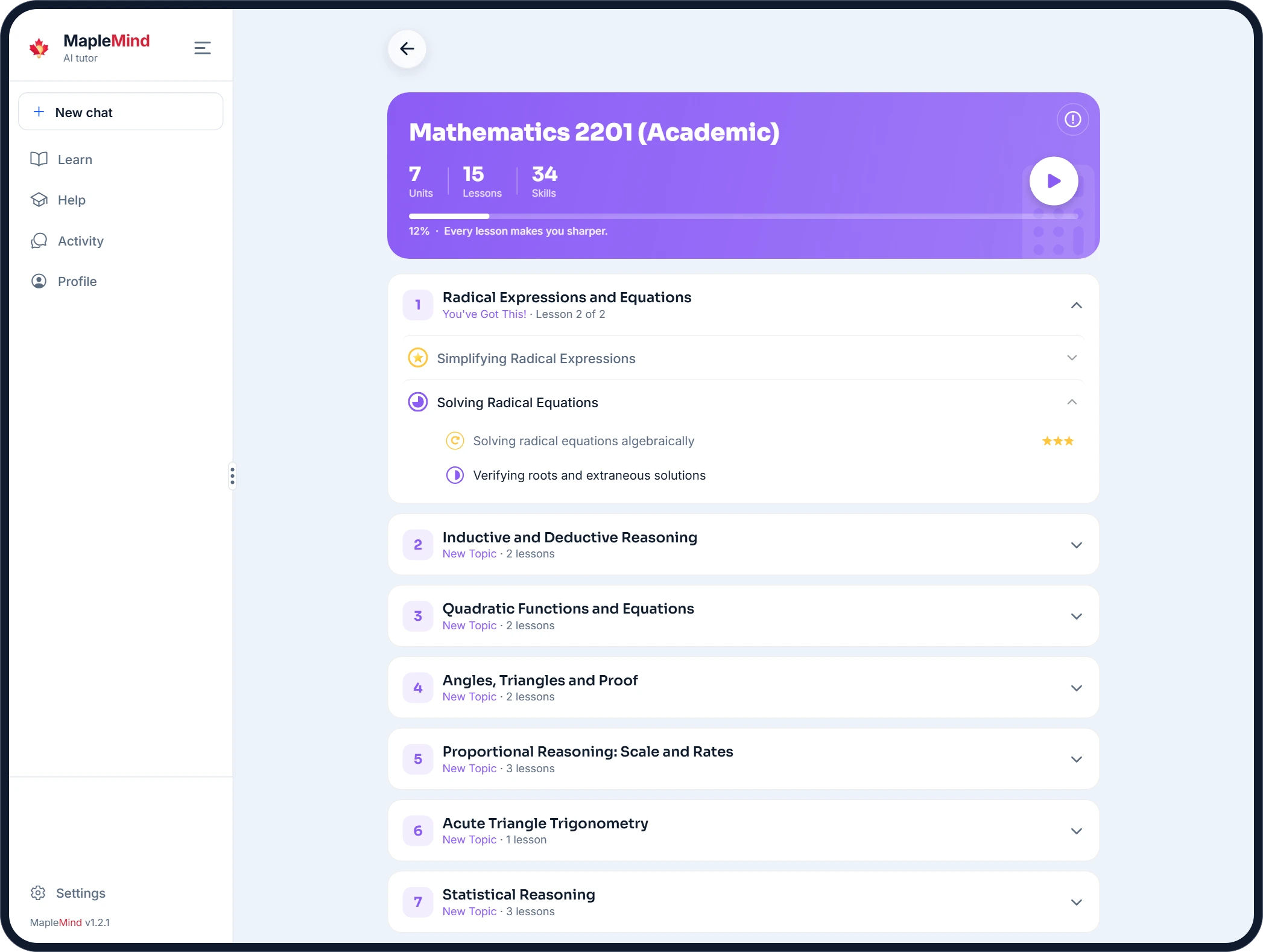
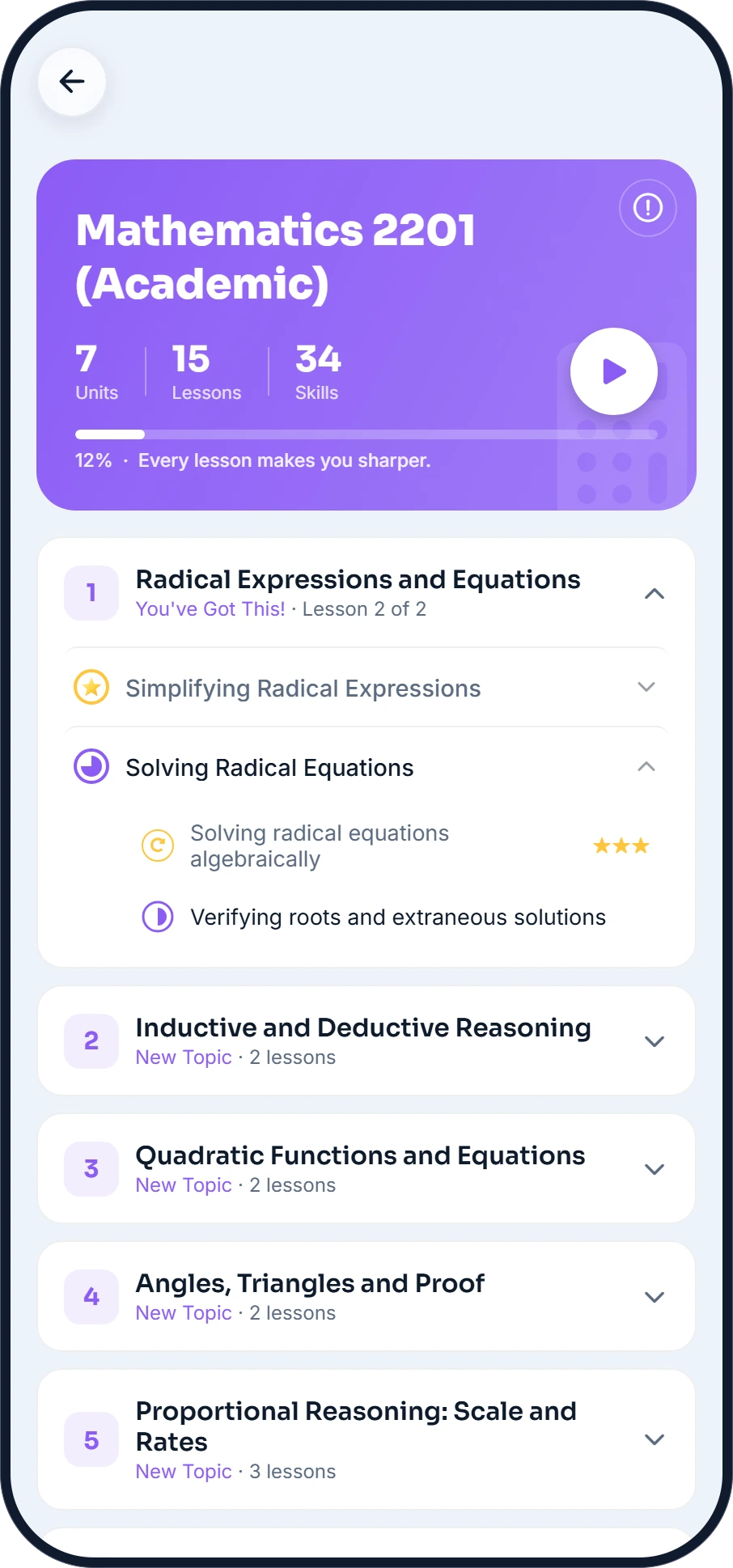
Mathematics 2201 (Academic) in MapleMind on a tablet: its units and lessons in order, a student partway through.Mathematics 2201 (Academic) in MapleMind on a phone: its units and lessons in order, a student partway through.
Their course, unit by unit, the way Newfoundland & Labrador teaches it.Shown: Mathematics 2201 (Academic)
Homework Help on a tablet: a photo of a worksheet, the tutor’s worked example of a two-step equation, and a question back to the student.Homework Help on a phone: a photo of a worksheet, the tutor’s worked example of a two-step equation, and a question back to the student.
Homework Help: they take a photo of the question, and the tutor works through it with them.
The Parent Dashboard on a tablet: a student’s days studied, streak, lessons, quiz average and recent activity.The Parent Dashboard on a phone: a student’s days studied, streak, lessons, quiz average and recent activity.
The Parent Dashboard: how each child’s week went, in lessons, quizzes and days studied.
A Grade 9 provincial mathematics exam on a tablet: a readiness score, the exam’s time and its next sitting.A Grade 9 provincial mathematics exam on a phone: a readiness score, the exam’s time and its next sitting.
A provincial exam: a practice sitting under the real time, and how ready they are.
The Learn tab on a tablet: a four-day streak, the week’s days, Homework Help, the next lesson and a review.The Learn tab on a phone: a four-day streak, the week’s days, Homework Help, the next lesson and a review.
The Learn tab: their week so far, and the next thing to do.

Help at home

Questions parents ask

What will my child learn in Grade 7 in Newfoundland & Labrador?

Math: Mathematics, Grade 7. Science: Science, Grade 7. English: English Language Arts, Grade 7. French: Core French, Grade 7. Social studies: Social Studies, Grade 7. That’s 136 skills in all, from Newfoundland & Labrador’s curriculum.

Does my child write a provincial exam in Grade 7?

No. Newfoundland & Labrador has no provincial exam in Grade 7.

Where does this list come from?

From Newfoundland & Labrador’s official curriculum, the documents its education ministry publishes for each course. Each skill here is one of their expectations, written in plain words.

Can MapleMind help my child in Grade 7?

Yes. Every course on this page is in MapleMind, with lessons, practice and a tutor that works through each step with them. A free account gets 30 messages and 4 activities a day.

Help with Grade 7, one skill at a time.

Every course on this page is in MapleMind, free with daily limits.