Get help with Science, Grade 7
Most tutoring makes you sit through material you already know. MapleMind flips that: pick the exact skill that's causing trouble — any of the 28 below — and the tutor teaches just that one, step by step, as many times as it takes. Ask questions in plain words, any time of day, in English, French, or 12 other languages.
The official Newfoundland and Labrador Science, Grade 7 curriculum
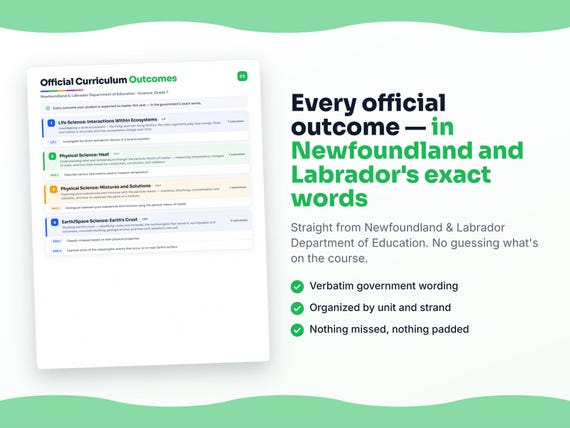
Newfoundland and Labrador defines Science, Grade 7 by strands and outcomes. MapleMind teaches the same curriculum reorganized for one-skill-at-a-time tutoring — the table shows exactly where every official strand lands, and the ministry's own wording is quoted under each unit below.
Official source Newfoundland and Labrador's official curriculumRead it on the government site — gov.nl.ca ↗| Official strand | Outcomes | Where MapleMind teaches it |
|---|---|---|
| Strand 1 | 6 | Life Science: Interactions Within Ecosystems |
| Strand 4 | 6 | Physical Science: Heat |
| Strand 7 | 7 | Physical Science: Mixtures and Solutions |
| Strand 10 | 9 | Earth/Space Science: Earth's Crust |
Every skill below, taught one on one.
 Try the first session free
How MapleMind teaches Science, Grade 7 — every unit, lesson, and skill
Every skill below runs as a short session: a plain-words lesson, a worked example, solving it together, then a five-question skill check that earns up to three stars. Guided Mode keeps it teaching instead of answer-handing — turning it off needs a parent's password.
Unit 1Life Science: Interactions Within EcosystemsOfficial strand · Strand 1
Investigating a local ecosystem — the living and non-living factors, the roles organisms play, how energy flows and matter is recycled, and how ecosystems change over time.
Ecosystem Factors and Roles
- Biotic and abiotic factorssci-7.1.1.1 — Investigate the biotic and abiotic factors of a local ecosystem.
- Interactions in an ecosystemsci-7.1.1.2 — Describe interactions between biotic and abiotic factors in an ecosystem.
- Producers, consumers, and decomposerssci-7.1.1.3 — Identify the niche of producers, consumers, and decomposers and classify organisms into these roles.
- Energy flow in food chains and webssci-7.1.1.5 — Describe how energy is supplied to and flows through a food chain and food web.
- Recycling matter in ecosystemssci-7.1.1.7 — Describe how matter is recycled in an ecosystem through interactions among plants, animals, fungi, and microorganisms.
- How ecosystems change over timesci-7.1.1.8 — Identify changes that have occurred in a local ecosystem over time.
The official wording — 6 outcomes in this unit
- sci-7.1.1.1
Investigate the biotic and abiotic factors of a local ecosystem
- sci-7.1.1.2
Describe interactions between biotic and abiotic factors in an ecosystem
- sci-7.1.1.3
Identify the niche of producers, consumers, and decomposers in a local ecosystem
- sci-7.1.1.5
Describe how energy is supplied to, and how it flows through, a food chain
- sci-7.1.1.7
Describe how matter is recycled in an ecosystem through interactions among plants, animals, fungi and microorganisms
- sci-7.1.1.8
Identify changes that have occurred in a local ecosystem over time
Unit 2Physical Science: HeatOfficial strand · Strand 4
Understanding heat and temperature through the particle theory of matter — measuring temperature, changes of state, and how heat moves by conduction, convection, and radiation.
Temperature and the Particle Theory
- Measuring temperaturesci-7.2.1.1 — Describe various instruments used to measure temperature.
- Temperature and moving particlessci-7.2.1.2 — Define temperature using the particle theory of matter.
- How states react to temperaturesci-7.2.1.3 — Explain how each state of matter reacts to changes in temperature.
- Changes of statesci-7.2.1.4 — Explain changes of state using the particle theory of matter.
- How heat movessci-7.2.1.5 — Compare heat transfer by conduction, convection, and radiation, and how surfaces absorb radiant heat.
- How much heat materials holdsci-7.2.1.7 — Compare, in qualitative terms, the specific heat capacities of some common materials.
The official wording — 6 outcomes in this unit
- sci-7.2.1.1
Describe various instruments used to measure temperature
- sci-7.2.1.2
Define temperature using the particle theory of matter
- sci-7.2.1.3
Explain how each state of matter reacts to changes in temperature
- sci-7.2.1.4
Explain changes of state using the particle theory of matter
- sci-7.2.1.5
Compare transmission of heat by conduction, convection, and radiation
- sci-7.2.1.7
Compare, in qualitative terms, the specific heat capacities of some common materials
Unit 3Physical Science: Mixtures and SolutionsOfficial strand · Strand 7
Exploring pure substances and mixtures with the particle theory — solutions, dissolving, concentration and solubility, and how to separate the parts of a mixture.
Pure Substances and Mixtures
- Pure substances and mixturessci-7.3.1.1 — Distinguish between pure substances and mixtures using the particle theory of matter.
- Heterogeneous and homogeneous mixturessci-7.3.1.2 — Distinguish between heterogeneous (mechanical) and homogeneous (solution) mixtures using the particle theory.
- Dissolvingsci-7.3.1.3 — Describe dissolving as a characteristic of solutions using the particle theory of matter.
- Concentration of solutionssci-7.3.1.4 — Describe the concentrations of solutions qualitatively and quantitatively.
- Solubilitysci-7.3.1.5 — Describe qualitatively the factors that affect the solubility of a solid and a gas.
- Separating a mixture's partssci-7.3.1.6 — Using apparatus safely, identify and separate the components of a variety of mixtures.
- Everyday separation techniquessci-7.3.1.7 — Identify common separation techniques used to separate the components of a variety of mixtures.
The official wording — 7 outcomes in this unit
- sci-7.3.1.1
Distinguish between pure substances and mixtures using the particle theory of matter
- sci-7.3.1.2
Distinguish between heterogeneous (mechanical) and homogeneous (solution) mixtures using the particle theory of matter
- sci-7.3.1.3
Describe dissolving as a characteristic of solutions using the particle theory of matter
- sci-7.3.1.4
Describe the concentrations of solutions qualitatively and quantitatively
- sci-7.3.1.5
Describe qualitatively the factors that affect the solubility of a solid and a gas
- sci-7.3.1.6
Using apparatus safely, identify and separate the components of a variety of mixtures
- sci-7.3.1.7
Identify common separation techniques used to separate the components of a variety of mixtures
Unit 4Earth/Space Science: Earth's CrustOfficial strand · Strand 10
Studying Earth's crust — classifying rocks and minerals, the technologies that reveal it, earthquakes and volcanoes, mountain building, geological time, and how rock weathers into soil.
Rocks, Minerals, and the Crust
- Classifying mineralssci-7.4.1.1 — Classify minerals based on their physical properties.
- Classifying rockssci-7.4.1.2 — Classify rocks based on their characteristics and method of formation.
- Studying Earth's crustsci-7.4.1.3 — Describe the characteristics of Earth's crust and technologies used to study its geological features.
Earth's Forces and Geological Time
- Earthquakes and volcanoessci-7.4.1.4 — Examine some of the catastrophic events that occur on or near Earth's surface.
- Where earthquakes and volcanoes occursci-7.4.1.5 — Organize and analyze data on the geographical distribution of earthquakes and volcanoes to determine patterns and trends.
- How mountains formsci-7.4.1.6 — Explain the processes of mountain formation.
- Geological timesci-7.4.1.7 — Develop a chronological model or geological time scale of major events in Earth's history.
- From rock to soilsci-7.4.1.8 — Explain various ways in which rocks can be weathered and eroded to form soils.
- Classifying soil typessci-7.4.1.9 — Classify various types of soil according to their characteristics.
The official wording — 9 outcomes in this unit
- sci-7.4.1.1
Classify minerals based on their physical properties
- sci-7.4.1.2
Classify rocks based on their characteristics and method of formation
- sci-7.4.1.3
Describe the characteristics of Earth’s crust and some of the technologies which have allowed scientists to study geological features in and on the Earth’s crust
- sci-7.4.1.4
Examine some of the catastrophic events that occur on or near Earth’s surface
- sci-7.4.1.5
Organize and analyze data on the geographical distribution of earthquakes and volcanoes to determine patterns and trends
- sci-7.4.1.6
Explain the processes of mountain formation
- sci-7.4.1.7
Develop a chronological model or geological time scale of major events in Earth’s history
- sci-7.4.1.8
Explain various ways in which rocks can be weathered and eroded to form soils
- sci-7.4.1.9
Classify various types of soil according to their characteristics
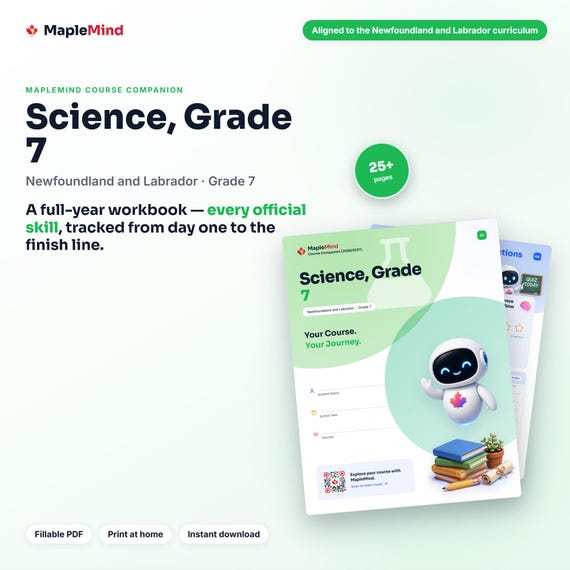
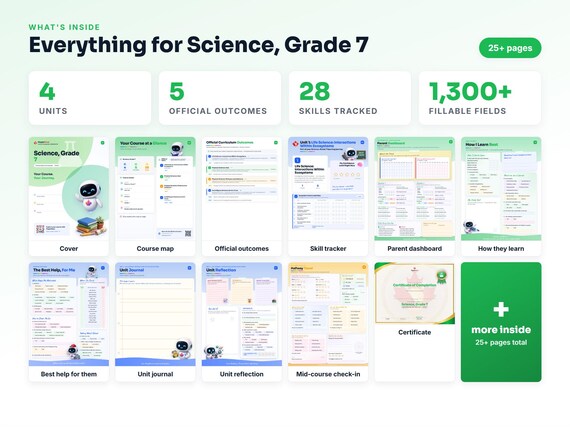
Printable workbook · A keepsake of the year
A Science, Grade 7 workbook worth keeping
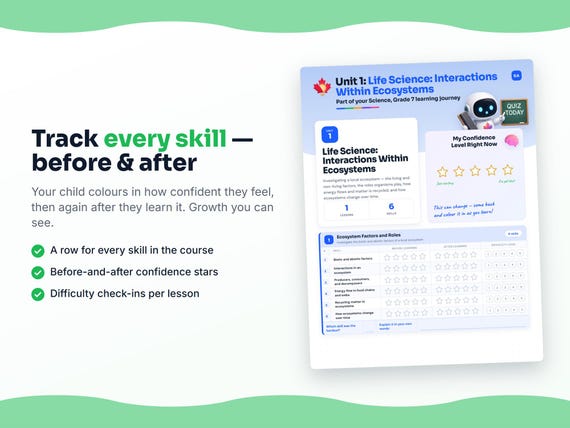
Built from the same official curriculum as this page. Before and after each skill above, your student colours in how sure they feel — so the two of you can see, on one page, what's clicking and what needs another look. It's a quiet way to follow how the year is really going.
By June it's full of their own handwriting: units worked through, confidence grown, a mid-year check-in, notes from parent-teacher night, and a certificate at the end. Less a worksheet, more a record of the year worth keeping on the shelf.
Instant download · see every page, reviews and the full description · five or more workbooks are $2.99 each
What it looks like in the app



Common questions
Can MapleMind help me with Science, Grade 7?
Yes. MapleMind's AI tutor covers all 28 skills in Newfoundland and Labrador's Science, Grade 7 — you pick the exact skill, and the tutor teaches it step by step: a short lesson, a worked example, solving together, then a skill check to show it stuck.
Is MapleMind aligned to Newfoundland and Labrador's official curriculum?
Yes. Every skill in this course maps to an official outcome code from Newfoundland and Labrador's Grade 7 Science curriculum, and the ministry's own wording is quoted under each unit on this page — with the official government source linked so you can check it yourself.
What does MapleMind cost?
It's free to start — 5 tutoring chats and a practice quiz every day, no credit card. A Pro subscription ($9.99/month or $49.99/year CAD, 7-day free trial) unlocks unlimited tutoring, practice, and exam simulations.
What if I'm stuck on just one topic?
That's the point of skill-level tutoring: open Science, Grade 7 in the app, tap the exact skill from the list on this page, and the tutor teaches just that — no wading through lessons you don't need.
Does MapleMind work in French or other languages?
Yes — 14 languages, including French. Both the app and the tutor's explanations switch to the language you choose.
Where can I see the official Newfoundland and Labrador curriculum for Science, Grade 7?
The official source is linked on this page — Newfoundland and Labrador's official curriculum. The outline here follows it: every MapleMind skill carries its official outcome code, and the ministry's own wording is quoted under each unit.
Keep exploring
Ready when you are
Pick a skill from this page and see it taught properly — free, in the browser, in under a minute.