Get help with Science, Grade 8
Most tutoring makes you sit through material you already know. MapleMind flips that: pick the exact skill that's causing trouble — any of the 29 below — and the tutor teaches just that one, step by step, as many times as it takes. Ask questions in plain words, any time of day, in English, French, or 12 other languages.
The official Newfoundland and Labrador Science, Grade 8 curriculum
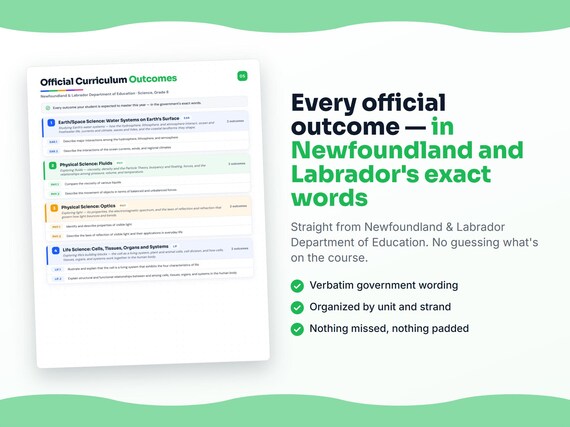
Newfoundland and Labrador defines Science, Grade 8 by strands and outcomes. MapleMind teaches the same curriculum reorganized for one-skill-at-a-time tutoring — the table shows exactly where every official strand lands, and the ministry's own wording is quoted under each unit below.
Official source Newfoundland and Labrador's official curriculumRead it on the government site — gov.nl.ca ↗| Official strand | Outcomes | Where MapleMind teaches it |
|---|---|---|
| Strand 1 | 9 | Earth/Space Science: Water Systems on Earth's Surface |
| Strand 4 | 9 | Physical Science: Fluids |
| Strand 7 | 4 | Physical Science: Optics |
| Strand 10 | 7 | Life Science: Cells, Tissues, Organs and Systems |
Every skill below, taught one on one.
 Try the first session free
How MapleMind teaches Science, Grade 8 — every unit, lesson, and skill
Every skill below runs as a short session: a plain-words lesson, a worked example, solving it together, then a five-question skill check that earns up to three stars. Guided Mode keeps it teaching instead of answer-handing — turning it off needs a parent's password.
Unit 1Earth/Space Science: Water Systems on Earth's SurfaceOfficial strand · Strand 1
Studying Earth's water systems — how the hydrosphere, lithosphere, and atmosphere interact, ocean and freshwater life, currents and climate, waves and tides, and the coastal landforms they shape.
Earth's Water Systems
- How Earth's spheres interactsci-8.1.1.1 — Describe major interactions among the hydrosphere, lithosphere, and atmosphere.
- Glaciers and climate changesci-8.1.1.2 — Describe how periods of climate change affect glaciers and the consequent effects on the environment.
- Life in oceans and fresh watersci-8.1.1.3 — Analyze factors that affect productivity and species distribution in freshwater and marine environments.
- Abiotic factors and aquatic lifesci-8.1.1.4 — Identify the effects of abiotic factors on plant and animal distributions in marine and freshwater ecosystems.
- Ocean basins and drainage systemssci-8.1.1.5 — Describe processes that lead to the development of ocean basins and continental drainage systems.
Currents, Tides, and Coastlines
- Ocean currents, winds, and climatesci-8.1.1.6 — Describe the interactions of ocean currents, winds, and regional climates.
- Waves and tidessci-8.1.1.7 — Explain how waves and tides are generated.
- Shaping shorelinessci-8.1.1.8 — Describe the processes of erosion and deposition at shorelines from wave action and water flow.
- Coastal landformssci-8.1.1.9 — Recognize that landforms result from erosion and deposition caused by wave action and water flow.
The official wording — 9 outcomes in this unit
- sci-8.1.1.1
Describe major interactions among the hydrosphere, lithosphere, and atmosphere
- sci-8.1.1.2
Describe how periods of climate change affect glaciers and describe the consequent effects on the environment
- sci-8.1.1.3
Analyze factors that affect productivity and species distribution in freshwater and marine environments
- sci-8.1.1.4
Identify the effects of abiotic factors on plant and animal distributions in marine and freshwater ecosystems
- sci-8.1.1.5
Describe processes that lead to the development of ocean basins and continental drainage systems
- sci-8.1.1.6
Describe the interactions of the ocean currents, winds, and regional climates
- sci-8.1.1.7
Explain how waves and tides are generated
- sci-8.1.1.8
Describe the processes of erosion and deposition at shorelines that result from wave action and water flow
- sci-8.1.1.9
Recognize that landforms result from the processes of erosion and deposition caused by wave action and water flow
Unit 2Physical Science: FluidsOfficial strand · Strand 4
Exploring fluids — viscosity, density and the Particle Theory, buoyancy and floating, forces, and the relationships among pressure, volume, and temperature.
Viscosity and Density
- Viscositysci-8.2.1.1 — Compare the viscosity of various liquids and describe factors that modify it.
- Density and the Particle Theorysci-8.2.1.3 — Describe the relationship among mass, volume, and density using the Particle Theory, and analyze density quantitatively.
- Temperature and densitysci-8.2.1.5 — Explain the effects of temperature changes on the density of solids, liquids, and gases and relate to the Particle Theory.
- Density in everyday lifesci-8.2.1.6 — Describe situations in life where the density of substances naturally changes or is intentionally changed.
Forces, Buoyancy, and Pressure
- Balanced and unbalanced forcessci-8.2.1.7 — Describe the movement of objects in terms of balanced and unbalanced forces.
- Mass and weightsci-8.2.1.8 — Describe qualitatively the difference between mass and weight.
- Buoyancy — sinking and floatingsci-8.2.1.9 — Describe the connection between weight, buoyancy, and sinking or floating.
- Force, area, and pressuresci-8.2.1.10 — Describe quantitatively the relationship between force, area, and pressure.
- Pressure, volume, and temperaturesci-8.2.1.11 — Explain qualitatively the relationship among pressure, volume, and temperature when fluids are compressed or heated.
The official wording — 9 outcomes in this unit
- sci-8.2.1.1
Compare the viscosity of various liquids
- sci-8.2.1.3
Describe the relationship among the mass, volume, and density of solids, liquids and gases using the Particle Theory
- sci-8.2.1.5
Explain the effects of changes in temperature on the density of solids, liquids, and gases and relate the results to the Particle Theory
- sci-8.2.1.6
Describe situations in life where the density of substances naturally changes or is intentionally changed
- sci-8.2.1.7
Describe the movement of objects in terms of balanced and unbalanced forces
- sci-8.2.1.8
Describe qualitatively the difference between mass and weight
- sci-8.2.1.9
Describe the connection between weight, buoyancy, and sinking or floating
- sci-8.2.1.10
Describe quantitatively the relationship between force, area, and pressure
- sci-8.2.1.11
Explain qualitatively the relationship among pressure, volume, and temperature when liquid and gaseous fluids are compressed or heated
Unit 3Physical Science: OpticsOfficial strand · Strand 7
Exploring light — its properties, the electromagnetic spectrum, and the laws of reflection and refraction that govern how light bounces and bends.
Light and the Spectrum
- Properties of visible lightsci-8.3.1.1 — Identify and describe properties of visible light.
- The electromagnetic spectrumsci-8.3.1.2 — Describe the different types of electromagnetic radiation and compare their properties to visible light.
Reflection and Refraction
- The law of reflectionsci-8.3.1.3 — Describe the laws of reflection of visible light and their applications in everyday life.
- Refractionsci-8.3.1.4 — Describe qualitatively how visible light is refracted.
The official wording — 4 outcomes in this unit
- sci-8.3.1.1
Identify and describe properties of visible light
- sci-8.3.1.2
Describe the different types of electromagnetic radiation and compare properties to visible light
- sci-8.3.1.3
Describe the laws of reflection of visible light and their applications in everyday life
- sci-8.3.1.4
Describe qualitatively how visible light is refracted
Unit 4Life Science: Cells, Tissues, Organs and SystemsOfficial strand · Strand 10
Exploring life's building blocks — the cell as a living system, plant and animal cells, cell division, and how cells, tissues, organs, and systems work together in the human body.
Cells
- The cell as a living systemsci-8.4.1.1 — Illustrate and explain that the cell is a living system that exhibits the four characteristics of life.
- Plant and animal cellssci-8.4.1.2 — Distinguish between typical plant and animal cells.
- Cell division, growth, and reproductionsci-8.4.1.3 — Explain that growth and reproduction depend on cell division.
From Cells to Systems
- Cells, tissues, organs, and systemssci-8.4.1.4 — Explain the structural and functional relationships between and among cells, tissues, organs, and systems.
- Cells and the whole organismsci-8.4.1.5 — Relate the needs and functions of various cells and organs to the needs and functions of the human organism as a whole.
- What affects body systemssci-8.4.1.6 — Describe the basic factors that affect the functions and efficiency of the human body systems.
- Systems working togethersci-8.4.1.7 — Describe three examples of the interdependence of various systems of the human body.
The official wording — 7 outcomes in this unit
- sci-8.4.1.1
Illustrate and explain that the cell is a living system that exhibits the four characteristics of life
- sci-8.4.1.2
Distinguish between typical plant and animal cells
- sci-8.4.1.3
Explain that growth and reproduction depend on cell division
- sci-8.4.1.4
Explain structural and functional relationships between and among cells, tissues, organs, and systems in the human body
- sci-8.4.1.5
Relate the needs and functions of various cells and organs to the needs and functions of the human organism as a whole
- sci-8.4.1.6
Describe the basic factors that affect the functions and efficiency of the human respiratory, circulatory, muscular, digestive, excretory, and nervous systems
- sci-8.4.1.7
Describe three examples of the interdependence of various systems of the human body
Printable workbook · A keepsake of the year
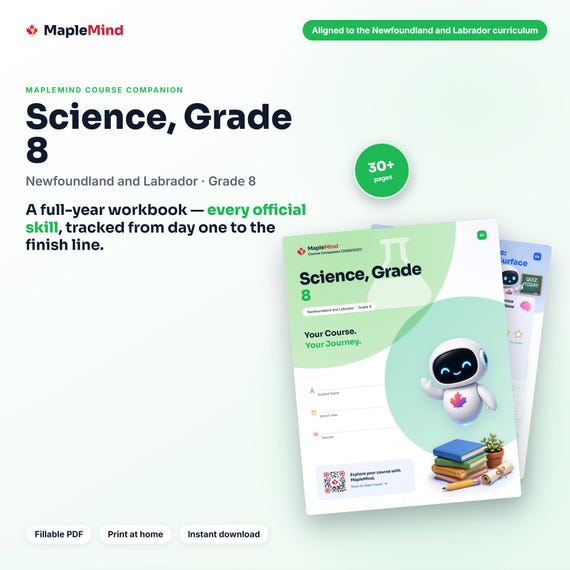
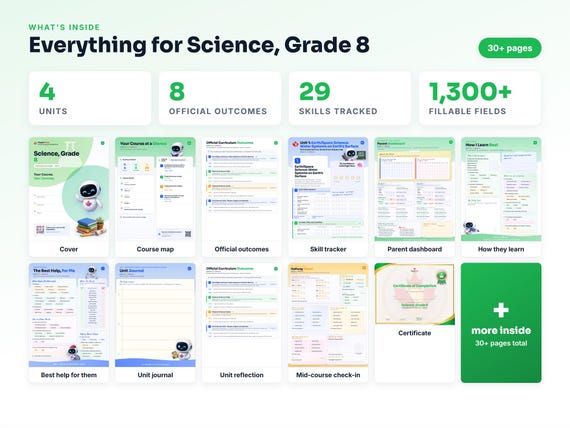
A Science, Grade 8 workbook worth keeping
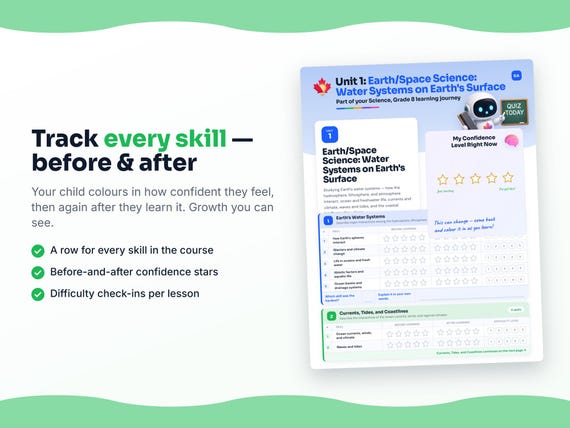
Built from the same official curriculum as this page. Before and after each skill above, your student colours in how sure they feel — so the two of you can see, on one page, what's clicking and what needs another look. It's a quiet way to follow how the year is really going.
By June it's full of their own handwriting: units worked through, confidence grown, a mid-year check-in, notes from parent-teacher night, and a certificate at the end. Less a worksheet, more a record of the year worth keeping on the shelf.
Instant download · see every page, reviews and the full description · five or more workbooks are $2.99 each
What it looks like in the app



Common questions
Can MapleMind help me with Science, Grade 8?
Yes. MapleMind's AI tutor covers all 29 skills in Newfoundland and Labrador's Science, Grade 8 — you pick the exact skill, and the tutor teaches it step by step: a short lesson, a worked example, solving together, then a skill check to show it stuck.
Is MapleMind aligned to Newfoundland and Labrador's official curriculum?
Yes. Every skill in this course maps to an official outcome code from Newfoundland and Labrador's Grade 8 Science curriculum, and the ministry's own wording is quoted under each unit on this page — with the official government source linked so you can check it yourself.
What does MapleMind cost?
It's free to start — 5 tutoring chats and a practice quiz every day, no credit card. A Pro subscription ($9.99/month or $49.99/year CAD, 7-day free trial) unlocks unlimited tutoring, practice, and exam simulations.
What if I'm stuck on just one topic?
That's the point of skill-level tutoring: open Science, Grade 8 in the app, tap the exact skill from the list on this page, and the tutor teaches just that — no wading through lessons you don't need.
Does MapleMind work in French or other languages?
Yes — 14 languages, including French. Both the app and the tutor's explanations switch to the language you choose.
Where can I see the official Newfoundland and Labrador curriculum for Science, Grade 8?
The official source is linked on this page — Newfoundland and Labrador's official curriculum. The outline here follows it: every MapleMind skill carries its official outcome code, and the ministry's own wording is quoted under each unit.
Keep exploring
Ready when you are
Pick a skill from this page and see it taught properly — free, in the browser, in under a minute.