Get help with Science, Grade 9
Most tutoring makes you sit through material you already know. MapleMind flips that: pick the exact skill that's causing trouble — any of the 34 below — and the tutor teaches just that one, step by step, as many times as it takes. Ask questions in plain words, any time of day, in English, French, or 12 other languages.
The official Newfoundland and Labrador Science, Grade 9 curriculum
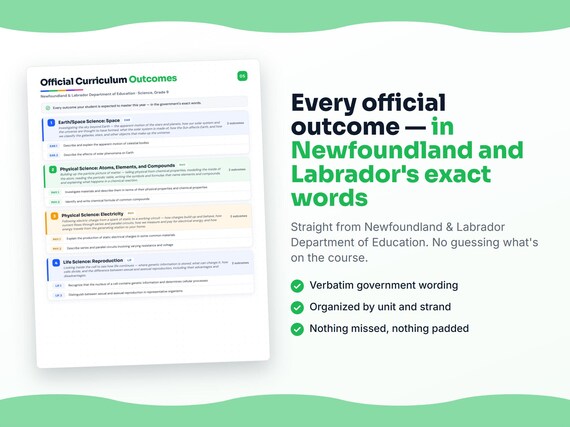
Newfoundland and Labrador defines Science, Grade 9 by strands and outcomes. MapleMind teaches the same curriculum reorganized for one-skill-at-a-time tutoring — the table shows exactly where every official strand lands, and the ministry's own wording is quoted under each unit below.
Official source Newfoundland and Labrador's official curriculumRead it on the government site — gov.nl.ca ↗| Official strand | Outcomes | Where MapleMind teaches it |
|---|---|---|
| Strand 1 | 8 | Earth/Space Science: Space |
| Strand 4 | 9 | Physical Science: Atoms, Elements, and Compounds |
| Strand 7 | 11 | Physical Science: Electricity |
| Strand 10 | 6 | Life Science: Reproduction |
Every skill below, taught one on one.
 Try the first session free
How MapleMind teaches Science, Grade 9 — every unit, lesson, and skill
Every skill below runs as a short session: a plain-words lesson, a worked example, solving it together, then a five-question skill check that earns up to three stars. Guided Mode keeps it teaching instead of answer-handing — turning it off needs a parent's password.
Unit 1Earth/Space Science: SpaceOfficial strand · Strand 1
Investigating the sky beyond Earth — the apparent motion of the stars and planets, how our solar system and the universe are thought to have formed, what the solar system is made of, how the Sun affects Earth, and how we classify the galaxies, stars, and other objects that make up the universe.
Motion and Make-up of the Solar System
- Apparent motion of celestial bodiessci-9.1.1.1 — Describe and explain why the Sun, Moon, planets, and stars appear to move across our sky.
- Theories on how the solar system formedsci-9.1.1.2 — Describe the leading scientific theories for how our solar system formed, especially the nebular hypothesis.
- Composition of the solar systemsci-9.1.1.3 — Describe the make-up and characteristics of the Sun, the planets, and the smaller bodies of the solar system.
- Measuring distances in spacesci-9.1.2.6 — Compare the units scientists use to measure the enormous distances in space.
- Technologies for exploring spacesci-9.1.2.4 — Identify some of the technologies designed to explore space.
The Sun's Reach and the Wider Universe
- Effects of solar phenomena on Earthsci-9.1.1.4 — Describe how activity on the Sun, such as solar wind and flares, affects Earth.
- Origin and evolution of the universesci-9.1.1.5 — Describe the main scientific theories for how the universe began and has changed over time.
- Classifying the components of the universesci-9.1.1.7 — Describe and classify the major objects that make up the universe, from nebulae and galaxies to different kinds of stars.
The official wording — 8 outcomes in this unit
- sci-9.1.1.1
Describe and explain the apparent motion of celestial bodies
- sci-9.1.1.2
Describe theories on the formation of the solar system
- sci-9.1.1.3
Describe the composition and characteristics of the following components of the solar system
- sci-9.1.2.6
Compare units used to measure distances in space
- sci-9.1.2.4
Identify some technologies designed to explore space
- sci-9.1.1.4
Describe the effects of solar phenomena on Earth
- sci-9.1.1.5
Describe theories on the origin and evolution of the universe
- sci-9.1.1.7
Describe and classify the major components of the universe
Unit 2Physical Science: Atoms, Elements, and CompoundsOfficial strand · Strand 4
Building up the particle picture of matter — telling physical from chemical properties, modelling the inside of the atom, reading the periodic table, writing the symbols and formulas that name elements and compounds, and explaining what happens in a chemical reaction.
Atoms and the Periodic Table
- Physical and chemical properties of materialssci-9.2.1.1 — Investigate materials and describe them by their physical and chemical properties.
- Modelling the structure of the atomsci-9.2.1.2 — Use models to describe the structure and components of atoms.
- The changing model of the atomsci-9.2.2.3 — Identify the major changes in atomic theory up to and including the Bohr model.
- Chemical symbols for common elementssci-9.2.1.3 — Identify and write the chemical symbols for common elements.
- Grouping elements on the periodic tablesci-9.2.1.4 — Use the periodic table to see that elements are grouped by similar characteristics.
- Comparing common elements and their atomssci-9.2.1.5 — Identify common elements and compare their characteristics and atomic structure.
Compounds and Chemical Reactions
- Chemical formulas of common compoundssci-9.2.1.6 — Identify and write the chemical formulas of common compounds.
- Property changes in chemical reactionssci-9.2.1.7 — Describe how the properties of materials change during common chemical reactions.
- WHMIS and safe lab practicesci-9.2.3.1 — Demonstrate a knowledge of WHMIS standards for safely handling and disposing of lab materials.
The official wording — 9 outcomes in this unit
- sci-9.2.1.1
Investigate materials and describe them in terms of their physical properties and chemical properties
- sci-9.2.1.2
Use models in describing the structure and components of atoms
- sci-9.2.2.3
Identify major changes in atomic theory up to and including the Bohr model
- sci-9.2.1.3
Identify and write chemical symbols for common elements
- sci-9.2.1.4
Using the Periodic Table, develop an understanding that the elements are grouped on the basis of similar characteristics
- sci-9.2.1.5
Identify examples of common elements, and compare their characteristics and atomic structure
- sci-9.2.1.6
Identify and write chemical formula of common compounds
- sci-9.2.1.7
Describe changes in the properties of materials that result from some common chemical reactions
- sci-9.2.3.1
Demonstrate a knowledge of WHMIS standards by using proper techniques for handling and disposing of lab material
Unit 3Physical Science: ElectricityOfficial strand · Strand 7
Following electric charge from a spark of static to a working circuit — how charges build up and behave, how current flows through series and parallel circuits, how we measure and pay for electrical energy, and how energy travels from the generating station to your home.
Static Charge and Electric Current
- Producing static electric chargessci-9.3.1.1 — Explain how static electric charges are produced in common materials.
- Properties of static chargessci-9.3.1.2 — Identify the properties of static electric charges, including how they attract and repel.
- Measuring with an ammeter and voltmetersci-9.3.3.4 — Use an ammeter and a voltmeter to measure current and voltage in a circuit.
- Static electricity versus electric currentsci-9.3.1.3 — Qualitatively compare static electricity with electric current.
- The flow of charge in a circuitsci-9.3.1.4 — Describe the flow of charge in an electric circuit using precise language.
Circuits and Electrical Energy
- Series and parallel circuitssci-9.3.1.5 — Describe series and parallel circuits with varying resistance and voltage.
- Electrical energy and consumption costsci-9.3.1.6 — Relate electrical energy use to what home power consumption costs.
- Precise language for electrical energy costssci-9.3.1.7 — Explain why precise language matters when evaluating electrical energy costs.
- Efficiency of an electrical appliancesci-9.3.1.8 — Determine quantitatively the efficiency of an electrical appliance that converts electrical energy to heat.
- From generating station to the homesci-9.3.1.9 — Describe how energy is transferred and converted from a generating station to the home.
- Alternative sources of electrical energysci-9.3.2.13 — Give examples of alternative sources of electrical energy.
The official wording — 11 outcomes in this unit
- sci-9.3.1.1
Explain the production of static electrical charges in some common materials
- sci-9.3.1.2
Identify properties of static electrical charges
- sci-9.3.3.4
Use an ammeter and voltmeter to measure current and voltage in a circuit
- sci-9.3.1.3
Qualitatively compare static electricity and electric current
- sci-9.3.1.4
Describe the flow of charge in an electric circuit using precise language
- sci-9.3.1.5
Describe series and parallel circuits involving varying resistance and voltage
- sci-9.3.1.6
Relate electrical energy to domestic power consumption costs
- sci-9.3.1.7
Explain the importance of using precise language in evaluating electrical energy costs
- sci-9.3.1.8
Determine quantitatively the efficiency of an electrical appliance that converts electrical energy to heat energy
- sci-9.3.1.9
Describe the transfer and conversion of energy from a generating station to the home
- sci-9.3.2.13
Give examples of alternative sources of electrical energy
Unit 4Life Science: ReproductionOfficial strand · Strand 10
Looking inside the cell to see how life continues — where genetic information is stored, what can change it, how cells divide, and the difference between sexual and asexual reproduction, including their advantages and disadvantages.
Genetic Information and Cell Division
- Genetic information in the nucleussci-9.4.1.1 — Recognize that the nucleus of a cell contains genetic information that determines cellular processes.
- Changes to a cell's genetic informationsci-9.4.1.2 — Discuss the factors that may lead to changes in a cell's genetic information.
- The process of cell divisionsci-9.4.1.3 — Illustrate and describe the basic process of cell division, including what happens to the nucleus and cell membrane.
Sexual and Asexual Reproduction
- Sexual and asexual reproductionsci-9.4.1.4 — Distinguish between sexual and asexual reproduction in representative organisms.
- Advantages of sexual and asexual reproductionsci-9.4.1.6 — Compare sexual and asexual reproduction in terms of their advantages and disadvantages.
- Milestones in understanding geneticssci-9.4.2.4 — Identify major shifts in the scientific understanding of genetics.
The official wording — 6 outcomes in this unit
- sci-9.4.1.1
Recognize that the nucleus of a cell contains genetic information and determines cellular processes
- sci-9.4.1.2
Discuss factors that may lead to changes in a cell
- sci-9.4.1.3
Illustrate and describe the basic processes of cell division, including what happens to the cell membrane and the contents of the nucleus
- sci-9.4.1.4
Distinguish between sexual and asexual reproduction in representative organisms
- sci-9.4.1.6
Compare sexual and asexual reproduction in terms of their advantages and disadvantages
- sci-9.4.2.4
Identify major shifts in scientific understanding of genetics
Printable workbook · A keepsake of the year
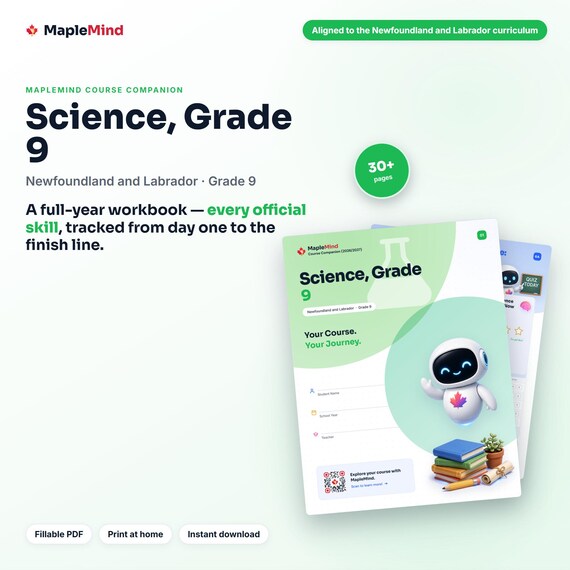
A Science, Grade 9 workbook worth keeping
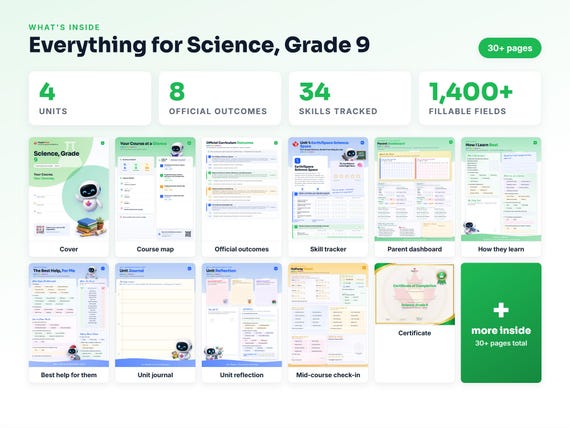
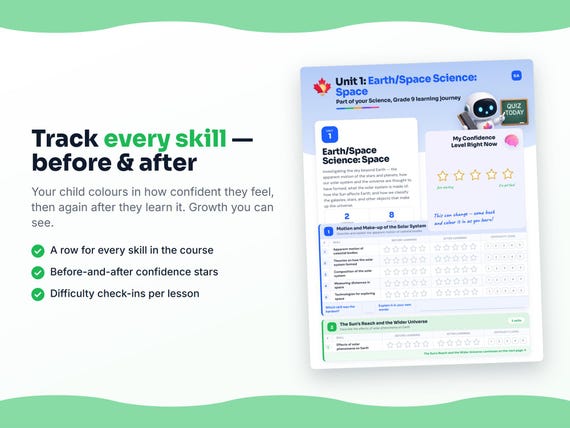
Built from the same official curriculum as this page. Before and after each skill above, your student colours in how sure they feel — so the two of you can see, on one page, what's clicking and what needs another look. It's a quiet way to follow how the year is really going.
By June it's full of their own handwriting: units worked through, confidence grown, a mid-year check-in, notes from parent-teacher night, and a certificate at the end. Less a worksheet, more a record of the year worth keeping on the shelf.
Instant download · see every page, reviews and the full description · five or more workbooks are $2.99 each
What it looks like in the app



Common questions
Can MapleMind help me with Science, Grade 9?
Yes. MapleMind's AI tutor covers all 34 skills in Newfoundland and Labrador's Science, Grade 9 — you pick the exact skill, and the tutor teaches it step by step: a short lesson, a worked example, solving together, then a skill check to show it stuck.
Is MapleMind aligned to Newfoundland and Labrador's official curriculum?
Yes. Every skill in this course maps to an official outcome code from Newfoundland and Labrador's Grade 9 Science curriculum, and the ministry's own wording is quoted under each unit on this page — with the official government source linked so you can check it yourself.
What does MapleMind cost?
It's free to start — 5 tutoring chats and a practice quiz every day, no credit card. A Pro subscription ($9.99/month or $49.99/year CAD, 7-day free trial) unlocks unlimited tutoring, practice, and exam simulations.
What if I'm stuck on just one topic?
That's the point of skill-level tutoring: open Science, Grade 9 in the app, tap the exact skill from the list on this page, and the tutor teaches just that — no wading through lessons you don't need.
Does MapleMind work in French or other languages?
Yes — 14 languages, including French. Both the app and the tutor's explanations switch to the language you choose.
Where can I see the official Newfoundland and Labrador curriculum for Science, Grade 9?
The official source is linked on this page — Newfoundland and Labrador's official curriculum. The outline here follows it: every MapleMind skill carries its official outcome code, and the ministry's own wording is quoted under each unit.
Keep exploring
Ready when you are
Pick a skill from this page and see it taught properly — free, in the browser, in under a minute.