Newfoundland & Labrador · For parents

What your child learns in Grade 6 in Newfoundland & Labrador

Every subject, unit by unit, from Newfoundland & Labrador’s curriculum: 133 skills in plain words.

Subjects
5
Skills
133
Provincial exams
1
Official curriculum
gov.nl.ca

Math in Grade 6

Mathematics, Grade 6

10 units · 42 skills

  1. Unit 1

    Number Relationships

    Large and small numbers appear in media, science, and technology.

    • Large and small numbers around us
    • The place-value pattern
    • Integers and the number line
    1 more skill
    • Comparing and ordering integers
  2. Unit 2

    Fractions, Percent, and Ratio

    An improper fraction is greater than one whole.

    • Improper fractions greater than one
    • Converting and placing fractions
    • Percent means out of 100
    3 more skills
    • Modelling and recording percents
    • Writing ratios in many forms
    • Part-to-part and part-to-whole ratios
  3. Unit 3

    Number Theory and Order of Operations

    A prime number has exactly two factors: 1 and itself.

    • Prime and composite numbers
    • Factors and multiples
    • Order of operations
  4. Unit 4

    Decimal Operations

    Estimating with whole numbers shows about where the point goes.

    • Estimating to place the decimal point
    • Multiplying and dividing decimals
    • Solving percent problems
    1 more skill
    • Solving ratio problems
  5. Unit 5

    Patterns and Relationships

    Each column can follow its own pattern.

    • Describing relationships in a table
    • Writing a pattern as an expression
    • Reading and building graphs of patterns
    1 more skill
    • Using tables to predict and solve
  6. Unit 6

    Equality and Equations

    a + b = b + a for any numbers.

    • The commutative property
    • Preserving equality across operations
  7. Unit 7

    Measurement

    Angles are acute, right, obtuse, straight, or reflex.

    • Classifying and estimating angles
    • Measuring and drawing angles
    • Angle sums of triangles and quadrilaterals
    2 more skills
    • Perimeter and area formulas
    • Volume of right rectangular prisms
  8. Unit 8

    Geometry and Transformations

    Triangles are sorted by side lengths and by angle types.

    • Classifying triangles
    • Drawing and replicating triangles
    • Regular and irregular polygons
    6 more skills
    • Congruence in a regular polygon
    • Plotting points in the first quadrant
    • Shapes and distances on the plane
    • Describing transformations on the plane
    • Performing transformations and finding the image
    • Combining successive transformations
  9. Unit 9

    Data and Graphs

    Some questions are best answered by a survey, others by a database.

    • Choosing a data collection method
    • Choosing an appropriate graph
    • Creating and interpreting line graphs
  10. Unit 10

    Probability

    The theoretical probability compares favourable outcomes to all outcomes.

    • Listing outcomes and theoretical probability
    • Comparing theoretical and experimental probability
Science in Grade 6

Science, Grade 6

3 units · 27 skills

  1. Unit 1

    Earth and Space Science

    The Sun is a star — a huge ball of hot, glowing gas at the centre of the solar system.

    • The Sun, planets, and moons
    • Day, night, and seasons
    • Moon phases, eclipses, and tides
    3 more skills
    • Comets, asteroids, and meteoroids
    • Constellations
    • Living in space
  2. Unit 2

    Physical Science

    Four forces act on flying things: lift, gravity (weight), thrust, and drag.

    • The forces of flight
    • Lift and wing shape
    • Bernoulli's principle
    11 more skills
    • Drag and propulsion
    • Aircraft and spacecraft
    • How birds and insects fly
    • Static and current electricity
    • Building circuits
    • Series and parallel circuits
    • Conductors and insulators
    • What electricity can do
    • Electricity and magnetism
    • Generating electricity
    • Saving electricity and staying safe
  3. Unit 3

    Life Science

    Classification means sorting living things into groups by shared features.

    • Why we classify living things
    • Vertebrates and invertebrates
    • Classes of vertebrates
    4 more skills
    • Arthropods
    • Microorganisms
    • Adaptations around the world
    • Fossils and change over time

English in Grade 6

English Language Arts, Grade 6

3 units · 35 skills

  1. Unit 1

    Speaking and Listening

    Talking through an idea often makes it clearer to you.

    • Examining how sharing clarifies and extends thinking
    • Using active listening strategies
    • Assessing how listening affects your thinking
    5 more skills
    • Expressing ideas in a range of discussions
    • Applying effective presentation skills
    • Analyzing a presentation's impact on an audience
    • Examining a speaker's perspective
    • Evaluating verbal and non-verbal communication
  2. Unit 2

    Reading and Viewing

    Cueing systems are meaning, structure (grammar), and visual (letters/sounds) cues.

    • Integrating cueing systems to construct meaning
    • Selecting texts for interests and learning needs
    • Integrating effective reading and viewing strategies
    14 more skills
    • Explaining how structures help the audience make meaning
    • Explaining how features help the audience make meaning
    • Reflecting on themselves as readers and viewers
    • Creating inquiry questions for multiple purposes
    • Selecting a variety of informational sources
    • Evaluating information from sources
    • Organizing reliable information
    • Sharing relevant information
    • Explaining thinking using support from texts
    • Explaining thinking using personal connections
    • Evaluating messages in texts
    • Comparing alternate points of view
    • Analyzing the impact of language in texts
    • Examining how responses to texts affect social change
  3. Unit 3

    Writing and Representing

    Developing ideas means adding depth: details, examples, and explanation.

    • Exploring ways to develop ideas
    • Developing voice in texts
    • Experimenting with stylistic effects
    7 more skills
    • Reflecting on themselves as text creators
    • Creating a range of texts
    • Assessing the influence of audience and purpose
    • Analyzing traits of writing to create texts
    • Analyzing responses from peers
    • Applying knowledge of language conventions
    • Examining the impact of publishing texts

French in Grade 6

Core French, Grade 6

3 units · 12 skills

  1. Unit 1

    Oral Communication

    Grade 6 widens the topics: sports, environment, technology, community.

    • Messages on a diversity of topics
    • Handling spontaneous conversations
    • Understanding and responding to oral texts
    6 more skills
    • Initiating real conversations
    • Discussing feelings
    • Describing with detail
    • Sharing ideas and opinions
    • Preferences across topics
    • Describing francophone cultures
  2. Unit 2

    Reading and Viewing

    Read fluently in phrases, with expression.

    • Reading short, simple texts
    • Applying reading strategies
  3. Unit 3

    Written Communication

    Grade 6 emphasizes VARIOUS text types, not just one form.

    • Planning and creating varied texts

Social studies in Grade 6

Social Studies, Grade 6

7 units · 17 skills

  1. Unit 1

    Social Studies Concepts and Skills - 1. Civic Engagement

    Democratic principles include democratic systems, liberty, and the rule of law.

    • Democratic systems and the rule of law
    • Collaboration and promoting positive change
  2. Unit 2

    Social Studies Concepts and Skills - 2. Inquiry and Research

    Using evidence means analyzing sources and observations.

    • Six forms of analysis
    • Inquiry and responding to issues
  3. Unit 3

    Anthropology - 3. Citizenship, Power, and Governance

    Freedom of cultural expression is a cornerstone of culture.

    • How government decisions influence culture
    • Rights and responsibilities of global citizenship
  4. Unit 4

    Anthropology - 4. Civic Engagement

    Global issues affect people and their cultures.

    • Investigating a global issue and responding
  5. Unit 5

    Anthropology - 5. Culture and Diversity

    Culture is an important part of our lives as individuals and groups.

    • The role and types of culture
    • Reflecting on my own culture and belonging
    • The common elements of culture
    4 more skills
    • Comparing Canadian culture to another country
    • How beliefs, values, and traditions are expressed
    • The importance of cross-cultural understanding
    • Indigenous cultures within Canada and the world
  6. Unit 6

    Anthropology - 6. Interdependence

    Global culture is aspects of culture shared by people in many parts of the world.

    • Factors that create global culture
  7. Unit 7

    Anthropology - 7. People, Place, and Environment

    A cultural region is an area sharing common elements of culture.

    • The concept of a cultural region
    • How environments and resources influence culture

Provincial exams in Grade 6

MapleMind

See Grade 6 in MapleMind

Real screens from the app your child would use.

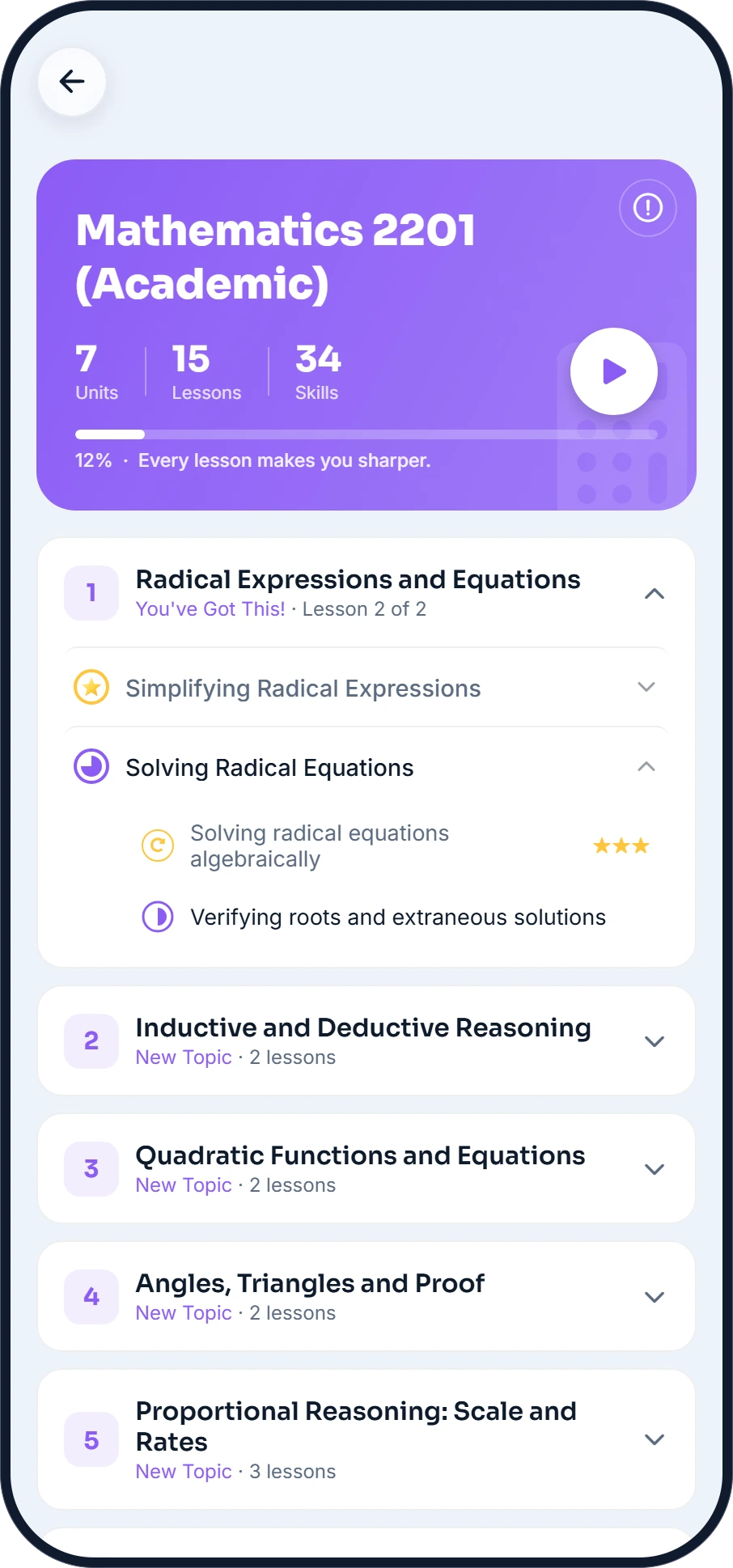
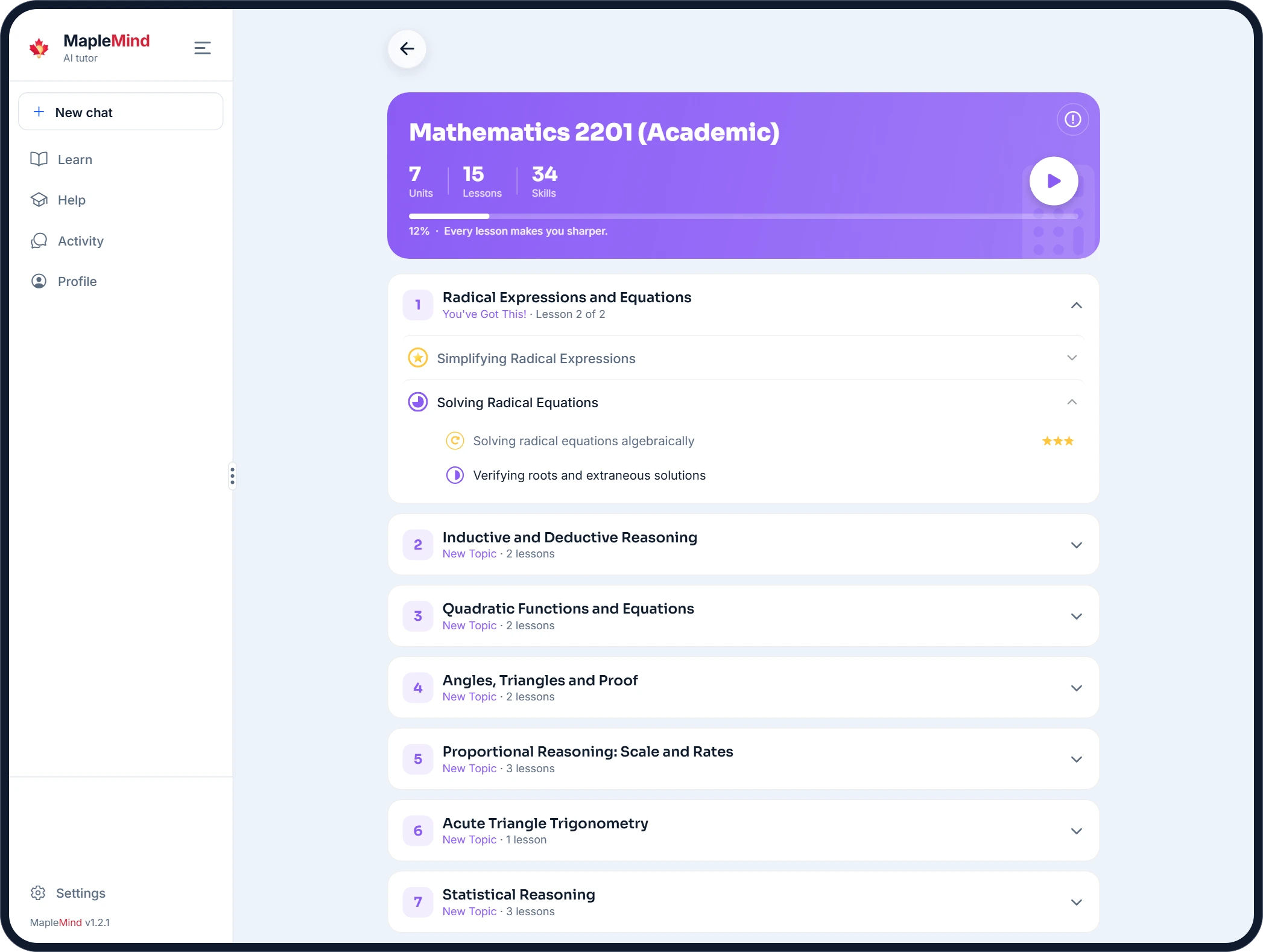
Mathematics 2201 (Academic) in MapleMind on a tablet: its units and lessons in order, a student partway through.Mathematics 2201 (Academic) in MapleMind on a phone: its units and lessons in order, a student partway through.
Their course, unit by unit, the way Newfoundland & Labrador teaches it.Shown: Mathematics 2201 (Academic)
Homework Help on a tablet: a photo of a worksheet, the tutor’s worked example of a two-step equation, and a question back to the student.Homework Help on a phone: a photo of a worksheet, the tutor’s worked example of a two-step equation, and a question back to the student.
Homework Help: they take a photo of the question, and the tutor works through it with them.
The Parent Dashboard on a tablet: a student’s days studied, streak, lessons, quiz average and recent activity.The Parent Dashboard on a phone: a student’s days studied, streak, lessons, quiz average and recent activity.
The Parent Dashboard: how each child’s week went, in lessons, quizzes and days studied.
A Grade 9 provincial mathematics exam on a tablet: a readiness score, the exam’s time and its next sitting.A Grade 9 provincial mathematics exam on a phone: a readiness score, the exam’s time and its next sitting.
A provincial exam: a practice sitting under the real time, and how ready they are.
The Learn tab on a tablet: a four-day streak, the week’s days, Homework Help, the next lesson and a review.The Learn tab on a phone: a four-day streak, the week’s days, Homework Help, the next lesson and a review.
The Learn tab: their week so far, and the next thing to do.

Help at home

Questions parents ask

What will my child learn in Grade 6 in Newfoundland & Labrador?

Math: Mathematics, Grade 6. Science: Science, Grade 6. English: English Language Arts, Grade 6. French: Core French, Grade 6. Social studies: Social Studies, Grade 6. That’s 133 skills in all, from Newfoundland & Labrador’s curriculum.

When is the Provincial Reading and Mathematics Assessment: Mathematics, Grade 6?

It’s written May 25, 2027 to June 4, 2027.

Where does this list come from?

From Newfoundland & Labrador’s official curriculum, the documents its education ministry publishes for each course. Each skill here is one of their expectations, written in plain words.

Can MapleMind help my child in Grade 6?

Yes. Every course on this page is in MapleMind, with lessons, practice and a tutor that works through each step with them. A free account gets 30 messages and 4 activities a day.

Help with Grade 6, one skill at a time.

Every course on this page is in MapleMind, free with daily limits.