Get help with Social Studies, Grade 7
Most tutoring makes you sit through material you already know. MapleMind flips that: pick the exact skill that's causing trouble — any of the 21 below — and the tutor teaches just that one, step by step, as many times as it takes. Ask questions in plain words, any time of day, in English, French, or 12 other languages.
The official Newfoundland and Labrador Social Studies, Grade 7 curriculum
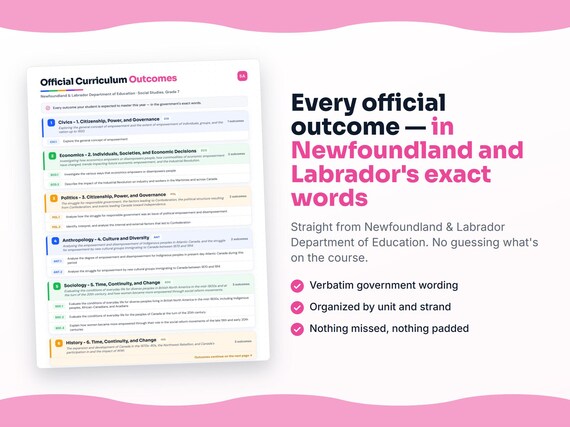
Newfoundland and Labrador defines Social Studies, Grade 7 by strands and outcomes. MapleMind teaches the same curriculum reorganized for one-skill-at-a-time tutoring — the table shows exactly where every official strand lands, and the ministry's own wording is quoted under each unit below.
Official source Newfoundland and Labrador's official curriculumRead it on the government site — gov.nl.ca ↗| Official strand | Outcomes | Where MapleMind teaches it |
|---|---|---|
| Strand 1 | 2 | Civics - 1. Citizenship, Power, and Governance |
| Strand 2 | 4 | Economics - 2. Individuals, Societies, and Economic Decisions |
| Strand 3 | 4 | Politics - 3. Citizenship, Power, and Governance |
| Strand 4 | 2 | Anthropology - 4. Culture and Diversity |
| Strand 5 | 3 | Sociology - 5. Time, Continuity, and Change |
| Strand 6 | 4 | History - 6. Time, Continuity, and Change |
Every skill below, taught one on one.
 Try the first session free
How MapleMind teaches Social Studies, Grade 7 — every unit, lesson, and skill
Every skill below runs as a short session: a plain-words lesson, a worked example, solving it together, then a five-question skill check that earns up to three stars. Guided Mode keeps it teaching instead of answer-handing — turning it off needs a parent's password.
Unit 1Civics - 1. Citizenship, Power, and GovernanceOfficial strand · Strand 1
Exploring the general concept of empowerment and the extent of empowerment of individuals, groups, and the nation up to 1920.
The Concept of Empowerment
- The general concept of empowermentNL-SS-7.1 — Explore the general concept of empowerment - who holds power and how people become empowered.
- The extent of empowerment up to 1920NL-SS-7.2 — Portray an understanding of the extent of empowerment of individuals, groups, and the nation up to 1920.
The official wording — 2 outcomes in this unit
- NL-SS-7.1
Explore the general concept of empowerment
- NL-SS-7.2
Portray an understanding of the extent of empowerment of individuals, groups, and the nation up to 1920
Unit 2Economics - 2. Individuals, Societies, and Economic DecisionsOfficial strand · Strand 2
Investigating how economics empowers or disempowers people, how commodities of economic empowerment have changed, trends impacting future economic empowerment, and the Industrial Revolution.
Economics and Empowerment
- How economics empowers or disempowersNL-SS-7.3 — Investigate the various ways that economics empowers or disempowers people.
- How commodities of empowerment changedNL-SS-7.4 — Analyse how commodities that lead to economic empowerment have changed over time.
- Trends impacting future economic empowermentNL-SS-7.5 — Identify and analyse trends that could impact future economic empowerment.
The Industrial Revolution
- Impact of the Industrial Revolution on workersNL-SS-7.6 — Describe the impact of the Industrial Revolution on industry and workers in the Maritimes and across Canada.
The official wording — 4 outcomes in this unit
- NL-SS-7.3
Investigate the various ways that economics empowers or disempowers people
- NL-SS-7.4
Analyse how commodities that lead to economic empowerment have changed
- NL-SS-7.5
Identify and analyse trends that could impact future economic empowerment
- NL-SS-7.6
Describe the impact of the Industrial Revolution on industry and workers in the Maritimes and across Canada
Unit 3Politics - 3. Citizenship, Power, and GovernanceOfficial strand · Strand 3
The struggle for responsible government, the factors leading to Confederation, the political structure resulting from Confederation, and events leading Canada toward independence.
The Struggle for Responsible Government
- Responsible government and empowermentNL-SS-7.7 — Analyse how the struggle for responsible government was an issue of political empowerment and disempowerment.
Confederation
- Perspectives and factors leading to ConfederationNL-SS-7.8 — Identify the colonies' perspectives on Confederation and analyse the internal and external factors affecting the debate.
- Was Confederation democratic?NL-SS-7.8 — Determine whether Confederation was a democratic process by today's standards.
- Canada's political structure after ConfederationNL-SS-7.9 — Explain the political structure of Canada that resulted from Confederation.
- Events leading Canada toward independenceNL-SS-7.10 — Identify and describe events in the early 20th century that led Canada toward independence.
The official wording — 4 outcomes in this unit
- NL-SS-7.7
Analyse how the struggle for responsible government was an issue of political empowerment and disempowerment
- NL-SS-7.8
Identify, interpret, and analyse the internal and external factors that led to Confederation
- NL-SS-7.9
Explain the political structure of Canada as a result of Confederation
- NL-SS-7.10
Identify and describe events in the early 20th century that led Canada toward independence
Unit 4Anthropology - 4. Culture and DiversityOfficial strand · Strand 4
Analysing the empowerment and disempowerment of Indigenous peoples in Atlantic Canada, and the struggle for empowerment by new cultural groups immigrating to Canada between 1870 and 1914.
Indigenous Peoples and Empowerment
- Indigenous peoples and their way of lifeNL-SS-7.11 — Identify the various Indigenous peoples in Atlantic Canada during this period and describe their way of life.
- The impact of policies, treaties, and the Indian ActNL-SS-7.11 — Explore how national policies, treaties, and the Indian Act affected the Indigenous peoples of Atlantic Canada, including the distinct situation of Indigenous peoples in Newfoundland.
New Cultural Groups and the Struggle for Empowerment
- Immigrant groups' struggle for empowermentNL-SS-7.12 — Analyse the struggle for empowerment by new cultural groups immigrating to Canada between 1870 and 1914.
The official wording — 2 outcomes in this unit
- NL-SS-7.11
Analyse the degree of empowerment and disempowerment for Indigneous peoples in present day Atlantic Canada during this period
- NL-SS-7.12
Analyse the struggle for empowerment by new cultural groups immigrating to Canada between 1870 and 1914
Unit 5Sociology - 5. Time, Continuity, and ChangeOfficial strand · Strand 5
Evaluating the conditions of everyday life for diverse peoples in British North America in the mid-1800s and at the turn of the 20th century, and how women became more empowered through social reform movements.
Everyday Life in British North America
- Everyday life for diverse peoples in the mid-1800sNL-SS-7.13 — Evaluate the conditions of everyday life for diverse peoples in British North America in the mid-1800s, including Indigenous peoples, African-Canadians, and Acadians.
Everyday Life at the Turn of the Century
- Everyday life at the turn of the 20th centuryNL-SS-7.14 — Evaluate the conditions of everyday life for the peoples of Canada at the turn of the 20th century.
Women and Social Reform
The official wording — 3 outcomes in this unit
- NL-SS-7.13
Evaluate the conditions of everyday life for diverse peoples living in British North America in the mid-1800s, including Indigenous peoples, African-Canadians, and Acadians
- NL-SS-7.14
Evaluate the conditions of everyday life for the peoples of Canada at the turn of the 20th century
- NL-SS-7.15
Explain how women became more empowered through their role in the social reform movements of the late 19th and early 20th centuries
Unit 6History - 6. Time, Continuity, and ChangeOfficial strand · Strand 6
The expansion and development of Canada in the 1870s-80s, the Northwest Rebellion, and Canada's participation in and the impact of WWI.
The Expansion of Canada
- Expansion's effect on people and regionsNL-SS-7.16 — Explain how the expansion and development of Canada in the 1870s and early 1880s affected its various people and regions, including the Red River Rebellion and encroachment on Indigenous land.
The Northwest Rebellion
- The Northwest Rebellion and perspectives on Louis RielNL-SS-7.17 — Analyse the events of the Northwest Rebellion of 1885, assess past and present perspectives on Louis Riel, and determine its impact on internal relations in Canada.
Canada and the First World War
- Causes of WWI and Canada's participationNL-SS-7.18 — Explain what caused WWI, why Canada became involved, and Canada's role, including how technology changed how the war was fought.
- The impact of WWI on Canada and its peopleNL-SS-7.19 — Demonstrate an understanding of the impact of WWI on Canada and her people.
The official wording — 4 outcomes in this unit
- NL-SS-7.16
Explain how the expansion and development of Canada during the 1870s and early 1880s affected its various people and regions
- NL-SS-7.17
Analyse the events of the Northwest Rebellion to determine its impact on internal relations in Canada
- NL-SS-7.18
Explain Canada's participation in WWI
- NL-SS-7.19
Demonstrate an understanding of the impact of WWI on Canada and her people
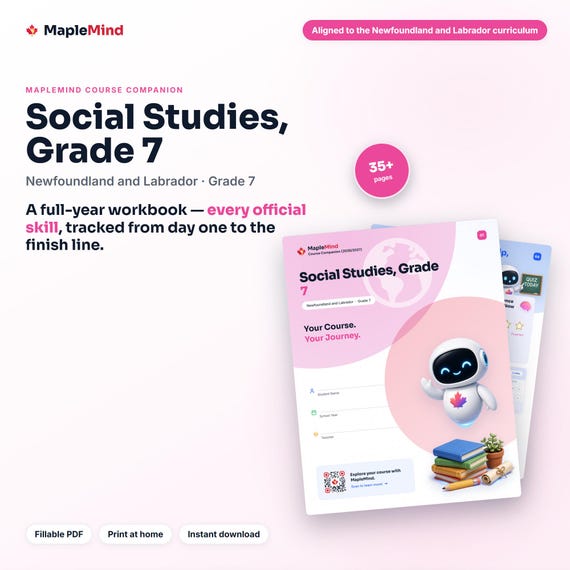
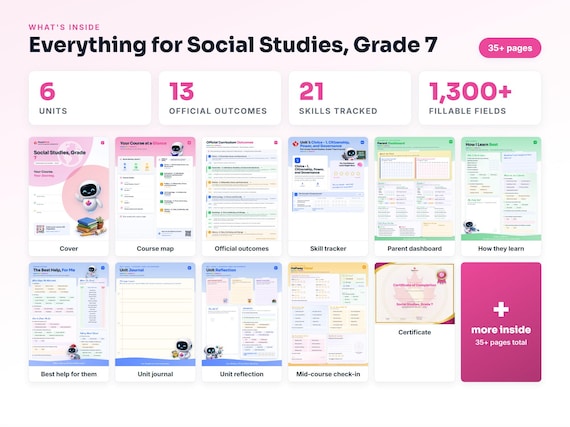
Printable workbook · A keepsake of the year
A Social Studies, Grade 7 workbook worth keeping
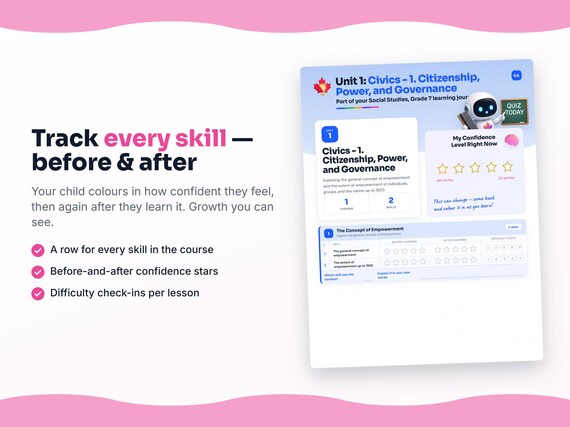
Built from the same official curriculum as this page. Before and after each skill above, your student colours in how sure they feel — so the two of you can see, on one page, what's clicking and what needs another look. It's a quiet way to follow how the year is really going.
By June it's full of their own handwriting: units worked through, confidence grown, a mid-year check-in, notes from parent-teacher night, and a certificate at the end. Less a worksheet, more a record of the year worth keeping on the shelf.
Instant download · see every page, reviews and the full description · five or more workbooks are $2.99 each
What it looks like in the app



Common questions
Can MapleMind help me with Social Studies, Grade 7?
Yes. MapleMind's AI tutor covers all 21 skills in Newfoundland and Labrador's Social Studies, Grade 7 — you pick the exact skill, and the tutor teaches it step by step: a short lesson, a worked example, solving together, then a skill check to show it stuck.
Is MapleMind aligned to Newfoundland and Labrador's official curriculum?
Yes. Every skill in this course maps to an official outcome code from Newfoundland and Labrador's Grade 7 Social Studies curriculum, and the ministry's own wording is quoted under each unit on this page — with the official government source linked so you can check it yourself.
What does MapleMind cost?
It's free to start — 5 tutoring chats and a practice quiz every day, no credit card. A Pro subscription ($9.99/month or $49.99/year CAD, 7-day free trial) unlocks unlimited tutoring, practice, and exam simulations.
What if I'm stuck on just one topic?
That's the point of skill-level tutoring: open Social Studies, Grade 7 in the app, tap the exact skill from the list on this page, and the tutor teaches just that — no wading through lessons you don't need.
Does MapleMind work in French or other languages?
Yes — 14 languages, including French. Both the app and the tutor's explanations switch to the language you choose.
Where can I see the official Newfoundland and Labrador curriculum for Social Studies, Grade 7?
The official source is linked on this page — Newfoundland and Labrador's official curriculum. The outline here follows it: every MapleMind skill carries its official outcome code, and the ministry's own wording is quoted under each unit.
Keep exploring
Ready when you are
Pick a skill from this page and see it taught properly — free, in the browser, in under a minute.