Get help with English Language Arts, Grade 5
Most tutoring makes your child sit through material your child already knows. MapleMind flips that: pick the exact skill that's causing trouble — any of the 37 below — and the tutor teaches just that one, step by step, as many times as it takes. Ask questions in plain words, any time of day, in English, French, or 12 other languages.
The official Newfoundland and Labrador English Language Arts, Grade 5 curriculum
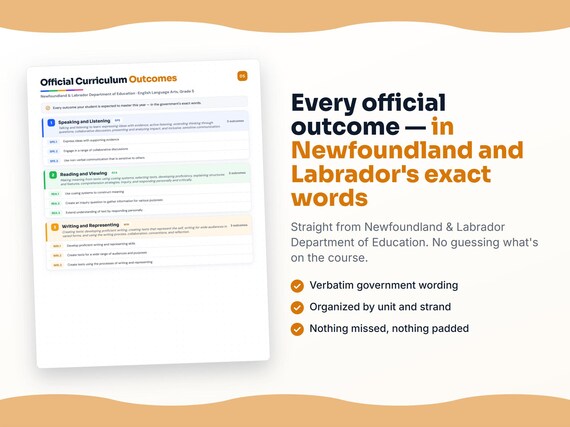
Newfoundland and Labrador defines English Language Arts, Grade 5 by strands and outcomes. MapleMind teaches the same curriculum reorganized for one-skill-at-a-time tutoring — the table shows exactly where every official strand lands, and the ministry's own wording is quoted under each unit below.
Official source Newfoundland and Labrador's official curriculumRead it on the government site — gov.nl.ca ↗| Official strand | Outcomes | Where MapleMind teaches it |
|---|---|---|
| Strand SL | 9 | Speaking and Listening |
| Strand RV | 20 | Reading and Viewing |
| Strand WR | 8 | Writing and Representing |
Every skill below, taught one on one.
 Try the first session free
How MapleMind teaches English Language Arts, Grade 5 — every unit, lesson, and skill
Every skill below runs as a short session: a plain-words lesson, a worked example, solving it together, then a five-question skill check that earns up to three stars. Guided Mode keeps it teaching instead of answer-handing — turning it off needs a parent's password.
Unit 1Speaking and ListeningOfficial strand · Strand SL
Talking and listening to learn: expressing ideas with evidence, active listening, extending thinking through questions, collaborative discussion, presenting and analyzing impact, and inclusive, sensitive communication.
Explore, extend, clarify and reflect
- Expressing ideas with supporting evidenceNL-ELA-5.1.1 — Express ideas with supporting evidence in discussion.
- Using active listening strategiesNL-ELA-5.1.2 — Use active listening strategies for a variety of purposes.
- Asking and answering questions to extend thinkingNL-ELA-5.1.3 — Ask and respond to questions to extend personal thinking.
Communicate and respond
- Engaging in collaborative discussionsNL-ELA-5.2.1 — Engage in a range of collaborative discussions.
- Using effective presentation skillsNL-ELA-5.2.2 — Use effective presentation skills to communicate clearly.
- Analyzing a presentation's impact on the audienceNL-ELA-5.2.3 — Analyze the impact of the presentation on the audience.
- Deciding whether you agree with a speakerNL-ELA-5.2.4 — Determine whether they agree or disagree with the speaker's perspective.
Interact with sensitivity and respect
- Using non-verbal communication sensitive to othersNL-ELA-5.3.1 — Use non-verbal communication that is sensitive to others.
- Using inclusive oral languageNL-ELA-5.3.2 — Use inclusive oral language to communicate to the intended audience.
The official wording — 9 outcomes in this unit
- NL-ELA-5.1.1
Express ideas with supporting evidence
- NL-ELA-5.1.2
Use active listening strategies for a variety of purposes
- NL-ELA-5.1.3
Ask and respond to questions to extend personal thinking
- NL-ELA-5.2.1
Engage in a range of collaborative discussions
- NL-ELA-5.2.2
Use effective presentation skills
- NL-ELA-5.2.3
Analyze the impact of the presentation on the audience
- NL-ELA-5.2.4
Determine whether they agree or disagree with the speaker
- NL-ELA-5.3.1
Use non-verbal communication that is sensitive to others
- NL-ELA-5.3.2
Use inclusive oral language to communicate to the intended audience
Unit 2Reading and ViewingOfficial strand · Strand RV
Making meaning from texts: using cueing systems, selecting texts, developing proficiency, explaining structures and features, comprehension strategies, inquiry, and responding personally and critically.
Select, read and view a range of texts
- Using cueing systems to construct meaningNL-ELA-5.4.1 — Use cueing systems to construct meaning, drawing on meaning, structure, and visual cues.
- Selecting appropriate textsNL-ELA-5.4.2 — Select appropriate texts for purpose and reading level.
- Developing proficient reading and viewingNL-ELA-5.4.3 — Develop proficient reading and viewing skills.
- Explaining how text structures help meaningNL-ELA-5.4.4 — Explain how text structures help readers construct meaning.
- Explaining how text features help understandingNL-ELA-5.4.5 — Explain how text features help readers understand text.
- Using a variety of comprehension strategiesNL-ELA-5.4.6 — Use a variety of comprehension strategies while reading.
- Reflecting on themselves as readersNL-ELA-5.4.7 — Reflect on themselves as readers.
Inquiry
- Creating an inquiry question to gather informationNL-ELA-5.5.1 — Create an inquiry question to gather information for various purposes.
- Selecting information from sourcesNL-ELA-5.5.2 — Select information from a variety of sources.
- Interpreting relevant informationNL-ELA-5.5.3 — Interpret relevant information from selected sources.
- Organizing relevant informationNL-ELA-5.5.4 — Organize relevant information from selected sources.
- Evaluating informationNL-ELA-5.5.5 — Evaluate information for reliability and usefulness.
- Sharing relevant informationNL-ELA-5.5.6 — Share relevant information from selected sources.
Respond personally and critically
- Extending understanding by responding personallyNL-ELA-5.6.1 — Extend understanding of text by responding personally.
- Quoting from text to support thinkingNL-ELA-5.6.2 — Quote from text to support thinking.
- Asking critical questions of textNL-ELA-5.7.1 — Ask critical questions of text.
- Analyzing intended messages in textsNL-ELA-5.7.2 — Analyze intended messages in texts.
- Discussing alternative points of viewNL-ELA-5.7.3 — Discuss alternative points of view.
- Analyzing how language influences thinkingNL-ELA-5.7.4 — Analyze how language is used to influence ways of thinking.
The official wording — 20 outcomes in this unit
- NL-ELA-5.4.1
Use cueing systems to construct meaning
- NL-ELA-5.4.2
Select appropriate texts
- NL-ELA-5.4.3
Develop proficient reading and viewing skills
- NL-ELA-5.4.4
Explain how text structures help readers construct meaning
- NL-ELA-5.4.5
Explain how text features help readers understand text
- NL-ELA-5.4.6
Use a variety of comprehension strategies
- NL-ELA-5.4.7
Reflect on themselves as readers
- NL-ELA-5.5.1
Create an inquiry question to gather information for various purposes
- NL-ELA-5.5.2
Select information from a variety of sources
- NL-ELA-5.5.3
Interpret relevant information from selected sources
- NL-ELA-5.5.4
Organize relevant information from selected sources
- NL-ELA-5.5.5
Evaluate information
- NL-ELA-5.5.6
Share relevant information from selected sources
- NL-ELA-5.6.1
Extend understanding of text by responding personally
- NL-ELA-5.6.2
Quote from text to support thinking
- NL-ELA-5.7.1
Ask critical questions of text
- NL-ELA-5.7.2
Analyze intended messages in texts
- NL-ELA-5.7.3
Discuss alternative points of view
- NL-ELA-5.7.4
Analyze how language is used to influence ways of thinking
- NL-ELA-5.7.5
Recognize that social action can bring about change
Unit 3Writing and RepresentingOfficial strand · Strand WR
Creating texts: developing proficient writing, creating texts that represent the self, writing for wide audiences in varied forms, and using the writing process, collaboration, conventions, and reflection.
Write to explore, clarify, reflect and imagine
- Developing proficient writing and representingNL-ELA-5.8.1 — Develop proficient writing and representing skills.
- Creating texts that represent who you areNL-ELA-5.8.2 — Create texts that represent experiences, personality and interests.
Create texts
- Creating texts for wide audiences and purposesNL-ELA-5.9.1 — Create texts for a wide range of audiences and purposes.
- Creating texts in various forms and genresNL-ELA-5.9.2 — Create texts in various forms and genres.
Develop effective writing products
- Creating texts using the writing processNL-ELA-5.10.1 — Create texts using the processes of writing and representing.
- Collaborating with others during text creationNL-ELA-5.10.2 — Collaborate with others during text creation.
- Using language conventions appropriatelyNL-ELA-5.10.3 — Use language conventions appropriately when writing.
- Reflecting on themselves as writersNL-ELA-5.10.4 — Reflect on themselves as writers.
The official wording — 8 outcomes in this unit
- NL-ELA-5.8.1
Develop proficient writing and representing skills
- NL-ELA-5.8.2
Create texts that represent experiences, personality and interests
- NL-ELA-5.9.1
Create texts for a wide range of audiences and purposes
- NL-ELA-5.9.2
Create texts in various forms and genres
- NL-ELA-5.10.1
Create texts using the processes of writing and representing
- NL-ELA-5.10.2
Collaborate with others during text creation
- NL-ELA-5.10.3
Use language conventions appropriately
- NL-ELA-5.10.4
Reflect on themselves as writers
Printable workbook · A keepsake of the year
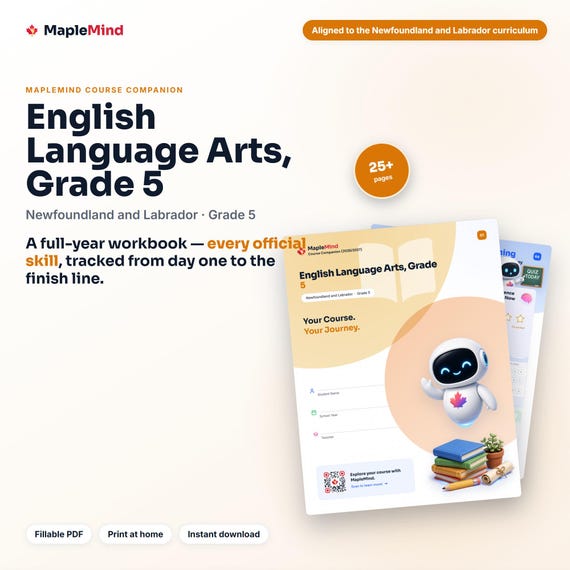
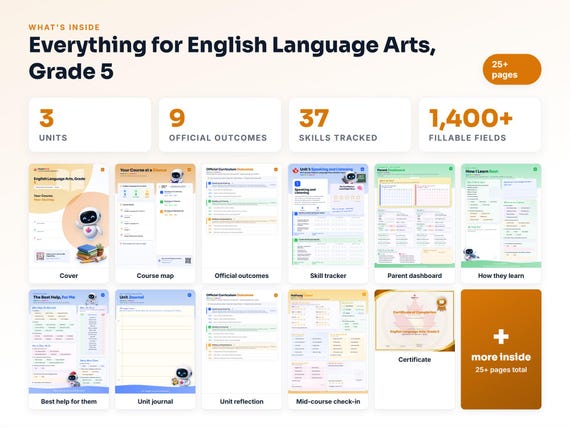
A English Language Arts, Grade 5 workbook worth keeping
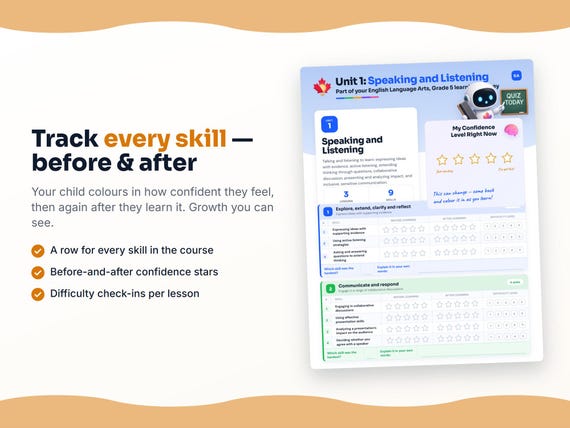
Built from the same official curriculum as this page. Before and after each skill above, your student colours in how sure they feel — so the two of you can see, on one page, what's clicking and what needs another look. It's a quiet way to follow how the year is really going.
By June it's full of their own handwriting: units worked through, confidence grown, a mid-year check-in, notes from parent-teacher night, and a certificate at the end. Less a worksheet, more a record of the year worth keeping on the shelf.
Instant download · see every page, reviews and the full description · five or more workbooks are $2.99 each
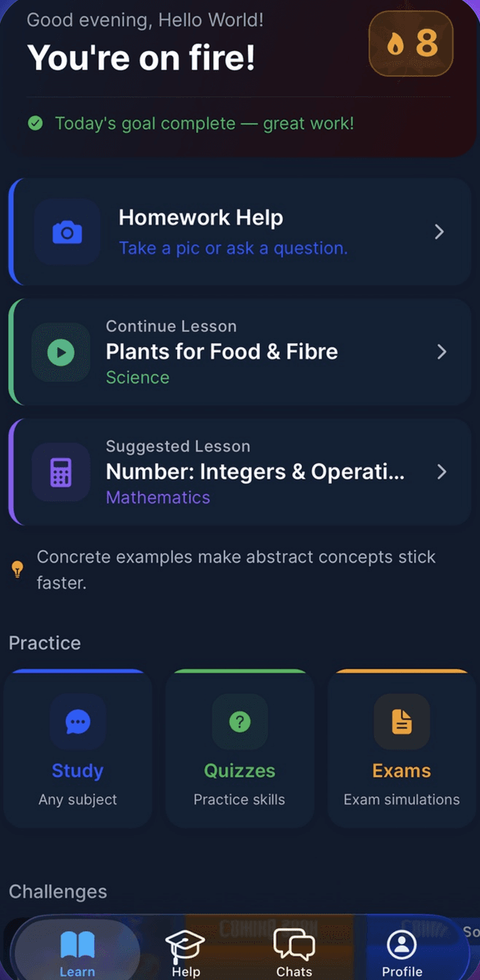
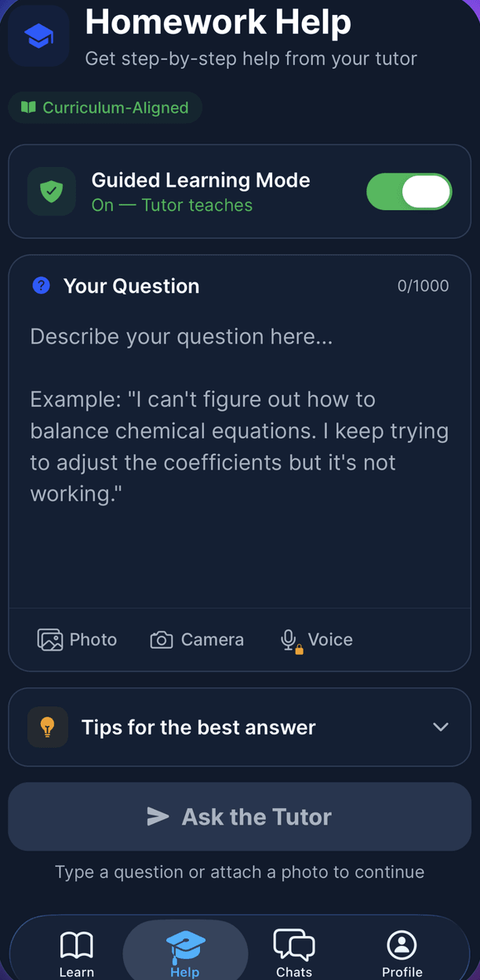
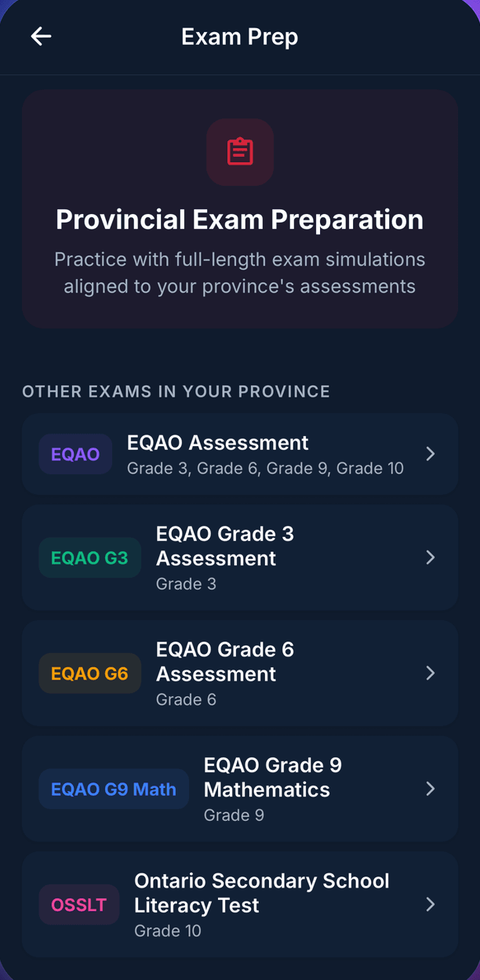
What it looks like in the app
Common questions
Can MapleMind help my child with English Language Arts, Grade 5?
Yes. MapleMind's AI tutor covers all 37 skills in Newfoundland and Labrador's English Language Arts, Grade 5 — your child picks the exact skill, and the tutor teaches it step by step: a short lesson, a worked example, solving together, then a skill check to show it stuck.
Is MapleMind aligned to Newfoundland and Labrador's official curriculum?
Yes. Every skill in this course maps to an official outcome code from Newfoundland and Labrador's Grade 5 English Language Arts curriculum, and the ministry's own wording is quoted under each unit on this page — with the official government source linked so you can check it yourself.
What does MapleMind cost?
It's free to start — 5 tutoring chats and a practice quiz every day, no credit card. A Pro subscription ($9.99/month or $49.99/year CAD, 7-day free trial) unlocks unlimited tutoring, practice, and exam simulations.
What if my child is stuck on just one topic?
That's the point of skill-level tutoring: open English Language Arts, Grade 5 in the app, tap the exact skill from the list on this page, and the tutor teaches just that — no wading through lessons your child doesn't need.
Does MapleMind work in French or other languages?
Yes — 14 languages, including French. Both the app and the tutor's explanations switch to the language your child chooses.
Where can I see the official Newfoundland and Labrador curriculum for English Language Arts, Grade 5?
The official source is linked on this page — Newfoundland and Labrador's official curriculum. The outline here follows it: every MapleMind skill carries its official outcome code, and the ministry's own wording is quoted under each unit.
Keep exploring
Ready when you are
Pick a skill from this page and see it taught properly — free, in the browser, in under a minute.