Get help with Mathematics 30-2
Most tutoring makes you sit through material you already know. MapleMind flips that: pick the exact skill that's causing trouble — any of the 36 below — and the tutor teaches just that one, step by step, as many times as it takes. Ask questions in plain words, any time of day, in English, French, or 12 other languages.
The official Alberta Mathematics 30-2 curriculum
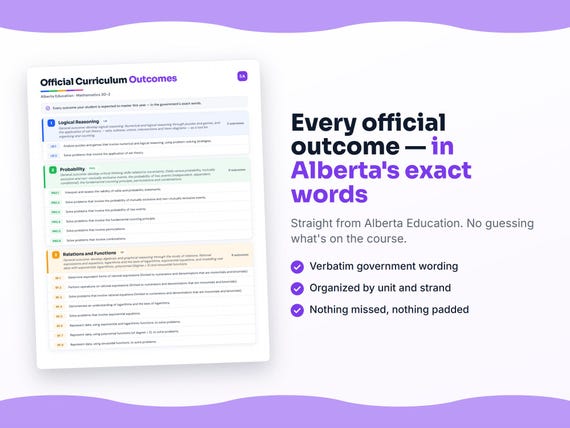
Alberta defines Mathematics 30-2 by strands and outcomes. MapleMind teaches the same curriculum reorganized for one-skill-at-a-time tutoring — the table shows exactly where every official strand lands, and the ministry's own wording is quoted under each unit below.
Official source Alberta's official programs of studyRead it on the government site — alberta.ca ↗| Official strand | Outcomes | Where MapleMind teaches it |
|---|---|---|
| Logical Reasoning | 2 | Logical Reasoning |
| Probability | 6 | Probability |
| Relations and Functions | 8 | Relations and Functions |
| Mathematics Research Project | 1 | Mathematics Research Project |
Every skill below, taught one on one.
 Try the first session free
How MapleMind teaches Mathematics 30-2 — every unit, lesson, and skill
Every skill below runs as a short session: a plain-words lesson, a worked example, solving it together, then a five-question skill check that earns up to three stars. Guided Mode keeps it teaching instead of answer-handing — turning it off needs a parent's password.
Unit 1Logical ReasoningOfficial strand · Logical Reasoning
General outcome: develop logical reasoning. Numerical and logical reasoning through puzzles and games, and the application of set theory — sets, subsets, unions, intersections and Venn diagrams — as a tool for organizing and counting.
Puzzles, Games and Reasoning
- Problem-solving strategies for puzzles30-2.LR.1 — Analyze puzzles and games using strategies such as guess-and-check, working backwards, looking for patterns, and reasoning by cases.
- Determining winning strategies30-2.LR.1 — Determine, explain and verify a reasoning strategy or winning play for a puzzle or game, justifying why it works.
Set Theory
- Sets, subsets and Venn diagrams30-2.LR.2 — Represent sets, subsets, the universal set, the empty set and complements, organizing them with Venn diagrams and set notation.
- Unions, intersections and complements30-2.LR.2 — Apply set operations — union $A \cup B$, intersection $A \cap B$ and complement $A'$ — to organize elements and count them without double-counting.
- Solving problems with set theory30-2.LR.2 — Solve contextual problems (surveys, overlapping groups) by placing counts into a Venn diagram and reading off the required region.
The official wording — 2 outcomes in this unit
- 30-2.LR.1
Analyze puzzles and games that involve numerical and logical reasoning, using problem-solving strategies.
- 30-2.LR.2
Solve problems that involve the application of set theory.
Unit 2ProbabilityOfficial strand · Probability
General outcome: develop critical thinking skills related to uncertainty. Odds versus probability, mutually exclusive and non–mutually exclusive events, the probability of two events (independent, dependent, conditional), the fundamental counting principle, permutations and combinations.
Odds and Probability
- Odds versus probability30-2.P.1 — Distinguish odds from probability, converting between odds in favour ($a:b$), odds against, and probability $P(A) = \frac{a}{a+b}$.
- Assessing validity of statements30-2.P.1 — Interpret and critique real-world odds and probability claims (advertising, games of chance), judging whether they are valid.
Mutually Exclusive and Non–Mutually Exclusive Events
- Mutually exclusive events30-2.P.2 — Recognize mutually exclusive events (they cannot co-occur, so $P(A \cap B) = 0$) and add their probabilities: $P(A \cup B) = P(A) + P(B)$.
- Non–mutually exclusive events30-2.P.2 — Apply the additive rule for overlapping events: $P(A \cup B) = P(A) + P(B) - P(A \cap B)$, subtracting the double-counted overlap.
The Probability of Two Events
- Independent events30-2.P.3 — Identify independent events (one does not affect the other) and multiply: $P(A \cap B) = P(A) \times P(B)$.
- Dependent and conditional events30-2.P.3 — Handle dependent events with conditional probability: $P(A \cap B) = P(A) \times P(B \mid A)$, updating the second probability after the first outcome.
The Fundamental Counting Principle
- Counting arrangements by multiplication30-2.P.4 — Apply the fundamental counting principle: when choices are made in sequence, multiply the number of options at each stage.
- Counting with restrictions30-2.P.4 — Count arrangements under conditions (fixed positions, forbidden adjacencies, cases) by combining the counting principle with careful casework.
Permutations
- Permutations of distinct objects30-2.P.5 — Count ordered arrangements with $_nP_r = \frac{n!}{(n-r)!}$, recognizing that in a permutation ORDER matters.
- Permutations with repetitions and restrictions30-2.P.5 — Adjust for repeated identical objects ($\frac{n!}{a!\,b!}$) and for restrictions, solving problems and simple equations involving $_nP_r$.
Combinations
- Combinations of distinct objects30-2.P.6 — Count unordered selections with $_nC_r = \frac{n!}{r!\,(n-r)!}$, recognizing that in a combination ORDER does not matter.
- Combinations in counting and probability30-2.P.6 — Use combinations to count favourable and total outcomes in probability problems, and solve equations involving $_nC_r$.
The official wording — 6 outcomes in this unit
- 30-2.P.1
Interpret and assess the validity of odds and probability statements.
- 30-2.P.2
Solve problems that involve the probability of mutually exclusive and non–mutually exclusive events.
- 30-2.P.3
Solve problems that involve the probability of two events.
- 30-2.P.4
Solve problems that involve the fundamental counting principle.
- 30-2.P.5
Solve problems that involve permutations.
- 30-2.P.6
Solve problems that involve combinations.
Unit 3Relations and FunctionsOfficial strand · Relations and Functions
General outcome: develop algebraic and graphical reasoning through the study of relations. Rational expressions and equations, logarithms and the laws of logarithms, exponential equations, and modelling real data with exponential, logarithmic, polynomial (degree ≤ 3) and sinusoidal functions.
Rational Expressions
- Equivalent forms and restrictions30-2.RF.1 — Determine equivalent forms of rational expressions (monomial and binomial numerators and denominators), simplifying by factoring and stating non-permissible values.
- Non-permissible values30-2.RF.1 — Find non-permissible values from the original denominators (before simplifying), since the expression is undefined wherever a denominator is zero.
Operations on Rational Expressions
- Multiplying and dividing30-2.RF.2 — Multiply and divide rational expressions (monomials and binomials) by factoring, cancelling common factors and tracking all restrictions.
- Adding and subtracting30-2.RF.2 — Add and subtract rational expressions over a lowest common denominator built from the factored denominators, distributing subtraction through the whole numerator.
Rational Equations
- Solving rational equations30-2.RF.3 — Solve rational equations (monomials and binomials) by clearing denominators with the LCD, then rejecting any candidate that is a non-permissible value.
- Problems with rational equations30-2.RF.3 — Model and solve applied problems (rates, work, mixtures) that lead to rational equations, checking answers against the context.
Logarithms and the Laws of Logarithms
- Logarithms as inverse exponents30-2.RF.4 — Understand $\log_b x = y$ as the equivalent of $b^y = x$, evaluating logarithms and converting between exponential and logarithmic form.
- The laws of logarithms30-2.RF.4 — Apply the product, quotient and power laws: $\log_b(xy) = \log_b x + \log_b y$, $\log_b\frac{x}{y} = \log_b x - \log_b y$, and $\log_b(x^n) = n\log_b x$.
Exponential Equations
- Solving with a common base30-2.RF.5 — Solve exponential equations by writing both sides with a common base and equating exponents.
- Solving with logarithms30-2.RF.5 — Solve exponential equations that lack a common base by taking the logarithm of both sides and applying the power law, then solving applied growth/decay problems.
Modelling with Exponential and Logarithmic Functions
- Exponential models30-2.RF.6 — Fit and use exponential models $y = ab^x$ (regression from data) to model growth and decay and to make predictions.
- Logarithmic models30-2.RF.6 — Fit and interpret logarithmic models $y = a + b\log x$ from data, using them to solve problems and read the function in context.
Modelling with Polynomial Functions
- Polynomial functions of degree ≤ 330-2.RF.7 — Describe the graphs of linear, quadratic and cubic functions (degree $\le 3$): end behaviour, turning points, intercepts and domain/range.
- Fitting polynomial models to data30-2.RF.7 — Fit polynomial models (degree $\le 3$) to data by regression, then interpolate, extrapolate and solve problems with the model.
Modelling with Sinusoidal Functions
- Amplitude, period, phase and midline30-2.RF.8 — Interpret the parameters of $y = a\sin(b(x - c)) + d$ — amplitude $|a|$, period $\frac{360^\circ}{|b|}$, horizontal (phase) shift $c$, and midline $y = d$.
- Fitting sinusoidal models to data30-2.RF.8 — Fit sinusoidal models to periodic data (tides, daylight, temperature) by regression and use them to solve problems and predict future values.
The official wording — 8 outcomes in this unit
- 30-2.RF.1
Determine equivalent forms of rational expressions (limited to numerators and denominators that are monomials and binomials).
- 30-2.RF.2
Perform operations on rational expressions (limited to numerators and denominators that are monomials and binomials).
- 30-2.RF.3
Solve problems that involve rational equations (limited to numerators and denominators that are monomials and binomials).
- 30-2.RF.4
Demonstrate an understanding of logarithms and the laws of logarithms.
- 30-2.RF.5
Solve problems that involve exponential equations.
- 30-2.RF.6
Represent data, using exponential and logarithmic functions, to solve problems.
- 30-2.RF.7
Represent data, using polynomial functions (of degree ≤ 3), to solve problems.
- 30-2.RF.8
Represent data, using sinusoidal functions, to solve problems.
Unit 4Mathematics Research ProjectOfficial strand · Mathematics Research Project
General outcome: develop an appreciation of the role of mathematics in society. Plan, conduct and present a research investigation on a current event or an area of interest that involves mathematics.
Plan, Conduct and Present a Research Project
- Planning the investigation30-2.MRP.1 — Choose a current event or area of interest that involves mathematics, frame a focused research question, and plan credible sources and a method.
- Conducting the research30-2.MRP.1 — Gather and analyze the mathematics behind the topic — collecting data and evidence, applying appropriate mathematical tools, and citing sources.
- Presenting the findings30-2.MRP.1 — Communicate the investigation in a clear, well-organized presentation, explaining the mathematics accurately and responding to questions.
The official wording — 1 outcome in this unit
- 30-2.MRP.1
Research and give a presentation on a current event or an area of interest that involves mathematics.
Printable workbook · A keepsake of the year
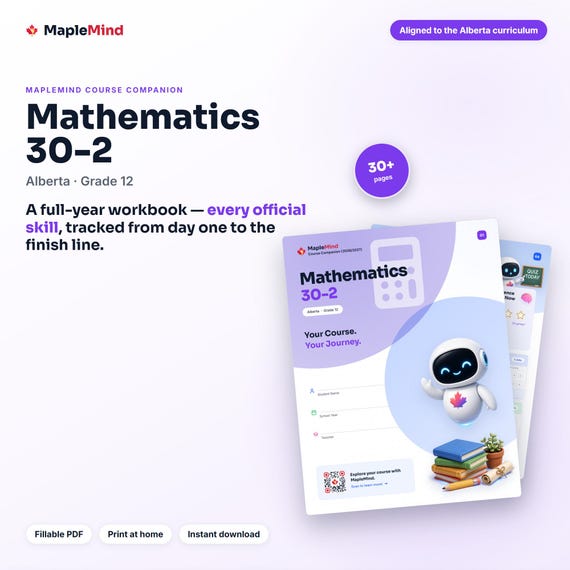
A Mathematics 30-2 workbook worth keeping
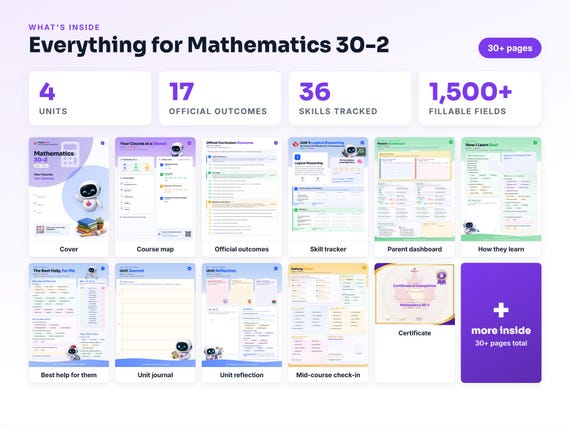
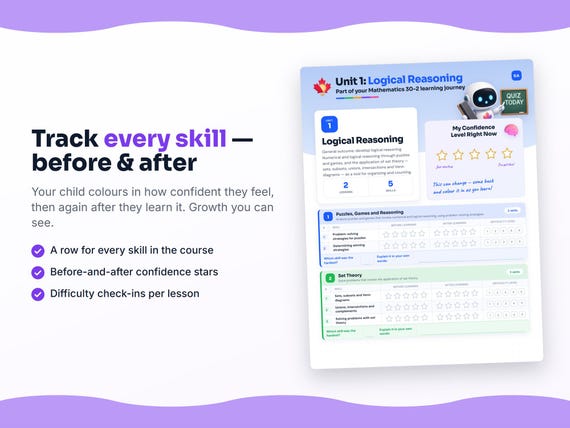
Built from the same official curriculum as this page. Before and after each skill above, your student colours in how sure they feel — so the two of you can see, on one page, what's clicking and what needs another look. It's a quiet way to follow how the year is really going.
By June it's full of their own handwriting: units worked through, confidence grown, a mid-year check-in, notes from parent-teacher night, and a certificate at the end. Less a worksheet, more a record of the year worth keeping on the shelf.
Instant download · see every page, reviews and the full description · five or more workbooks are $2.99 each
What it looks like in the app
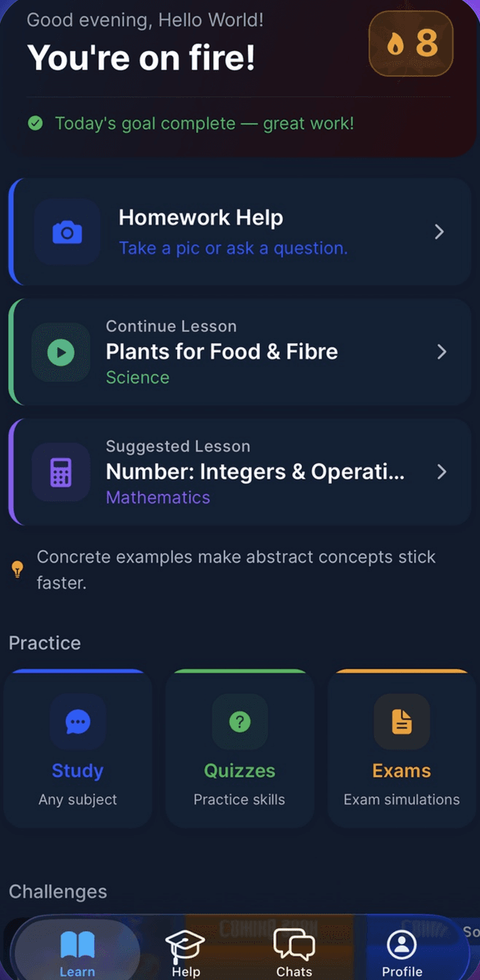
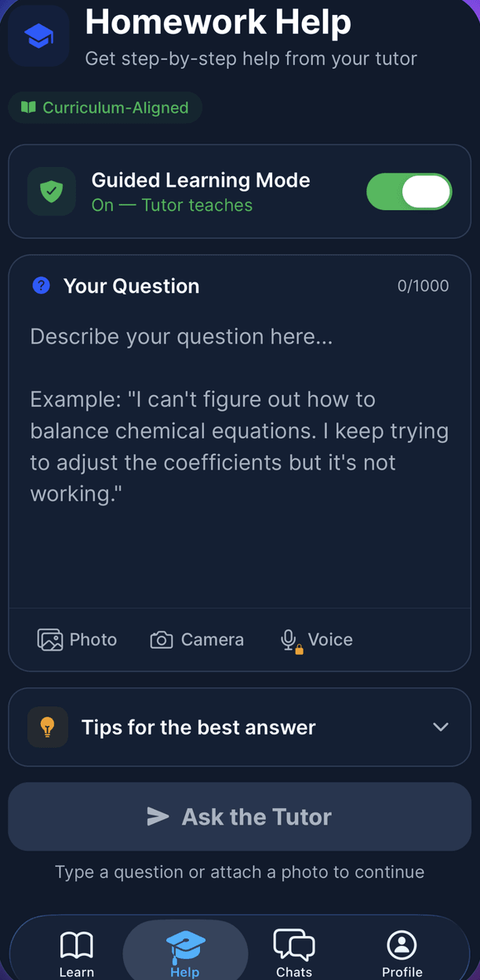
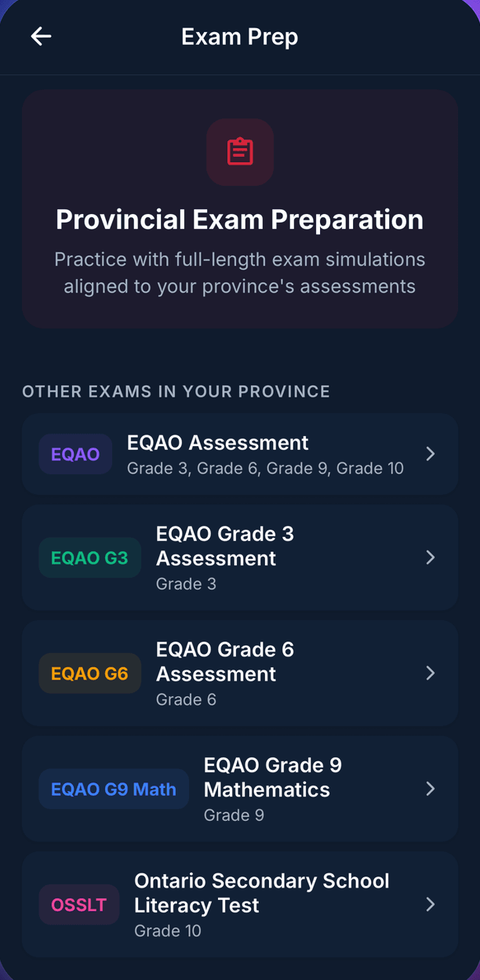
Common questions
Can MapleMind help me with Mathematics 30-2?
Yes. MapleMind's AI tutor covers all 36 skills in Alberta's Mathematics 30-2 — you pick the exact skill, and the tutor teaches it step by step: a short lesson, a worked example, solving together, then a skill check to show it stuck.
Is MapleMind aligned to Alberta's official curriculum?
Yes. Every skill in this course maps to an official outcome code from Alberta's Grade 12 Mathematics curriculum, and the ministry's own wording is quoted under each unit on this page — with the official government source linked so you can check it yourself.
What does MapleMind cost?
It's free to start — 5 tutoring chats and a practice quiz every day, no credit card. A Pro subscription ($9.99/month or $49.99/year CAD, 7-day free trial) unlocks unlimited tutoring, practice, and exam simulations.
What if I'm stuck on just one topic?
That's the point of skill-level tutoring: open Mathematics 30-2 in the app, tap the exact skill from the list on this page, and the tutor teaches just that — no wading through lessons you don't need.
Does MapleMind work in French or other languages?
Yes — 14 languages, including French. Both the app and the tutor's explanations switch to the language you choose.
Where can I see the official Alberta curriculum for Mathematics 30-2?
The official source is linked on this page — Alberta's official programs of study. The outline here follows it: every MapleMind skill carries its official outcome code, and the ministry's own wording is quoted under each unit.
Keep exploring
Ready when you are
Pick a skill from this page and see it taught properly — free, in the browser, in under a minute.