Get help with Social Studies 3201 (Academic)
Most tutoring makes you sit through material you already know. MapleMind flips that: pick the exact skill that's causing trouble — any of the 22 below — and the tutor teaches just that one, step by step, as many times as it takes. Ask questions in plain words, any time of day, in English, French, or 12 other languages.
The official Newfoundland and Labrador Social Studies 3201 (Academic) curriculum
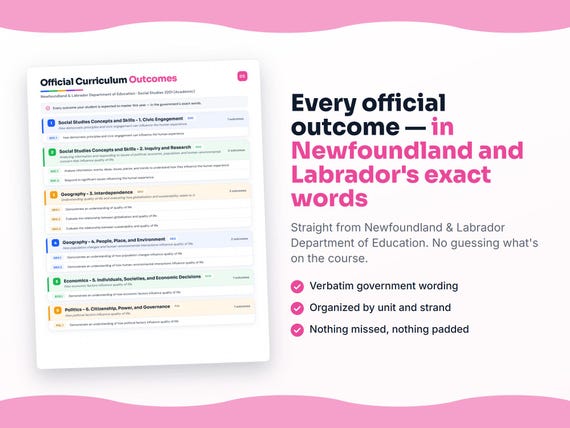
Newfoundland and Labrador defines Social Studies 3201 (Academic) by strands and outcomes. MapleMind teaches the same curriculum reorganized for one-skill-at-a-time tutoring — the table shows exactly where every official strand lands, and the ministry's own wording is quoted under each unit below.
Official source Newfoundland and Labrador's official curriculumRead it on the government site — gov.nl.ca ↗| Official strand | Outcomes | Where MapleMind teaches it |
|---|---|---|
| Strand 1 | 1 | Social Studies Concepts and Skills - 1. Civic Engagement |
| Strand 2 | 5 | Social Studies Concepts and Skills - 2. Inquiry and Research |
| Strand 3 | 3 | Geography - 3. Interdependence |
| Strand 4 | 2 | Geography - 4. People, Place, and Environment |
| Strand 5 | 1 | Economics - 5. Individuals, Societies, and Economic Decisions |
| Strand 6 | 1 | Politics - 6. Citizenship, Power, and Governance |
Every skill below, taught one on one.
 Try the first session free
How MapleMind teaches Social Studies 3201 (Academic) — every unit, lesson, and skill
Every skill below runs as a short session: a plain-words lesson, a worked example, solving it together, then a five-question skill check that earns up to three stars. Guided Mode keeps it teaching instead of answer-handing — turning it off needs a parent's password.
Unit 1Social Studies Concepts and Skills - 1. Civic EngagementOfficial strand · Strand 1
How democratic principles and civic engagement can influence the human experience.
Democratic Principles and Civic Engagement
- The principles of Canadian democracyNL-SS-3201.1 — Explain the principles on which Canadian democracy is based - liberty, democracy, and the rule of law - and evaluate why these evolving ideals should not be taken for granted.
- Collaboration and acting on quality-of-life issuesNL-SS-3201.1 — Explain how citizens collaborate to achieve a common goal and evaluate how civic action can improve quality of life, articulating a vision for a better world.
The official wording — 1 outcome in this unit
- NL-SS-3201.1
how democratic principles and civic engagement can influence the human experience
Unit 2Social Studies Concepts and Skills - 2. Inquiry and ResearchOfficial strand · Strand 2
Analyzing information and responding to issues of political, economic, population, and human-environmental concern that influence quality of life.
The Tools of Social Science Analysis
- Evidence, comparison, and causationNL-SS-3201.2 — Analyse information by evaluating the reliability of evidence, comparing places and trends to identify continuity and change, and determining causes and consequences of global issues.
- Significance, perspective, and value judgementsNL-SS-3201.2 — Analyse global issues by determining significance (magnitude, scope, duration), explaining perspectives fairly, and making reasoned value judgements on questions of justice and well-being.
Responding to Issues That Shape Quality of Life
- Responding to a significant issueNL-SS-3201.3 — Frame a focused question, gather and interpret reliable information, develop an evidence-based conclusion, and communicate a response to a significant issue.
- Responding to political and economic issuesNL-SS-3201.4 — Identify, analyse, and develop a cogent response to an issue of political or economic concern that influences quality of life.
- Responding to population issuesNL-SS-3201.5 — Identify, analyse, and develop a cogent response to an issue related to population that influences quality of life.
- Responding to human-environmental issuesNL-SS-3201.6 — Identify, analyse, and develop a cogent response to an issue related to human-environmental interaction that influences quality of life.
The official wording — 5 outcomes in this unit
- NL-SS-3201.2
Analyze information, events, ideas, issues, places, and trends to understand how they influence the human experience
- NL-SS-3201.3
Respond to significant issues influencing the human experience
- NL-SS-3201.4
Respond to issues of political and economic concern that influence quality of life
- NL-SS-3201.5
Respond to issues related to population that influence quality of life
- NL-SS-3201.6
Respond to issues related to human-environmental interaction that influence quality of life
Unit 3Geography - 3. InterdependenceOfficial strand · Strand 3
Understanding quality of life and evaluating how globalization and sustainability relate to it.
Understanding Quality of Life
- The concept of quality of lifeNL-SS-3201.7 — Explain the concept of quality of life, distinguishing objective and subjective dimensions and the difference between quality of life and standard of living.
- Measuring quality of life, then and nowNL-SS-3201.7 — Explain the indicators used to measure quality of life, such as GDP per capita, the HDI, and the GINI index, and how past innovations and ideas shaped quality of life.
Globalization and Quality of Life
- The concept of globalizationNL-SS-3201.8 — Explain the concept of globalization - the growing economic, cultural, and political interconnection of the world - and its main drivers.
- Globalization's influence on quality of lifeNL-SS-3201.8 — Evaluate how globalization influences quality of life - its benefits and costs - and develop a response to a globalization-related issue.
Sustainability and Quality of Life
- The concept of sustainabilityNL-SS-3201.9 — Explain the concept of sustainability - meeting present needs without compromising the ability of future generations to meet theirs - across its environmental, economic, and social pillars.
- Sustainability's influence on quality of lifeNL-SS-3201.9 — Evaluate how sustainability influences quality of life and develop a response to a sustainability-related issue, weighing present needs against future well-being.
The official wording — 3 outcomes in this unit
- NL-SS-3201.7
Demonstrate an understanding of quality of life
- NL-SS-3201.8
Evaluate the relationship between globalization and quality of life
- NL-SS-3201.9
Evaluate the relationship between sustainability and quality of life
Unit 4Geography - 4. People, Place, and EnvironmentOfficial strand · Strand 4
How population changes and human-environmental interactions influence quality of life.
Population Change and Quality of Life
- Carrying capacity and the demographic transitionNL-SS-3201.10 — Explain the relationship between population, carrying capacity, and technology, and the theory of demographic transition through which birth and death rates change as a society develops.
- The challenges of high and low population growthNL-SS-3201.10 — Analyse the challenges and possible responses associated with high population growth rates and with low population growth rates, and how each affects quality of life.
Human-Environmental Interaction and Quality of Life
- Resource use and quality of lifeNL-SS-3201.11 — Explain the relationship between natural resource use and quality of life, including how dependence on resources shapes economies and well-being.
- Consequences and responses to environmental issuesNL-SS-3201.11 — Analyse the consequences of issues arising from human-environmental interaction - such as pollution and climate change - and evaluate responses to them.
The official wording — 2 outcomes in this unit
- NL-SS-3201.10
Demonstrate an understanding of how population changes influence quality of life
- NL-SS-3201.11
Demonstrate an understanding of how human-environmental interactions influence quality of life
Unit 5Economics - 5. Individuals, Societies, and Economic DecisionsOfficial strand · Strand 5
How economic factors influence quality of life.
Economic Factors and Quality of Life
- The concept of economic disparityNL-SS-3201.12 — Explain the concept of economic disparity - the uneven distribution of wealth and income within and between countries - and how it is measured.
- Causes of and responses to economic disparityNL-SS-3201.12 — Explain the factors that influence economic disparity and evaluate responses to it, including foreign aid, trade policy, and redistribution.
The official wording — 1 outcome in this unit
- NL-SS-3201.12
Demonstrate an understanding of how economic factors influence quality of life
Unit 6Politics - 6. Citizenship, Power, and GovernanceOfficial strand · Strand 6
How political factors influence quality of life.
Political Factors and Quality of Life
- The concept of political stabilityNL-SS-3201.13 — Explain the concept of political stability - the durability and legitimacy of a government and the absence of violent conflict - and how it relates to quality of life.
- Causes of and responses to political instabilityNL-SS-3201.13 — Explain the factors that influence political stability and evaluate responses to political instability, including governance reform, diplomacy, and international intervention.
The official wording — 1 outcome in this unit
- NL-SS-3201.13
Demonstrate an understanding of how political factors influence quality of life
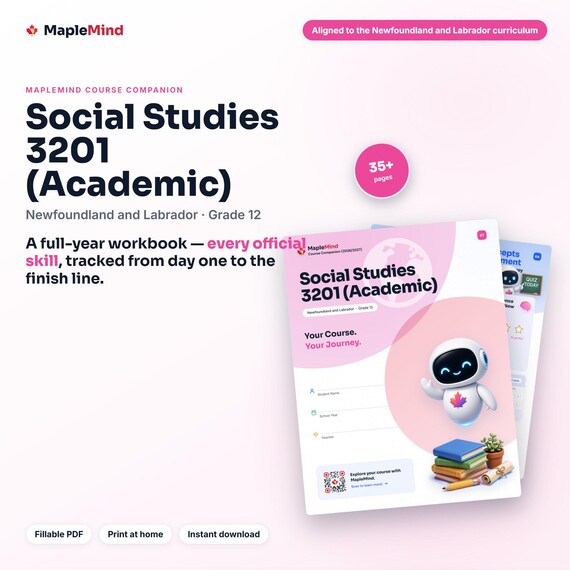
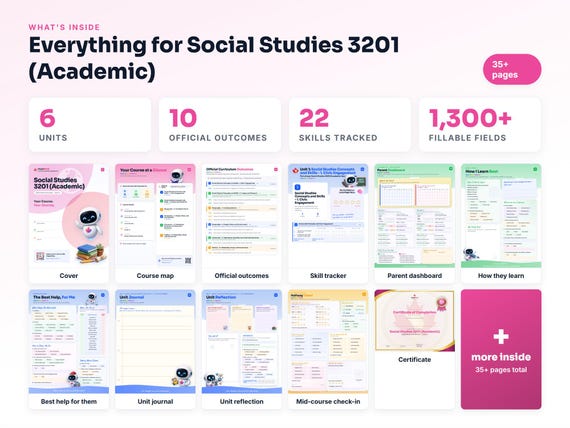
Printable workbook · A keepsake of the year
A Social Studies 3201 (Academic) workbook worth keeping
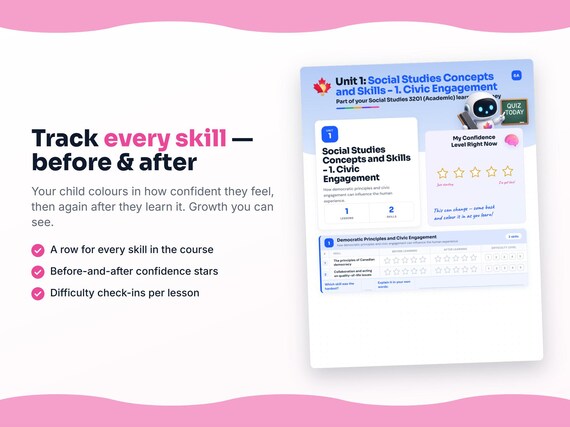
Built from the same official curriculum as this page. Before and after each skill above, your student colours in how sure they feel — so the two of you can see, on one page, what's clicking and what needs another look. It's a quiet way to follow how the year is really going.
By June it's full of their own handwriting: units worked through, confidence grown, a mid-year check-in, notes from parent-teacher night, and a certificate at the end. Less a worksheet, more a record of the year worth keeping on the shelf.
Instant download · see every page, reviews and the full description · five or more workbooks are $2.99 each
What it looks like in the app



Common questions
Can MapleMind help me with Social Studies 3201 (Academic)?
Yes. MapleMind's AI tutor covers all 22 skills in Newfoundland and Labrador's Social Studies 3201 (Academic) — you pick the exact skill, and the tutor teaches it step by step: a short lesson, a worked example, solving together, then a skill check to show it stuck.
Is MapleMind aligned to Newfoundland and Labrador's official curriculum?
Yes. Every skill in this course maps to an official outcome code from Newfoundland and Labrador's Grade 12 Social Studies curriculum, and the ministry's own wording is quoted under each unit on this page — with the official government source linked so you can check it yourself.
What does MapleMind cost?
It's free to start — 5 tutoring chats and a practice quiz every day, no credit card. A Pro subscription ($9.99/month or $49.99/year CAD, 7-day free trial) unlocks unlimited tutoring, practice, and exam simulations.
What if I'm stuck on just one topic?
That's the point of skill-level tutoring: open Social Studies 3201 (Academic) in the app, tap the exact skill from the list on this page, and the tutor teaches just that — no wading through lessons you don't need.
Does MapleMind work in French or other languages?
Yes — 14 languages, including French. Both the app and the tutor's explanations switch to the language you choose.
Where can I see the official Newfoundland and Labrador curriculum for Social Studies 3201 (Academic)?
The official source is linked on this page — Newfoundland and Labrador's official curriculum. The outline here follows it: every MapleMind skill carries its official outcome code, and the ministry's own wording is quoted under each unit.
Keep exploring
Ready when you are
Pick a skill from this page and see it taught properly — free, in the browser, in under a minute.