Get help with Social Studies 2201 (Academic)
Most tutoring makes you sit through material you already know. MapleMind flips that: pick the exact skill that's causing trouble — any of the 26 below — and the tutor teaches just that one, step by step, as many times as it takes. Ask questions in plain words, any time of day, in English, French, or 12 other languages.
The official Newfoundland and Labrador Social Studies 2201 (Academic) curriculum
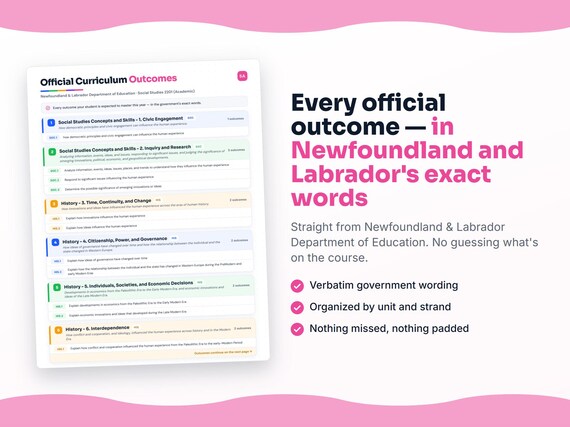
Newfoundland and Labrador defines Social Studies 2201 (Academic) by strands and outcomes. MapleMind teaches the same curriculum reorganized for one-skill-at-a-time tutoring — the table shows exactly where every official strand lands, and the ministry's own wording is quoted under each unit below.
Official source Newfoundland and Labrador's official curriculumRead it on the government site — gov.nl.ca ↗| Official strand | Outcomes | Where MapleMind teaches it |
|---|---|---|
| Strand 1 | 1 | Social Studies Concepts and Skills - 1. Civic Engagement |
| Strand 2 | 6 | Social Studies Concepts and Skills - 2. Inquiry and Research |
| Strand 3 | 2 | History - 3. Time, Continuity, and Change |
| Strand 4 | 2 | History - 4. Citizenship, Power, and Governance |
| Strand 5 | 2 | History - 5. Individuals, Societies, and Economic Decisions |
| Strand 6 | 2 | History - 6. Interdependence |
Every skill below, taught one on one.
 Try the first session free
How MapleMind teaches Social Studies 2201 (Academic) — every unit, lesson, and skill
Every skill below runs as a short session: a plain-words lesson, a worked example, solving it together, then a five-question skill check that earns up to three stars. Guided Mode keeps it teaching instead of answer-handing — turning it off needs a parent's password.
Unit 1Social Studies Concepts and Skills - 1. Civic EngagementOfficial strand · Strand 1
How democratic principles and civic engagement can influence the human experience.
Democratic Principles and Civic Engagement
- The principles of Canadian democracyNL-SS-2201.1 — Explain the principles on which Canadian democracy is based - liberty, democracy, and the rule of law - and evaluate why these evolving ideals should not be taken for granted.
- Collaboration and acting to improve the human experienceNL-SS-2201.1 — Explain how citizens collaborate to achieve a common goal and evaluate how civic action can improve the human experience, articulating a vision for what a country should be.
The official wording — 1 outcome in this unit
- NL-SS-2201.1
how democratic principles and civic engagement can influence the human experience
Unit 2Social Studies Concepts and Skills - 2. Inquiry and ResearchOfficial strand · Strand 2
Analyzing information, events, ideas, and issues, responding to significant issues, and judging the significance of emerging innovations, political, economic, and geopolitical developments.
The Tools of Social Science Analysis
- Evidence, comparison, and causationNL-SS-2201.2 — Analyse information by evaluating the reliability and quality of evidence, making comparisons to identify continuity and change, and determining immediate causes, underlying influences, and consequences.
- Significance, perspective, and value judgementsNL-SS-2201.2 — Analyse issues by determining historical significance (magnitude, scope, duration), explaining perspectives while avoiding presentism, and making reasoned value judgements on ethical questions.
Responding to Significant Issues
- Framing questions and gathering informationNL-SS-2201.3 — Frame powerful, carefully sequenced questions to focus a historical inquiry, and locate, judge, and organize reliable primary and secondary sources.
- Interpreting information and arguing conclusionsNL-SS-2201.3 — Interpret and evaluate information, develop rational conclusions supported by evidence-based arguments and counter-arguments, and communicate perspectives and conclusions cogently.
Judging the Significance of Current Events and Trends
- The significance of emerging innovations or ideasNL-SS-2201.4 — Determine the possible significance of an emerging innovation or idea by applying the criteria of significance and projecting its likely consequences.
- The significance of a current political trendNL-SS-2201.5 — Determine the possible significance of a current political event or emerging political trend using the criteria of significance and evidence.
- The significance of a current economic trendNL-SS-2201.6 — Determine the possible significance of a current economic event or emerging economic trend using the criteria of significance and economic evidence.
- The significance of a geopolitical disputeNL-SS-2201.7 — Determine the possible significance of a current or emerging geopolitical dispute using the criteria of significance, perspective, and evidence.
The official wording — 6 outcomes in this unit
- NL-SS-2201.2
Analyze information, events, ideas, issues, places, and trends to understand how they influence the human experience
- NL-SS-2201.3
Respond to significant issues influencing the human experience
- NL-SS-2201.4
Determine the possible significance of emerging innovations or ideas
- NL-SS-2201.5
Determine the possible significance of a current political event or emerging political trend
- NL-SS-2201.6
Determine the possible significance of a current economic event or emerging economic trend
- NL-SS-2201.7
Determine the possible significance of a current or emerging geopolitical dispute
Unit 3History - 3. Time, Continuity, and ChangeOfficial strand · Strand 3
How innovations and ideas have influenced the human experience across the eras of human history.
How Innovations Shaped History
- Innovations of the Paleolithic and Neolithic ErasNL-SS-2201.8 — Explain the significance of the innovations of the Paleolithic Era (stone tools, language, mastery of fire) and the Neolithic Era (agriculture, settlement), and how each transformed human life.
- Innovations of the Ancient to Modern ErasNL-SS-2201.8 — Explain how innovation influenced the human experience and evaluate the significance of select innovations from the Ancient, Pre-Modern, and Modern Eras.
How Ideas Shaped History
- The Pre-Modern worldviewNL-SS-2201.9 — Describe the worldview of Western Europeans in the late Pre-Modern Era, in which Christianity and traditional knowledge, including the geocentric model, explained humanity's place in the universe.
- Empiricism and the changing worldviewNL-SS-2201.9 — Explain how empiricism and the Scientific Revolution changed the Western worldview, weakening the authority of the Church and giving rise to a world dominated by science and rationality.
The official wording — 2 outcomes in this unit
- NL-SS-2201.8
Explain how innovations influence the human experience
- NL-SS-2201.9
Explain how ideas influence the human experience
Unit 4History - 4. Citizenship, Power, and GovernanceOfficial strand · Strand 4
How ideas of governance have changed over time and how the relationship between the individual and the state changed in Western Europe.
How Ideas of Governance Changed
- Models of governanceNL-SS-2201.10 — Differentiate between models of governance - rule of one (monarchy, autocracy), rule of the few (oligarchy), and rule of the many (democracy) - explaining the strengths and limitations of each.
- The development of governance and citizenshipNL-SS-2201.10 — Explain the development of governance systems and the concept of citizenship as it developed in the ancient era, including its origins in Greece and Rome.
The Individual and the State
- Political structures of the Pre-Modern EraNL-SS-2201.11 — Explain the political structures of Western Europe in the Pre-Modern Era, including feudalism and the concentration of power in monarchs and the Church.
- Changing governance and the rise of the individualNL-SS-2201.11 — Explain the changes in governance in the early Modern Era and how the relationship between the individual and the state shifted toward rights and limited government.
The official wording — 2 outcomes in this unit
- NL-SS-2201.10
Explain how ideas of governance have changed over time
- NL-SS-2201.11
Explain how the relationship between the individual and the state has changed in Western Europe during the PreModern and early Modern Eras
Unit 5History - 5. Individuals, Societies, and Economic DecisionsOfficial strand · Strand 5
Developments in economics from the Paleolithic Era to the Early Modern Era, and economic innovations and ideas of the Late Modern Era.
Economic Developments to the Early Modern Era
- Economics from the Paleolithic to the Ancient EraNL-SS-2201.12 — Explain economic innovation from the Paleolithic Era to the Ancient Era, including the shift from subsistence to surplus, the beginnings of trade, and the rise of early markets.
- Economics of the Pre-Modern and Early Modern EraNL-SS-2201.12 — Explain economic innovation from the Pre-Modern to the Early Modern Era, including the manorial economy, the growth of towns and commerce, and the expansion of trade.
Economic Ideas of the Late Modern Era
- The rise of capitalism and industrialismNL-SS-2201.13 — Explain the factors that led to the rise of capitalism and how industrialism transformed the economy during the Late Modern Era, including the factory system and wage labour.
The official wording — 2 outcomes in this unit
- NL-SS-2201.12
Explain developments in economics from the Paleolithic Era to the Early Modern Era
- NL-SS-2201.13
Explain economic innovations and ideas that developed during the Late Modern Era
Unit 6History - 6. InterdependenceOfficial strand · Strand 6
How conflict and cooperation, and ideology, influenced the human experience across history and in the Modern Era.
Conflict and Cooperation Across History
- The rationale for conflict and cooperationNL-SS-2201.14 — Explain the reasons societies enter into conflict and cooperation - resources, power, security, and shared interest - and how each shapes the human experience.
- Conflict and cooperation across the erasNL-SS-2201.14 — Explain how conflict and cooperation were used across the eras from the Paleolithic to the early-Modern Period, and their consequences for the human experience.
Ideology in the Modern Era
- The ideology of imperialismNL-SS-2201.15 — Explain the ideology of imperialism and its influence on the human experience, including the justifications used and the consequences for colonized peoples.
- Supranational agencies and interdependenceNL-SS-2201.15 — Explain the role of supranational agencies such as the United Nations in promoting cooperation and restraining conflict, and how they reflect growing global interdependence.
The official wording — 2 outcomes in this unit
- NL-SS-2201.14
Explain how conflict and cooperation influenced the human experience from the Paleolithic Era to the early-Modern Period
- NL-SS-2201.15
Explain how ideology has influenced the human experience in the Modern Era
Printable workbook · A keepsake of the year
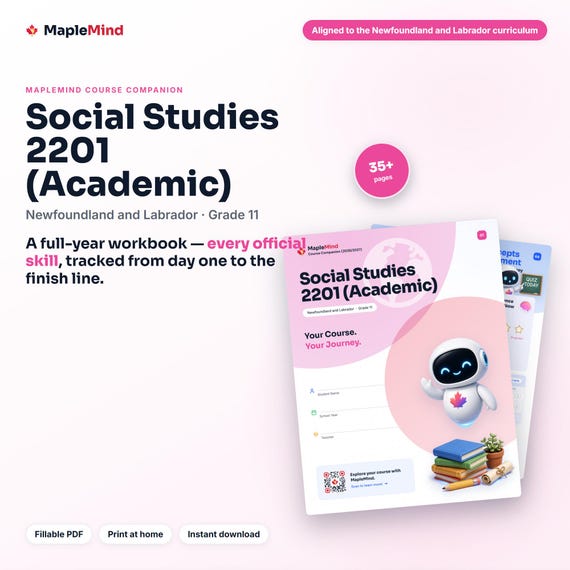
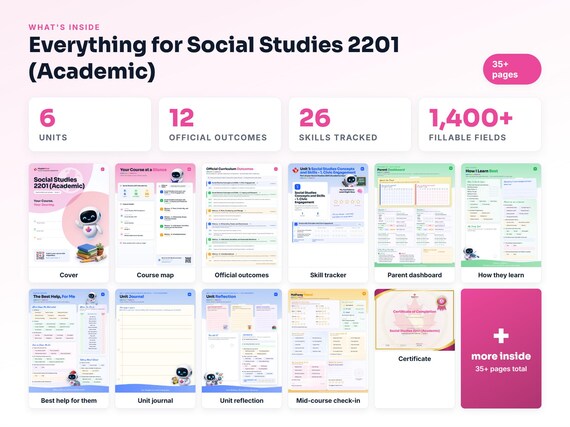
A Social Studies 2201 (Academic) workbook worth keeping
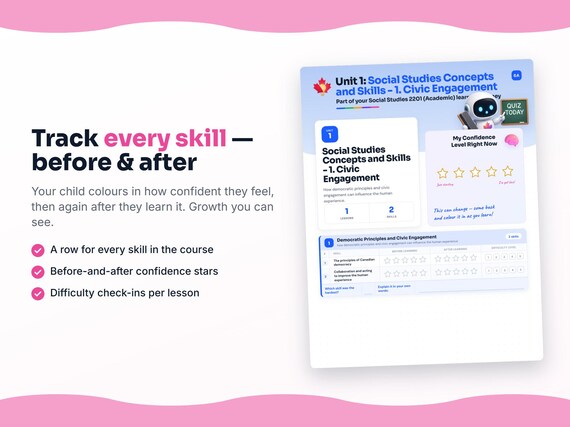
Built from the same official curriculum as this page. Before and after each skill above, your student colours in how sure they feel — so the two of you can see, on one page, what's clicking and what needs another look. It's a quiet way to follow how the year is really going.
By June it's full of their own handwriting: units worked through, confidence grown, a mid-year check-in, notes from parent-teacher night, and a certificate at the end. Less a worksheet, more a record of the year worth keeping on the shelf.
Instant download · see every page, reviews and the full description · five or more workbooks are $2.99 each
What it looks like in the app



Common questions
Can MapleMind help me with Social Studies 2201 (Academic)?
Yes. MapleMind's AI tutor covers all 26 skills in Newfoundland and Labrador's Social Studies 2201 (Academic) — you pick the exact skill, and the tutor teaches it step by step: a short lesson, a worked example, solving together, then a skill check to show it stuck.
Is MapleMind aligned to Newfoundland and Labrador's official curriculum?
Yes. Every skill in this course maps to an official outcome code from Newfoundland and Labrador's Grade 11 Social Studies curriculum, and the ministry's own wording is quoted under each unit on this page — with the official government source linked so you can check it yourself.
What does MapleMind cost?
It's free to start — 5 tutoring chats and a practice quiz every day, no credit card. A Pro subscription ($9.99/month or $49.99/year CAD, 7-day free trial) unlocks unlimited tutoring, practice, and exam simulations.
What if I'm stuck on just one topic?
That's the point of skill-level tutoring: open Social Studies 2201 (Academic) in the app, tap the exact skill from the list on this page, and the tutor teaches just that — no wading through lessons you don't need.
Does MapleMind work in French or other languages?
Yes — 14 languages, including French. Both the app and the tutor's explanations switch to the language you choose.
Where can I see the official Newfoundland and Labrador curriculum for Social Studies 2201 (Academic)?
The official source is linked on this page — Newfoundland and Labrador's official curriculum. The outline here follows it: every MapleMind skill carries its official outcome code, and the ministry's own wording is quoted under each unit.
Keep exploring
Ready when you are
Pick a skill from this page and see it taught properly — free, in the browser, in under a minute.