Get help with Social Studies 2202 (Applied)
Most tutoring makes you sit through material you already know. MapleMind flips that: pick the exact skill that's causing trouble — any of the 26 below — and the tutor teaches just that one, step by step, as many times as it takes. Ask questions in plain words, any time of day, in English, French, or 12 other languages.
The official Newfoundland and Labrador Social Studies 2202 (Applied) curriculum
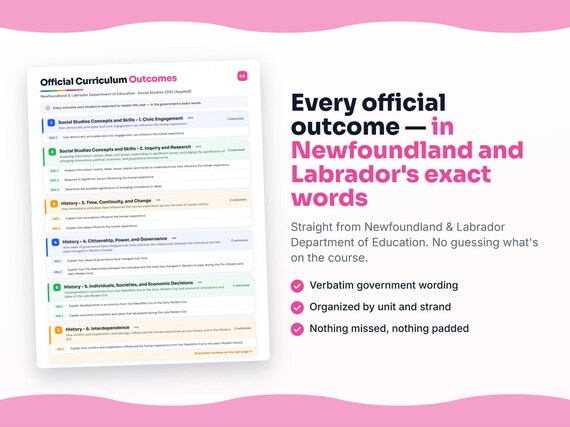
Newfoundland and Labrador defines Social Studies 2202 (Applied) by strands and outcomes. MapleMind teaches the same curriculum reorganized for one-skill-at-a-time tutoring — the table shows exactly where every official strand lands, and the ministry's own wording is quoted under each unit below.
Official source Newfoundland and Labrador's official curriculumRead it on the government site — gov.nl.ca ↗| Official strand | Outcomes | Where MapleMind teaches it |
|---|---|---|
| Strand 1 | 1 | Social Studies Concepts and Skills - 1. Civic Engagement |
| Strand 2 | 6 | Social Studies Concepts and Skills - 2. Inquiry and Research |
| Strand 3 | 2 | History - 3. Time, Continuity, and Change |
| Strand 4 | 2 | History - 4. Citizenship, Power, and Governance |
| Strand 5 | 2 | History - 5. Individuals, Societies, and Economic Decisions |
| Strand 6 | 2 | History - 6. Interdependence |
Every skill below, taught one on one.
 Try the first session free
How MapleMind teaches Social Studies 2202 (Applied) — every unit, lesson, and skill
Every skill below runs as a short session: a plain-words lesson, a worked example, solving it together, then a five-question skill check that earns up to three stars. Guided Mode keeps it teaching instead of answer-handing — turning it off needs a parent's password.
Unit 1Social Studies Concepts and Skills - 1. Civic EngagementOfficial strand · Strand 1
How democratic principles and civic engagement can influence the human experience.
Democratic Principles and Civic Engagement
- The principles of Canadian democracy in everyday lifeNL-SS-2202.1 — Describe the basic principles of Canadian democracy - freedom, having a say, and fair rules - using everyday examples of the rights people rely on.
- Working together and taking actionNL-SS-2202.1 — Show how people work together toward a shared goal and how taking action - even small action - can make life better in a community.
The official wording — 1 outcome in this unit
- NL-SS-2202.1
how democratic principles and civic engagement can influence the human experience
Unit 2Social Studies Concepts and Skills - 2. Inquiry and ResearchOfficial strand · Strand 2
Analyzing information, events, ideas, and issues, responding to significant issues, and judging the significance of emerging innovations, political, economic, and geopolitical developments.
Tools for Making Sense of Information
- Checking evidence, comparing, and asking whyNL-SS-2202.2 — Check whether evidence is trustworthy, compare two things to spot what changed, and figure out what caused an event and what followed from it.
- What matters, whose view, and what's fairNL-SS-2202.2 — Decide how much an event really matters, explain how different people see it, and make a fair judgement about right and wrong.
Taking On a Real Question
- Asking a good question and finding informationNL-SS-2202.3 — Turn a topic into a clear question you can actually answer, then find and sort reliable information from a few different places.
- Reading the information and backing up your answerNL-SS-2202.3 — Read your information for what it really says, reach a conclusion you can back up, and share it clearly.
Sizing Up What's Happening Now
- Sizing up a new innovation or ideaNL-SS-2202.4 — Judge how much a new innovation or idea might matter by asking who it affects, how widely, and for how long.
- Sizing up a political eventNL-SS-2202.5 — Judge how much a political event or trend in the news might matter by looking at who it affects and how widely.
- Sizing up an economic trendNL-SS-2202.6 — Judge how much an economic change - like prices, jobs, or interest rates - might matter in everyday life.
- Sizing up a conflict between countriesNL-SS-2202.7 — Judge how much a dispute between countries might matter by looking at who is involved, what they each want, and how far the effects could reach.
The official wording — 6 outcomes in this unit
- NL-SS-2202.2
Analyze information, events, ideas, issues, places, and trends to understand how they influence the human experience
- NL-SS-2202.3
Respond to significant issues influencing the human experience
- NL-SS-2202.4
Determine the possible significance of emerging innovations or ideas
- NL-SS-2202.5
Determine the possible significance of a current political event or emerging political trend
- NL-SS-2202.6
Determine the possible significance of a current economic event or emerging economic trend
- NL-SS-2202.7
Determine the possible significance a current or emerging geopolitical dispute
Unit 3History - 3. Time, Continuity, and ChangeOfficial strand · Strand 3
How innovations and ideas have influenced the human experience across the eras of human history.
How New Tools Changed Life
- Tools of the earliest humans and the first farmersNL-SS-2202.8 — Describe how the tools of the earliest humans (stone tools, fire, language) and the first farmers (growing food, settling down) changed daily life.
- Inventions from ancient times to todayNL-SS-2202.8 — Describe important inventions from ancient times to today - like writing, the printing press, and modern machines - and how each changed everyday life.
How New Ideas Changed Life
- How people saw the world before scienceNL-SS-2202.9 — Describe how people in Western Europe saw the world before modern science, when tradition and the Church explained everything, including the idea that Earth was the centre of the universe.
- How science changed the way people thinkNL-SS-2202.9 — Describe how the idea of learning from observation - science - changed the way people in Western Europe understood the world and challenged old authority.
The official wording — 2 outcomes in this unit
- NL-SS-2202.8
Explain how innovations influence the human experience
- NL-SS-2202.9
Explain how ideas influence the human experience
Unit 4History - 4. Citizenship, Power, and GovernanceOfficial strand · Strand 4
How ideas of governance have changed over time and how the relationship between the individual and the state changed in Western Europe.
Who's In Charge, and How That Changed
- Ways countries are runNL-SS-2202.10 — Sort the main ways countries are run - one person in charge, a small group in charge, or the many in charge - with a modern example of each.
- Where the idea of a citizen came fromNL-SS-2202.10 — Describe how governments grew as societies grew, and where the idea of being a citizen - a person with a say - came from in the ancient world.
From Subject to Citizen
- Life under kings and the ChurchNL-SS-2202.11 — Describe how Western Europe was run in the pre-modern era, when kings and the Church held the power and most people were subjects with duties rather than rights.
- How people gained rightsNL-SS-2202.11 — Describe how, in the early modern era, new ideas began to limit the power of rulers and give ordinary people rights, changing the link between a person and the state.
The official wording — 2 outcomes in this unit
- NL-SS-2202.10
Explain how ideas of governance have changed over time
- NL-SS-2202.11
Explain how the relationship between the individual and the state has changed in Western Europe during the Pre-Modern and early Modern Eras
Unit 5History - 5. Individuals, Societies, and Economic DecisionsOfficial strand · Strand 5
Developments in economics from the Paleolithic Era to the Early Modern Era, and economic innovations and ideas of the Late Modern Era.
How People Made a Living Through History
- From finding food to tradingNL-SS-2202.12 — Describe how people went from finding their own food to growing extra, trading it, and using early money in the ancient world.
- Towns, markets, and growing tradeNL-SS-2202.12 — Describe how making a living changed as towns grew and trade spread between regions in the pre-modern and early modern era.
Big Economic Ideas of Modern Times
- Capitalism and the factory ageNL-SS-2202.13 — Describe what capitalism is and how factories changed work and life during modern times.
The official wording — 2 outcomes in this unit
- NL-SS-2202.12
Explain developments in economics from the Paleolithic Era to the Early Modern Era
- NL-SS-2202.13
Explain economic innovations and ideas that developed during the Late Modern Era
Unit 6History - 6. InterdependenceOfficial strand · Strand 6
How conflict and cooperation, and ideology, influenced the human experience across history and in the Modern Era.
Fighting and Working Together
- Why people fight and why they team upNL-SS-2202.14 — Describe the main reasons societies fight - over resources, land, or power - and the reasons they team up - safety and shared benefit.
- Fighting and teaming up through the agesNL-SS-2202.14 — Describe examples of fighting and teaming up from the earliest times to the early modern period, and what came of them.
Big Ideas in the Modern World
- Empire-building and its effectsNL-SS-2202.15 — Describe what imperialism (empire-building) was, why powerful countries did it, and the serious effects it had on the people who were taken over.
- Countries working together worldwideNL-SS-2202.15 — Describe how countries built global groups like the United Nations to work together and keep the peace, and why the world became more connected.
The official wording — 2 outcomes in this unit
- NL-SS-2202.14
Explain how conflict and cooperation influenced the human experience from the Paleolithic Era to the early-Modern Period
- NL-SS-2202.15
Explain how ideology has influenced the human experience in the Modern Era
Printable workbook · A keepsake of the year
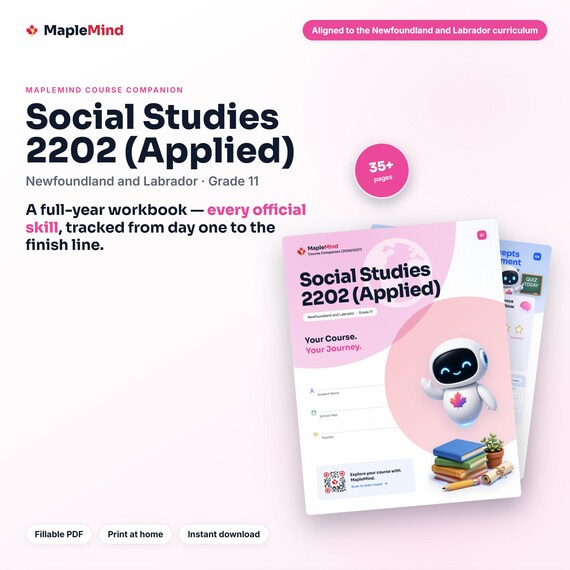
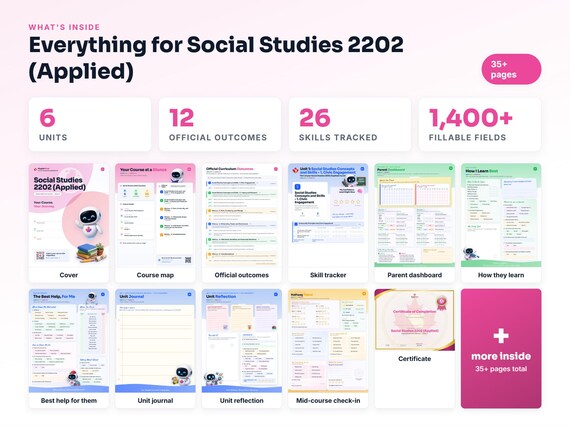
A Social Studies 2202 (Applied) workbook worth keeping
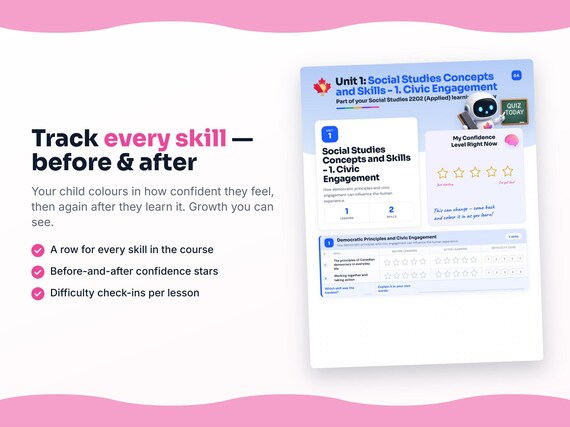
Built from the same official curriculum as this page. Before and after each skill above, your student colours in how sure they feel — so the two of you can see, on one page, what's clicking and what needs another look. It's a quiet way to follow how the year is really going.
By June it's full of their own handwriting: units worked through, confidence grown, a mid-year check-in, notes from parent-teacher night, and a certificate at the end. Less a worksheet, more a record of the year worth keeping on the shelf.
Instant download · see every page, reviews and the full description · five or more workbooks are $2.99 each
What it looks like in the app



Common questions
Can MapleMind help me with Social Studies 2202 (Applied)?
Yes. MapleMind's AI tutor covers all 26 skills in Newfoundland and Labrador's Social Studies 2202 (Applied) — you pick the exact skill, and the tutor teaches it step by step: a short lesson, a worked example, solving together, then a skill check to show it stuck.
Is MapleMind aligned to Newfoundland and Labrador's official curriculum?
Yes. Every skill in this course maps to an official outcome code from Newfoundland and Labrador's Grade 11 Social Studies curriculum, and the ministry's own wording is quoted under each unit on this page — with the official government source linked so you can check it yourself.
What does MapleMind cost?
It's free to start — 5 tutoring chats and a practice quiz every day, no credit card. A Pro subscription ($9.99/month or $49.99/year CAD, 7-day free trial) unlocks unlimited tutoring, practice, and exam simulations.
What if I'm stuck on just one topic?
That's the point of skill-level tutoring: open Social Studies 2202 (Applied) in the app, tap the exact skill from the list on this page, and the tutor teaches just that — no wading through lessons you don't need.
Does MapleMind work in French or other languages?
Yes — 14 languages, including French. Both the app and the tutor's explanations switch to the language you choose.
Where can I see the official Newfoundland and Labrador curriculum for Social Studies 2202 (Applied)?
The official source is linked on this page — Newfoundland and Labrador's official curriculum. The outline here follows it: every MapleMind skill carries its official outcome code, and the ministry's own wording is quoted under each unit.
Keep exploring
Ready when you are
Pick a skill from this page and see it taught properly — free, in the browser, in under a minute.