New Brunswick · For parents

What your child learns in Grade 12 in New Brunswick

Every subject, unit by unit, from New Brunswick’s curriculum: 665 skills in plain words.

Subjects
5
Skills
665
Provincial exams
4
Official curriculum
gnb.ca

Math in Grade 12

5 courses. Choose the one your child takes.

Calculus 120

1 unit · 18 skills

  1. Unit 1

    Calculus

    Average rate of change is the slope of the secant line between two points.

    • Average and instantaneous rate of change
    • The derivative from the definition
    • Constant, power, sum, and difference rules
    15 more skills
    • Product and quotient rules
    • Derivatives of trigonometric functions
    • The chain rule
    • Inverse trigonometric functions
    • Limits and derivatives of exponential and logarithmic functions
    • Analyzing a function for curve sketching
    • Sketching the graph from the analysis
    • Optimization problems
    • Applied optimization in context
    • Linearization and Newton's Method
    • Related rates
    • The definite integral
    • Antiderivatives
    • Integration to find area and accumulation
    • Integral applications in science, economics, and business

Financial and Workplace Mathematics 120

7 units · 30 skills

  1. Unit 1

    Measurement

    Precision is how finely an instrument reads; accuracy is how close it is to the true value.

    • Precision, accuracy, and uncertainty
    • Tolerance and solving problems
    • Significant figures and reporting measurements
  2. Unit 2

    Geometry

    A triangle's angles sum to 180°; a quadrilateral's to 360°.

    • Triangle and quadrilateral problems
    • Regular polygon problems
    • Perimeter and area of composite figures
    5 more skills
    • Solving triangles with the sine law
    • Solving triangles with the cosine law
    • Choosing and applying the right law in context
    • Translations, rotations, and reflections
    • Dilations and resizing
  3. Unit 3

    Number

    Logical reasoning rules out impossibilities until the answer remains.

    • Finding a logical strategy in a puzzle or game
    • Justifying a logical strategy
    • Expenses, sales, and profit or loss
    2 more skills
    • Break-even and critiquing viability
    • Comparing small-business options
  4. Unit 4

    Algebra

    A linear relation changes by a constant amount each step.

    • Patterns, trends, and tables of values
    • Graphing a linear relation
    • Writing the equation of a linear relation
    1 more skill
    • Interpolating, extrapolating, and solving problems
  5. Unit 5

    Statistics

    The mean is the total divided by the count; the median is the middle value; the mode is the most frequent.

    • Mean, median, and mode
    • Weighted mean and trimmed mean
    • Choosing a measure and spotting misleading statistics
    2 more skills
    • Analyzing and describing percentiles
    • Quartiles and box plots
  6. Unit 6

    Probability

    Probability = favourable outcomes divided by total outcomes.

    • Computing and expressing probability
    • Interpreting probability in decisions
  7. Unit 7

    Mathematical Research Project

    A good research question is focused and genuinely mathematical.

    • Framing the research inquiry
    • Researching and doing the mathematics
    • Presenting the findings

Foundations of Mathematics 120

4 units · 30 skills

  1. Unit 1

    Statistics

    A normal distribution is symmetric and bell-shaped around its mean.

    • Standard deviation and the bell curve
    • z-scores
    • Confidence intervals and levels
    1 more skill
    • Margin of error
  2. Unit 2

    Logical Reasoning

    Logical elimination rules out impossible options.

    • Strategies for logic puzzles and games
    • Justifying puzzle and game reasoning
    • Sets, unions and intersections
    3 more skills
    • Counting with set theory
    • Conditional statements and their related forms
    • Truth values and biconditionals
  3. Unit 3

    Probability

    Probability is favourable outcomes over total outcomes.

    • Interpreting odds and probability
    • Assessing the validity of probability claims
    • Mutually exclusive events
    11 more skills
    • Non-mutually-exclusive events
    • Independent events
    • Dependent events
    • Applying the fundamental counting principle
    • Counting with restrictions
    • Permutations of distinct objects
    • Permutations with restrictions or repeated objects
    • Combinations of objects
    • Choosing combinations or permutations
    • Expanding binomials with Pascal's triangle
    • The binomial theorem and general term
  4. Unit 4

    Relations and Functions

    Data with turning points may fit a quadratic or cubic model.

    • Fitting a polynomial model to data
    • Solving problems with a polynomial model
    • Modelling with exponential functions
    3 more skills
    • Modelling with logarithmic functions and scales
    • Building a sinusoidal model
    • Solving problems with a sinusoidal model

Pre-Calculus 120A

2 units · 30 skills

  1. Unit 1

    Relations and Functions

    y = f(x) + k shifts the graph up by k (or down when k is negative).

    • Vertical translations
    • Horizontal translations
    • Vertical stretches
    16 more skills
    • Horizontal stretches
    • Applying combined translations and stretches
    • Writing the equation of a transformed graph
    • Reflections in the x- and y-axes
    • Reflection in the line y = x
    • Inverses of relations and the y = x reflection
    • When is the inverse a function?
    • Graphing and analyzing radical functions
    • Solving radical equations from the graph
    • Understanding exponential functions
    • Modelling growth and decay with exponentials
    • Understanding logarithms
    • Graphing exponential and logarithmic functions
    • Transformations of exponential and logarithmic graphs
    • Product, quotient, and power laws of logarithms
    • Solving exponential and logarithmic equations
  2. Unit 2

    Trigonometry

    An angle in standard position starts on the positive x-axis; positive angles turn counterclockwise.

    • Angles in standard position: degrees and radians
    • Arc length and the meaning of a radian
    • The equation of the unit circle
    8 more skills
    • Solving problems with the six trigonometric ratios
    • Exact values at special angles
    • Graphing sine, cosine, and tangent
    • Transformed sinusoidal graphs and modelling
    • Solving trigonometric equations
    • Solving trigonometric equations graphically
    • Proving reciprocal, quotient, and Pythagorean identities
    • Proving with sum, difference, and double-angle identities

Pre-Calculus 120B

3 units · 30 skills

  1. Unit 1

    Relations and Functions

    An arithmetic sequence adds a constant common difference d each step.

    • Arithmetic sequences
    • Arithmetic series
    • Geometric sequences
    13 more skills
    • Geometric and infinite geometric series
    • Factoring higher-degree polynomials
    • Factoring sums and differences of cubes
    • Graphing polynomial functions
    • Analyzing polynomial characteristics
    • Graphing reciprocal functions
    • Reciprocal of a quadratic function
    • Graphing rational functions
    • Solving rational equations
    • Operations on functions
    • Composition of functions
    • A function toolkit: comparing function types
    • Choosing a function to model a situation
  2. Unit 2

    Permutations, Combinations and Binomial Theorem

    If one step has m outcomes and the next has n, together they have m·n outcomes.

    • The fundamental counting principle
    • Permutations of n objects taken r at a time
    • Permutations with repetition and identical objects
    4 more skills
    • Combinations of n objects taken r at a time
    • Combination problems with cases and conditions
    • Expanding binomials with the binomial theorem
    • Finding a specific term of a binomial expansion
  3. Unit 3

    Limits

    lim(x→a) f(x) is the value the graph approaches near x = a.

    • Limits from a graph
    • Limits analytically
    • One-sided limits
    4 more skills
    • Continuity of a function
    • Continuity on an interval and making a function continuous
    • Limits involving infinity
    • Indeterminate forms at infinity

Science in Grade 12

4 courses. Choose the one your child takes.

Biology 12

3 units · 101 skills

  1. Unit 1

    Genetic Continuity

    The cell cycle: interphase (G1, S, G2) then the mitotic phase (mitosis + cytokinesis).

    • The cell cycle
    • Chromosomes and chromosome number
    • Controls on cell division
    42 more skills
    • Mitosis and cancer (p53)
    • Treating cancer
    • Observing chromosomes
    • Cyclin-dependent kinases
    • Telomeres and telomerase
    • Stem cell technology
    • Meiosis and cytokinesis
    • Chromosome reduction
    • Chromosomes and heredity
    • Crossing over
    • Karyotypes
    • Non-disjunction
    • Discovery of the gene
    • Nucleic acids
    • The DNA double helix
    • DNA replication
    • Replication terms
    • Types of RNA
    • Protein synthesis
    • Gene mutations
    • Causes of mutations
    • RNA processing
    • Gene regulation
    • Mendel's work
    • Mendelian genetics
    • Complex inheritance
    • Probability in genetics
    • Monohybrid and dihybrid crosses
    • Polyploidy
    • Genotype and phenotype
    • Sex-linkage
    • Sex-linked defects in males
    • Sex-linked crosses
    • Environment and gene expression
    • Pedigree charts
    • Human genome research
    • Genetic engineering techniques
    • Restriction enzymes
    • Genetically modified organisms
    • Risks and benefits of biotechnology
    • Current genetic engineering technologies
    • Topics in human genomics
  2. Unit 2

    Evolution, Change and Diversity

    Life likely arose from simple chemicals under early-Earth conditions.

    • Origin and diversity of life
    • Historical and cultural contexts
    • The theory of evolution
    7 more skills
    • Key evolution terms
    • Modern theory of evolution
    • Genes and variation
    • Variation, mutation, and selection
    • Hardy-Weinberg principle
    • Environmental pressures on evolution
    • Hardy-Weinberg and chi-square
  3. Unit 3

    Maintaining Dynamic Equilibrium II

    A neuron has dendrites (receive signals), a cell body, and an axon (sends signals).

    • Neuron structure
    • Types of neurons
    • Impulse transmission
    43 more skills
    • Compounds in neuron function
    • Ion distribution on the membrane
    • Transmitters and inhibitors
    • The central nervous system
    • The peripheral nervous system
    • Reflex arcs
    • Nervous system and homeostasis
    • Nervous system disorders
    • Drugs disrupting homeostasis
    • Drugs maintaining homeostasis
    • Endocrine glands
    • Endocrine system and homeostasis
    • Neural and endocrine control together
    • Hormones and target cells
    • Protein and steroid hormones
    • Investigating the endocrine system
    • Feedback mechanisms
    • Discovery of insulin
    • Health and feedback loops
    • Endocrine disorders
    • The brain
    • The eye
    • The ear
    • Diseases and injury of brain, eye, and ear
    • Male reproductive system
    • Sperm structure
    • Male reproductive hormones
    • Female reproductive system
    • Egg cell structure
    • Female reproductive hormones
    • Journey to fertilization
    • Fraternal and identical twins
    • Hormones of pregnancy
    • Embryonic development
    • Primary membranes
    • Placenta and umbilical cord
    • Monitoring development
    • Diagnosing genetic problems
    • Drugs and fetal development
    • Fertility technologies
    • Contraceptive effectiveness
    • Birth control and demographics
    • Debating fertility funding
See the course: Biology 12

Chemistry 12

4 units · 55 skills

  1. Unit 1

    Thermochemistry

    Identify the independent variable (e.g. amount of reactant), dependent (temperature change), and controls.

    • Designing a thermochemistry experiment
    • Selecting instruments and processes
    • Researching information
    13 more skills
    • Selecting and integrating information
    • Displaying evidence
    • Predicting heats of reaction
    • Proposing alternative solutions
    • Multiple perspectives
    • Working cooperatively
    • Combustion equations for alkanes
    • Thermochemistry terms
    • Energy in state changes and reactions
    • Bond energies and reaction energy
    • Potential energy diagrams
    • Measuring reaction energy experimentally
    • Molar enthalpies of combustion
  2. Unit 2

    From Solutions to Kinetics to Equilibrium

    Sampling means selecting representative measurements over time.

    • Developing sampling procedures
    • Implementing sampling procedures
    • Compiling and organizing data
    5 more skills
    • Classification and nomenclature
    • Reaction rate
    • The concept of equilibrium
    • Solubility as equilibrium
    • Factors affecting solubility
  3. Unit 3

    Acids and Bases

    A hypothesis proposes a testable acid-base relationship.

    • Stating a prediction and hypothesis
    • Using instruments accurately
    • Using apparatus safely
    14 more skills
    • WHMIS standards
    • Classification and nomenclature (acids/bases)
    • Line of best fit
    • Interpreting data patterns
    • New questions from results
    • Modes of representation
    • Working cooperatively (acids/bases)
    • Acid-base definitions
    • Predicting acid-base products
    • Strong vs weak acids and bases
    • Calculating pH
    • H+ and OH- and Le Chatelier
    • Concentration by titration
    • Acid-base indicators
  4. Unit 4

    Organic Chemistry

    Delimiting a problem narrows it to a specific, answerable question.

    • Defining and delimiting problems
    • Limits of a classification system
    • Evaluating evidence for bias
    11 more skills
    • Stating a conclusion
    • Communicating ideas
    • Synthesizing information
    • Defending a position
    • Formulas of organic compounds
    • Diversity of organic compounds
    • IUPAC naming
    • Isomers
    • Organic families
    • Predicting organic reactions
    • Polymerization

Environmental Science 120

3 units · 94 skills

  1. Unit 1

    An Overview of Environmental Science

    Populations are held in check by food, space, predators, and disease.

    • Populations in equilibrium
    • Limiting factors and carrying capacity
    • Natural capital and natural income
    9 more skills
    • Human population growth
    • Measuring populations
    • Earth's carrying capacity
    • Issues from overpopulation
    • Exploring a local issue
    • Research and presentation skills
    • Technology for information
    • Technology and understanding the environment
    • Choosing a research project
  2. Unit 2

    Sustainable Development

    Life is organized in levels: cell, organism, species, population, ecosystem, biosphere.

    • Organization of life
    • Indigenous ways of knowing
    • Energy flow and chemical cycling
    17 more skills
    • Technology measuring natural systems
    • The biosphere as a system
    • Evolution and natural selection
    • Humans in the biosphere
    • Attitudes toward the environment
    • History of environmental attitudes
    • Changing land and water use
    • Growing environmental awareness
    • Technology and land/water use
    • The environmental movement
    • Canadian environmental contributors
    • Principles of sustainable development
    • Dynamics of sustainable ecosystems
    • Sustainable human communities
    • Ecosystems and communities
    • Sustainable and unsustainable development
    • Stewardship and sustainability
  3. Unit 3

    Investigating Environmental Issues

    New Brunswick agriculture employs people and contributes to the economy.

    • Agriculture in New Brunswick
    • Agriculture and natural ecology
    • Testing agriculture's impact
    59 more skills
    • Methods of farming
    • Soil structure and fertility
    • Global food production
    • Agriculture organizations
    • Agriculture legislation
    • Forest regions of Canada
    • New Brunswick forest types
    • Forests as natural capital
    • Forestry and forest ecology
    • Testing forestry's impact
    • Managing forests sustainably
    • History of NB forests
    • Forestry organizations
    • Forestry legislation
    • Earth's water supply
    • Water use
    • Freshwater ecology and impact
    • Testing impact on fresh water
    • Water scarcity
    • Using water sustainably
    • Water organizations
    • Research methods for water issues
    • Water legislation
    • Importance of ocean resources
    • Fishery practices
    • Fisheries and ocean ecology
    • Testing fisheries' impact
    • Global ocean issues
    • Fisheries organizations
    • Fisheries legislation
    • NB energy resources
    • Advantages and disadvantages of energy sources
    • Energy use in NB
    • Testing energy use and efficiency
    • Improving energy efficiency
    • Energy organizations
    • Energy legislation
    • Greenhouse effect and climate change
    • Past climate change
    • Climate change effects on NB
    • Climate change organizations
    • Testing a climate change impact
    • Climate change legislation
    • Effects of pollution
    • Types and sources of water pollution
    • Cultural eutrophication
    • Testing for pollutants
    • Preventing and cleaning up pollution
    • Pollution organizations
    • Research methods for pollution issues
    • Pollution legislation
    • Independent research
    • Analyzing and communicating results
    • Collaborative presentation
    • Participating in presentations
    • Appreciation of the environment
    • Stewardship of the environment
    • Advocacy for the environment
    • Engaging others

Physics 12

3 units · 51 skills

  1. Unit 1

    Dynamic Extension

    Vectors in 2D are resolved into perpendicular components (x and y).

    • Vector analysis in two dimensions
    • Conservation of momentum in collisions
    • Choosing energy or momentum
    20 more skills
    • Representing forces as vectors (2D)
    • Designing a dynamics experiment
    • Selecting instruments and processes
    • Carrying out procedures
    • Displaying evidence
    • Modes of representation
    • Multiple perspectives on an issue
    • Working cooperatively
    • Designing an experiment (extended)
    • Displaying evidence (extended)
    • Building and testing a prototype
    • Evaluating a designed device
    • Modes of representation (analysis)
    • Compiling and organizing data
    • Projectile motion (dynamic extension)
    • Uniform circular motion (algebraic/vector)
    • Circular motion and Newton's laws
    • Wave equation (dynamic extension)
    • Simple harmonic motion energy
    • Kepler's laws (dynamic extension)
  2. Unit 2

    Projectiles, Circular Motion and Universal Gravitation

    Set measurable criteria (range, accuracy, consistency) before building.

    • Building and evaluating a device
    • Projectile motion analysis
    • Projectile motion qualitatively and quantitatively
    8 more skills
    • Uniform circular motion in depth
    • Circular motion with Newton's laws
    • Investigating a development
    • SHM: displacement, velocity, acceleration
    • SHM energy in depth
    • Compiling and organizing orbital data
    • Kepler's laws applied
    • Universal gravitation and orbits
  3. Unit 3

    Fields

    Field concepts require precise vocabulary (field, field line, source, direction).

    • Communicating ideas about fields
    • Fields as regions of space
    • Fields affecting mass and charge
    14 more skills
    • Field lines
    • Charges and poles
    • Newton's law vs Coulomb's law
    • Ohm's law and circuits
    • Carrying out circuit procedures
    • Circuit procedures (extended)
    • Predicting and hypothesizing (circuits)
    • Designing a circuit experiment
    • Magnetic field of a current
    • Force on a moving charge
    • Electromagnetic induction
    • Motors and generators
    • Alternating and direct current
    • Selecting and integrating information (fields)
See the course: Physics 12

English in Grade 12

3 courses. Choose the one your child takes.

English 12

3 units · 33 skills

  1. Unit 1

    Speaking and Listening

    Synthesising what is helpful means selecting, which means rejecting: a synthesis containing everybody's contribution is a list.

    • Synthesizing others' ideas to expand your own
    • Asking discriminating questions
    • Advocating positions with a range of viewpoints
    8 more skills
    • Listening critically to concepts and information
    • Leadership and support roles in complex situations
    • Adapting language for complex contexts
    • Responding to complex questions and directions
    • Elements of powerful communication
    • Consistent active listening and concern for others
    • How spoken language influences and reveals
    • Critical choices of tone, style and voice
  2. Unit 2

    Reading and Viewing

    A special interest is a route in rather than a narrowing, as long as the interest is the subject and not the style.

    • Selecting texts for your needs and interests
    • Reading world literature across genres and periods
    • How information texts are built for a purpose
    8 more skills
    • Cueing systems and strategies for sophisticated texts
    • Articulating your own reading processes
    • Systematic research and evaluating the process
    • Informed responses and universal themes
    • Justifying views and interpreting ambiguities
    • Critically evaluating information you access
    • Relationships among texts and their elements
    • How texts and media construct meaning and reality
  3. Unit 3

    Writing and Representing

    A challenging text is one your existing way of reading does not handle, so writing about it is where the new way gets built.

    • Writing to explore insights and values
    • Notes for increasingly complex knowledge
    • Effective choices for imaginative impact
    8 more skills
    • Producing complex writing and representations
    • How construction creates and controls meaning
    • Evaluating others' responses to your work
    • Applying the strategies that work for you
    • Accurate and consistent conventions
    • Technology and design that serve the reader
    • Skilful crafting across a range
    • Integrating many sources into meaning
See the course: English 12

Media Studies 120

3 units · 10 skills

  1. Unit 1

    Impact and Influence

    Media literacy rests on key concepts: media are constructed, carry values, are shaped by audience and by commercial/ownership interests.

    • Understanding the key concepts of media literacy
    • Employing critical literacy skills as media consumers
    • Examining how media shape ideologies and culture
  2. Unit 2

    Deconstruct

    Every media text embeds values and an ideology, even if unstated.

    • Identifying values and ideologies in media texts
    • Discerning the production process of media texts
    • Engaging in the inquiry process
    1 more skill
    • Dissecting meaning from complex media texts
  3. Unit 3

    Analyze and Respond

    A justified position rests on evidence from the media text and sound reasoning.

    • Justifying positions and respecting others' positions
    • Using media to communicate an idea for varied audiences
    • Applying key concepts of media literacy as creators

Reading Tutor 120

3 units · 9 skills

  1. Unit 1

    Leadership and Professional Conduct

    A tutor works within ethical responsibilities and school policies.

    • Knowing the ethical responsibilities and policies of professional conduct
    • Preparing, planning, and executing instruction professionally
    • Interacting positively and demonstrating reliability and commitment
    1 more skill
    • Setting, monitoring, and adjusting goals for the tutor role
  2. Unit 2

    Effective Reading Practices

    Tutoring reading requires understanding HOW reading works — decoding, fluency, comprehension.

    • Understanding reading processes and strategies
    • Examining approaches to reading instruction
    • Employing before, during, and after strategies for the developing reader
  3. Unit 3

    Assessment and Goal-Setting

    Formative assessment gathers evidence OF a developing reader during learning to guide next steps.

    • Applying formative assessment and setting goals in consultation
    • Adapting instruction to the developing needs and interests of the student

French in Grade 12

Post-Intensive French, Grade 12

4 units · 44 skills

  1. Unit 1

    Unité 1 : Moi dans 10 ans

    Inventory vocabulary: les intérêts, les aptitudes, les attitudes, les compétences.

    • Presenting your interests, skills, and attitudes
    • Researching and presenting a trade
    • Presenting a hobbies-vs-obligations graph
    10 more skills
    • Explaining who you'd like to resemble
    • Talking about yourself in ten years
    • Reading about a time capsule
    • Reading about interests and career choices
    • Reading résumé and cover-letter exemplars
    • Reading about future plans and idols
    • Reading researched trade information
    • Writing a résumé and application letter
    • Writing about your time graph and duties
    • Writing about role models and your ten-year self
  2. Unit 2

    Unité 2 : Les défis écologiques

    Eco vocabulary: l'empreinte écologique, le gaspillage, recycler, réduire.

    • Exploring your ecological footprint
    • Discussing and evaluating ecological challenges
    • Identifying possible solutions
    7 more skills
    • Presenting solutions in a debate
    • Justifying your opinion and convincing others
    • Reading about ecological issues and footprints
    • Reading about solutions and changes
    • Explaining ecological issues in writing
    • Writing reasons for your solutions
    • Describing current and future impacts
  3. Unit 3

    Unité 3 : Semblables mais différents

    Link frames: cette tradition représente, cela montre que.

    • Linking activities and traditions to culture
    • Explaining why you'd visit a country
    • Giving examples of cultural differences
    8 more skills
    • Presenting cultural differences within a country
    • Reading about a cultural activity
    • Reading about places to visit
    • Reading comparisons of two countries
    • Reading about the Territories' cultures
    • Writing why you'd visit a country
    • Writing a two-place cultural difference
    • Writing about differences within a country
  4. Unit 4

    Unité 4 : Ma carrière : rêve ou réalité

    Project vocabulary: un projet de carrière, un emploi, un objectif.

    • Discussing employment and career projects
    • Discussing challenges of your career choice
    • Discussing solutions to career challenges
    7 more skills
    • Interpreting statistical information aloud
    • Reading statistical information
    • Understanding and analyzing statistics
    • Reading about labour-market challenges
    • Writing the full application document set
    • Completing an aptitude survey
    • Writing the career findings report

Social studies in Grade 12

2 courses. Choose the one your child takes.

Law 120

14 units · 115 skills

  1. Unit 1

    Unit 1: Foundations of the Law

    Law is a set of enforceable rules that govern how people live together.

    • The need for and purposes of law
    • Historical sources of our laws
    • Classifying laws by type
    8 more skills
    • Division of governmental powers
    • How laws are made in Canada
    • The Charter of Rights and Freedoms
    • The NB Human Rights Act
    • The structure of the Indian Act
    • Impact of the Indian Act on Aboriginal peoples
    • Applying human rights law to cases
    • Structure of federal and provincial courts
  2. Unit 2

    Unit 2: Criminal Law

    Criminal law prohibits behaviour society considers seriously harmful or wrong.

    • Why society criminalizes behaviour
    • Elements of a criminal offence
    • Parties to an offence
    11 more skills
    • Indictable and summary offences
    • Police investigation and arrest
    • Officers of the court
    • Pre-trial and trial procedures
    • The jury system
    • Rules of evidence
    • Defences to criminal charges
    • Sentencing alternatives
    • Avenues of appeal
    • Parole eligibility
    • Applying criminal law to cases
  3. Unit 3

    Unit 3: Civil Law - Torts

    Criminal law involves the state prosecuting a wrong against society; civil law resolves disputes between parties.

    • Civil vs criminal matters
    • Civil court procedures
    • Torts and the purposes of tort law
    8 more skills
    • Kinds of torts and their elements
    • Intentional vs unintentional torts
    • Negligence concepts
    • Remedies for victims
    • Kinds of damages
    • Aboriginal litigants in tort actions
    • Defences to torts
    • Applying tort law to cases
  4. Unit 4

    Unit 4: Contracts

    A contract is a legally enforceable agreement between parties.

    • The need for contracts and valid agreements
    • Purpose, nature, and types of contracts
    • Making a valid contract
    5 more skills
    • Limits and constraints of contracts
    • Discharging a contract
    • Breach of contract
    • Remedies for breach of contract
    • Applying contract law to cases
  5. Unit 5

    Unit 5: Family Law

    Family law recognizes families formed by marriage, common-law relationships, and parent-child ties.

    • What is a family in legal terms
    • Changing trends in family structure
    • Legal requirements of marriage and common-law relationships
    10 more skills
    • Rights and responsibilities of family members
    • Adoption
    • Legal ramifications of family breakdown
    • Separation, divorce, and annulment
    • Pre-nuptial and cohabitation agreements
    • Deciding custody
    • Deciding support
    • Dividing matrimonial property
    • Applying family law to cases
    • Domestic violence and abuse
  6. Unit 6

    Unit 6: Estate Law

    A last will and testament sets out how a person's property is distributed after death.

    • The importance of a will
    • Making, changing, and executing a will
    • Types of wills
    8 more skills
    • Legal capacity to make a will
    • Required elements of a valid will
    • Duties of the executor
    • Intestate succession
    • Applying estate law to cases
    • Power of attorney
    • Living wills
    • Living will vs last will and testament
  7. Unit 7

    Unit 7: Environmental Law

    Environmental law protects air, water, land, and living things from harm.

    • The need for environmental law
    • The extent of environmental protection laws
    • Effectiveness of environmental law
    4 more skills
    • Sustainability of resource use
    • Balancing economy and environment
    • Role of lobby and interest groups
    • Applying environmental law to cases
  8. Unit 8

    Unit 8: Consumer Law

    Consumers often have less power and information than sellers.

    • Why consumer protection is needed
    • Protection provided by legislation
    • Conditions and warranties
    1 more skill
    • Remedies for buyer and seller
  9. Unit 9

    Unit 9: Aboriginal Peoples and Law

    The Indian Act defines who is a 'Status Indian' - a legal category with specific rights under the Act.

    • Status and non-Status Indians under the Indian Act
    • Rights of Status and non-Status Indians
    • The Charter and Bill C-31
    3 more skills
    • Aboriginal Rights and Treaty Rights
    • Aboriginal self-government
    • Aboriginal vs parliamentary models of government
  10. Unit 10

    Unit 10: International Law

    International law governs relations between states and some other actors.

    • The nature of international law
    • Examples of international law
    • Applying international law to current issues
  11. Unit 11

    Unit 11: Labour Law

    Employment law sets out the rights and duties of employers and employees.

    • Rights and responsibilities in employment
    • Elements of employment contracts
    • Federal and provincial labour legislation
    2 more skills
    • Formation and role of unions
    • Collective bargaining
  12. Unit 12

    Unit 12: Youth and the Law

    Society's approach to young offenders has shifted over time.

    • Changing attitudes toward young offenders
    • Youth justice legislation over time
    • Special rights and protections for young offenders
    4 more skills
    • Treatment of adult and young offenders
    • Why special provisions for young offenders
    • Validity of treating youth differently
    • Resources for young victims
  13. Unit 13

    Unit 13: Human Rights

    Human rights are the basic rights all people have simply for being human.

    • Protecting human rights nationally and internationally
    • The UN Universal Declaration of Human Rights
    • The Canadian Bill of Rights
    6 more skills
    • The Canadian Charter of Rights and Freedoms
    • The Canadian and NB Human Rights Acts
    • Rights under human-rights documents
    • Filing a human-rights complaint
    • Remedies under human-rights law
    • Effectiveness of human-rights legislation
  14. Unit 14

    Unit 14: Property Law

    Real property is land and things attached to it, like buildings.

    • Purchase and sale of real property
    • Rights and responsibilities of property owners
    • Limits on property ownership
    3 more skills
    • Rights and responsibilities of landlord and tenant
    • Types of leases
    • Classes of tenancies
See the course: Law 120

World Issues 120

3 units · 15 skills

  1. Unit 1

    Humanity

    Demographics is the statistical study of populations; demographic data describes them.

    • Measuring wealth and disparity
    • Solutions to poverty and economic disparity
    • Quality of life beyond economics
    2 more skills
    • Identity, diversity, and common humanity
    • Analysing rights documents
  2. Unit 2

    Interdependence

    Interdependence means people, nations, ecosystems, and institutions are connected in global networks.

    • Globalization and the global village
    • Media, bias, and fake news
    • Actions and movements for peace and sustainability
    1 more skill
    • Taking responsible action as a global citizen
  3. Unit 3

    Geopolitics

    Geopolitics is how geography, power, and motivation shape relations between countries.

    • What geopolitics is
    • Origins and evolution of conflict
    • Strategies to defuse conflict
    3 more skills
    • Human-rights violations, including Indigenous rights
    • Advocating and solving human-rights violations
    • Assessing social-justice initiatives

Provincial exams in Grade 12

MapleMind

See Grade 12 in MapleMind

Real screens from the app your child would use.

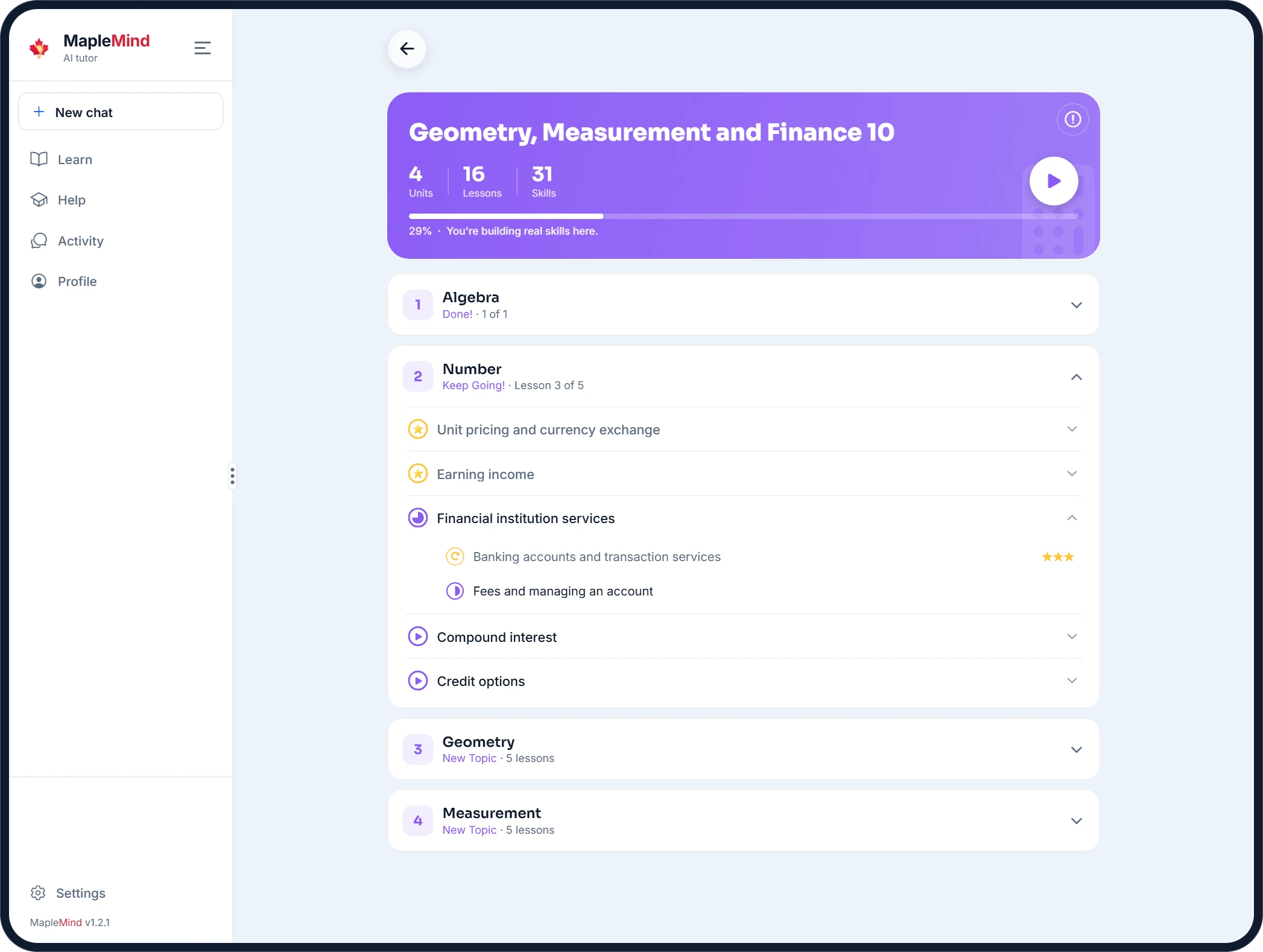
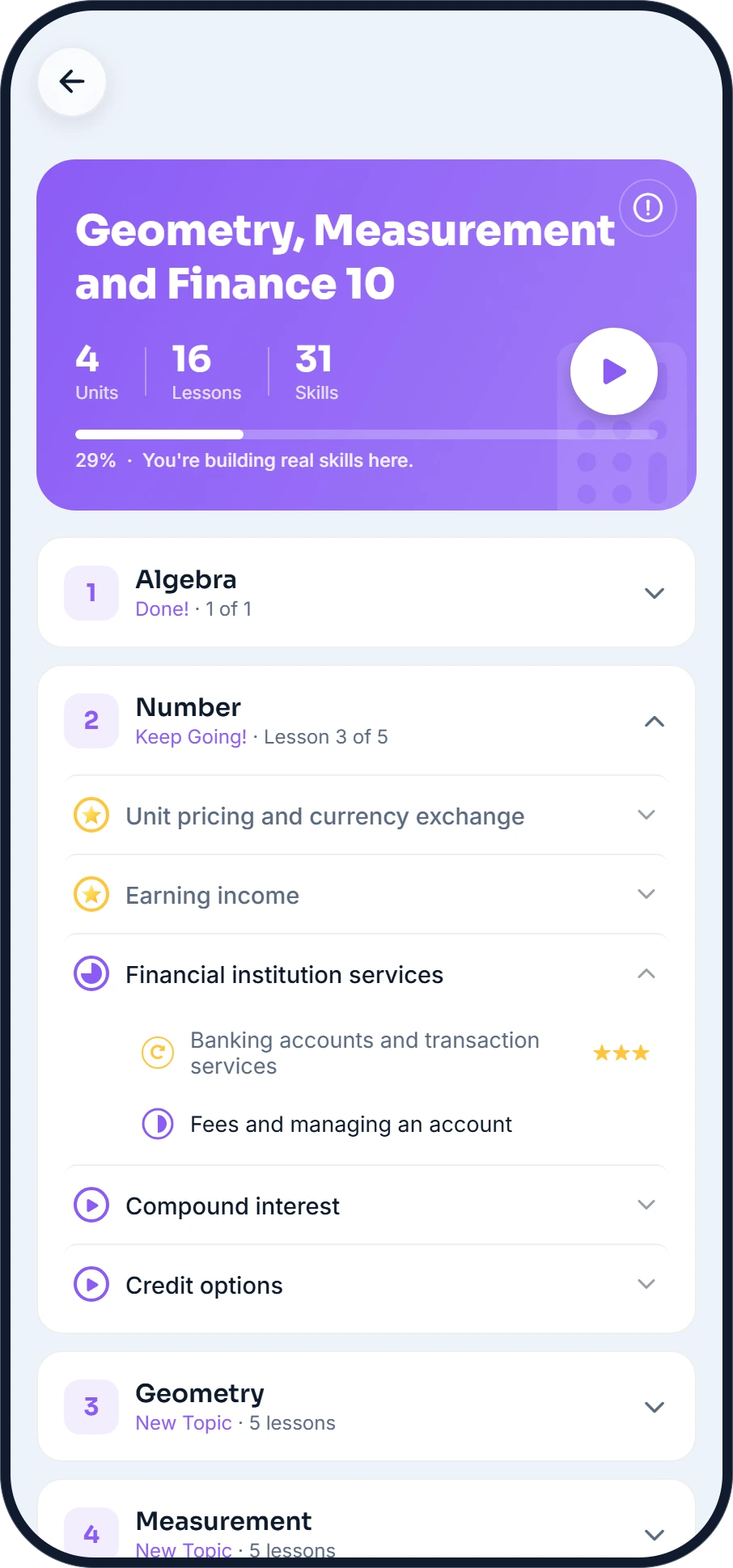
Geometry, Measurement and Finance 10 in MapleMind on a tablet: its units and lessons in order, a student partway through.Geometry, Measurement and Finance 10 in MapleMind on a phone: its units and lessons in order, a student partway through.
Their course, unit by unit, the way New Brunswick teaches it.Shown: Geometry, Measurement and Finance 10
Homework Help on a tablet: a photo of a worksheet, the tutor’s worked example of a two-step equation, and a question back to the student.Homework Help on a phone: a photo of a worksheet, the tutor’s worked example of a two-step equation, and a question back to the student.
Homework Help: they take a photo of the question, and the tutor works through it with them.
The Parent Dashboard on a tablet: a student’s days studied, streak, lessons, quiz average and recent activity.The Parent Dashboard on a phone: a student’s days studied, streak, lessons, quiz average and recent activity.
The Parent Dashboard: how each child’s week went, in lessons, quizzes and days studied.
A Grade 9 provincial mathematics exam on a tablet: a readiness score, the exam’s time and its next sitting.A Grade 9 provincial mathematics exam on a phone: a readiness score, the exam’s time and its next sitting.
A provincial exam: a practice sitting under the real time, and how ready they are.
The Learn tab on a tablet: a four-day streak, the week’s days, Homework Help, the next lesson and a review.The Learn tab on a phone: a four-day streak, the week’s days, Homework Help, the next lesson and a review.
The Learn tab: their week so far, and the next thing to do.

Help at home

Questions parents ask

What will my child learn in Grade 12 in New Brunswick?

Math: Calculus 120, Financial and Workplace Mathematics 120, Foundations of Mathematics 120, Pre-Calculus 120A and Pre-Calculus 120B. Science: Biology 12, Chemistry 12, Environmental Science 120 and Physics 12. English: English 12, Media Studies 120 and Reading Tutor 120. French: Post-Intensive French, Grade 12. Social studies: Law 120 and World Issues 120. That’s 665 skills in all, from New Brunswick’s curriculum.

When is the English Language Proficiency Assessment?

It’s written January 18, 2027 to January 29, 2027.

Where does this list come from?

From New Brunswick’s official curriculum, the documents its education ministry publishes for each course. Each skill here is one of their expectations, written in plain words.

Can MapleMind help my child in Grade 12?

Yes. Every course on this page is in MapleMind, with lessons, practice and a tutor that works through each step with them. A free account gets 30 messages and 4 activities a day.
Help with Grade 12, one skill at a time.

Every course on this page is in MapleMind, free with daily limits.









