Get help with Environmental Science 120
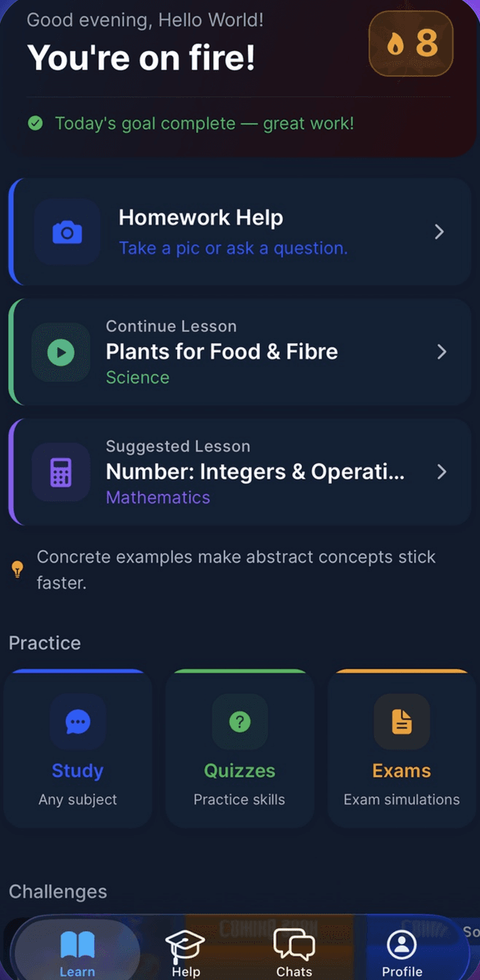
Most tutoring makes you sit through material you already know. MapleMind flips that: pick the exact skill that's causing trouble — any of the 94 below — and the tutor teaches just that one, step by step, as many times as it takes. Ask questions in plain words, any time of day, in English, French, or 12 other languages.
The official New Brunswick Environmental Science 120 curriculum
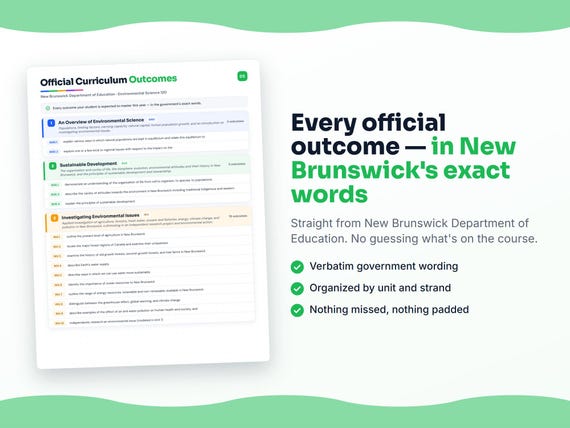
New Brunswick defines Environmental Science 120 by strands and outcomes. MapleMind teaches the same curriculum reorganized for one-skill-at-a-time tutoring — the table shows exactly where every official strand lands, and the ministry's own wording is quoted under each unit below.
Official source New Brunswick's official K-12 education resourcesRead it on the government site — www2.gnb.ca ↗| Official strand | Outcomes | Where MapleMind teaches it |
|---|---|---|
| Strand 1 | 12 | An Overview of Environmental Science |
| Strand 2 | 20 | Sustainable Development |
| Strand 3 | 62 | Investigating Environmental Issues |
Every skill below, taught one on one.
 Try the first session free
How MapleMind teaches Environmental Science 120 — every unit, lesson, and skill
Every skill below runs as a short session: a plain-words lesson, a worked example, solving it together, then a five-question skill check that earns up to three stars. Guided Mode keeps it teaching instead of answer-handing — turning it off needs a parent's password.
Unit 1An Overview of Environmental ScienceOfficial strand · Strand 1
Populations, limiting factors, carrying capacity, natural capital, human population growth, and an introduction to investigating environmental issues.
Populations, carrying capacity, and natural capital
- Populations in equilibriumenvsci120.1.1 — Explain how natural populations are kept in equilibrium and relate this to an ecosystem's resource limits.
- Limiting factors and carrying capacityenvsci120.1.2 — Explain the concepts of limiting factor and carrying capacity in species population growth.
- Natural capital and natural incomeenvsci120.1.3 — Understand and use the terms natural capital and natural income.
- Human population growthenvsci120.1.4 — Examine the growth and fluctuations of human population globally, regionally, and locally.
- Measuring populationsenvsci120.1.5 — Examine the ways population fluctuations are measured and tracked.
- Earth's carrying capacityenvsci120.1.6 — Evaluate Earth's carrying capacity, human population growth, its demands on natural capital, and consumer culture.
- Issues from overpopulationenvsci120.1.7 — Become aware of the range of issues arising from overpopulation and human activity.
Investigating environmental issues
- Exploring a local issueenvsci120.1.8 — Explore local or regional issues with respect to their impact on the environment, history, economics, and social systems.
- Research and presentation skillsenvsci120.1.9 — Practise research and presentation skills, including experimenting, accessing organizations, and considering legislation.
- Technology for informationenvsci120.1.10 — Explore how technology is used to gather and communicate information and to address issues.
- Technology and understanding the environmentenvsci120.1.11 — Explore how past and current technologies have impacted our study and understanding of the environment.
- Choosing a research projectenvsci120.1.12 — Choose an issue to explore in depth and develop a plan for a research project.
The official wording — 12 outcomes in this unit
- envsci120.1.1
explain various ways in which natural populations are kept in equilibrium and relate this equilibrium to
- envsci120.1.2
explain the concepts of limiting factor and carrying capacity in the context of species population growth
- envsci120.1.3
understand and be able to use of the term “natural capital “and “natural income”
- envsci120.1.4
examine the growth and fluctuations of human population globally, regionally and locally
- envsci120.1.5
examine the ways in which population fluctuations are measured and tracked
- envsci120.1.6
evaluate Earth’s carrying capacity, human population growth and its demands on natural capital, and consumer culture
- envsci120.1.7
become aware of the range of issues arising from overpopulation and human activity
- envsci120.1.8
explore one or a few local or regional issues with respect to the impact on the
- envsci120.1.9
practice research and presentation skills including experimenting to test environmental impact, identifying and accessing various organizations
- envsci120.1.10
explore how technology is used to gather and communicate information, and to address the issues
- envsci120.1.11
explore how past and current technologies have impacted our study and understanding of the environment, and
- envsci120.1.12
choose an issue to explore in more depth, and develop a plan for a research project
Unit 2Sustainable DevelopmentOfficial strand · Strand 2
The organization and cycles of life, the biosphere, evolution, environmental attitudes and their history in New Brunswick, and the principles of sustainable development and stewardship.
The organization and cycles of life
- Organization of lifeenvsci120.2.1 — Demonstrate an understanding of the organization of life from cell to organism to ecosystem to biosphere.
- Indigenous ways of knowingenvsci120.2.2 — Explore Indigenous ways of knowing organisms, beginning with the whole.
- Energy flow and chemical cyclingenvsci120.2.3 — Demonstrate an awareness of energy flow and chemical cycling that support ecological systems.
- Technology measuring natural systemsenvsci120.2.4 — Explore the role technology has played in measuring factors such as weather and chemical cycles.
- The biosphere as a systemenvsci120.2.5 — Understand that the biosphere is a complex system extending into the geosphere, atmosphere, and hydrosphere.
- Evolution and natural selectionenvsci120.2.6 — Demonstrate an understanding of evolution and natural selection and briefly examine the history of life.
- Humans in the biosphereenvsci120.2.7 — Recognize that humans are one part of a complex system with an outsized impact, often accelerated by technology.
Environmental attitudes and their history
- Attitudes toward the environmentenvsci120.2.8 — Describe the variety of attitudes toward the environment in New Brunswick, including Indigenous and western scientific worldviews.
- History of environmental attitudesenvsci120.2.9 — Describe the development of environmental attitudes in NB from colonization to today.
- Changing land and water useenvsci120.2.10 — Describe how land and water use in New Brunswick has changed over the last 300 years.
- Growing environmental awarenessenvsci120.2.11 — Discuss the increasing awareness of environmental issues and understanding of ecology in New Brunswick.
- Technology and land/water useenvsci120.2.12 — Explore how the development of technologies has affected land and water use.
- The environmental movementenvsci120.2.13 — Explore the people and ideas involved in the development of the Western environmental movement.
- Canadian environmental contributorsenvsci120.2.14 — Research present-day and historical Canadians and New Brunswickers who contributed to the environmental movement.
Principles of sustainable development
- Principles of sustainable developmentenvsci120.2.15 — Explain the principles of sustainable development.
- Dynamics of sustainable ecosystemsenvsci120.2.16 — Demonstrate an understanding of the dynamics of healthy and sustainable ecosystems.
- Sustainable human communitiesenvsci120.2.17 — Demonstrate an understanding of the requirements for sustainable human communities.
- Ecosystems and communitiesenvsci120.2.18 — Demonstrate an understanding of the relationships between ecosystems and communities locally, regionally, and globally.
- Sustainable and unsustainable developmentenvsci120.2.19 — Find examples of development that is and is not sustainable ecologically, economically, socially, and culturally.
- Stewardship and sustainabilityenvsci120.2.20 — Understand stewardship in relation to sustainability.
The official wording — 20 outcomes in this unit
- envsci120.2.1
demonstrate an understanding of the organization of life from cell to organism, to species, to populations,
- envsci120.2.2
explore Indigenous ways of knowing organisms beginning with the whole
- envsci120.2.3
demonstrate an awareness and understanding of the concepts of energy flow, and chemical cycling (carbon, nitrogen,
- envsci120.2.4
recognize and explore the role that technology has played in measuring factors such and weather and
- envsci120.2.5
understand that the biosphere is a complex system of living things that interact with each other
- envsci120.2.6
demonstrate an understanding of evolution & natural selection. Briefly examine the history of life on earth.
- envsci120.2.7
recognize that humans are just one part of a complex system of living things, with a
- envsci120.2.8
describe the variety of attitudes towards the environment in New Brunswick including traditional Indigenous and western
- envsci120.2.9
describe the development of attitudes towards the environment in NB by Europeans and later settlers to
- envsci120.2.10
describe how land and water use in New Brunswick has changed over the last 300 years
- envsci120.2.11
discuss the increasing awareness of environmental issues and understanding of ecology in New Brunswick
- envsci120.2.12
explore how the development of technologies has affected land and water use
- envsci120.2.13
explore the people and ideas involved in the development of the Western environmental movement
- envsci120.2.14
research present day and historical Canadians and New Brunswickers who have contributed in a variety of
- envsci120.2.15
explain the principles of sustainable development
- envsci120.2.16
demonstrate an understanding of the dynamics of healthy and sustainable ecosystems
- envsci120.2.17
demonstrate an understanding of the requirements for sustainable human communities
- envsci120.2.18
demonstrate an understanding of the relationships between ecosystems and communities locally, regionally, and global
- envsci120.2.19
find examples of development that is sustainable and is not sustainable – ecologically, economically, socially, and
- envsci120.2.20
understand stewardship in relation to sustainability
Unit 3Investigating Environmental IssuesOfficial strand · Strand 3
Applied investigation of agriculture, forestry, fresh water, oceans and fisheries, energy, climate change, and pollution in New Brunswick, culminating in an independent research project and environmental action.
Agriculture and the environment
- Agriculture in New Brunswickenvsci120.3.1 — Outline the present level of agriculture in New Brunswick, including employment, economy, farms, and products.
- Agriculture and natural ecologyenvsci120.3.2 — Develop an understanding of the natural ecology of the environment and how it is affected by farming.
- Testing agriculture's impactenvsci120.3.3 — Design and carry out an experiment to test the impact of agriculture on the environment.
- Methods of farmingenvsci120.3.4 — Explain different methods of farming including organic, non-pesticide, traditional, and industrial.
- Soil structure and fertilityenvsci120.3.5 — Explain practices for improving and maintaining soil structure and fertility.
- Global food productionenvsci120.3.6 — Summarize the state of global food production and issues affecting it.
- Agriculture organizationsenvsci120.3.7 — Contact organizations and agencies and identify their mandate and perspective on agriculture.
- Agriculture legislationenvsci120.3.8 — Develop a working knowledge of current environmental legislation and policy as it applies to agriculture.
Forests: ecology and value
- Forest regions of Canadaenvsci120.3.9 — Locate the major forest regions of Canada and examine their uniqueness.
- New Brunswick forest typesenvsci120.3.10 — Identify the forest types of New Brunswick and the characteristics of each.
- Forests as natural capitalenvsci120.3.11 — Identify the value of forests as natural capital: economically, socially, and ecologically.
- Forestry and forest ecologyenvsci120.3.12 — Develop an understanding of natural forest ecology and how it is affected by forestry practices.
- Testing forestry's impactenvsci120.3.13 — Design and carry out an experiment to test the impact of forestry on the environment.
- Managing forests sustainablyenvsci120.3.14 — Explain how to manage forests sustainably, including certification, harvesting methods, and protected areas.
Forestry history and governance
- History of NB forestsenvsci120.3.15 — Examine the history of old-growth forests, second-growth forests, and tree farms in New Brunswick.
- Forestry organizationsenvsci120.3.16 — Contact organizations and identify their mandate and perspective on forest use.
- Forestry legislationenvsci120.3.17 — Develop a working knowledge of current environmental legislation and policy as it applies to forest use.
Fresh water: supply and ecology
- Earth's water supplyenvsci120.3.18 — Describe Earth's water supply.
- Water useenvsci120.3.19 — Describe water use locally, nationally, and globally.
- Freshwater ecology and impactenvsci120.3.20 — Develop an understanding of natural fresh water ecology and the impact of people.
- Testing impact on fresh waterenvsci120.3.21 — Design and carry out an experiment to test the impact of people on fresh water ecology.
- Water scarcityenvsci120.3.22 — Investigate the causes of water scarcity and assess the significance of water for international relations.
Fresh water: sustainability and governance
- Using water sustainablyenvsci120.3.23 — Describe ways in which we can use water more sustainably.
- Water organizationsenvsci120.3.24 — Contact organizations and agencies and identify their mandate and perspective on water issues.
- Research methods for water issuesenvsci120.3.25 — Demonstrate the effective and critical use of a variety of investigation and research methods.
- Water legislationenvsci120.3.26 — Develop a working knowledge of current environmental legislation and policy as it applies to water issues.
Oceans and fisheries
- Importance of ocean resourcesenvsci120.3.27 — Identify the importance of ocean resources to New Brunswick.
- Fishery practicesenvsci120.3.28 — Describe a range of fishery practices.
- Fisheries and ocean ecologyenvsci120.3.29 — Develop an understanding of natural ocean ecology and how it is affected by fisheries practices.
- Testing fisheries' impactenvsci120.3.30 — Design and carry out an experiment to test the impact of fisheries on the environment.
- Global ocean issuesenvsci120.3.31 — Outline the major issues facing the world's ocean resources.
- Fisheries organizationsenvsci120.3.32 — Contact organizations and agencies and identify their mandate and perspective on fisheries.
- Fisheries legislationenvsci120.3.34 — Develop a working knowledge of current environmental legislation and policy as it applies to fisheries.
Energy resources
- NB energy resourcesenvsci120.3.35 — Outline the range of energy resources, renewable and non-renewable, available in New Brunswick.
- Advantages and disadvantages of energy sourcesenvsci120.3.36 — Evaluate the advantages and disadvantages of renewable and non-renewable energy from various perspectives.
- Energy use in NBenvsci120.3.37 — Describe energy use in New Brunswick, its environmental impact, and factors affecting its future.
- Testing energy use and efficiencyenvsci120.3.38 — Design and carry out an experiment to test energy use and the effect of efficiency measures.
- Improving energy efficiencyenvsci120.3.39 — Describe how to improve energy efficiency at national, global, regional, community, and home levels.
- Energy organizationsenvsci120.3.40 — Contact organizations and agencies and identify their mandate and perspective on energy resources.
- Energy legislationenvsci120.3.42 — Develop a working knowledge of current legislation and policy on energy use and resources.
Climate change
- Greenhouse effect and climate changeenvsci120.3.43 — Distinguish between the greenhouse effect, global warming, and climate change.
- Past climate changeenvsci120.3.44 — Describe how Earth's climate has changed in the short and long term and how scientists study these changes.
- Climate change effects on NBenvsci120.3.45 — Identify possible effects of climate change on New Brunswick, including ecosystem, community, economic, and social impacts.
- Climate change organizationsenvsci120.3.46 — Contact organizations and agencies and identify their mandate and perspective on climate change.
- Testing a climate change impactenvsci120.3.48 — Design and carry out an experiment to test an impact that climate change could have on the environment.
- Climate change legislationenvsci120.3.49 — Develop a working knowledge of current environmental legislation and policy as it applies to climate change.
Air and water pollution
- Effects of pollutionenvsci120.3.50 — Describe examples of the effect of air and water pollution on human health, society, and the natural environment.
- Types and sources of water pollutionenvsci120.3.51 — Summarize the main types and sources of water pollution, distinguishing point and nonpoint sources.
- Cultural eutrophicationenvsci120.3.52 — Explore the concept of cultural eutrophication and its causes.
- Testing for pollutantsenvsci120.3.53 — Design and conduct an experiment to determine the presence and concentration of air or water pollutants.
- Preventing and cleaning up pollutionenvsci120.3.54 — Research and report on prevention and cleanup strategies to reduce air and water pollution.
- Pollution organizationsenvsci120.3.55 — Contact organizations and agencies and identify their mandate and perspective on pollution.
- Research methods for pollution issuesenvsci120.3.56 — Demonstrate the effective and critical use of a variety of investigation and research methods.
- Pollution legislationenvsci120.3.57 — Develop a working knowledge of current environmental legislation and policy as it applies to pollution.
The environmental research project
- Independent researchenvsci120.3.58 — Independently research an environmental issue.
- Analyzing and communicating resultsenvsci120.3.59 — Summarize and analyze research results and communicate them in writing, supported with visuals.
- Collaborative presentationenvsci120.3.60 — Team up with others on related issues to develop a cohesive, engaging presentation with visuals.
- Participating in presentationsenvsci120.3.61 — Actively participate in other students' presentations.
- Appreciation of the environmentenvsci120.3.62 — Demonstrate a personal appreciation of the environment.
- Stewardship of the environmentenvsci120.3.63 — Demonstrate stewardship of the environment.
- Advocacy for the environmentenvsci120.3.64 — Demonstrate advocacy for the environment.
- Engaging othersenvsci120.3.65 — Demonstrate engagement of others in environmental inquiry.
The official wording — 62 outcomes in this unit
- envsci120.3.1
outline the present level of agriculture in New Brunswick
- envsci120.3.2
develop an understanding of the natural ecology of the environment and how it is affected by
- envsci120.3.3
design and carry out an experiment to test the impact of agriculture on the environment
- envsci120.3.4
explain different methods of farming including organic, non-pesticide, traditional, and industrial farming practices
- envsci120.3.5
explain practices for improving and maintaining soil structure and fertility
- envsci120.3.6
summarize the state of global food production and issues that affect it including natural disasters, war,
- envsci120.3.7
contact local, regional and/or national organizations and government agencies, and identify their mandate and perspective on
- envsci120.3.8
develop a working knowledge of current environmental legislation and policy and how it applies to agriculture
- envsci120.3.9
locate the major forest regions of Canada and examine their uniqueness
- envsci120.3.10
identify the forest types of New Brunswick and the characteristics of each type
- envsci120.3.11
identify the value of forests as natural capital, economically, socially and ecologically
- envsci120.3.12
develop an understanding of the natural forest ecology and how it is and has been affected
- envsci120.3.13
design and carry out an experiment to test the impact of forestry on the environment
- envsci120.3.14
explain how to manage forests for sustainably
- envsci120.3.15
examine the history of old growth forests, second-growth forests, and tree farms in New Brunswick
- envsci120.3.16
contact relevant local, regional and/or national organizations, and identify their mandate and perspective on forest use
- envsci120.3.17
develop a working knowledge of current environmental legislation and policy and how it applies to forest
- envsci120.3.18
describe Earth’s water supply
- envsci120.3.19
describe water use, locally, nationally, and globally
- envsci120.3.20
develop an understanding of the natural fresh water ecology and the impact of people
- envsci120.3.21
design and carry out an experiment to test the impact of people on fresh water ecology
- envsci120.3.22
investigate the causes of water scarcity and assess the significance of water resources for international relations
- envsci120.3.23
describe ways in which we can use water more sustainably
- envsci120.3.24
contact relevant local, regional and/or national organizations and government agencies, and identify their mandate and perspective
- envsci120.3.25
demonstrate the effective and critical use of a variety of investigation and research methods
- envsci120.3.26
develop a working knowledge of current environmental legislation and policy and how it applies to water
- envsci120.3.27
identify the importance of ocean resources to New Brunswick
- envsci120.3.28
describe a range of fishery practices
- envsci120.3.29
develop an understanding of natural ocean ecology and how it is and has been affected by
- envsci120.3.30
design and carry out an experiment to test the impact of fisheries on the environment
- envsci120.3.31
outline the major issues facing the world’s ocean resources
- envsci120.3.32
contact relevant local, regional and/or national organizations and government agencies, and identify their mandate and perspective
- envsci120.3.34
develop a working knowledge of current environmental legislation and policy and how it applies to fisheries
- envsci120.3.35
outline the range of energy resources, renewable and non-renewable, available in New Brunswick
- envsci120.3.36
evaluate the advantages and disadvantages of renewable and non- renewable energy sources from a variety of
- envsci120.3.37
describe energy use in NB, its impact on the environment and the factors that might affect
- envsci120.3.38
design and carry out an experiment to test energy use and effect of efficiency measures
- envsci120.3.39
describe how to improve energy efficiency nationally, globally, regionally and at the community and home level
- envsci120.3.40
contact relevant local, regional and/or national organizations and government agencies, and identify their mandate and perspective
- envsci120.3.42
develop a working knowledge of current legislation and policy on energy use and resources
- envsci120.3.43
distinguish between the greenhouse effect, global warming, and climate change
- envsci120.3.44
describe how Earth’s climate has changed in the short and long term, and how scientists have
- envsci120.3.45
identify possible effects of climate change on NB. Include ecosystem changes, community effects, economic impact, cultural
- envsci120.3.46
contact relevant local, regional and/or national organizations and government agencies, and identify their mandate and perspective
- envsci120.3.48
design and carry out an experiment to test an impact that climate change could have on
- envsci120.3.49
develop a working knowledge of current environmental legislation and policy and how it applies to the
- envsci120.3.50
describe examples of the effect of air and water pollution on human health and society, and
- envsci120.3.51
summarize the main types and sources of water pollution - distinguish between point sources and nonpoint
- envsci120.3.52
explore the concept of cultural eutrofication amid its causes
- envsci120.3.53
design and conduct an experiment to determine the presence and concentration of air or water pollutants
- envsci120.3.54
research and report on prevention and cleanup strategies to reduce air and water pollution
- envsci120.3.55
contact local, regional and/or national organizations and government agencies, and identify their mandate and perspective on
- envsci120.3.56
demonstrate the effective and critical use of a variety of investigation and research methods
- envsci120.3.57
develop a working knowledge of current environmental legislation and policy and how it applies to the
- envsci120.3.58
independently research an environmental issue (modeled in Unit 1)
- envsci120.3.59
summarize and analyze the results of their research and communicate the results in writing, which can
- envsci120.3.60
team up with others researching related environmental issues to develop a cohesive and engaging presentation for
- envsci120.3.61
actively participate in other student presentations
- envsci120.3.62
Personal Appreciation of the Environment
- envsci120.3.63
Stewardship of the Environment
- envsci120.3.64
Advocacy for the Environment
- envsci120.3.65
Engagement of Others in Environmental inquiry
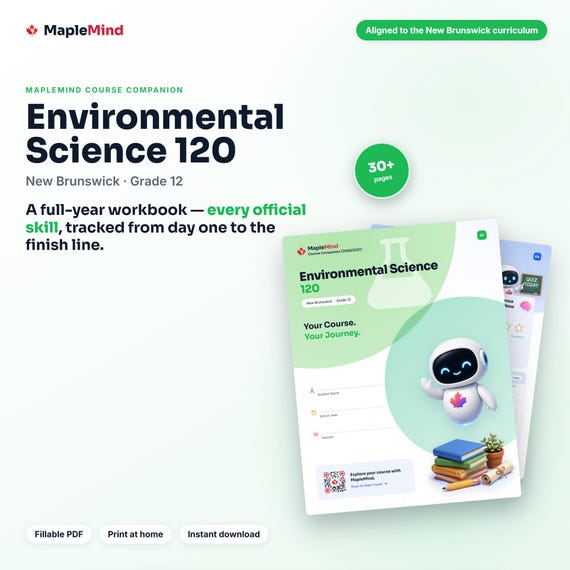
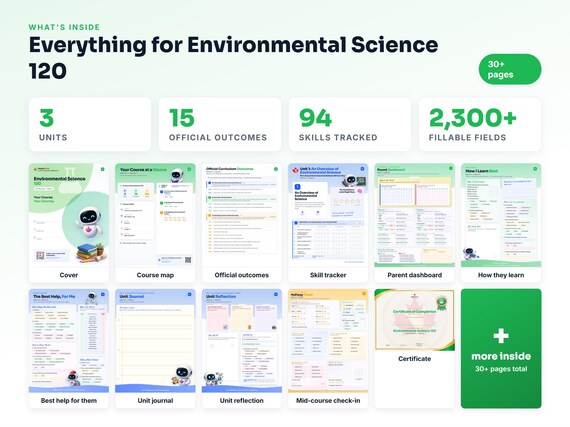
Printable workbook · A keepsake of the year
A Environmental Science 120 workbook worth keeping
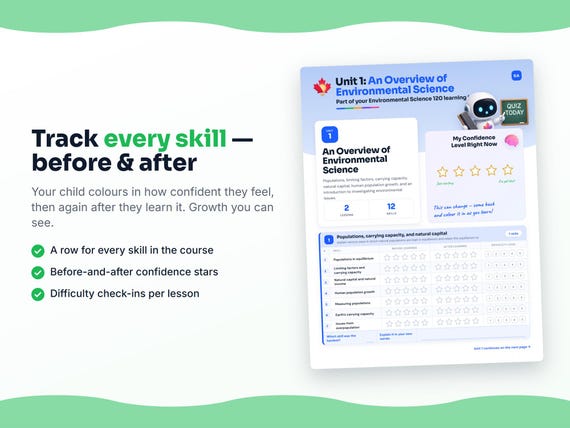
Built from the same official curriculum as this page. Before and after each skill above, your student colours in how sure they feel — so the two of you can see, on one page, what's clicking and what needs another look. It's a quiet way to follow how the year is really going.
By June it's full of their own handwriting: units worked through, confidence grown, a mid-year check-in, notes from parent-teacher night, and a certificate at the end. Less a worksheet, more a record of the year worth keeping on the shelf.
Instant download · see every page, reviews and the full description · five or more workbooks are $2.99 each
What it looks like in the app

Common questions
Can MapleMind help me with Environmental Science 120?
Yes. MapleMind's AI tutor covers all 94 skills in New Brunswick's Environmental Science 120 — you pick the exact skill, and the tutor teaches it step by step: a short lesson, a worked example, solving together, then a skill check to show it stuck.
Is MapleMind aligned to New Brunswick's official curriculum?
Yes. Every skill in this course maps to an official outcome code from New Brunswick's Grade 12 Science curriculum, and the ministry's own wording is quoted under each unit on this page — with the official government source linked so you can check it yourself.
What does MapleMind cost?
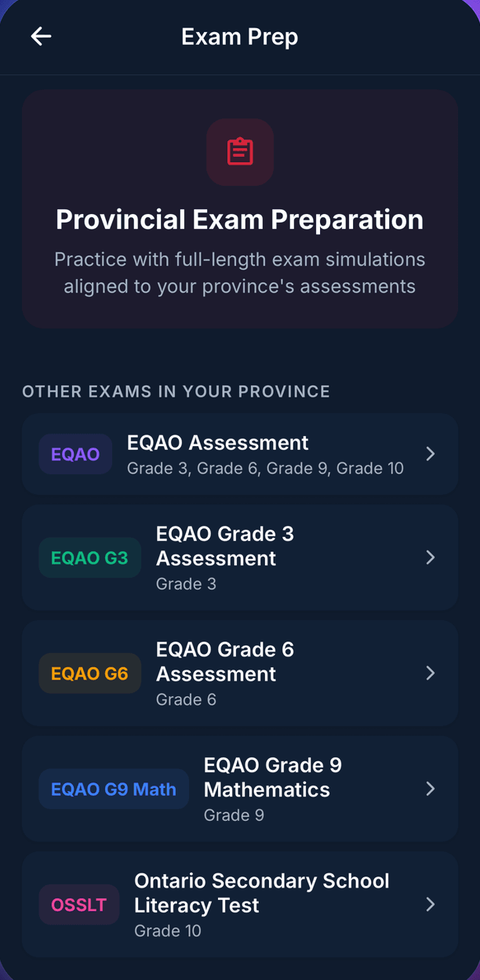
It's free to start — 5 tutoring chats and a practice quiz every day, no credit card. A Pro subscription ($9.99/month or $49.99/year CAD, 7-day free trial) unlocks unlimited tutoring, practice, and exam simulations.
What if I'm stuck on just one topic?
That's the point of skill-level tutoring: open Environmental Science 120 in the app, tap the exact skill from the list on this page, and the tutor teaches just that — no wading through lessons you don't need.
Does MapleMind work in French or other languages?
Yes — 14 languages, including French. Both the app and the tutor's explanations switch to the language you choose.
Where can I see the official New Brunswick curriculum for Environmental Science 120?
The official source is linked on this page — New Brunswick's official K-12 education resources. The outline here follows it: every MapleMind skill carries its official outcome code, and the ministry's own wording is quoted under each unit.
Keep exploring
Ready when you are
Pick a skill from this page and see it taught properly — free, in the browser, in under a minute.