Get help with Biology 11
Most tutoring makes you sit through material you already know. MapleMind flips that: pick the exact skill that's causing trouble — any of the 68 below — and the tutor teaches just that one, step by step, as many times as it takes. Ask questions in plain words, any time of day, in English, French, or 12 other languages.
The official New Brunswick Biology 11 curriculum
New Brunswick defines Biology 11 by strands and outcomes. MapleMind teaches the same curriculum reorganized for one-skill-at-a-time tutoring — the table shows exactly where every official strand lands, and the ministry's own wording is quoted under each unit below.
Official source New Brunswick's official K-12 education resourcesRead it on the government site — www2.gnb.ca ↗| Official strand | Outcomes | Where MapleMind teaches it |
|---|---|---|
| Strand 1 | 19 | The Cell |
| Strand 2 | 23 | Biodiversity |
| Strand 3 | 26 | Maintaining Dynamic Equilibrium |
Every skill below, taught one on one.
 Try the first session free
How MapleMind teaches Biology 11 — every unit, lesson, and skill
Every skill below runs as a short session: a plain-words lesson, a worked example, solving it together, then a five-question skill check that earns up to three stars. Guided Mode keeps it teaching instead of answer-handing — turning it off needs a parent's password.
Unit 1The CellOfficial strand · Strand 1
The cell as the unit of life: cell theory and microscopy, cell structure and organelles, cellular energy (photosynthesis and respiration), and transport across the membrane.
Cell theory and the microscope
- Discrediting spontaneous generationbio11.1.1 — Describe how early scientists discredited spontaneous generation (abiogenesis) in favour of biogenesis.
- The development of cell theorybio11.1.2 — Describe how early scientists developed cell theory and demonstrate understanding of its tenets.
- How the microscope advanced sciencebio11.1.3 — Analyze how the invention of the microscope enhanced and revised scientific understanding.
- Bias in the abiogenesis debatebio11.1.4 — Research and discuss examples where investigator bias affected outcomes in the abiogenesis-vs-biogenesis debate.
- Using the light microscopebio11.1.5 — Demonstrate effective and accurate use of the light microscope: parts, care, focusing, field of view, and safety.
- Preparing a wet mountbio11.1.6 — Demonstrate the ability to prepare a wet mount of a specimen, including staining techniques.
- Recording microscope observationsbio11.1.7 — Demonstrate the ability to display information accurately through line diagrams of microscope observations.
Cell structure and function
- Prokaryotic vs eukaryotic cellsbio11.1.8 — Examine and compare the structure of prokaryotic and eukaryotic cells.
- Plant vs animal cellsbio11.1.9 — Describe the differences between plant and animal cells.
- Eukaryotic organelles and their jobsbio11.1.10 — Describe eukaryotic cellular structures and how they manage various cell processes.
- Light vs electron microscope imagesbio11.1.11 — Examine and compare images of cell structure generated by light and electron microscopes.
- Mitochondria and chloroplastsbio11.1.12 — Describe the structure of mitochondria and chloroplasts.
Cell energy and transport
- Photosynthesis vs respirationbio11.1.13 — Compare and contrast the matter and energy transformations of photosynthesis and aerobic respiration.
- Complementary energy processesbio11.1.14 — Demonstrate that photosynthesis and aerobic respiration are complementary processes.
- Investigating photosynthesis and respirationbio11.1.15 — Design and perform experiments to investigate photosynthesis and respiration.
- Importance to human enterprisesbio11.1.16 — Explain the importance of photosynthesis and aerobic respiration to human enterprises.
- Transport across the membranebio11.1.17 — Explain how materials move into and out of cells through a selectively permeable membrane, including passive and active transport.
- Osmosis and cellsbio11.1.18 — Describe the effects of osmosis on cells with and without cell walls.
- Surface area and cell sizebio11.1.19 — Carry out procedures to investigate the relationship between membrane surface area and cell size.
The official wording — 19 outcomes in this unit
- bio11.1.1
Describe the contribution of early scientists in discrediting the concept of spontaneous generation (abiogenesis) in favour of biogenesis
- bio11.1.2
Describe the contribution of early scientists in development of the cell theory and have a good understanding of the cell theory
- bio11.1.3
Analyze and describe how scientific understanding was enhanced or revised as a result of invention of the microscope
- bio11.1.4
Research and discuss examples of abiogenisis versus biogenisis in which the bias of the investigators affected outcomes
- bio11.1.5
Demonstrate effective and accurate use of the light microscope including: o Parts and their function o General care o Focusing technique o Field of view calculation o Safety concerns
- bio11.1.6
Demonstrate the ability to prepare a wet mount of a specimen, including staining techniques
- bio11.1.7
Demonstrate the ability to display accurately, through line diagrams, information compiled through the use of the microscope
- bio11.1.8
Examine and compare the structure of prokaryotic and eukaryotic cells
- bio11.1.9
Describe the differences between plant and animal cells
- bio11.1.10
Describe eukaryotic cellular structures and the ways in which they manage various cell processes. Include: nucleus, nucleolus, nuclear membrane, ribosomes, smooth and rough endoplasmic reticulum, Golgi apparatus, vesicles, chromosomes, lysosomes, microtubules and microfilaments, vacuoles, mitochondria, centrioles, chloroplasts, cell membranes and cell walls
- bio11.1.11
Examine and compare images of cell structure generated b both the light and electron microscopes
- bio11.1.12
Describe the structure of mitochondria, and chloroplasts
- bio11.1.13
Compare and contrast the basic matter and energy transformations associated with the processes of photosynthesis and aerobic respiration
- bio11.1.14
Demonstrate that photosynthesis and aerobic respiration are complementary processes
- bio11.1.15
Design and perform experiments to investigate photosynthesis and respiration
- bio11.1.16
Explain the importance of the processes of photosynthesis and aerobic respiration to human enterprises
- bio11.1.17
Explain how materials are able to move into and out of cells through a selectively permeable membrane. Include: fluid mosaic model passive transport – osmosis, diffusion and facilitated diffusion active transport – molecular transport, endo- and exocytosis
- bio11.1.18
Describe the effects of osmosis on cells with and without cell walls
- bio11.1.19
Carry out procedures to investigate the relationship between membrane surface area and cell size and summarize your findings
Unit 2BiodiversityOfficial strand · Strand 2
Classifying the diversity of life: the principles and systems of taxonomy, the kingdoms, viruses, the plant groups, animal phyla, and the biodiversity of New Brunswick ecosystems.
Taxonomy and classification
- Principles of taxonomybio11.2.1 — Use local organisms to demonstrate the fundamental principles of taxonomy.
- Limits of classification systemsbio11.2.2 — Identify limitations inherent to any classification system.
- Binomial nomenclaturebio11.2.3 — Understand binomial nomenclature as developed by Linnaeus and its advantages.
- Levels of classificationbio11.2.4 — List, in order, the levels of classification (taxa) from broad to narrow, with species as the base.
- How classification changesbio11.2.5 — Explain how scientific classification systems change as new evidence is discovered.
- Modern classification techniquesbio11.2.6 — Research modern techniques used for classification.
Kingdoms and viruses
- Characteristics of living thingsbio11.2.7 — Develop a list of characteristics shared by living things.
- Characteristics of the kingdomsbio11.2.8 — Identify the general characteristics that distinguish the members of each recognized kingdom.
- Diversity within the kingdomsbio11.2.9 — Demonstrate that the recognized kingdoms represent a diversity of organisms with extensive variety in form and function.
- Viruses and their reproductionbio11.2.10 — Analyze and explain the major features of a virus and its reproductive cycle.
Plant diversity and structure
- Major plant groupsbio11.2.11 — Describe the differences between the major groups of plants: bryophytes, ferns, gymnosperms, angiosperms.
- Flower and seed structurebio11.2.12 — Describe the structure and function of a flower, and compare monocot and dicot seeds.
- Dissecting plant phylabio11.2.13 — Dissect, compare, and identify a variety of plant phyla.
- Dissecting flowersbio11.2.14 — Dissect a variety of flower types and identify their structures.
- Plant homeostasis and tropismsbio11.2.15 — Explain how plants maintain homeostasis with reference to tropisms and adaptations to harsh climates.
- Experiments on plant tropismsbio11.2.16 — Design and carry out experiments on plant tropisms.
- Plant hormonesbio11.2.17 — Investigate the role played by plant hormones such as cytokinins, auxins, and gibberellins.
Animal diversity and NB biodiversity
- Invertebrate phylabio11.2.18 — Describe the differences between invertebrate phyla in symmetry, body cavity, reproduction, and digestion.
- Arthropod successbio11.2.19 — Describe characteristics that have contributed to the success of arthropods in many environments.
- Classes of chordatesbio11.2.20 — Describe the differences and similarities between the classes of chordates.
- NB biodiversity and sustainabilitybio11.2.21 — Explain how the biodiversity of New Brunswick ecosystems is related to their sustainability.
- New Brunswick eco-regionsbio11.2.22 — Compare New Brunswick eco-regions in biodiversity, climate, physical geography, and location.
- Human impact on biodiversitybio11.2.23 — Analyze the impact of human behaviour and population growth on biodiversity and ecosystems.
The official wording — 23 outcomes in this unit
- bio11.2.1
Use organisms found in a local or regional ecosystem to demonstrate an understanding of the fundamental principles of taxonomy
- bio11.2.2
Identify limitations inherent to any classification system
- bio11.2.3
Understand the concept of binomial nomenclature as developed by Linnaeus and understand its advantages for the scientific community
- bio11.2.4
List, in order, levels of classification (taxa) based on increasingly narrower categories, using the species as the base identification level
- bio11.2.5
Explain how scientific classification systems are changing as new evidence concerning living things is being discovered
- bio11.2.6
Research modern techniques used for classification
- bio11.2.7
Develop a list of characteristics shared by living things
- bio11.2.8
Identify the general characteristics that distinguish the members of each recognized kingdom
- bio11.2.9
Demonstrate an understanding that the recognized kingdoms of living things represent a diversity of organisms exhibiting extensive variety in terms of form and function
- bio11.2.10
Analyze and explain the major features of a virus and its reproductive cycle
- bio11.2.11
Describe the differences that exist between the major groups of plants (bryophytes, ferns, gymnosperms, angiosperms)
- bio11.2.12
Describe the structure and function of a flower, and compare the structure of monocot and dicot seeds
- bio11.2.13
Dissect, compare and identify a variety of plant phyla
- bio11.2.14
Dissect a variety of flower types and identify structures
- bio11.2.15
Explain how plants maintain homeostasis with reference to tropisms and adaptations to harsh climates
- bio11.2.16
Students should design and carry out experiments on plant tropisms
- bio11.2.17
Investigate the role played by plant hormones such as cytokinins, auxins and gibberellins
- bio11.2.18
Describe the differences that exist between the invertebrate phyla with respect to symmetry, body cavity, reproduction and digestion
- bio11.2.19
Describe characteristics that have contributed to the success of arthropods in a wide variety of environments
- bio11.2.20
Describe the differences and similarities that exist between the classes of chordates
- bio11.2.21
Explain how biodiversity of New Brunswick ecosystems is related to their sustainability
- bio11.2.22
Compare New Brunswick eco-regions in terms of biodiversity, climate, physical geography, and location
- bio11.2.23
Analyze the impact of human behaviour, and human population growth on biodiversity and ecosystems
Unit 3Maintaining Dynamic EquilibriumOfficial strand · Strand 3
Homeostasis in the human body: the concept of dynamic equilibrium, the biological macromolecules, and the digestive, urinary, circulatory, respiratory, and immune systems that maintain internal balance.
Homeostasis and the molecules of life
- The concept of homeostasisbio11.3.1 — Explain what is meant by homeostasis and its critical nature to living things.
- Responding to the environmentbio11.3.2 — Explore ways that human behaviours and systems respond to changes in the external environment.
- The macromolecules of lifebio11.3.3 — Identify and describe the structure and function of carbohydrates, proteins, lipids, and nucleic acids.
Digestion and nutrition
- Nutrition, fitness, and homeostasisbio11.3.4 — Explain the importance of nutrition and fitness to the maintenance of homeostasis.
- Eating and digestive disordersbio11.3.5 — Describe eating and digestive disorders and their effect on homeostasis.
- The digestive systembio11.3.6 — Describe the structures, purpose, and functioning of the digestive system.
- Glands of digestionbio11.3.7 — Identify the major glands of digestion, their secretions, and their roles.
Excretion and enzyme investigations
- The urinary systembio11.3.8 — Describe the main structures of the human urinary system.
- The kidney as an excretory organbio11.3.9 — Explain the role of the kidney in removing metabolic wastes and the impact of kidney failure.
- The nephronbio11.3.12 — Describe the internal structure of the kidney and explain the function of a nephron.
- Investigating enzyme activitybio11.3.10 — Perform an experiment to investigate the effect of variables on enzyme effectiveness.
- Designing an enzyme experimentbio11.3.11 — Design an experiment to investigate the effect of variables on enzyme effectiveness.
Circulation and respiration
- Circulation and respiration togetherbio11.3.13 — Explain the function of the human circulatory and respiratory systems and how they interact.
- Blood flow through the heartbio11.3.14 — Trace the flow of blood through the heart and describe the pulmonary and systemic pathways.
- Arteries, veins, and capillariesbio11.3.15 — Describe the structure and function of an artery, a vein, and a capillary.
- Components of bloodbio11.3.16 — Identify and explain the role of leucocytes, erythrocytes, platelets, and plasma.
- Respiratory system mechanicsbio11.3.17 — Investigate the structures and mechanics of the respiratory system.
- Investigating cardiac and respiratory functionbio11.3.18 — Design and carry out an experiment on blood pressure, respiratory function, or cardiac output.
- Circulatory and respiratory disordersbio11.3.19 — Describe disorders of the circulatory and respiratory systems and their effect on homeostasis.
- Adaptations for gas exchangebio11.3.20 — Describe adaptive features that provide for efficient gas exchange in humans.
Immunity and disease
- Environmental factors and homeostasisbio11.3.21 — Predict the impact of environmental factors such as allergens on homeostasis.
- How the immune system worksbio11.3.22 — Explain how the immune system recognizes and destroys antigens past the first line of defense.
- Forms of acquired immunitybio11.3.23 — Compare the mechanisms of various forms of acquired immunity.
- Allergens and antibodiesbio11.3.24 — Explain the terms allergen and antibody and their role in an allergic reaction.
- Autoimmune diseasesbio11.3.25 — Describe various autoimmune diseases, their causes, and possible treatments.
- The AIDS epidemicbio11.3.26 — Explore the political and economic issues around the worldwide AIDS epidemic.
The official wording — 26 outcomes in this unit
- bio11.3.1
Explain what is meant by the concept of homeostasis and its critical nature to living things
- bio11.3.2
Using humans as an example, explore ways that behaviours and systems respond to changes in the external environment
- bio11.3.3
Identify and describe the structure and function of carbohydrates, protein, lipids and nucleic acids and where they are found in living organisms
- bio11.3.4
Explain the importance of nutrition and fitness to the maintenance of homeostasis
- bio11.3.5
Describe eating and digestive disorders and their effect on the homeostasis of the system and the organism as a whole
- bio11.3.6
Describe the structures, purpose and functioning of the digestive system
- bio11.3.7
Identify the major glands of digestion, their secretions and their role in the digestive process
- bio11.3.8
Describe the main structures of the human urinary system, including the kidney, ureter, bladder, urethra and nephrons
- bio11.3.9
Explain the role of the kidney as an excretory organ in removing metabolic wastes from the body and excreting them to the environment, and the impact of kidney failure
- bio11.3.12
Describe the internal structure of the kidney and explain the function of a nephron
- bio11.3.10
Perform an experiment to investigate the effect of specified variables on the effectiveness of an enzyme
- bio11.3.11
Design an experiment to investigate the effect of specified variables on the effectiveness of an enzyme
- bio11.3.13
Explain the function of the human circulatory and respiratory systems and how they interact
- bio11.3.14
Trace the flow of blood through the heart, describe the pulmonary and systemic pathways, and follow the flow through the complete cycle
- bio11.3.15
Describe the structure and function of an artery, a vein and a capillary
- bio11.3.16
Identify and explain the role of leucocytes, erythrocytes, platelets, and plasma
- bio11.3.17
Investigate the structures and mechanics of respiratory system
- bio11.3.18
Design and carry out an experiment to investigate blood pressure, respiratory function or cardiac output under various conditions
- bio11.3.19
Describe disorders linked to the circulatory system and/or the respiratory system and their effect on the homeostasis of the system and the organism as a whole
- bio11.3.20
Describe adaptive features that provide for efficient gas exchange in humans
- bio11.3.21
Predict the impact of environmental factors such as allergens on homeostasis within an organism
- bio11.3.22
In general, explain how the immune system recognizes and destroys antigens that penetrate the first line of defense
- bio11.3.23
Compare the mechanisms of various forms of acquired immunity
- bio11.3.24
Explain the meaning of the terms allergen and antibody and their role in an allergic reaction
- bio11.3.25
Describe various autoimmune diseases, their causes, and possible treatments
- bio11.3.26
Explore the political and economic issues around the worldwide AIDS epidemic
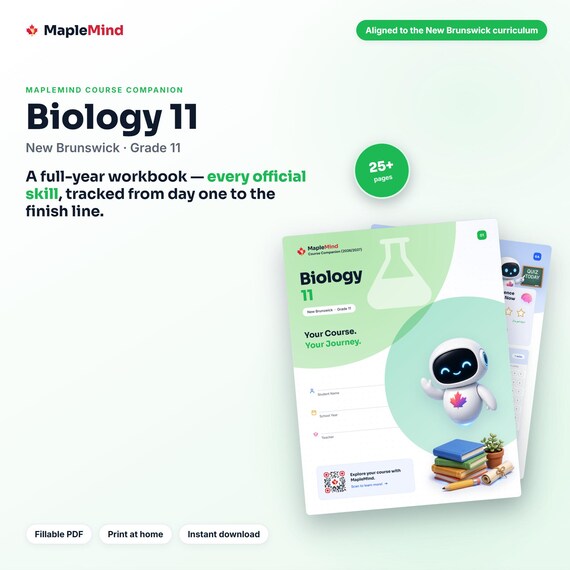


Printable workbook · A keepsake of the year
A Biology 11 workbook worth keeping
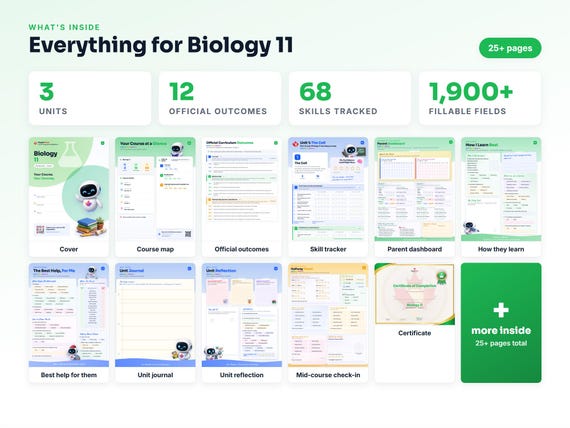
Built from the same official curriculum as this page. Before and after each skill above, your student colours in how sure they feel — so the two of you can see, on one page, what's clicking and what needs another look. It's a quiet way to follow how the year is really going.
By June it's full of their own handwriting: units worked through, confidence grown, a mid-year check-in, notes from parent-teacher night, and a certificate at the end. Less a worksheet, more a record of the year worth keeping on the shelf.
Instant download · see every page, reviews and the full description · five or more workbooks are $2.99 each
What it looks like in the app



Common questions
Can MapleMind help me with Biology 11?
Yes. MapleMind's AI tutor covers all 68 skills in New Brunswick's Biology 11 — you pick the exact skill, and the tutor teaches it step by step: a short lesson, a worked example, solving together, then a skill check to show it stuck.
Is MapleMind aligned to New Brunswick's official curriculum?
Yes. Every skill in this course maps to an official outcome code from New Brunswick's Grade 11 Science curriculum, and the ministry's own wording is quoted under each unit on this page — with the official government source linked so you can check it yourself.
What does MapleMind cost?
It's free to start — 5 tutoring chats and a practice quiz every day, no credit card. A Pro subscription ($9.99/month or $49.99/year CAD, 7-day free trial) unlocks unlimited tutoring, practice, and exam simulations.
What if I'm stuck on just one topic?
That's the point of skill-level tutoring: open Biology 11 in the app, tap the exact skill from the list on this page, and the tutor teaches just that — no wading through lessons you don't need.
Does MapleMind work in French or other languages?
Yes — 14 languages, including French. Both the app and the tutor's explanations switch to the language you choose.
Where can I see the official New Brunswick curriculum for Biology 11?
The official source is linked on this page — New Brunswick's official K-12 education resources. The outline here follows it: every MapleMind skill carries its official outcome code, and the ministry's own wording is quoted under each unit.
Keep exploring
Ready when you are
Pick a skill from this page and see it taught properly — free, in the browser, in under a minute.