Get help with Science, Grade 10
Most tutoring makes you sit through material you already know. MapleMind flips that: pick the exact skill that's causing trouble — any of the 23 below — and the tutor teaches just that one, step by step, as many times as it takes. Ask questions in plain words, any time of day, in English, French, or 12 other languages.
The official New Brunswick Science, Grade 10 curriculum
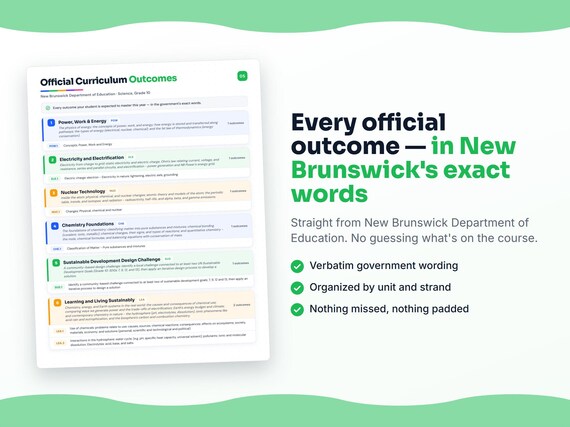
New Brunswick defines Science, Grade 10 by strands and outcomes. MapleMind teaches the same curriculum reorganized for one-skill-at-a-time tutoring — the table shows exactly where every official strand lands, and the ministry's own wording is quoted under each unit below.
Official source New Brunswick's official K-12 education resourcesRead it on the government site — www2.gnb.ca ↗| Official strand | Outcomes | Where MapleMind teaches it |
|---|---|---|
| Strand 1 | 3 | Power, Work & Energy |
| Strand 2 | 4 | Electricity and Electrification |
| Strand 3 | 4 | Nuclear Technology |
| Strand 4 | 5 | Chemistry Foundations |
| Strand 5 | 1 | Sustainable Development Design Challenge |
| Strand 6 | 6 | Learning and Living Sustainably |
Every skill below, taught one on one.
 Try the first session free
How MapleMind teaches Science, Grade 10 — every unit, lesson, and skill
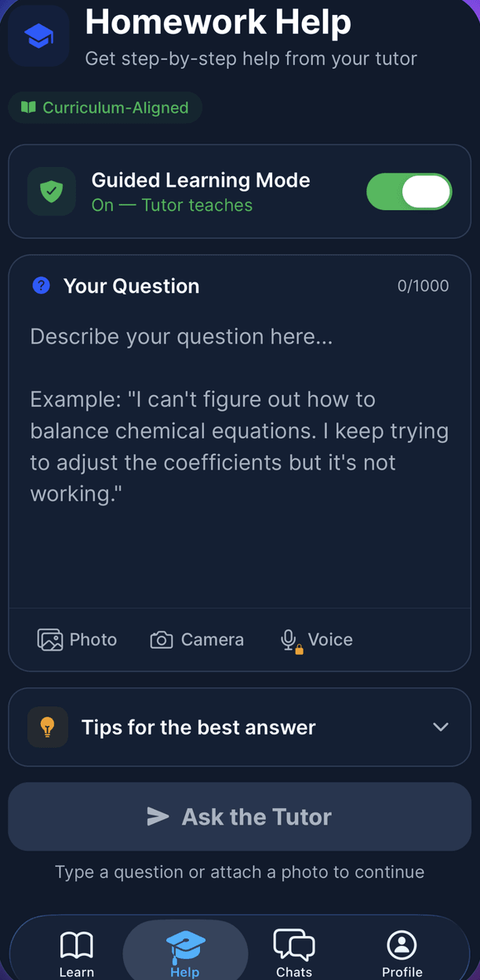
Every skill below runs as a short session: a plain-words lesson, a worked example, solving it together, then a five-question skill check that earns up to three stars. Guided Mode keeps it teaching instead of answer-handing — turning it off needs a parent's password.
Unit 1Power, Work & EnergyOfficial strand · Strand 1
The physics of energy: the concepts of power, work, and energy; how energy is stored and transferred along pathways; the types of energy (electrical, nuclear, chemical); and the 1st law of thermodynamics (energy conservation).
Work, Energy, and Power
- Power, work, and energysci10.C1 — Explore the scientific concepts of power, work, and energy.
- Energy stores and pathwayssci10.C2 — Explore how energy is stored and transferred along pathways.
- Types of energy and conservationsci10.C3 — Explore the types of energy and the 1st law of thermodynamics (energy conservation).
The official wording — 3 outcomes in this unit
- sci10.C1
Concepts: Power, Work and Energy
- sci10.C2
Stores of energy and pathways (energy as quasi-material)
- sci10.C3
Types: electrical, nuclear, and chemical 1st Law Thermodynamics: energy conservation
Unit 2Electricity and ElectrificationOfficial strand · Strand 2
Electricity from charge to grid: static electricity and electric charge, Ohm's law relating current, voltage, and resistance, series and parallel circuits, and electrification - power generation and NB Power's energy grid.
Charge, Circuits, and Ohm's Law
- Static electricity and chargesci10.C4 — Explore static electricity, electric charge, and electricity in nature.
- Ohm's lawsci10.C5 — Explore Ohm's law relating current, voltage, and resistance.
- Series and parallel circuitssci10.C6 — Explore series and parallel circuits and how to model them with schematics.
- Electrification and power generationsci10.C7 — Explore electrification - power generation, the mixed energy grid, and calculating energy consumption (NB Power).
The official wording — 4 outcomes in this unit
- sci10.C4
Electric charge: electron - Electricity in nature: lightening, electric eels, grounding
- sci10.C5
Ohms Law: Current, voltage and resistance
- sci10.C6
Series and parallel circuits: V, I, and R calculations - Model circuits schematics using conventional components
- sci10.C7
Renewable vs. non-renewable; clean vs. green tech; emerging technologies; - Power generation: energy sector; electricity as a commodity; electricity resilience; mixed grid; calculating of energy consumption (NB Power)
Unit 3Nuclear TechnologyOfficial strand · Strand 3
Inside the atom: physical, chemical, and nuclear changes; atomic theory and models of the atom; the periodic table, trends, and isotopes; and radiation - radioactivity, half-life, and alpha, beta, and gamma emissions.
Atoms, the Periodic Table, and Radiation
- Physical, chemical, and nuclear changessci10.C8 — Distinguish physical, chemical, and nuclear changes.
- Atomic theory and models of the atomsci10.C9 — Explore atomic theory and models of the atom.
- The periodic table and isotopessci10.C10 — Explore the periodic table, its trends, and isotopes.
- Radiation and radioactivitysci10.C11 — Explore radioactivity, half-life, and alpha, beta, and gamma emissions.
The official wording — 4 outcomes in this unit
- sci10.C8
Changes: Physical, chemical and nuclear
- sci10.C9
Atom Theory and Model of the Atom (contemporary perspectives)
- sci10.C10
The Periodic Table of Elements: - Arrangement of elements in the PTE - Trends and Ionisation energy - Isotopes and relative abundance: H, Cl, O, Li, He and C
- sci10.C11
Radioactivity: half-life; fusion, fission, bombs (atomic and Hydrogen) - Emissions: Alpha, Beta and Gamma
Unit 4Chemistry FoundationsOfficial strand · Strand 4
The foundations of chemistry: classifying matter into pure substances and mixtures; chemical bonding (covalent, ionic, metallic); chemical changes, their signs, and types of reactions; and quantitative chemistry - the mole, chemical formulae, and balancing equations with conservation of mass.
Matter, Bonding, and Reactions
- Classifying mattersci10.C12 — Classify matter into pure substances and mixtures.
- Chemical bondingsci10.C13 — Explore chemical bonding - covalent, ionic, and metallic bonds - and their properties.
- Chemical changes and reactionssci10.C14 — Explore chemical changes, the signs of change, and the main types of chemical reactions.
- Balancing equations and the molesci10.C15 — Explore quantitative chemistry: the mole, writing chemical formulae, and balancing equations with conservation of mass.
- Representing molecules and chemical changes with modelssci10.C16 — Explore how chemists use models - chemical formulae, structural diagrams, and equations - to represent molecules, compounds, and chemical changes.
The official wording — 5 outcomes in this unit
- sci10.C12
Classification of Matter - Pure substances and mixtures
- sci10.C13
Chemical Bonding - Covalent/molecular, ionic, and metallic bonds and properties - Electrolytes vs non-electrolytes
- sci10.C14
Chemical Changes in a matter - Signs of change - Energy and matter: Flows, cycles, and conservation - Chemical reactions: Synthesis, decomposition, single replacement, double replacement, combustion and neutralisation
- sci10.C15
Quantitative aspects of chemical change (simple balancing) - Atomic mass and the mole (M) - Chemical symbols; writing chemical formulae; balancing chemical equations - Laws: conservation of energy; conservation of mass; and constant composition - Energy changes: endothermic versus exothermic
- sci10.C16
Representing molecules, compounds and chemical changes
Unit 5Sustainable Development Design ChallengeOfficial strand · Strand 5
A community-based design challenge: identify a local challenge connected to at least two UN Sustainable Development Goals (Grade 10: SDGs 7, 9, 12, and 13), then apply an iterative design process to develop a solution.
Designing for Sustainable Development
- A community SDG design challengesci10.2.2 — Identify a community-based challenge connected to at least two of the Sustainable Development Goals 7, 9, 12, and 13, then design and iterate a solution.
The official wording — 1 outcome in this unit
- sci10.2.2
identify a community-based challenge connected to at least two of sustainable development goals; 7, 9, 12 and 13, then apply an iterative process to design a solution
Unit 6Learning and Living SustainablyOfficial strand · Strand 6
Chemistry, energy, and Earth systems in the real world: the causes and consequences of chemical use; comparing ways we generate power and the trade-offs of electrification; Earth's energy budget and climate; and contemporary chemistry in nature - the hydrosphere (pH, electrolytes, dissolution), ionic phenomena like acid rain and eutrophication, and the biosphere's carbon and combustion chemistry.
Chemicals, Power, and Earth Systems
- Use of chemicals: causes, consequences, solutionssci10.C17 — Explore the causes and sources of chemical problems, their consequences for ecosystems and society, and possible solutions.
- Power generation and electrificationsci10.C18 — Compare ways of generating power - renewable versus non-renewable, clean versus green - and weigh the trade-offs of electrification.
- Earth's energy budget and global warmingsci10.C19 — Explore Earth's energy budget - the balance of incoming and outgoing energy - and how greenhouse gases cause global warming.
Contemporary Chemistry in Nature
- Chemistry of the hydrosphere: pH and electrolytessci10.C20 — Explore the chemistry of water - why it is a universal solvent, how substances dissolve, and pH, acids, bases, and salts as electrolytes.
- Ionic phenomena: acid rain and eutrophicationsci10.C21 — Explore ionic phenomena in nature - acid rain, coral bleaching, and eutrophication - and their effects on ecosystems.
- Biosphere chemistry: combustion and the carbon cyclesci10.C22 — Explore biosphere chemistry - combustion, carbon sinks, carbon footprints, and persistent 'forever chemicals'.
The official wording — 6 outcomes in this unit
- sci10.C17
Use of chemicals: problems relate to use: causes, sources, chemical reactions; consequences: effects on ecosystems; society, materials, economy; and solutions (personal, scientific and technological and political)
- sci10.C18
Power Generation - Renewable vs. non-renewable; Clean vs. Green; Emerging technologies; - Energy output comparison (fossil fuels and nuclear) - Cost, benefits and trade-offs of electrification
- sci10.C19
Biosphere: Energy budget; global warming; climate change adaptation and mitigation strategies
- sci10.C20
Interactions in the hydrosphere: water cycle; (e.g. pH, specific heat capacity, universal solvent); pollutants; ionic and molecular dissolution; Electrolytes: acid, base, and salts
- sci10.C21
Ionic phenomena in nature: Acid rain, coral bleaching, eutrophication, and chemical toxicology
- sci10.C22
Interactions in the biosphere: forever chemicals; combustion; Carbon [C] sink; Carbon [C] footprint; energy budget
Printable workbook · A keepsake of the year
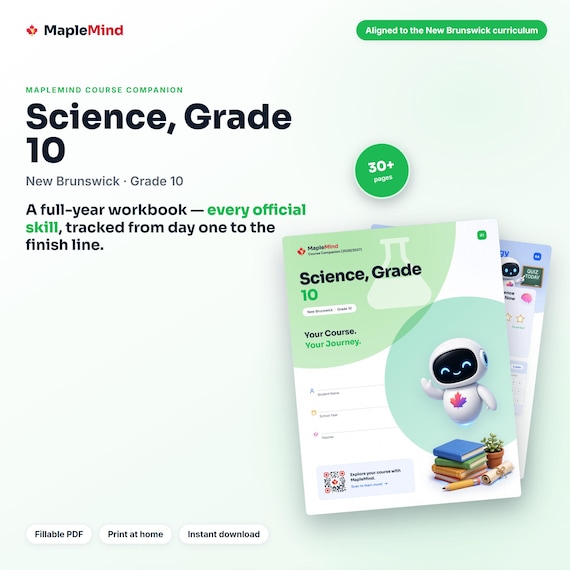
A Science, Grade 10 workbook worth keeping
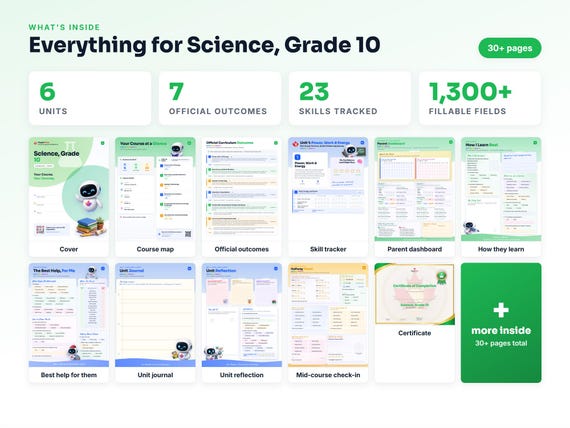
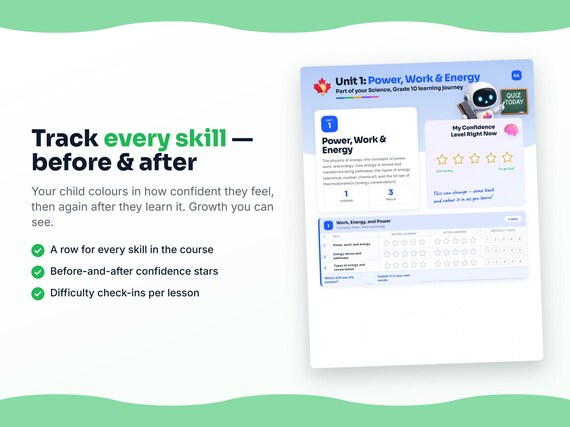
Built from the same official curriculum as this page. Before and after each skill above, your student colours in how sure they feel — so the two of you can see, on one page, what's clicking and what needs another look. It's a quiet way to follow how the year is really going.
By June it's full of their own handwriting: units worked through, confidence grown, a mid-year check-in, notes from parent-teacher night, and a certificate at the end. Less a worksheet, more a record of the year worth keeping on the shelf.
Instant download · see every page, reviews and the full description · five or more workbooks are $2.99 each
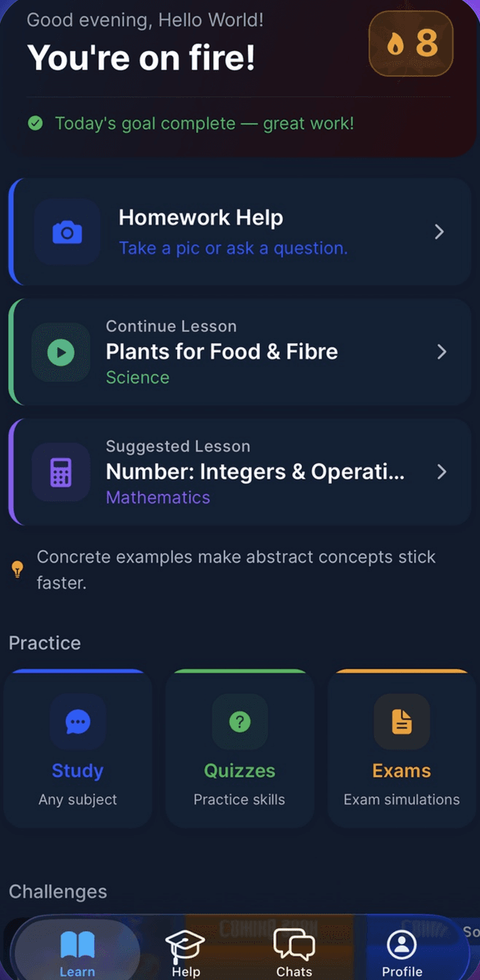
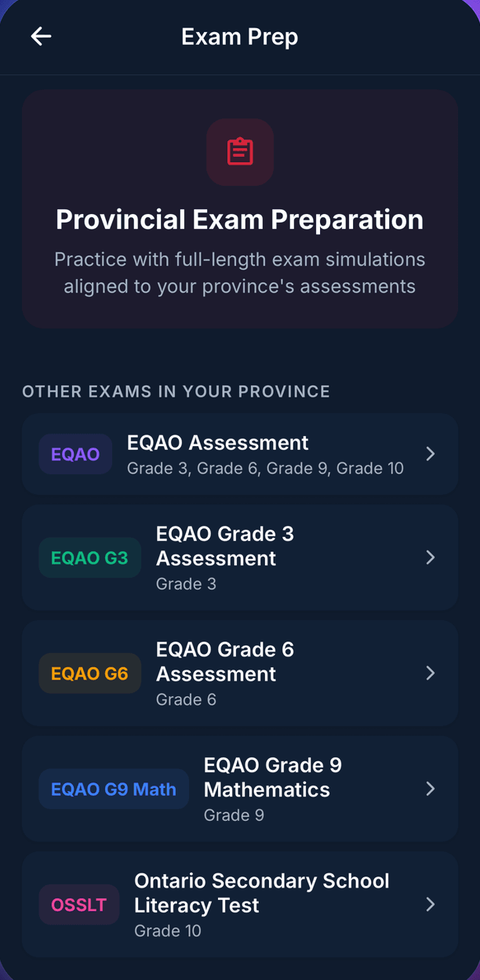
What it looks like in the app
Common questions
Can MapleMind help me with Science, Grade 10?
Yes. MapleMind's AI tutor covers all 23 skills in New Brunswick's Science, Grade 10 — you pick the exact skill, and the tutor teaches it step by step: a short lesson, a worked example, solving together, then a skill check to show it stuck.
Is MapleMind aligned to New Brunswick's official curriculum?
Yes. Every skill in this course maps to an official outcome code from New Brunswick's Grade 10 Science curriculum, and the ministry's own wording is quoted under each unit on this page — with the official government source linked so you can check it yourself.
What does MapleMind cost?
It's free to start — 5 tutoring chats and a practice quiz every day, no credit card. A Pro subscription ($9.99/month or $49.99/year CAD, 7-day free trial) unlocks unlimited tutoring, practice, and exam simulations.
What if I'm stuck on just one topic?
That's the point of skill-level tutoring: open Science, Grade 10 in the app, tap the exact skill from the list on this page, and the tutor teaches just that — no wading through lessons you don't need.
Does MapleMind work in French or other languages?
Yes — 14 languages, including French. Both the app and the tutor's explanations switch to the language you choose.
Where can I see the official New Brunswick curriculum for Science, Grade 10?
The official source is linked on this page — New Brunswick's official K-12 education resources. The outline here follows it: every MapleMind skill carries its official outcome code, and the ministry's own wording is quoted under each unit.
Keep exploring
Ready when you are
Pick a skill from this page and see it taught properly — free, in the browser, in under a minute.