Get help with Science, Grade 9
Most tutoring makes you sit through material you already know. MapleMind flips that: pick the exact skill that's causing trouble — any of the 19 below — and the tutor teaches just that one, step by step, as many times as it takes. Ask questions in plain words, any time of day, in English, French, or 12 other languages.
The official New Brunswick Science, Grade 9 curriculum
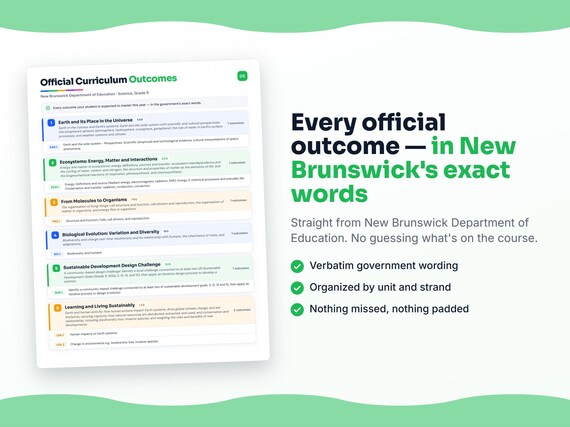
New Brunswick defines Science, Grade 9 by strands and outcomes. MapleMind teaches the same curriculum reorganized for one-skill-at-a-time tutoring — the table shows exactly where every official strand lands, and the ministry's own wording is quoted under each unit below.
Official source New Brunswick's official K-12 education resourcesRead it on the government site — www2.gnb.ca ↗| Official strand | Outcomes | Where MapleMind teaches it |
|---|---|---|
| Strand 1 | 4 | Earth and its Place in the Universe |
| Strand 2 | 4 | Ecosystems: Energy, Matter and Interactions |
| Strand 3 | 2 | From Molecules to Organisms |
| Strand 4 | 2 | Biological Evolution: Variation and Diversity |
| Strand 5 | 1 | Sustainable Development Design Challenge |
| Strand 6 | 6 | Learning and Living Sustainably |
Every skill below, taught one on one.
 Try the first session free
How MapleMind teaches Science, Grade 9 — every unit, lesson, and skill
Every skill below runs as a short session: a plain-words lesson, a worked example, solving it together, then a five-question skill check that earns up to three stars. Guided Mode keeps it teaching instead of answer-handing — turning it off needs a parent's password.
Unit 1Earth and its Place in the UniverseOfficial strand · Strand 1
Earth in the cosmos and Earth's systems: Earth and the solar system with scientific and cultural perspectives; the biosphere's spheres (atmosphere, hydrosphere, cryosphere, geosphere); the role of water in Earth's surface processes; and weather systems and climate.
Earth in the Universe and Its Systems
- Earth and the solar systemsci9.C1 — Explore Earth and the solar system through scientific evidence and cultural interpretations of space.
- The Earth system's spheressci9.C2 — Explore the interacting spheres of the Earth system: atmosphere, hydrosphere, cryosphere, and geosphere.
- Water in Earth's surface processessci9.C3 — Explore the role of water in shaping Earth's surface processes.
- Weather systems and climatesci9.C4 — Explore weather systems and climate as outcomes of the interacting Earth system.
The official wording — 4 outcomes in this unit
- sci9.C1
Earth and the solar system - Perspectives: Scientific (empirical) and technological evidence; cultural interpretations of space phenomena
- sci9.C2
The Biosphere: Atmosphere, hydrosphere, cryosphere, and geosphere
- sci9.C3
The role of water in Earth’s surface process
- sci9.C4
Weather systems and climate
Unit 2Ecosystems: Energy, Matter and InteractionsOfficial strand · Strand 2
Energy and matter in ecosystems: energy definitions, sources and transfer; ecosystem interdependence and the cycling of water, carbon, and nitrogen; the structure and properties of matter as the elements of life; and the biogeochemical reactions of respiration, photosynthesis, and chemosynthesis.
Energy and Matter in Ecosystems
- Energy: sources and transfersci9.C5 — Explore energy definitions, sources, and transfer through radiation, conduction, and convection.
- Ecosystem interdependence and matter cyclingsci9.C6 — Explore ecosystem interdependence and the cycling of water, carbon, and nitrogen.
- The structure of matter and elements of lifesci9.C7 — Explore the structure and properties of matter as the elements of life and nutrient cycles.
- Respiration, photosynthesis, chemosynthesissci9.C8 — Explore the biogeochemical reactions that power life: respiration, photosynthesis, and chemosynthesis.
The official wording — 4 outcomes in this unit
- sci9.C5
Energy: Definitions and source (Radiant energy, electromagnetic radiation, EMS); Energy in chemical processes and everyday life; Conservation and transfer: radiation, conduction, convection
- sci9.C6
Ecosystems: Interdependent relationships; Cycling of matter: Water, Carbon and Nitrogen; Energetics: Energy transfer in ecosystems; Ecosystem dynamics: functioning and resilience
- sci9.C7
Structure and properties of matter: Elements of life and nutrient cycles
- sci9.C8
Biogeochemical reactions: respiration, photosynthesis and chemosynthesis (oceans)
Unit 3From Molecules to OrganismsOfficial strand · Strand 3
The organisation of living things: cell structure and function, cell division and reproduction, the organisation of matter in organisms, and energy flow in organisms.
Cells and the Organisation of Life
- Cells, division, and reproductionsci9.C9 — Explore cell structure and function, cell division, and reproduction.
- Organisation of matter and energy flowsci9.C10 — Explore how matter is organized and how energy flows within organisms.
The official wording — 2 outcomes in this unit
- sci9.C9
Structure and function: Cells, cell division, and reproduction
- sci9.C10
Organisation of matter Energy flow in organisms
Unit 4Biological Evolution: Variation and DiversityOfficial strand · Strand 4
Biodiversity and change over time: biodiversity and its relationship with humans, the inheritance of traits, and adaptations.
Biodiversity, Inheritance, and Adaptation
- Biodiversity and humanssci9.C11 — Explore biodiversity and its relationship with humans.
- Inheritance of traits and adaptationssci9.C12 — Explore how traits are inherited and how organisms become adapted to their environments.
The official wording — 2 outcomes in this unit
- sci9.C11
Biodiversity and humans
- sci9.C12
Inheritance of traits Adaptations
Unit 5Sustainable Development Design ChallengeOfficial strand · Strand 5
A community-based design challenge: identify a local challenge connected to at least two UN Sustainable Development Goals (Grade 9: SDGs 3, 13, 14, and 15), then apply an iterative design process to develop a solution.
Designing for Sustainable Development
- A community SDG design challengesci9.2.2 — Identify a community-based challenge connected to at least two of the Sustainable Development Goals 3, 13, 14, and 15, then design and iterate a solution.
The official wording — 1 outcome in this unit
- sci9.2.2
identify a community-based challenge connected to at least two of sustainable development goals; 3, 13, 14 and 15, then apply an iterative process to design a solution
Unit 6Learning and Living SustainablyOfficial strand · Strand 6
Earth and human activity: how human actions impact Earth systems, drive global climate change, and are limited by carrying capacity; how natural resources are distributed, extracted, and used; and conservation and stewardship, including biodiversity loss, invasive species, and weighing the risks and benefits of new developments.
Earth and Human Activity
- Human impacts on Earth systemssci9.C13 — Explore how human activity affects Earth's interconnected systems - the atmosphere, water, land, and living things.
- Global climate changesci9.C14 — Explore the causes and consequences of global climate change as a major human impact on Earth systems.
- Populations and carrying capacitysci9.C15 — Explore carrying capacity - the largest population an environment can support - and what limits population growth.
- Natural resourcessci9.C16 — Explore how natural resources are distributed geographically, how available they are, and how they are extracted and used.
Conservation and Stewardship
- Change in environments: biodiversity and invasive speciessci9.C17 — Explore how environments change through biodiversity loss and invasive species, and why these matter.
- Risks and benefits of developmentssci9.C18 — Explore how to weigh the risks and benefits of a scientific or technological development.
The official wording — 6 outcomes in this unit
- sci9.C13
Human impacts on Earth systems
- sci9.C14
Global climate change
- sci9.C15
Populations and carrying capacity
- sci9.C16
Natural resources: geographic distribution, availability, extraction and use
- sci9.C17
Change in environments e.g., biodiversity loss, invasive species
- sci9.C18
Risks and benefits of a scientific or technological development
Printable workbook · A keepsake of the year
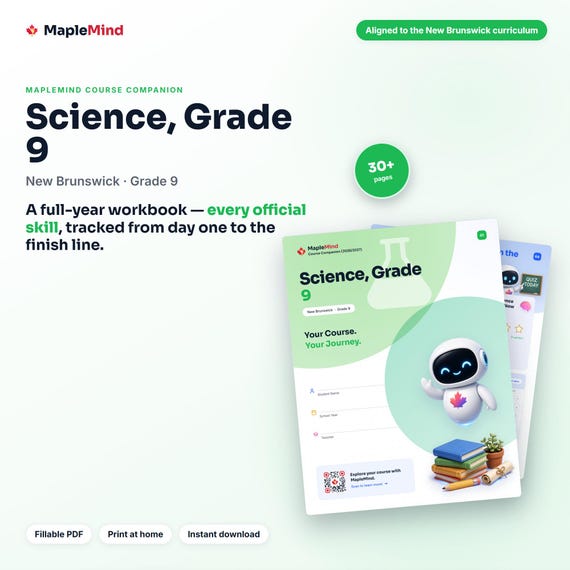
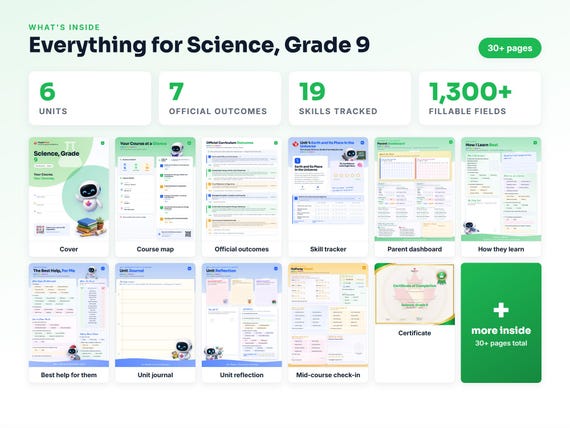
A Science, Grade 9 workbook worth keeping
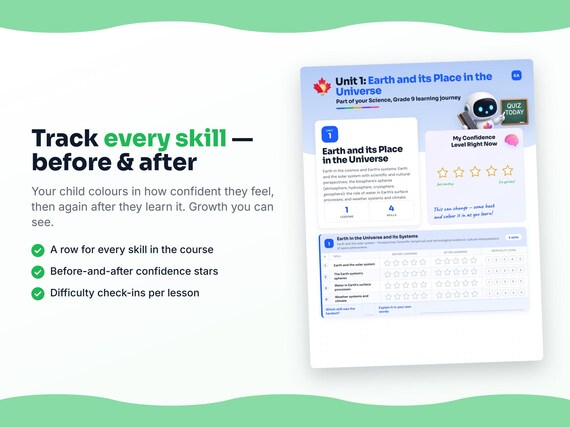
Built from the same official curriculum as this page. Before and after each skill above, your student colours in how sure they feel — so the two of you can see, on one page, what's clicking and what needs another look. It's a quiet way to follow how the year is really going.
By June it's full of their own handwriting: units worked through, confidence grown, a mid-year check-in, notes from parent-teacher night, and a certificate at the end. Less a worksheet, more a record of the year worth keeping on the shelf.
Instant download · see every page, reviews and the full description · five or more workbooks are $2.99 each
What it looks like in the app



Common questions
Can MapleMind help me with Science, Grade 9?
Yes. MapleMind's AI tutor covers all 19 skills in New Brunswick's Science, Grade 9 — you pick the exact skill, and the tutor teaches it step by step: a short lesson, a worked example, solving together, then a skill check to show it stuck.
Is MapleMind aligned to New Brunswick's official curriculum?
Yes. Every skill in this course maps to an official outcome code from New Brunswick's Grade 9 Science curriculum, and the ministry's own wording is quoted under each unit on this page — with the official government source linked so you can check it yourself.
What does MapleMind cost?
It's free to start — 5 tutoring chats and a practice quiz every day, no credit card. A Pro subscription ($9.99/month or $49.99/year CAD, 7-day free trial) unlocks unlimited tutoring, practice, and exam simulations.
What if I'm stuck on just one topic?
That's the point of skill-level tutoring: open Science, Grade 9 in the app, tap the exact skill from the list on this page, and the tutor teaches just that — no wading through lessons you don't need.
Does MapleMind work in French or other languages?
Yes — 14 languages, including French. Both the app and the tutor's explanations switch to the language you choose.
Where can I see the official New Brunswick curriculum for Science, Grade 9?
The official source is linked on this page — New Brunswick's official K-12 education resources. The outline here follows it: every MapleMind skill carries its official outcome code, and the ministry's own wording is quoted under each unit.
Keep exploring
Ready when you are
Pick a skill from this page and see it taught properly — free, in the browser, in under a minute.