Get help with Science, Grade 8
Most tutoring makes you sit through material you already know. MapleMind flips that: pick the exact skill that's causing trouble — any of the 20 below — and the tutor teaches just that one, step by step, as many times as it takes. Ask questions in plain words, any time of day, in English, French, or 12 other languages.
The official New Brunswick Science, Grade 8 curriculum
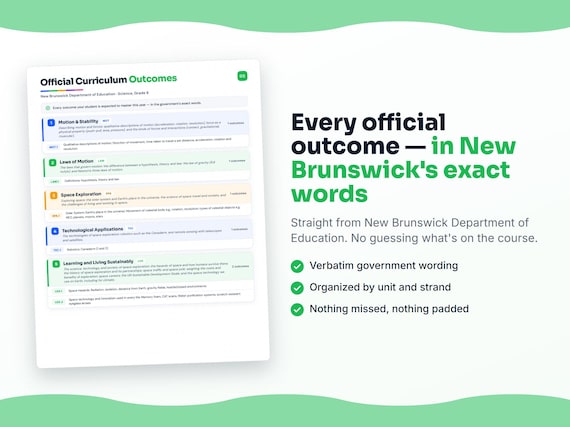
New Brunswick defines Science, Grade 8 by strands and outcomes. MapleMind teaches the same curriculum reorganized for one-skill-at-a-time tutoring — the table shows exactly where every official strand lands, and the ministry's own wording is quoted under each unit below.
Official source New Brunswick's official K-12 education resourcesRead it on the government site — www2.gnb.ca ↗| Official strand | Outcomes | Where MapleMind teaches it |
|---|---|---|
| Strand 1 | 3 | Motion & Stability |
| Strand 2 | 3 | Laws of Motion |
| Strand 3 | 3 | Space Exploration |
| Strand 4 | 11 | Technological Applications · Learning and Living Sustainably |
Every skill below, taught one on one.
 Try the first session free
How MapleMind teaches Science, Grade 8 — every unit, lesson, and skill
Every skill below runs as a short session: a plain-words lesson, a worked example, solving it together, then a five-question skill check that earns up to three stars. Guided Mode keeps it teaching instead of answer-handing — turning it off needs a parent's password.
Unit 1Motion & StabilityOfficial strand · Strand 1
Describing motion and forces: qualitative descriptions of motion (acceleration, rotation, revolution), force as a physical property (push-pull, area, pressure), and the kinds of forces and interactions (contact, gravitational, muscular).
Describing Motion and Forces
- Describing motionsci8.C1 — Describe motion qualitatively: direction, speed, acceleration, rotation, and revolution.
- Force, area, and pressuresci8.C2 — Explore force as a push or pull, and how force spread over an area gives pressure.
- Kinds of forcessci8.C3 — Identify kinds of forces and interactions: contact, gravitational, and muscular.
The official wording — 3 outcomes in this unit
- sci8.C1
Qualitative descriptions of motion: Direction of movement, time taken to travel a set distance, acceleration, rotation and revolution
- sci8.C2
Force as a physical property: Push-pull, area, and pressure
- sci8.C3
Forces and Interactions: Contact, gravitational, and muscular
Unit 2Laws of MotionOfficial strand · Strand 2
The laws that govern motion: the difference between a hypothesis, theory, and law; the law of gravity (9.8 m/s/s); and Newton's three laws of motion.
Newton's Laws of Motion
- Hypothesis, theory, and lawsci8.C4 — Distinguish a hypothesis, a theory, and a law in science.
- The law of gravitysci8.C5 — Explore the law of gravity - objects near Earth accelerate at about 9.8 m/s/s.
- Newton's three lawssci8.C6 — Explore Newton's three laws of motion: inertia, force and acceleration, and action-reaction.
The official wording — 3 outcomes in this unit
- sci8.C4
Definitions: Hypothesis, theory and law
- sci8.C5
Law of Gravity: force, 9.8 m/s/s
- sci8.C6
Newton’s Laws: 1st Law: Inertia, net force, balanced and unbalanced forces; 2nd Law: Effects of force and mass on acceleration; and 3rd Law: Action-reaction, Forces in pairs
Unit 3Space ExplorationOfficial strand · Strand 3
Exploring space: the solar system and Earth's place in the universe, the science of space travel and rockets, and the challenges of living and working in space.
Exploring Space
- The solar systemsci8.C7 — Explore the solar system, Earth's place in the universe, and the types and movements of celestial objects.
- Space travel and rocketssci8.C8 — Explore the science of space travel: rockets, propulsion, and spaceship design.
- Living and working in spacesci8.C9 — Explore the hazards of living and working in space, including zero-gravity effects on the human body.
The official wording — 3 outcomes in this unit
- sci8.C7
Solar System: Earth’s place in the universe; Movement of celestial body e.g., rotation, revolution; types of celestial objects e.g. NEO, planets, moons, stars
- sci8.C8
Space Travel: Aeronautics – Rockets, propulsion, fuel, navigation and steering, and atmospheric drag; Spaceships – Design and construction, parts of a rocket, form and function e.g. the ISS modular design; and Propulsion – hydraulics, gravity, atmospheric drag, and friction
- sci8.C9
Living and working in space: Hazards, Zero-gravity, effect on human systems
Unit 4Technological ApplicationsOfficial strand · Strand 4
The technologies of space exploration: robotics such as the Canadarm, and remote sensing with telescopes and satellites.
Space Technology
- Space robotics: the Canadarmsci8.C10 — Explore space robotics, such as Canada's Canadarm.
- Remote sensing and satellitessci8.C11 — Explore remote sensing with telescopes and satellites, such as RADARSAT.
The official wording — 2 outcomes in this unit
- sci8.C10
Robotics: Canadarm (1 and 2)
- sci8.C11
Remote sensing; telescopes; RADARSTAT satellites
Unit 5Learning and Living SustainablyOfficial strand · Strand 4
The science, technology, and society of space exploration: the hazards of space and how humans survive there; the history of space exploration and its partnerships; space traffic and space junk; weighing the costs and benefits of exploration; space careers; the UN Sustainable Development Goals; and the space technology we use on Earth, including for climate.
Surviving and Exploring Space
- Space hazardssci8.C12 — Explore the hazards of space - radiation, isolation, distance from Earth, and hostile, closed environments.
- Human survival in spacesci8.C13 — Explore how astronauts stay physically and mentally well in space, and how zero gravity affects the body.
- History of space explorationsci8.C14 — Explore the history of space exploration - its milestones, successes and failures - and the partnerships between Canadian and international space agencies.
- Space traffic and space junksci8.C15 — Explore space traffic - reusable rockets and the growing problem of space junk orbiting Earth.
- Cost-benefit of space explorationsci8.C16 — Explore how to weigh the costs and benefits of exploring space.
- Careers in space sciencesci8.C17 — Explore the many careers connected to space, from astronauts and astrophysicists to engineers and project managers.
- Science and the UN Sustainable Development Goalssci8.C18 — Connect space science to the UN Sustainable Development Goals - health, innovation, climate action, and global partnership.
Space Technology on Earth
- Space technology in everyday lifesci8.C19 — Explore everyday technologies that came from space research, such as memory foam, water purifiers, and scratch-resistant lenses.
- Space technology and climate changesci8.C20 — Explore how space technology - Earth-observation satellites and remote sensing - helps monitor the environment and climate change.
The official wording — 9 outcomes in this unit
- sci8.C12
Space Hazards: Radiation, isolation, distance from Earth, gravity fields, hostile/closed environments
- sci8.C13
Human Survival: wellness: mental and physical well-being; Zero-gravity: body systems and functions
- sci8.C14
History of space exploration: Successes, failures, and milestones, partnerships between Canadian and International space agencies e.g. NASA, ESA, and UN Space agency
- sci8.C15
Exosphere (space) traffic: Reusable rockets, space junk
- sci8.C16
Cost - benefit analysis of space exploration
- sci8.C17
Life and career pathways science literate citizen, astronaut, biomedical engineer, astrophysicist, computer/information systems scientist, science policy analyst, software engineer, project manager, space artist
- sci8.C18
Science and the UN Sustainable Development Goals: Good Health and Well-Being [SDG 3], Industry, Innovation and Infrastructure [SDG 9], Climate Action [SDG 13], and Partnership for the Goals [SDG 17]
- sci8.C19
Space technology and innovation used in every life: Memory foam, CAT scans, Water purification systems, scratch resistant eyeglass lenses
- sci8.C20
Space technologies and Climate Change: Earth observation techniques, global environment monitoring, and remote sensing
Printable workbook · A keepsake of the year
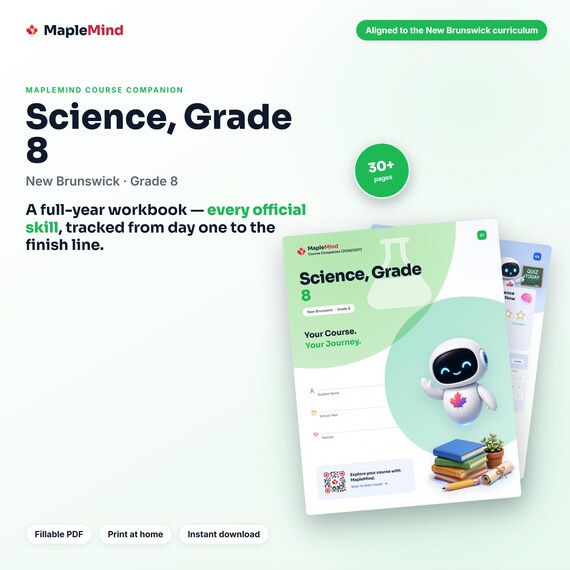
A Science, Grade 8 workbook worth keeping
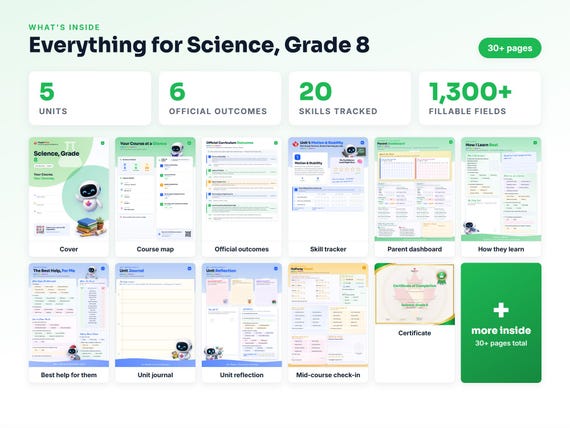
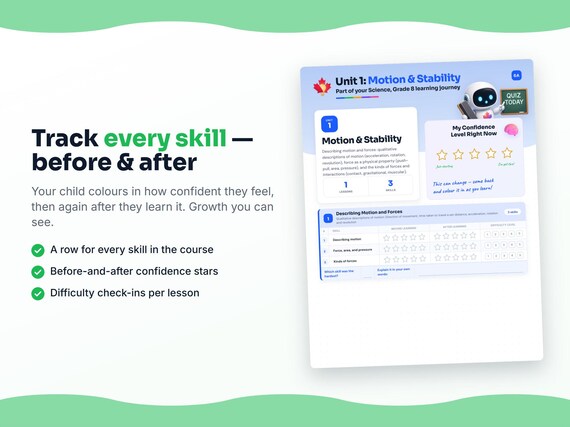
Built from the same official curriculum as this page. Before and after each skill above, your student colours in how sure they feel — so the two of you can see, on one page, what's clicking and what needs another look. It's a quiet way to follow how the year is really going.
By June it's full of their own handwriting: units worked through, confidence grown, a mid-year check-in, notes from parent-teacher night, and a certificate at the end. Less a worksheet, more a record of the year worth keeping on the shelf.
Instant download · see every page, reviews and the full description · five or more workbooks are $2.99 each
What it looks like in the app



Common questions
Can MapleMind help me with Science, Grade 8?
Yes. MapleMind's AI tutor covers all 20 skills in New Brunswick's Science, Grade 8 — you pick the exact skill, and the tutor teaches it step by step: a short lesson, a worked example, solving together, then a skill check to show it stuck.
Is MapleMind aligned to New Brunswick's official curriculum?
Yes. Every skill in this course maps to an official outcome code from New Brunswick's Grade 8 Science curriculum, and the ministry's own wording is quoted under each unit on this page — with the official government source linked so you can check it yourself.
What does MapleMind cost?
It's free to start — 5 tutoring chats and a practice quiz every day, no credit card. A Pro subscription ($9.99/month or $49.99/year CAD, 7-day free trial) unlocks unlimited tutoring, practice, and exam simulations.
What if I'm stuck on just one topic?
That's the point of skill-level tutoring: open Science, Grade 8 in the app, tap the exact skill from the list on this page, and the tutor teaches just that — no wading through lessons you don't need.
Does MapleMind work in French or other languages?
Yes — 14 languages, including French. Both the app and the tutor's explanations switch to the language you choose.
Where can I see the official New Brunswick curriculum for Science, Grade 8?
The official source is linked on this page — New Brunswick's official K-12 education resources. The outline here follows it: every MapleMind skill carries its official outcome code, and the ministry's own wording is quoted under each unit.
Keep exploring
Ready when you are
Pick a skill from this page and see it taught properly — free, in the browser, in under a minute.