Get help with Science, Grade 7
Most tutoring makes you sit through material you already know. MapleMind flips that: pick the exact skill that's causing trouble — any of the 19 below — and the tutor teaches just that one, step by step, as many times as it takes. Ask questions in plain words, any time of day, in English, French, or 12 other languages.
The official New Brunswick Science, Grade 7 curriculum
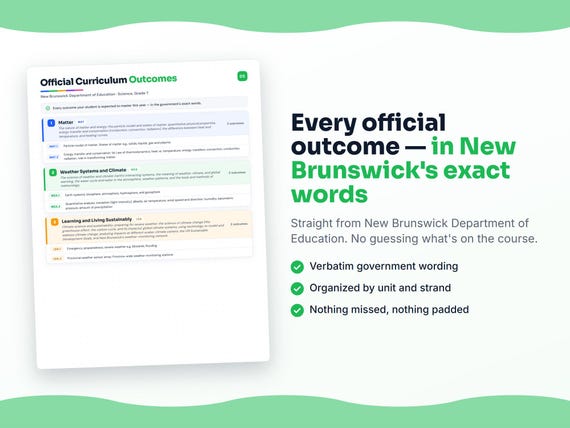
New Brunswick defines Science, Grade 7 by strands and outcomes. MapleMind teaches the same curriculum reorganized for one-skill-at-a-time tutoring — the table shows exactly where every official strand lands, and the ministry's own wording is quoted under each unit below.
Official source New Brunswick's official K-12 education resourcesRead it on the government site — www2.gnb.ca ↗| Official strand | Outcomes | Where MapleMind teaches it |
|---|---|---|
| Strand 1 | 4 | Matter |
| Strand 2 | 7 | Weather Systems and Climate |
| Strand 4 | 8 | Learning and Living Sustainably |
Every skill below, taught one on one.
 Try the first session free
How MapleMind teaches Science, Grade 7 — every unit, lesson, and skill
Every skill below runs as a short session: a plain-words lesson, a worked example, solving it together, then a five-question skill check that earns up to three stars. Guided Mode keeps it teaching instead of answer-handing — turning it off needs a parent's password.
Unit 1MatterOfficial strand · Strand 1
The nature of matter and energy: the particle model and states of matter, quantitative physical properties, energy transfer and conservation (conduction, convection, radiation), the difference between heat and temperature, and heating curves.
The Particle Model of Matter
- Particle model and states of mattersci7.C1 — Explore the particle model of matter and the states of matter: solid, liquid, gas, and plasma.
- Measuring physical propertiessci7.C2 — Measure physical properties of matter: temperature, mass, volume, and density.
Energy, Heat, and Temperature
- Energy transfer and conservationsci7.C3 — Explore how energy transfers by conduction, convection, and radiation, and how it is conserved.
- Heat, temperature, and heating curvessci7.C4 — Distinguish heat from temperature and read a heating curve showing the melting, freezing, and boiling points of water.
The official wording — 4 outcomes in this unit
- sci7.C1
Particle model of matter: States of matter e.g., solids, liquids, gas and plasma
- sci7.C2
Quantitative analysis of physical properties: Temperature, mass, volume, and density
- sci7.C3
Energy transfer and conservation: 1st Law of thermodynamics; heat vs. temperature; energy transfers: convection, conduction, radiation; role in transforming matter
- sci7.C4
Heating curve: Temperature; heat vs. temperature; boiling, melting, and freezing points of water
Unit 2Weather Systems and ClimateOfficial strand · Strand 2
The science of weather and climate: Earth's interacting systems, the meaning of weather, climate, and global warming, the water cycle and water in the atmosphere, weather patterns, and the tools and methods of meteorology.
Earth's Systems and Water in the Air
- Earth's interacting systemssci7.C5 — Explore Earth's four interacting systems: biosphere, atmosphere, hydrosphere, and geosphere.
- Weather, climate, and global warmingsci7.C6 — Define weather, climate, and global warming and how they differ.
- Cycles that drive weathersci7.C7 — Explore the cycles that drive weather: seasons, the water cycle, atmospheric flow, and the role of gravity.
- Water in the atmospheresci7.C8 — Explore how water changes phase and moves through the atmosphere, producing precipitation.
Measuring and Predicting Weather
- Measuring the weathersci7.C9 — Measure weather quantitatively: air temperature, wind, humidity, barometric pressure, and precipitation.
- Weather patternssci7.C10 — Explore weather patterns - the relationships between pressure, temperature, and precipitation.
- Meteorology and forecastingsci7.C11 — Explore meteorology - the instruments, satellite data, and methods (including Traditional knowledge) used to monitor and predict weather.
The official wording — 7 outcomes in this unit
- sci7.C5
Earth systems: biosphere, atmosphere, hydrosphere, and geosphere
- sci7.C6
Definitions: Weather, climate, global warming
- sci7.C7
Cycles: Seasons e.g., day-night (sunlight); water e.g., fresh water, salt water; atmospheric flow patterns; role of gravity
- sci7.C8
Water in the atmosphere: Complex patterns of changes; movement e.g. winds, landforms, ocean temperatures and currents; phases e.g., solidification, evaporation, transpiration, condensation, sublimation; precipitation e.g., rain, snow, sleet, hail
- sci7.C9
Quantitative analysis: Insolation (light intensity), albedo, air temperature, wind speed and direction, humidity, barometric pressure, amount of precipitation
- sci7.C10
Weather patterns: Trends and relationships between barometric pressure, temperature, precipitation patterns and weather systems
- sci7.C11
Meteorology: Weather instruments e.g., analog and digital instruments; remote sensing e.g. satellite imagery; monitoring, reporting and predicting e.g., Traditional knowledge systems, farmers almanac; accuracy and reliability
Unit 3Learning and Living SustainablyOfficial strand · Strand 4
Climate science and sustainability: preparing for severe weather; the science of climate change (the greenhouse effect, the carbon cycle, and its impacts); global climate systems; using technology to model and address climate change; analysing impacts at different scales; climate careers; the UN Sustainable Development Goals; and New Brunswick's weather-monitoring network.
Climate Science and Change
- Emergency preparedness for severe weathersci7.C12 — Explore how to prepare for and stay safe during severe weather such as blizzards and flooding.
- Climate science basicssci7.C13 — Explore the basics of climate science - the greenhouse effect, the carbon cycle, and physical impacts like sea-level rise - and how we adapt and reduce them.
- Global climate systemssci7.C14 — Explore global climate systems and key terms - global warming, greenhouse effect, and climate change - and their local and global impacts.
- Technology for good: climate modellingsci7.C15 — Explore how scientists use climate models and simulations to understand climate change and test ways to respond.
- Climate impacts across scalessci7.C16 — Explore how climate and weather impacts differ across scales - local to global - and how geography shapes weather and its effects on land and infrastructure.
- Careers in climate sciencesci7.C17 — Explore careers in climate and weather science, such as meteorologists and climatologists.
- Science and the UN Sustainable Development Goalssci7.C18 — Connect climate science to the UN Sustainable Development Goals - sustainable cities, climate action, and protecting life.
Weather Monitoring Technology
- Provincial weather sensor arraysci7.C19 — Explore how a province-wide network of weather stations measures and monitors weather across New Brunswick.
The official wording — 8 outcomes in this unit
- sci7.C12
Emergency preparedness; severe weather e.g. blizzards, flooding
- sci7.C13
Climate science basics e.g., greenhouse gas effects, carbon cycle and physical impacts – sea level rise and severe weather; Climate resilience e.g., Adaptation and mitigation strategies
- sci7.C14
Global climate systems: Definitions e.g., global warming, greenhouse effect, climate change; local and global impacts e.g., economic, societal, and environmental concepts and connection to human lives and threats to biodiversity
- sci7.C15
Technology for good: Climate modelling; mitigation and adaption simulations
- sci7.C16
Impact analysis across spatial and temporal scales: Local, regional, national and global; impact of geographic locale on weather e.g., coastal, land-locked, lake-effect, etc. and impact of weather on land and infrastructure
- sci7.C17
Life and career pathways: Climate literate citizen, meteorologist, climatologist, climate scientist, and climate adaptation and mitigation
- sci7.C18
Science and the UN Sustainable Development Goals: Sustainable communities and cities [SDG 11]. Climate Action [SDG 13], Life Below Water [SDG 14] and Life on Land [SDG 15]
- sci7.C19
Provincial weather sensor array: Province-wide weather monitoring stations
Printable workbook · A keepsake of the year
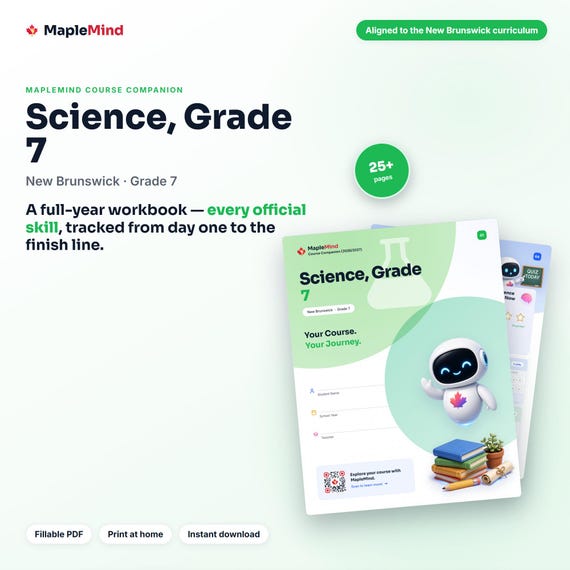
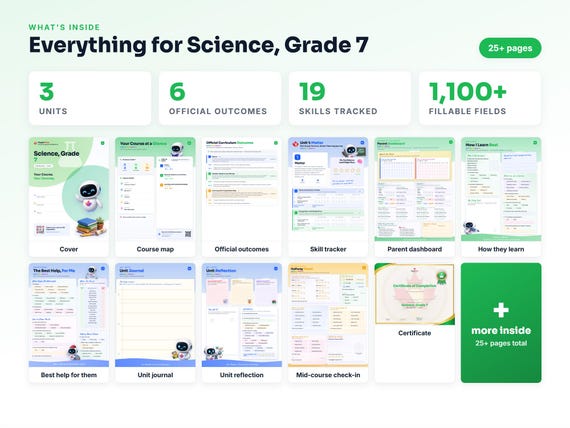
A Science, Grade 7 workbook worth keeping
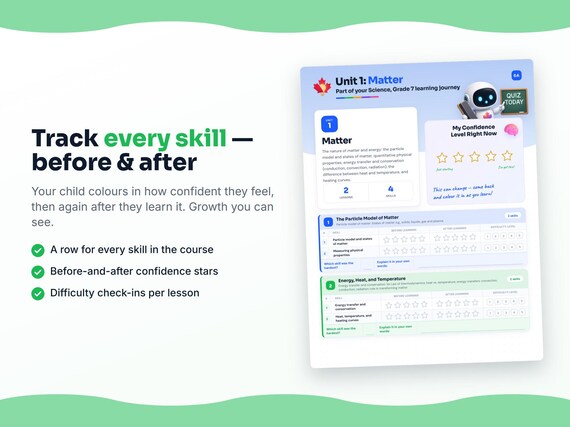
Built from the same official curriculum as this page. Before and after each skill above, your student colours in how sure they feel — so the two of you can see, on one page, what's clicking and what needs another look. It's a quiet way to follow how the year is really going.
By June it's full of their own handwriting: units worked through, confidence grown, a mid-year check-in, notes from parent-teacher night, and a certificate at the end. Less a worksheet, more a record of the year worth keeping on the shelf.
Instant download · see every page, reviews and the full description · five or more workbooks are $2.99 each
What it looks like in the app



Common questions
Can MapleMind help me with Science, Grade 7?
Yes. MapleMind's AI tutor covers all 19 skills in New Brunswick's Science, Grade 7 — you pick the exact skill, and the tutor teaches it step by step: a short lesson, a worked example, solving together, then a skill check to show it stuck.
Is MapleMind aligned to New Brunswick's official curriculum?
Yes. Every skill in this course maps to an official outcome code from New Brunswick's Grade 7 Science curriculum, and the ministry's own wording is quoted under each unit on this page — with the official government source linked so you can check it yourself.
What does MapleMind cost?
It's free to start — 5 tutoring chats and a practice quiz every day, no credit card. A Pro subscription ($9.99/month or $49.99/year CAD, 7-day free trial) unlocks unlimited tutoring, practice, and exam simulations.
What if I'm stuck on just one topic?
That's the point of skill-level tutoring: open Science, Grade 7 in the app, tap the exact skill from the list on this page, and the tutor teaches just that — no wading through lessons you don't need.
Does MapleMind work in French or other languages?
Yes — 14 languages, including French. Both the app and the tutor's explanations switch to the language you choose.
Where can I see the official New Brunswick curriculum for Science, Grade 7?
The official source is linked on this page — New Brunswick's official K-12 education resources. The outline here follows it: every MapleMind skill carries its official outcome code, and the ministry's own wording is quoted under each unit.
Keep exploring
Ready when you are
Pick a skill from this page and see it taught properly — free, in the browser, in under a minute.