Get help with Science, Grade 6
Most tutoring makes your child sit through material your child already knows. MapleMind flips that: pick the exact skill that's causing trouble — any of the 18 below — and the tutor teaches just that one, step by step, as many times as it takes. Ask questions in plain words, any time of day, in English, French, or 12 other languages.
The official New Brunswick Science, Grade 6 curriculum
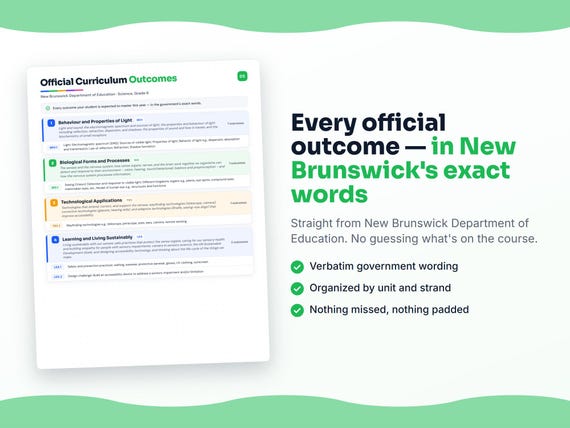
New Brunswick defines Science, Grade 6 by strands and outcomes. MapleMind teaches the same curriculum reorganized for one-skill-at-a-time tutoring — the table shows exactly where every official strand lands, and the ministry's own wording is quoted under each unit below.
Official source New Brunswick's official K-12 education resourcesRead it on the government site — www2.gnb.ca ↗| Official strand | Outcomes | Where MapleMind teaches it |
|---|---|---|
| Strand 1 | 3 | Behaviour and Properties of Light |
| Strand 2 | 5 | Biological Forms and Processes |
| Strand 3 | 3 | Technological Applications |
| Strand 4 | 7 | Learning and Living Sustainably |
Every skill below, taught one on one.
 Try the first session free
How MapleMind teaches Science, Grade 6 — every unit, lesson, and skill
Every skill below runs as a short session: a plain-words lesson, a worked example, solving it together, then a five-question skill check that earns up to three stars. Guided Mode keeps it teaching instead of answer-handing — turning it off needs a parent's password.
Unit 1Behaviour and Properties of LightOfficial strand · Strand 1
Light and sound: the electromagnetic spectrum and sources of light; the properties and behaviour of light including reflection, refraction, dispersion, and shadows; the properties of sound and how it travels; and the biochemistry of smell receptors.
How Light Behaves
- Light and the electromagnetic spectrumsci6.C1 — Explore light - the electromagnetic spectrum, sources of visible light, and its behaviour through reflection, refraction, dispersion, and shadow formation.
- Sound and how it travelssci6.C2 — Explore the properties of sound and how it propagates through different materials.
- Smell receptorssci6.C3 — Explore olfactory (smell) receptors as biochemical detectors.
The official wording — 3 outcomes in this unit
- sci6.C1
Light: Electromagnetic spectrum (EMS); Sources of visible light; Properties of light; Behavior of light e.g., dispersion, absorption and transmission; Law of reflection; Refraction; Shadow formation
- sci6.C2
Sound: Properties; Propagation through different mediums (matter)
- sci6.C3
Olfactory (smell) receptors: biochemical and biophysical receptors
Unit 2Biological Forms and ProcessesOfficial strand · Strand 2
The senses and the nervous system: how sense organs, nerves, and the brain work together so organisms can detect and respond to their environment - vision, hearing, touch/taste/smell, balance and proprioception - and how the nervous system processes information.
The Senses
- Seeing: visionsci6.C4 — Explore vision - how the eye detects light - and a model of the human eye.
- Hearing: the earsci6.C5 — Explore hearing - how the ear detects sound - and a model of the human ear.
- Touch, taste, and smellsci6.C6 — Explore the senses of touch, taste, and smell, and conditions that can affect these organs.
- Balance and body positionsci6.C7 — Explore the vestibular sense of balance and proprioception, the awareness of body position.
- The nervous systemsci6.C8 — Explore how the nervous system - brain, spinal cord, and nerves - processes information from the senses.
The official wording — 5 outcomes in this unit
- sci6.C4
Seeing (Vision): Detection and response to visible light; Different kingdoms organs e.g., plants, eye spots, compound eyes, mammalian eyes, etc.; Model of human eye e.g., structures and functions
- sci6.C5
Hearing (Auditory): Detection and response; how do different organisms process sound; Model of human ear e.g., structures and functions
- sci6.C6
Touch (Tactile), Taste (Gustatory) and Smell (Olfactory): Conditions and diseases affecting organs; Prevention; Treatment
- sci6.C7
Vestibular (sense of balance) and proprioception (unconscious awareness of the position of our body parts)
- sci6.C8
Information processing: brain, spinal cord, and nerve network (Nervous System)
Unit 3Technological ApplicationsOfficial strand · Strand 3
Technologies that extend, correct, and support the senses: wayfinding technologies (telescope, camera), corrective technologies (glasses, hearing aids), and adaptive technologies (Braille, seeing-eye dogs) that improve accessibility.
Technologies for the Senses
- Wayfinding technologiessci6.C9 — Explore wayfinding technologies - such as telescopes, periscopes, and cameras - that extend our senses.
- Corrective technologiessci6.C10 — Explore corrective technologies - such as glasses and hearing aids - that fix problems with the senses.
- Adaptive technologiessci6.C11 — Explore adaptive technologies - such as Braille and seeing-eye dogs - that improve accessibility for people with sensory impairments.
The official wording — 3 outcomes in this unit
- sci6.C9
Wayfinding technologies e.g., telescope, periscope, eyes, ears, camera, remote sensing
- sci6.C10
Corrective technologies e.g., eye glasses, hearing aid
- sci6.C11
Adaptive technologies e.g., Braille, immersive reader, seeing-eye dog
Unit 4Learning and Living SustainablyOfficial strand · Strand 4
Living sustainably with our senses: safe practices that protect the sense organs; caring for our sensory health and building empathy for people with sensory impairments; careers in sensory science; the UN Sustainable Development Goals; and designing accessibility technology and thinking about the life cycle of the things we make.
Caring for Our Senses
- Protecting the sense organssci6.C12 — Explore safety and prevention practices that protect the sense organs - eyewear, ear protection, gloves, and sun protection.
- Keeping our senses healthysci6.C13 — Explore how to keep the sensory organs - eyes, ears, and the sense of smell - healthy.
- Empathy and sensory impairmentssci6.C14 — Build empathy by exploring what it means to have a sensory impairment such as being visually impaired, hard of hearing, or colour blind.
- Careers in sensory sciencesci6.C15 — Explore careers that help people with their senses, such as optometrists, audiologists, and ENT specialists.
- Science and the UN Sustainable Development Goalssci6.C16 — Connect the study of the senses and accessibility to the UN Sustainable Development Goals - good health, reduced inequalities, and protecting life.
Designing for the Senses
- Design an accessibility devicesci6.C17 — Design and build an accessibility device that helps someone with a sensory impairment, such as a tool or a calming sensory space.
- The life cycle of what we makesci6.C18 — Explore how the things we make fit into larger systems, and follow a product through its life cycle from materials to disposal.
The official wording — 7 outcomes in this unit
- sci6.C12
Safety and prevention practices: wafting, eyewear, protective earwear, gloves, UV clothing, sunscreen
- sci6.C13
Health and well being of self: sensory organs; eyes; ears; olfactory system
- sci6.C14
Empathy for those with sensory impairments: visually impaired, hard of hearing, colour blindness
- sci6.C15
Life and career pathways: scientific literate citizen, eye surgeon, ENT specialist, hearing health professional, audiologist, hearing instrument technician, optometrist, ophthalmologist
- sci6.C16
Science and the UN Sustainable Development Goals: Good Health and Well-being [SDG 3], Reduced Inequalities [SDG 10], Life Below Water [SDG 14] and Life on Land [SDG 15]
- sci6.C17
Design challenge: Build an accessibility device to address a sensory impairment and/or limitation
- sci6.C18
Ecological systems: economic and environmental challenge of making stuff; what we make; how we make it; how does it fit into a larger system; and life cycle of a product
Printable workbook · A keepsake of the year
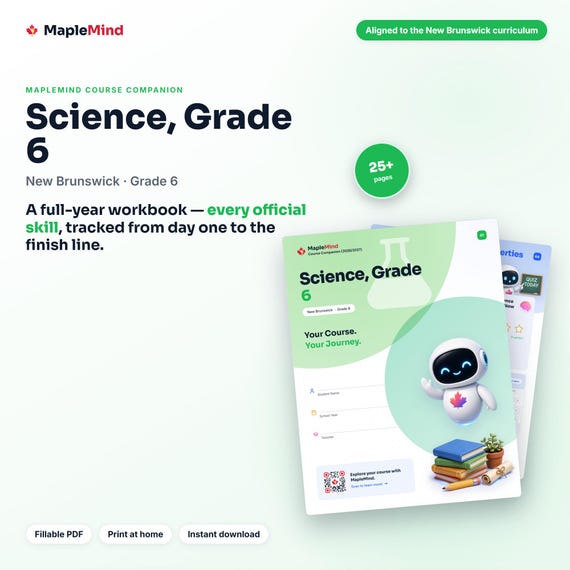
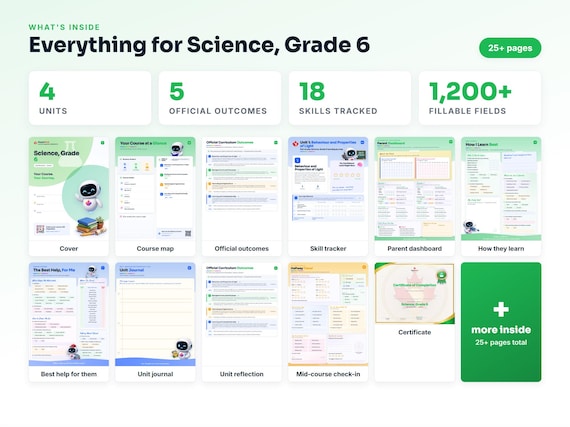
A Science, Grade 6 workbook worth keeping
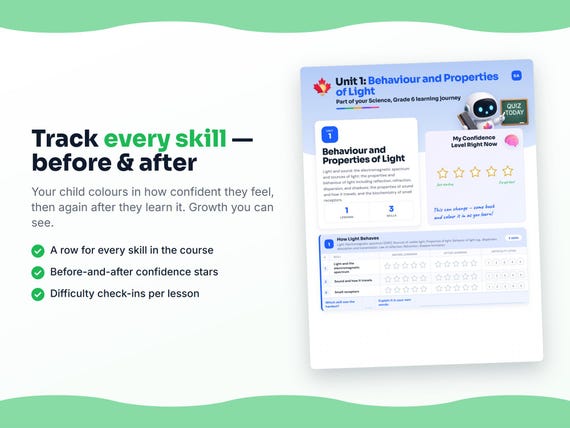
Built from the same official curriculum as this page. Before and after each skill above, your student colours in how sure they feel — so the two of you can see, on one page, what's clicking and what needs another look. It's a quiet way to follow how the year is really going.
By June it's full of their own handwriting: units worked through, confidence grown, a mid-year check-in, notes from parent-teacher night, and a certificate at the end. Less a worksheet, more a record of the year worth keeping on the shelf.
Instant download · see every page, reviews and the full description · five or more workbooks are $2.99 each
What it looks like in the app



Common questions
Can MapleMind help my child with Science, Grade 6?
Yes. MapleMind's AI tutor covers all 18 skills in New Brunswick's Science, Grade 6 — your child picks the exact skill, and the tutor teaches it step by step: a short lesson, a worked example, solving together, then a skill check to show it stuck.
Is MapleMind aligned to New Brunswick's official curriculum?
Yes. Every skill in this course maps to an official outcome code from New Brunswick's Grade 6 Science curriculum, and the ministry's own wording is quoted under each unit on this page — with the official government source linked so you can check it yourself.
What does MapleMind cost?
It's free to start — 5 tutoring chats and a practice quiz every day, no credit card. A Pro subscription ($9.99/month or $49.99/year CAD, 7-day free trial) unlocks unlimited tutoring, practice, and exam simulations.
What if my child is stuck on just one topic?
That's the point of skill-level tutoring: open Science, Grade 6 in the app, tap the exact skill from the list on this page, and the tutor teaches just that — no wading through lessons your child doesn't need.
Does MapleMind work in French or other languages?
Yes — 14 languages, including French. Both the app and the tutor's explanations switch to the language your child chooses.
Where can I see the official New Brunswick curriculum for Science, Grade 6?
The official source is linked on this page — New Brunswick's official K-12 education resources. The outline here follows it: every MapleMind skill carries its official outcome code, and the ministry's own wording is quoted under each unit.
Keep exploring
Ready when you are
Pick a skill from this page and see it taught properly — free, in the browser, in under a minute.