Get help with Chemistry 11
Most tutoring makes you sit through material you already know. MapleMind flips that: pick the exact skill that's causing trouble — any of the 36 below — and the tutor teaches just that one, step by step, as many times as it takes. Ask questions in plain words, any time of day, in English, French, or 12 other languages.
The official New Brunswick Chemistry 11 curriculum
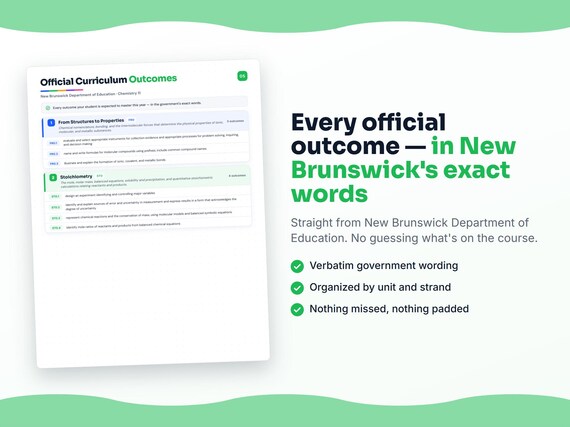
New Brunswick defines Chemistry 11 by strands and outcomes. MapleMind teaches the same curriculum reorganized for one-skill-at-a-time tutoring — the table shows exactly where every official strand lands, and the ministry's own wording is quoted under each unit below.
Official source New Brunswick's official K-12 education resourcesRead it on the government site — www2.gnb.ca ↗| Official strand | Outcomes | Where MapleMind teaches it |
|---|---|---|
| Strand 1 | 17 | From Structures to Properties |
| Strand 2 | 19 | Stoichiometry |
Every skill below, taught one on one.
 Try the first session free
How MapleMind teaches Chemistry 11 — every unit, lesson, and skill
Every skill below runs as a short session: a plain-words lesson, a worked example, solving it together, then a five-question skill check that earns up to three stars. Guided Mode keeps it teaching instead of answer-handing — turning it off needs a parent's password.
Unit 1From Structures to PropertiesOfficial strand · Strand 1
Chemical nomenclature, bonding, and the intermolecular forces that determine the physical properties of ionic, molecular, and metallic substances.
Investigating substances in the lab
- Selecting instruments and processeschem11.1.7 — Evaluate and select appropriate instruments and processes for investigating the properties of a substance.
- A theory-based prediction and hypothesischem11.1.8 — Identify the theoretical basis of an investigation and develop a prediction and hypothesis consistent with it.
- Evaluating processes for problem-solvingchem11.1.9 — Evaluate and select appropriate processes for problem solving, inquiring, and decision making about a substance.
- Using instruments accuratelychem11.1.10 — Use instruments effectively and accurately to collect data on a substance's properties.
- Researching and integrating informationchem11.1.11 — Use library, electronic, and multiple print/electronic sources to collect and integrate information on a chemistry topic.
- Selecting and integrating informationchem11.1.12 — Select and integrate information from various print and electronic sources or several parts of the same source.
- Limits of a classification systemchem11.1.13 — Identify limitations of a given classification system and alternative ways of classifying to accommodate anomalies.
- Displaying evidence and informationchem11.1.14 — Compile and display evidence in a variety of formats including diagrams, tables, graphs, and scatter plots.
Naming and writing chemical formulas
- Naming molecular compoundschem11.1.15 — Name and write formulas for molecular compounds using prefixes, including common names.
- Naming ionic compoundschem11.1.16 — Name and write formulas for ionic compounds (binary, complex, hydrates) using the periodic table and ion nomenclature.
- Acids, bases, and saltschem11.1.17 — Classify substances as acids, bases, or salts from their characteristics, names, and formulas.
Bonding and intermolecular forces
- Forming ionic, covalent, and metallic bondschem11.1.18 — Illustrate and explain the formation of ionic, covalent, and metallic bonds.
- Hydrogen bonds and van der Waals forceschem11.1.19 — Illustrate and explain hydrogen bonds and van der Waals forces.
- Properties of ionic, molecular, and metallic substanceschem11.1.20 — Identify and describe the properties of ionic and molecular compounds and metallic substances.
- Forces explain propertieschem11.1.21 — Describe how intermolecular forces account for the properties of substances.
- Classifying substances by propertieschem11.1.22 — Classify ionic, molecular, and metallic substances according to their properties.
- The structural model of a substancechem11.1.23 — Explain the structural model of a substance in terms of the various bonds that define it.
The official wording — 17 outcomes in this unit
- chem11.1.7
evaluate and select appropriate instruments for collection evidence and appropriate processes for problem solving, inquiring, and decision making
- chem11.1.8
identify the theoretical basis of an investigation and develop a prediction and a hypothesis that are consistent with the theoretical basis
- chem11.1.9
evaluate and select appropriate instruments for collecting evidence and appropriate processes for problem solving, inquiring, and decision making
- chem11.1.10
use instruments effectively and accurately for collecting data
- chem11.1.11
use library and electronic research tools to collect information on a given topic
- chem11.1.12
select and integrate information from various print and electronic sources or from several parts of the same source
- chem11.1.13
identify limitations of a given classification system and identify alternative ways of classifying to accommodate anomalies
- chem11.1.14
compile and display evidence and information, by hand or computer, in a variety of formats, including diagrams, flow charts, tables, graphs, and scatter plots
- chem11.1.15
name and write formulas for molecular compounds using prefixes, include common compound names
- chem11.1.16
name and write formulas for ionic compounds (include binary, complex and hydrates), using the periodic table, a list of ions, and appropriate nomenclature for metal and non-metal ions
- chem11.1.17
classify substances as acids, bases, or salts, based on their characteristics, and on the basis of their names and formulas
- chem11.1.18
illustrate and explain the formation of ionic, covalent, and metallic bonds
- chem11.1.19
illustrate and explain hydrogen bonds and van der Waals‟ forces
- chem11.1.20
identify and describe the properties of ionic and molecular compounds and metallic substances
- chem11.1.21
describe how intermolecular forces account for the properties of ionic and molecular compounds and metallic substances
- chem11.1.22
classify ionic, molecular, and metallic substances according to their properties
- chem11.1.23
explain the structural model of a substance in terms of the various bonds that define it
Unit 2StoichiometryOfficial strand · Strand 2
The mole, molar mass, balanced equations, solubility and precipitation, and quantitative stoichiometric calculations relating reactants and products.
Designing and measuring quantitatively
- Designing a controlled experimentchem11.2.6 — Design an experiment identifying and controlling major variables.
- Stating a prediction and hypothesischem11.2.7 — State a prediction and a hypothesis based on available evidence and background information.
- Estimating quantitieschem11.2.9 — Estimate quantities before measuring to check reasonableness.
- Compiling and organizing datachem11.2.10 — Compile and organize data using appropriate formats and treatments to aid interpretation.
- Using apparatus and materials safelychem11.2.11 — Select and use apparatus and materials safely.
Analysing and communicating results
- Error and uncertainty in measurementchem11.2.12 — Identify and explain sources of error and uncertainty and express results acknowledging that uncertainty.
- Do the data support the prediction?chem11.2.13 — Explain how data support or refute the hypothesis or prediction.
- Correcting problems in a technological devicechem11.2.14 — Identify and correct practical problems in how a technological device or system functions.
- Communicating ideas and resultschem11.2.15 — Communicate questions, ideas, and intentions and respond to the ideas of others.
The mole, solubility, and precipitation
- Representing reactions and conservation of masschem11.2.16 — Represent chemical reactions and the conservation of mass using models and balanced equations.
- Neutralizationchem11.2.17 — Describe how neutralization tempers the effects of an acid with a base or vice versa.
- Molar mass and mole-mass conversionschem11.2.18 — Define molar mass and perform mole-mass inter-conversions for pure substances.
- Solubility and equilibriumchem11.2.19 — Explain solubility using the concept of equilibrium.
- Why solubility varieschem11.2.20 — Explain variations in the solubility of various pure substances in the same solvent.
- Predicting precipitateschem11.2.21 — Use solubility generalizations to predict the formation of precipitates.
Stoichiometric calculations
- Mole ratios from balanced equationschem11.2.22 — Identify mole ratios of reactants and products from balanced chemical equations.
- Performing stoichiometric calculationschem11.2.23 — Perform stoichiometric calculations related to chemical equations.
- Applications of stoichiometrychem11.2.24 — Identify various stoichiometric applications.
- Maximizing yieldchem11.2.25 — Predict how the yield of a chemical process can be maximized.
The official wording — 19 outcomes in this unit
- chem11.2.6
design an experiment identifying and controlling major variables
- chem11.2.7
state a prediction and a hypothesis based on available evidence and background information
- chem11.2.9
estimate quantities
- chem11.2.10
compile and organize data, using appropriate formats and data treatments to facilitate interpretation of the data
- chem11.2.11
select and use apparatus and materials safely
- chem11.2.12
identify and explain sources of error and uncertainty in measurement and express results in a form that acknowledges the degree of uncertainty
- chem11.2.13
explain how data support or refute the hypothesis or prediction
- chem11.2.14
identify and correct practical problems in the way a technological device or system functions
- chem11.2.15
communicate questions, ideas and intentions, and receive, interpret, understand, support, and respond to the ideas of others
- chem11.2.16
represent chemical reactions and the conservation of mass, using molecular models and balanced symbolic equations
- chem11.2.17
describe how neutralization involves tempering the effects of an acid with a base or vice versa
- chem11.2.18
define molar mass and perform mole-mass inter-conversions for pure substances
- chem11.2.19
explain solubility, using the concept of equilibrium
- chem11.2.20
explain the variations in the solubility of various pure substances, given the same solvent
- chem11.2.21
use the solubility generalizations to predict the formation of precipitates
- chem11.2.22
identify mole ratios of reactants and products from balanced chemical equations
- chem11.2.23
perform stoichiometric calculations related to chemical equations
- chem11.2.24
identify various stoichiometric applications
- chem11.2.25
predict how the yield of a particular chemical process can be maximized
Printable workbook · A keepsake of the year
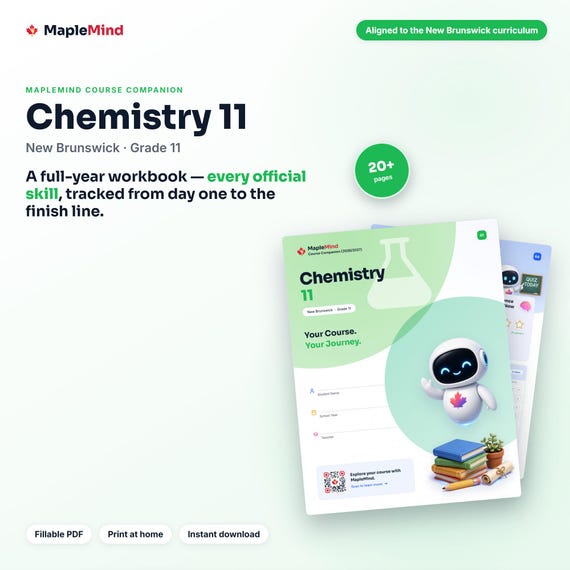
A Chemistry 11 workbook worth keeping
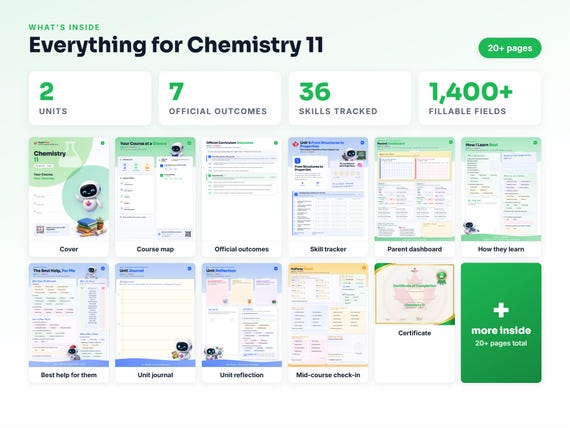
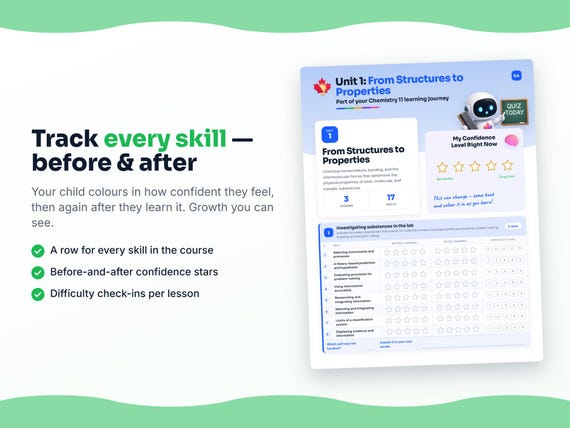
Built from the same official curriculum as this page. Before and after each skill above, your student colours in how sure they feel — so the two of you can see, on one page, what's clicking and what needs another look. It's a quiet way to follow how the year is really going.
By June it's full of their own handwriting: units worked through, confidence grown, a mid-year check-in, notes from parent-teacher night, and a certificate at the end. Less a worksheet, more a record of the year worth keeping on the shelf.
Instant download · see every page, reviews and the full description · five or more workbooks are $2.99 each
What it looks like in the app
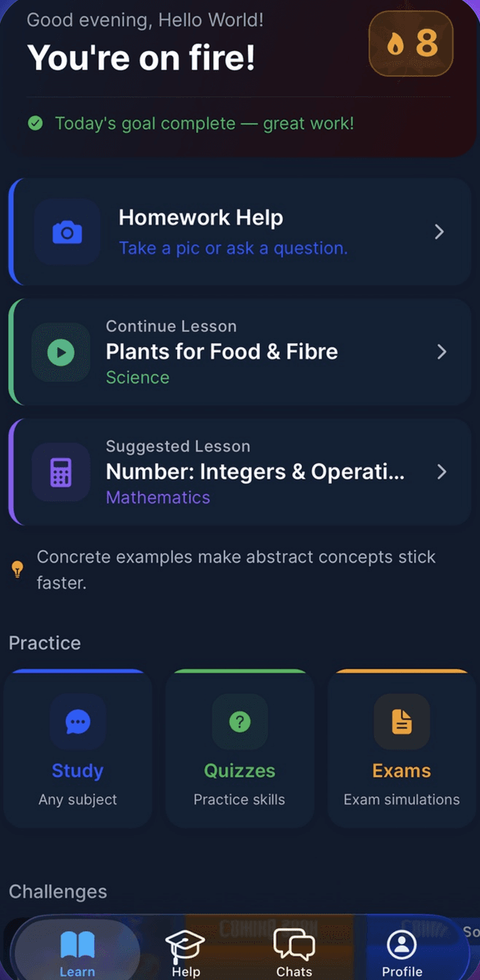
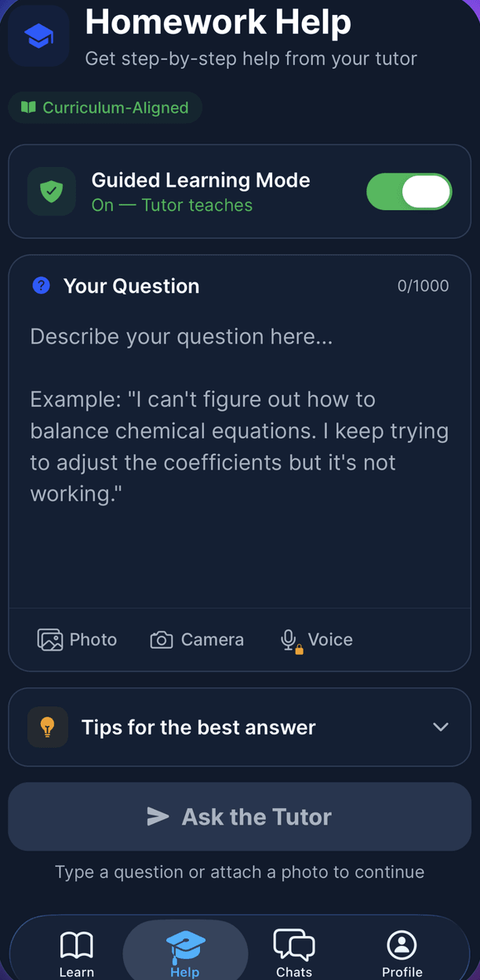
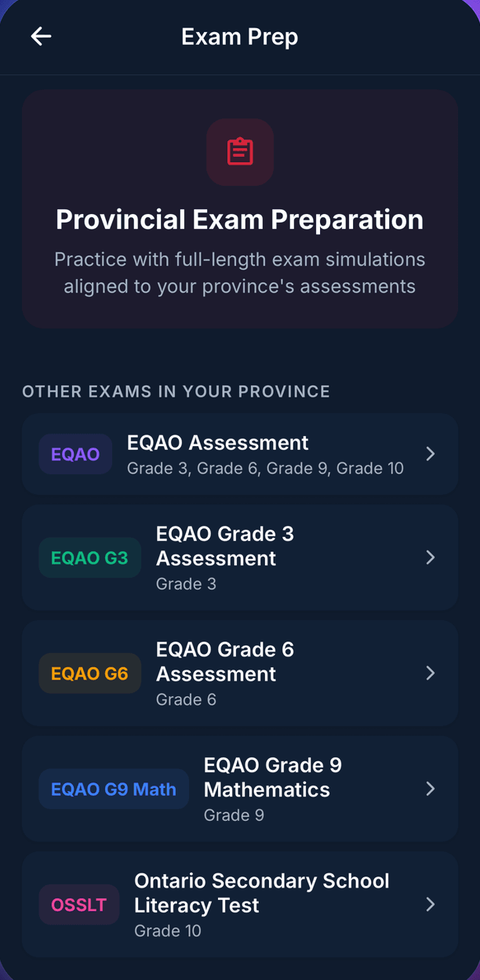
Common questions
Can MapleMind help me with Chemistry 11?
Yes. MapleMind's AI tutor covers all 36 skills in New Brunswick's Chemistry 11 — you pick the exact skill, and the tutor teaches it step by step: a short lesson, a worked example, solving together, then a skill check to show it stuck.
Is MapleMind aligned to New Brunswick's official curriculum?
Yes. Every skill in this course maps to an official outcome code from New Brunswick's Grade 11 Science curriculum, and the ministry's own wording is quoted under each unit on this page — with the official government source linked so you can check it yourself.
What does MapleMind cost?
It's free to start — 5 tutoring chats and a practice quiz every day, no credit card. A Pro subscription ($9.99/month or $49.99/year CAD, 7-day free trial) unlocks unlimited tutoring, practice, and exam simulations.
What if I'm stuck on just one topic?
That's the point of skill-level tutoring: open Chemistry 11 in the app, tap the exact skill from the list on this page, and the tutor teaches just that — no wading through lessons you don't need.
Does MapleMind work in French or other languages?
Yes — 14 languages, including French. Both the app and the tutor's explanations switch to the language you choose.
Where can I see the official New Brunswick curriculum for Chemistry 11?
The official source is linked on this page — New Brunswick's official K-12 education resources. The outline here follows it: every MapleMind skill carries its official outcome code, and the ministry's own wording is quoted under each unit.
Keep exploring
Ready when you are
Pick a skill from this page and see it taught properly — free, in the browser, in under a minute.