Get help with Biology 12
Most tutoring makes you sit through material you already know. MapleMind flips that: pick the exact skill that's causing trouble — any of the 101 below — and the tutor teaches just that one, step by step, as many times as it takes. Ask questions in plain words, any time of day, in English, French, or 12 other languages.
The official New Brunswick Biology 12 curriculum
New Brunswick defines Biology 12 by strands and outcomes. MapleMind teaches the same curriculum reorganized for one-skill-at-a-time tutoring — the table shows exactly where every official strand lands, and the ministry's own wording is quoted under each unit below.
Official source New Brunswick's official K-12 education resourcesRead it on the government site — www2.gnb.ca ↗| Official strand | Outcomes | Where MapleMind teaches it |
|---|---|---|
| Strand 1 | 45 | Genetic Continuity |
| Strand 2 | 10 | Evolution, Change and Diversity |
| Strand 3 | 46 | Maintaining Dynamic Equilibrium II |
Every skill below, taught one on one.
 Try the first session free
How MapleMind teaches Biology 12 — every unit, lesson, and skill
Every skill below runs as a short session: a plain-words lesson, a worked example, solving it together, then a five-question skill check that earns up to three stars. Guided Mode keeps it teaching instead of answer-handing — turning it off needs a parent's password.
Unit 1Genetic ContinuityOfficial strand · Strand 1
The cellular and molecular basis of heredity: the cell cycle, mitosis and cancer, meiosis and chromosome disorders, DNA structure, replication, protein synthesis, mutations, Mendelian and human genetics, and biotechnology.
The cell cycle, mitosis, and cancer
- The cell cyclebio12.1.1 — Observe, identify, and describe the events of the plant and animal cell cycle including mitosis.
- Chromosomes and chromosome numberbio12.1.2 — Explain the role of chromosomes and the importance of maintaining the chromosome number.
- Controls on cell divisionbio12.1.3 — Investigate physical and molecular controls (cell cycle regulators) on cell division.
- Mitosis and cancer (p53)bio12.1.4 — Investigate the link between mitosis and cancer, including the role of gene p53.
- Treating cancerbio12.1.5 — Research cancer treatment methods and evaluate physiological and ethical considerations.
Molecular detail of cell division
- Observing chromosomesbio12.1.6 — Propagate rapidly growing plant material and prepare squashes to observe chromosomes.
- Cyclin-dependent kinasesbio12.1.7 — Explore the role of cyclin-dependent kinases (cdks) in the regulation of cell growth.
- Telomeres and telomerasebio12.1.8 — Discuss the role of telomerase in preventing telomere shortening and uncontrolled growth.
- Stem cell technologybio12.1.9 — Research the use of stem cell technology, its potency and applications, and the ethics involved.
Meiosis and the basis of inheritance
- Meiosis and cytokinesisbio12.1.10 — Describe in detail the events of meiosis (reduction-division) and cytokinesis.
- Chromosome reductionbio12.1.11 — Explain the necessity of chromosome reduction during the production of sex cells.
- Chromosomes and hereditybio12.1.12 — Describe and illustrate the role of chromosomes in the transmission of hereditary information.
- Crossing overbio12.1.13 — Describe the crossing-over process and explain its role in randomizing the gene combination.
- Karyotypesbio12.1.14 — Analyze and identify normal and abnormal human karyotypes.
- Non-disjunctionbio12.1.15 — Describe non-disjunction in human karyotypes and the conditions it may cause, such as Down syndrome.
DNA structure and replication
- Discovery of the genebio12.1.16 — Summarize the main scientific discoveries that led to the modern concept of the gene.
- Nucleic acidsbio12.1.17 — Identify and describe the structure and function of nucleic acids.
- The DNA double helixbio12.1.18 — Describe the Watson and Crick double helix model of DNA.
- DNA replicationbio12.1.19 — Diagram and explain the process of DNA replication.
- Replication termsbio12.1.20 — Explain the terms Okazaki fragments, helicase, primers, and single-strand binding proteins.
Gene expression and mutation
- Types of RNAbio12.1.21 — Compare and contrast the structure of DNA, tRNA, mRNA, and rRNA and explain their roles.
- Protein synthesisbio12.1.22 — Demonstrate an understanding of the process of protein synthesis through illustrations and analysis.
- Gene mutationsbio12.1.23 — Explain what is meant by a gene mutation and predict the effect on protein structure.
- Causes of mutationsbio12.1.24 — Describe factors that can lead to mutations, including those that cause genetic diseases.
- RNA processingbio12.1.25 — Explain the terms RNA editing, 5-prime cap and poly-A tail, and RNA splicing.
- Gene regulationbio12.1.26 — Describe the process of gene regulation in prokaryotes and eukaryotes.
Mendelian inheritance
- Mendel's workbio12.1.27 — Briefly describe the life and work of Gregor Mendel and the beginning of the understanding of heredity.
- Mendelian geneticsbio12.1.28 — Demonstrate an understanding of Mendelian genetics, including independent assortment.
- Complex inheritancebio12.1.29 — Explain the influence of multiple alleles, polygenic, pleiotropic, and epistatic traits.
- Probability in geneticsbio12.1.30 — Explain and illustrate how probability techniques predict the outcome of genetic crosses.
- Monohybrid and dihybrid crossesbio12.1.31 — Predict the outcome of monohybrid and dihybrid crosses using genotypic and phenotypic ratios.
- Polyploidybio12.1.32 — Demonstrate an understanding of polyploidy and its application in biotechnology.
- Genotype and phenotypebio12.1.33 — Distinguish between genotypes and phenotypes evident in autosomal and sex-linked inheritance.
Sex-linkage and pedigrees
- Sex-linkagebio12.1.34 — Define sex-linkage.
- Sex-linked defects in malesbio12.1.35 — Explain why sex-linked defects are more common in males than females.
- Sex-linked crossesbio12.1.36 — Predict the outcome of genetic problems involving sex-linked genes.
- Environment and gene expressionbio12.1.37 — Discuss the influence of hormonal and environmental factors on gene expression.
- Pedigree chartsbio12.1.38 — Draw and interpret the patterns of inheritance shown on pedigree charts.
Genomics and biotechnology
- Human genome researchbio12.1.39 — Explain the importance of human genome research.
- Genetic engineering techniquesbio12.1.40 — Demonstrate an understanding of current genetic engineering techniques.
- Restriction enzymesbio12.1.41 — Demonstrate an understanding of the use of restriction enzymes within biotechnology.
- Genetically modified organismsbio12.1.42 — Demonstrate an understanding of genetic modifications found in a variety of organisms.
- Risks and benefits of biotechnologybio12.1.43 — Analyze from biological, social, ethical, and environmental perspectives the risks and benefits of biotechnology.
- Current genetic engineering technologiesbio12.1.44 — Research and demonstrate an in-depth understanding of current technologies in genetic engineering.
- Topics in human genomicsbio12.1.45 — Find and review topical areas of research in human genomics.
The official wording — 45 outcomes in this unit
- bio12.1.1
Observe, identify and describe the events of the plant and animal cell cycle, including growth, cytokinesis and chromosome
- bio12.1.2
Explain the role of chromosomes and the importance of maintaining the chromosome number through cellular reproduction
- bio12.1.3
Investigate controls on cell division including physical and molecular cell cycle regulators
- bio12.1.4
Investigate the link between mitosis and cancer, including links to gene p53
- bio12.1.5
Research the methods used to treat cancer and evaluate the physiological and ethical consequences of medical treatments such
- bio12.1.6
Propagate rapidly growing plant material and prepare squashes to observe the chromosomes during cell division
- bio12.1.7
Explore the role of cyclin dependent kinases (cdks) in the regulation of cell growth
- bio12.1.8
Discuss the role of telomerase in preventing telomere shortening and uncontrolled growth of cells in cancer
- bio12.1.9
Research the use of stem cell technology, its potency and applications, and the ethics of using it in
- bio12.1.10
Describe, in detail, the events of meiosis (reduction-division) and cytokinesis
- bio12.1.11
Explain the necessity of chromosome reduction during the production of sex cells
- bio12.1.12
Describe and illustrate the role of chromosomes in the transmission of hereditary information from one cell to another
- bio12.1.13
Describe the crossing-over process and explain its role in helping randomize the gene combinations for sex cells
- bio12.1.14
Analyze and identify normal and abnormal human karyotypes
- bio12.1.15
Describe non-disjunction in human karyotypes and the conditions it may causes such as Down‟s syndrome, and Turner‟s syndrome
- bio12.1.16
Summarize the main scientific discoveries that led to the modern concept of the gene
- bio12.1.17
Identify and describe the structure and function of nucleic acids
- bio12.1.18
Describe the Watson and Crick double helix model of DNA
- bio12.1.19
Diagram and explain the process of DNA replication
- bio12.1.20
Explain the following terms and concepts: Okazaki fragments, Helicase, primers, single stranded binding proteins, primase, ligase, leading/lagging strands
- bio12.1.21
Compare and contrast the structure of DNA and tRNA, mRNA and rRNA explain their role in protein synthesis
- bio12.1.22
Demonstrate an understanding of the process of protein synthesis through illustrations and explanations
- bio12.1.23
Explain what is meant by a gene mutation and predict, in general, the effect on protein synthesis. Describe
- bio12.1.24
Describe factors that can lead to mutations, including those that cause genetic diseases
- bio12.1.25
Explain the following terms and concepts: RNA editing, 5 prime cap and poly A tail, RNA structures, A
- bio12.1.26
Describe the process of gene regulation in prokaryotes and eukaryotes
- bio12.1.27
Briefly describe the life and work of Gregor Mendel and the beginning of an understanding of the basis
- bio12.1.28
Demonstrate an understanding of Mendelian genetics, including the concepts of independent assortment, complete dominance, incomplete dominance, codominance
- bio12.1.29
Explain the influence of multiple alleles and polygenic traits, plyotropic and epistatic on inheritance patterns
- bio12.1.30
Explain and illustrate how probability techniques are used to predict the outcome of various genetic crosses
- bio12.1.31
Predict the outcome of monohybrid and dihybrid crosses using genotypic and phenotypic ratios
- bio12.1.32
Demonstrate an understanding of polyploidy and its application in biotechnology
- bio12.1.33
Distinguish between genotypes and phenotypes evident in autosomal and sex-linked inheritance
- bio12.1.34
Define sex-linkage
- bio12.1.35
Explain why sex-linked defects are more common in males than females
- bio12.1.36
Predict the outcome of genetic problems involving sex-linked genes
- bio12.1.37
Discuss the influence of hormonal and environmental factors on gene expression
- bio12.1.38
Draw and interpret the patterns of inheritance shown on pedigree charts
- bio12.1.39
Explain the importance of human genome research
- bio12.1.40
Demonstrate an understanding of current genetic engineering techniques, using knowledge of DNA
- bio12.1.41
Demonstrate an understanding of the use of restriction enzymes within biotechnology and the role of plasmids and bacteria
- bio12.1.42
Demonstrate an understanding of genetic modifications found in a variety of organisms either through naturally occurring processes or
- bio12.1.43
Analyze from a biological, social, ethical and environmental perspective the risks and benefits involved in the production and
- bio12.1.44
Research and demonstrate an in- depth understanding of current technologies in genetic engineering and the ways in which
- bio12.1.45
Find and review two or three topical areas of research in human genomics
Unit 2Evolution, Change and DiversityOfficial strand · Strand 2
The origin and diversity of life, the theory of evolution and its mechanisms (variation, natural selection, adaptation), and population genetics through the Hardy-Weinberg principle.
The theory of evolution and its mechanisms
- Origin and diversity of lifebio12.2.1 — Explain various scientific hypotheses for the origin, development, and diversity of living things.
- Historical and cultural contextsbio12.2.2 — Describe historical and cultural contexts that have influenced evolutionary concepts.
- The theory of evolutionbio12.2.3 — Explain the theory of evolution and its importance to biological sciences.
- Key evolution termsbio12.2.4 — Define the terms evolution, variation, natural selection, and adaptation and give examples.
- Modern theory of evolutionbio12.2.5 — Explain the modern theory of evolution, punctuated equilibrium, and current examples of selection.
- Genes and variationbio12.2.6 — Describe ways genes can change and become the basis of variation within a species.
- Variation, mutation, and selectionbio12.2.7 — Analyze the role of sexually produced genetic variations and mutations in evolution.
Population genetics
- Hardy-Weinberg principlebio12.2.8 — Explain the Hardy-Weinberg principle and its role in population genetics.
- Environmental pressures on evolutionbio12.2.9 — Describe how natural evolution of organisms has been impacted by environmental pressures.
- Hardy-Weinberg and chi-squarebio12.2.10 — Extend understanding of the Hardy-Weinberg principle by adding chi-square calculations.
The official wording — 10 outcomes in this unit
- bio12.2.1
Explain various scientific hypotheses for the origin, development, and diversity of living organisms on Earth
- bio12.2.2
Describe historical and cultural contexts that have influenced evolutionary concepts
- bio12.2.3
Explain the theory of evolution and its importance to biological sciences
- bio12.2.4
Define the terms evolution, variation, natural selection and adaptation and be able to give examples of where scientists
- bio12.2.5
Explain the modern theory of evolution, punctuated equilibrium, current examples of selective pressures (natural and artificial), and demonstrate
- bio12.2.6
Describe some of the ways in which genes can change and become the basis of variation within a
- bio12.2.7
Analyze the role of sexually produced genetic variations and mutations in the process of natural selection
- bio12.2.8
Explain the Hardy- Weinberg principle, and its role in population genetics
- bio12.2.9
Describe how natural evolution of organisms has been impacted by environmental pressures and human intervention
- bio12.2.10
Extend their understanding of the Hardy-Weinberg principle by adding Chi- Square calculations
Unit 3Maintaining Dynamic Equilibrium IIOfficial strand · Strand 3
Homeostasis at the systems level: the nervous system and impulse transmission, the endocrine system and feedback control, the brain and senses, and human reproduction and development.
Neurons and impulse transmission
- Neuron structurebio12.3.1 — Diagram and explain the structure of a neuron.
- Types of neuronsbio12.3.2 — Describe the basic structure and function of sensory neurons, motor neurons, and interneurons.
- Impulse transmissionbio12.3.3 — Describe the transmission of a nerve impulse.
- Compounds in neuron functionbio12.3.4 — Identify the role of certain compounds in neuron function: oxygen, glucose, ATP, sodium and potassium ions.
- Ion distribution on the membranebio12.3.5 — Explain the ion distribution on a neuron's membrane and its influence on the impulse.
- Transmitters and inhibitorsbio12.3.6 — Demonstrate an understanding of natural and artificial transmitters and inhibitors of nerve impulses.
- The central nervous systembio12.3.7 — Explain the basic structure and function of the central nervous system.
Nervous system organization and homeostasis
- The peripheral nervous systembio12.3.8 — Describe the basic functions of the peripheral nervous system.
- Reflex arcsbio12.3.9 — Investigate the physiology of reflex arcs.
- Nervous system and homeostasisbio12.3.10 — Describe how the nervous system helps maintain homeostasis.
- Nervous system disordersbio12.3.11 — Describe disorders linked to the nervous system and their effect on homeostasis.
- Drugs disrupting homeostasisbio12.3.12 — Describe how the use of drugs can disrupt homeostasis.
- Drugs maintaining homeostasisbio12.3.13 — Describe how prescription and non-prescription drugs can help maintain homeostasis.
Endocrine glands and hormone action
- Endocrine glandsbio12.3.14 — Identify the location and function of the principal endocrine glands in humans.
- Endocrine system and homeostasisbio12.3.15 — Describe how the endocrine system helps maintain homeostasis.
- Neural and endocrine control togetherbio12.3.16 — Describe an example of neural and endocrine control systems acting together.
- Hormones and target cellsbio12.3.17 — Understand the general concept of a hormone and a target cell or organ.
- Protein and steroid hormonesbio12.3.18 — Explain how protein and steroid hormones cause changes in target cells.
- Investigating the endocrine systembio12.3.19 — Design an experiment to investigate and collect data on selected aspects of the endocrine system.
Feedback and endocrine health
- Feedback mechanismsbio12.3.20 — Analyze homeostatic phenomena to identify the feedback mechanisms in the endocrine system.
- Discovery of insulinbio12.3.21 — Investigate the role of Frederick Banting and Charles Best in the discovery of insulin.
- Health and feedback loopsbio12.3.22 — Demonstrate an understanding of the relationship between human health and feedback loops.
- Endocrine disordersbio12.3.23 — Describe disorders linked to endocrine secretions and their effect on homeostasis.
The brain and the senses
- The brainbio12.3.24 — Describe the structure and function of the brain: meninges, cerebrospinal fluid, cerebrum, and more.
- The eyebio12.3.25 — Describe the general structure and function of the eye: lens, iris, cornea, retina, and more.
- The earbio12.3.26 — Describe the general structure and function of the ear: tympanic membrane, ossicles, and more.
- Diseases and injury of brain, eye, and earbio12.3.27 — Investigate the effect of diseases, malformations, and injury on the brain, eye, and ear.
Reproductive systems and hormones
- Male reproductive systembio12.3.28 — Identify the structures of the male reproductive system and describe their functions.
- Sperm structurebio12.3.29 — Describe the structure of sperm.
- Male reproductive hormonesbio12.3.30 — Identify and describe the function of the principal reproductive hormones of the human male.
- Female reproductive systembio12.3.31 — Identify the structures of the female reproductive system and describe their functions.
- Egg cell structurebio12.3.32 — Describe the structure of egg cells.
- Female reproductive hormonesbio12.3.33 — Identify and describe the function of the principal reproductive hormones of the human female.
Fertilization and development
- Journey to fertilizationbio12.3.34 — Trace the journey of sperm and egg from their origin to fertilization.
- Fraternal and identical twinsbio12.3.35 — Explain how fraternal and identical offspring are produced.
- Hormones of pregnancybio12.3.36 — Identify chemical control hormones associated with implantation, embryo development, and birth.
- Embryonic developmentbio12.3.37 — Describe the basic stages of embryonic development.
- Primary membranesbio12.3.38 — Describe the functions of primary membranes during embryonic development.
- Placenta and umbilical cordbio12.3.39 — Describe the roles of the placenta and umbilical cord during pregnancy and the process of birth.
Reproductive technologies and ethics
- Monitoring developmentbio12.3.40 — Describe techniques and technologies used to monitor stages of embryonic or fetal development.
- Diagnosing genetic problemsbio12.3.41 — Describe techniques and technologies used to diagnose early genetic problems.
- Drugs and fetal developmentbio12.3.42 — Investigate the effect of chemical and drug abuse on fetal development.
- Fertility technologiesbio12.3.43 — Evaluate the use of currently available procedures and technologies to increase fertility.
- Contraceptive effectivenessbio12.3.44 — Explain how and at what rate various procedures and technologies decrease fertility.
- Birth control and demographicsbio12.3.45 — Assess the effects of birth control technology on the population demographics of various regions.
- Debating fertility fundingbio12.3.46 — Debate the merits of funding solutions to human fertility problems versus other funding priorities.
The official wording — 46 outcomes in this unit
- bio12.3.1
Diagram and explain the structure of a neuron
- bio12.3.2
Describe the basic structure and function of sensory neurons, motor neurons and interneuron‟s, using the concept of the
- bio12.3.3
Describe the transmission of an impulse
- bio12.3.4
Identify the role of certain compounds to neuron function: oxygen, glucose, ATP, sodium ions
- bio12.3.5
Explain, in general terms, the ion distribution on the membrane of a neuron and the influence of myelin
- bio12.3.6
Demonstrate an understanding of natural and artificial transmitters and inhibitors of the nervous system
- bio12.3.7
Explain the basic structure and function of the central nervous system
- bio12.3.8
Describe the basic functions of a peripheral nervous system
- bio12.3.9
Investigate the physiology of reflex arcs
- bio12.3.10
Describe how the nervous system helps maintain homeostasis
- bio12.3.11
Describe disorders linked to the nervous system and their effect on the homeostasis of the system and the
- bio12.3.12
Describe how the use of drugs can have a role in disrupting homeostasis
- bio12.3.13
Describe how the use of prescription and non- prescription drugs can have a role in maintaining or disrupting
- bio12.3.14
Identify the location and function of principal endocrine glands in humans, and identify hormones, their source gland, and
- bio12.3.15
Describe how the endocrine system helps maintain homeostasis
- bio12.3.16
Describe an example of neural and endocrine control systems acting together in animals
- bio12.3.17
Understand the general concept of a hormone and target cell or organ
- bio12.3.18
Explain how protein and steroid hormones cause changes in target cells
- bio12.3.19
Design an experiment to investigate and collect data on selected aspects of the endocrine system and identify specific
- bio12.3.20
Analyze homeostatic phenomena to identify the feedback mechanisms involved in the endocrine system
- bio12.3.21
Investigate the role played by Frederick Banting and Charles Best in the discovery of insulin
- bio12.3.22
Demonstrate an understanding of the relationship between human health and feedback loops (e.g. diabetes)
- bio12.3.23
Describe disorders linked to the secretions of the endocrine system and their effect on the homeostasis of the
- bio12.3.24
Describe the structure and function of the brain: meninges, cerebrospinal fluid, cerebrum, cerebellum, brain stem, thalamus, hypothalamus
- bio12.3.25
Describe the general structure and function of the eye: lens, iris, cornea, retina, vitreous fluid, choroid, fovea, rods,
- bio12.3.26
Describe the general structure and function of the ear: tympanic membrane, ossicles (hammer, anvil, stirrup), eustachian tube, semicircular
- bio12.3.27
Investigate the effect of diseases, malformations, and injury on the brain, eye, and ear, and the corresponding mechanical
- bio12.3.28
Identify the structures of the male reproductive system and describe their functions
- bio12.3.29
Describe the structure of sperm
- bio12.3.30
Identify and describe the function of the principal reproductive hormones of the human male
- bio12.3.31
Identify the structures of the female reproductive system and describe their functions
- bio12.3.32
Describe the structure of egg cells
- bio12.3.33
Identify and describe the function of the principal reproductive hormones of the human female
- bio12.3.34
Trace the journey of sperm and egg from their origin to fertilization
- bio12.3.35
Explain how fraternal and identical offspring are produced
- bio12.3.36
Identify chemical control hormones associated with implantation, embryo development, birth and lactation including: progesterone, oxytocin, and prolactin
- bio12.3.37
Describe the basic stages of embryonic development
- bio12.3.38
Describe the functions of primary membranes during the embryonic development of animals including: yolk, allantois, amnion, and chorion
- bio12.3.39
Describe the roles of the placenta and umbilical cord during pregnancy, and the process of childbirth
- bio12.3.40
Describe techniques and technologies used to monitor various stages of embryonic or fetal development
- bio12.3.41
Describe techniques and technologies used to diagnose early genetic problems
- bio12.3.42
Investigate the effect of chemical and drug abuse on fetal development, and discuss the role that society should
- bio12.3.43
Evaluate the use of currently available procedures and technologies to increase fertility
- bio12.3.44
Explain how and at what rate the use of various procedures and technologies decrease the chance of conception
- bio12.3.45
Assess the effects of birth control technology on the population demographics of various countries with varying levels of
- bio12.3.46
Debate the merits of funding solutions to human fertility problems versus the funding of human population control

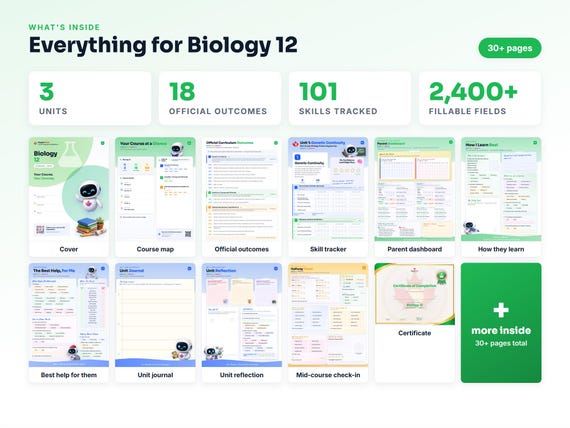


Printable workbook · A keepsake of the year
A Biology 12 workbook worth keeping
Built from the same official curriculum as this page. Before and after each skill above, your student colours in how sure they feel — so the two of you can see, on one page, what's clicking and what needs another look. It's a quiet way to follow how the year is really going.
By June it's full of their own handwriting: units worked through, confidence grown, a mid-year check-in, notes from parent-teacher night, and a certificate at the end. Less a worksheet, more a record of the year worth keeping on the shelf.
Instant download · see every page, reviews and the full description · five or more workbooks are $2.99 each
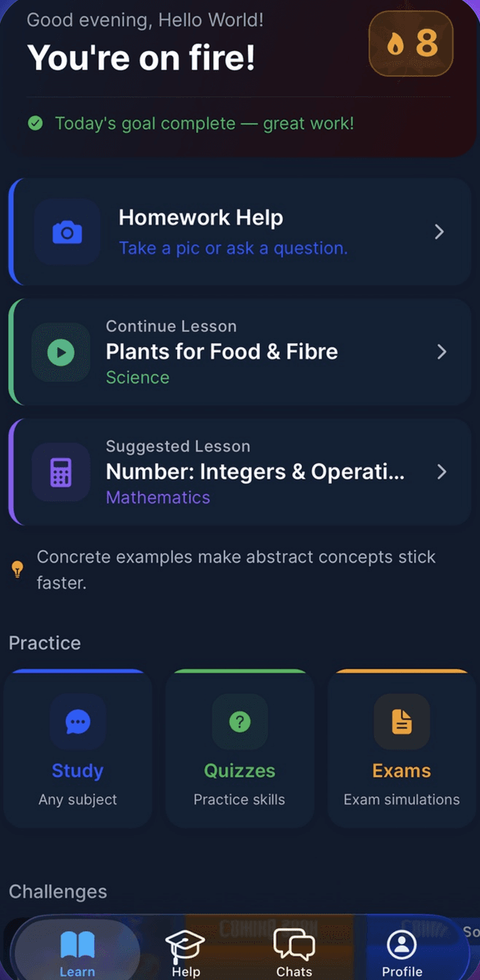
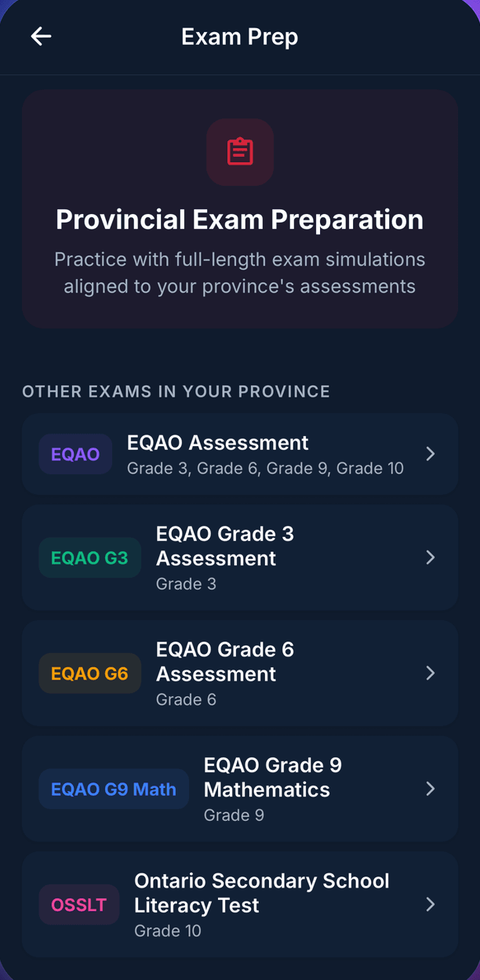
What it looks like in the app

Common questions
Can MapleMind help me with Biology 12?
Yes. MapleMind's AI tutor covers all 101 skills in New Brunswick's Biology 12 — you pick the exact skill, and the tutor teaches it step by step: a short lesson, a worked example, solving together, then a skill check to show it stuck.
Is MapleMind aligned to New Brunswick's official curriculum?
Yes. Every skill in this course maps to an official outcome code from New Brunswick's Grade 12 Science curriculum, and the ministry's own wording is quoted under each unit on this page — with the official government source linked so you can check it yourself.
What does MapleMind cost?
It's free to start — 5 tutoring chats and a practice quiz every day, no credit card. A Pro subscription ($9.99/month or $49.99/year CAD, 7-day free trial) unlocks unlimited tutoring, practice, and exam simulations.
What if I'm stuck on just one topic?
That's the point of skill-level tutoring: open Biology 12 in the app, tap the exact skill from the list on this page, and the tutor teaches just that — no wading through lessons you don't need.
Does MapleMind work in French or other languages?
Yes — 14 languages, including French. Both the app and the tutor's explanations switch to the language you choose.
Where can I see the official New Brunswick curriculum for Biology 12?
The official source is linked on this page — New Brunswick's official K-12 education resources. The outline here follows it: every MapleMind skill carries its official outcome code, and the ministry's own wording is quoted under each unit.
Keep exploring
Ready when you are
Pick a skill from this page and see it taught properly — free, in the browser, in under a minute.