Get help with Physics 12
Most tutoring makes you sit through material you already know. MapleMind flips that: pick the exact skill that's causing trouble — any of the 51 below — and the tutor teaches just that one, step by step, as many times as it takes. Ask questions in plain words, any time of day, in English, French, or 12 other languages.
The official New Brunswick Physics 12 curriculum
New Brunswick defines Physics 12 by strands and outcomes. MapleMind teaches the same curriculum reorganized for one-skill-at-a-time tutoring — the table shows exactly where every official strand lands, and the ministry's own wording is quoted under each unit below.
Official source New Brunswick's official K-12 education resourcesRead it on the government site — www2.gnb.ca ↗| Official strand | Outcomes | Where MapleMind teaches it |
|---|---|---|
| Strand 1 | 23 | Dynamic Extension |
| Strand 2 | 11 | Projectiles, Circular Motion and Universal Gravitation |
| Strand 3 | 17 | Fields |
Every skill below, taught one on one.
 Try the first session free
How MapleMind teaches Physics 12 — every unit, lesson, and skill
Every skill below runs as a short session: a plain-words lesson, a worked example, solving it together, then a five-question skill check that earns up to three stars. Guided Mode keeps it teaching instead of answer-handing — turning it off needs a parent's password.
Unit 1Dynamic ExtensionOfficial strand · Strand 1
Extending dynamics to two dimensions: vector analysis, conservation of momentum and energy in collisions, projectile and circular motion, simple harmonic motion, and Kepler's laws, tested through investigations.
Two-dimensional dynamics and momentum
- Vector analysis in two dimensionsphys12.1.1 — Use vector analysis in two dimensions for systems involving two or more masses and relative motions.
- Conservation of momentum in collisionsphys12.1.2 — Apply quantitatively the laws of conservation of momentum to one- and two-dimensional collisions.
- Choosing energy or momentumphys12.1.3 — Determine which conservation law (energy or momentum) best solves a real-life problem.
- Representing forces as vectors (2D)phys12.1.4 — Use vectors to represent force in two-dimensional systems.
Designing and representing a dynamics investigation
- Designing a dynamics experimentphys12.1.9 — Design an experiment identifying and controlling major variables.
- Selecting instruments and processesphys12.1.10 — Evaluate and select appropriate instruments and processes for a dynamics investigation.
- Carrying out proceduresphys12.1.11 — Carry out procedures controlling major variables and adapting them where required.
- Displaying evidencephys12.1.12 — Compile and display evidence in a variety of formats.
- Modes of representationphys12.1.13 — Select and use appropriate numeric, symbolic, graphical, and linguistic modes of representation.
- Multiple perspectives on an issuephys12.1.14 — Identify multiple perspectives that influence a science-related decision or issue.
- Working cooperativelyphys12.1.15 — Work cooperatively with team members to develop and carry out a plan and troubleshoot problems.
Prototyping and analysing a device
- Designing an experiment (extended)phys12.1.20 — Design an experiment identifying and controlling major variables for an extended investigation.
- Displaying evidence (extended)phys12.1.21 — Compile and display evidence and information in a variety of formats for an extended investigation.
- Building and testing a prototypephys12.1.22 — Construct and test a prototype of a device or system and troubleshoot problems.
- Evaluating a designed devicephys12.1.23 — Evaluate a personally designed and constructed device based on developed criteria.
- Modes of representation (analysis)phys12.1.24 — Select and use appropriate numeric, symbolic, graphical, and linguistic modes of representation to analyse.
- Compiling and organizing dataphys12.1.25 — Compile and organize data using data tables and graphs to facilitate interpretation.
Projectiles, circular motion, and orbits
- Projectile motion (dynamic extension)phys12.1.26 — Analyse quantitatively the horizontal and vertical motion of a projectile.
- Uniform circular motion (algebraic/vector)phys12.1.27 — Describe uniform circular motion using algebraic and vector analysis.
- Circular motion and Newton's lawsphys12.1.28 — Explain quantitatively circular motion using Newton's laws.
- Wave equation (dynamic extension)phys12.1.29 — Apply the wave equation to explain and predict the behaviour of waves.
- Simple harmonic motion energyphys12.1.30 — Explain quantitatively the relationship between potential and kinetic energies of a mass in simple harmonic motion.
- Kepler's laws (dynamic extension)phys12.1.31 — Explain qualitatively Kepler's first and second laws and apply quantitatively Kepler's third law.
The official wording — 23 outcomes in this unit
- phys12.1.1
use vector analysis in two dimensions for systems involving two or more masses, relative motions
- phys12.1.2
apply quantitatively the laws of conservation of momentum to one- and two- dimensional collisions
- phys12.1.3
determine which laws of conservation of energy or momentum are best used to solve particular real-life
- phys12.1.4
use vectors to represent force
- phys12.1.9
design an experiment identifying and controlling major variables
- phys12.1.10
evaluate and select appropriate instruments for collecting evidence and appropriate processes for problem solving
- phys12.1.11
carry out procedures controlling major variables and adapting or extending prodecures where required
- phys12.1.12
compile and display evidence, by hand or computer, in a variety of formats, including diagrams, charts, tables, graphs, and scatter plots
- phys12.1.13
select and use appropriate numeric, symbolic, graphical, and linguistic modes of representations
- phys12.1.14
identify multiple perspectives that influence a science related decision or issue
- phys12.1.15
work cooperatively with team members to develop and carryout a plan, and troubleshoot problems
- phys12.1.20
design and experiment identifying and controlling major variables
- phys12.1.21
compile and display evidence and information, by hand or computer, in a variety of formats, including diagrams, charts, tables, graphs, and scatter plots
- phys12.1.22
construct and test a prototype of a device or system and troubleshoot problems as they arise
- phys12.1.23
evaluate a personally designed and constructed device on the basis of criteria they have developed
- phys12.1.24
select and use appropriate numeric, symbolic, graphical, and linguistic modes of representation to
- phys12.1.25
compile and organize data, using data tables and graphs, to facilitate interpretation of the data
- phys12.1.26
analyse quantitatively the horizontal and vertical motion of a projectile
- phys12.1.27
describe uniform circular motion, using algebraic and vector analysis
- phys12.1.28
explain quantitatively circular motion, using Newton’s laws
- phys12.1.29
apply the wave equation to explain and predict the behaviour of waves
- phys12.1.30
explain quantitatively the relationship between potential and kinetic energies of mass in simple ha
- phys12.1.31
explain qualitatively Kepler’s first and second laws and apply quantitatively Kepler’s third law
Unit 2Projectiles, Circular Motion and Universal GravitationOfficial strand · Strand 2
Projectile and circular motion in depth, simple harmonic motion, Kepler's laws, and Newton's law of universal gravitation applied to orbits.
Projectiles and circular motion in depth
- Building and evaluating a devicephys12.2.3 — Construct, test, and evaluate a device or system on the basis of developed criteria.
- Projectile motion analysisphys12.2.4 — Analyse quantitatively the horizontal and vertical motion of a projectile.
- Projectile motion qualitatively and quantitativelyphys12.2.5 — Analyse qualitatively and quantitatively the horizontal and vertical motion of a projectile.
- Uniform circular motion in depthphys12.2.7 — Describe uniform circular motion using algebraic and vector analysis.
- Circular motion with Newton's lawsphys12.2.8 — Explain quantitatively circular motion using Newton's laws.
- Investigating a developmentphys12.2.9 — Identify questions, analyse, compile, and display evidence to investigate a development.
Harmonic motion and universal gravitation
- SHM: displacement, velocity, accelerationphys12.2.10 — Explain qualitatively the relationship between displacement, velocity, time, and acceleration for simple harmonic motion.
- SHM energy in depthphys12.2.11 — Explain quantitatively the relationship between potential and kinetic energies of a mass in simple harmonic motion.
- Compiling and organizing orbital dataphys12.2.12 — Compile and organize data using data tables and graphs to facilitate interpretation.
- Kepler's laws appliedphys12.2.13 — Explain qualitatively Kepler's first and second laws and apply quantitatively Kepler's third law.
- Universal gravitation and orbitsphys12.2.14 — Use numeric and graphic analysis to explain and apply the law of universal gravitation to orbits.
The official wording — 11 outcomes in this unit
- phys12.2.3
construct, test and evaluate a device or system on the basis of developed criteria
- phys12.2.4
analyse quantitatively the horizontal and vertical motion of a projectile
- phys12.2.5
analyse qualitatively and quantitatively the horizontal and vertical motion of a projectile
- phys12.2.7
describe uniform circular motion using algebraic and vector analysis
- phys12.2.8
explain quantitatively circular motion using Newton’s laws
- phys12.2.9
identify questions, analyse, compile, and display evidence and information to investigate the development
- phys12.2.10
explain qualitatively the relationship between displacement, velocity, time, and acceleration for simple
- phys12.2.11
explain quantitatively the relationship between potential and kinetic energies of a mass in simple harmonic motion
- phys12.2.12
compile and organize data, using data tables and graphs, to facilitate interpretation of the data
- phys12.2.13
explain qualitatively Kepler’s first and second laws and apply quantitatively Kepler’s third law
- phys12.2.14
use appropriate numeric and graphic analysis to explain and apply the law of universal gravitation to orb
Unit 3FieldsOfficial strand · Strand 3
Gravitational, electric, and magnetic fields and field lines; Coulomb's law; Ohm's law and circuits; magnetic forces, electromagnetic induction, motors and generators, and AC/DC.
Fields and forces
- Communicating ideas about fieldsphys12.3.2 — Communicate questions, ideas, and intentions and respond to the ideas of others.
- Fields as regions of spacephys12.3.3 — Describe magnetic, electric, and gravitational fields as regions of space that affect mass and charge.
- Fields affecting mass and chargephys12.3.4 — Describe magnetic, electric, and gravitational fields as regions of space that affect mass and charge.
- Field linesphys12.3.5 — Describe fields by illustrating the source and direction of the field lines.
- Charges and polesphys12.3.6 — Describe electric fields in terms of like and unlike charges, and magnetic fields in terms of poles.
- Newton's law vs Coulomb's lawphys12.3.7 — Compare Newton's law of universal gravitation with Coulomb's law and apply both quantitatively.
Circuits and Ohm's law
- Ohm's law and circuitsphys12.3.8 — Apply Ohm's law to series, parallel, and combination circuits.
- Carrying out circuit proceduresphys12.3.9 — Carry out procedures controlling major variables and selecting and using instruments effectively.
- Circuit procedures (extended)phys12.3.11 — Carry out procedures controlling major variables and using instruments effectively and accurately.
- Predicting and hypothesizing (circuits)phys12.3.12 — State a prediction and a hypothesis based on available evidence and background information.
- Designing a circuit experimentphys12.3.13 — Design an experiment and identify specific variables.
Magnetism and electromagnetic induction
- Magnetic field of a currentphys12.3.18 — Describe the magnetic field produced by a current in a long straight conductor and in a solenoid.
- Force on a moving chargephys12.3.19 — Analyse qualitatively the forces acting on a moving charge in a uniform magnetic field.
- Electromagnetic inductionphys12.3.20 — Analyse qualitatively electromagnetic induction by changing magnetic flux and a moving conductor.
- Motors and generatorsphys12.3.21 — Compare and contrast how a motor and a generator function using electromagnetism.
- Alternating and direct currentphys12.3.22 — Describe and compare direct current and alternating current.
- Selecting and integrating information (fields)phys12.3.25 — Select and integrate information from various print and electronic sources or several parts of the same source.
The official wording — 17 outcomes in this unit
- phys12.3.2
communicate questions, ideas and intentions, and receive, interpret, understand, support and respond to the ideas of others
- phys12.3.3
describe magnetic, electric and gravitational fields as regions of space that affect mass and charge
- phys12.3.4
describe magnetic, electric, and gravitational fields as regions of space that affect mass and charge
- phys12.3.5
describe magnetic, electric, and gravitational fields by illustrating the source and direction of the lines
- phys12.3.6
describe electric fields in terms of like and unlike charges, and magnetic fields in terms of poles
- phys12.3.7
compare Newton’s Law of universal gravitation with Coulomb’s Law, and apply both laws quantitatively
- phys12.3.8
apply Ohm’s Law to series, parallel, and combination circuits
- phys12.3.9
carry out procedures controlling the major variables, selecting and using instruments effectively, accurately
- phys12.3.11
carry out procedures controlling the major variables, selecting and using instruments effectively, accurately
- phys12.3.12
state a prediction and a hypothesis based on available evidence and background information
- phys12.3.13
design an experiment and identify specific variables
- phys12.3.18
describe the magnetic field produced by a current in a long, straight conductor, and in a solenoid
- phys12.3.19
analyse qualitatively the forces acting on a moving charge in a uniform magnetic field
- phys12.3.20
analyse qualitatively electromagnetic induction by both a changing magnetic flux and a moving conductor
- phys12.3.21
compare and contrast the ways a motor and generator function, using the principles of electromagnetism
- phys12.3.22
describe and compare direct current and alternating current
- phys12.3.25
select and integrate information from various print and electronic sources or from several parts of the s
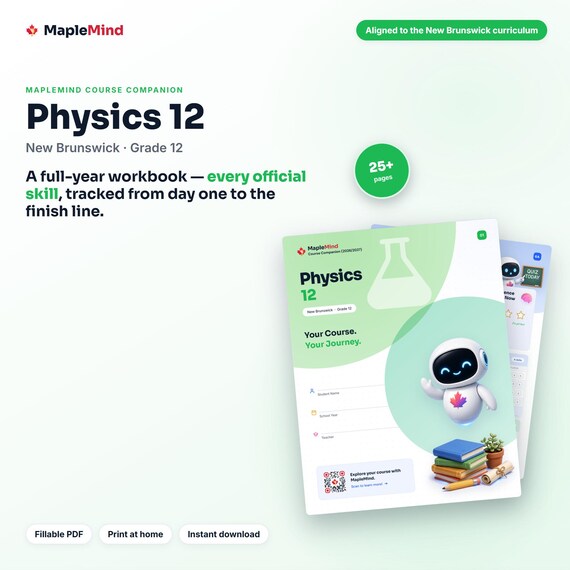
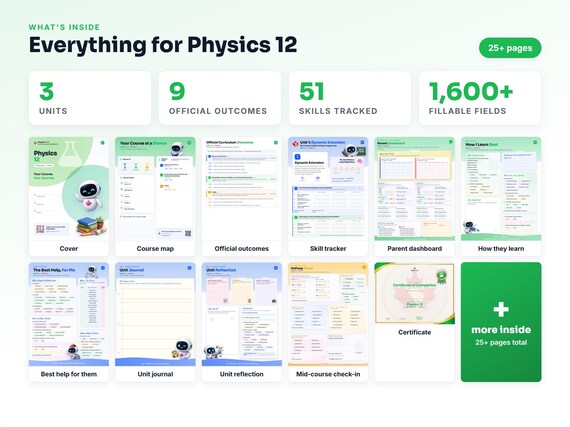
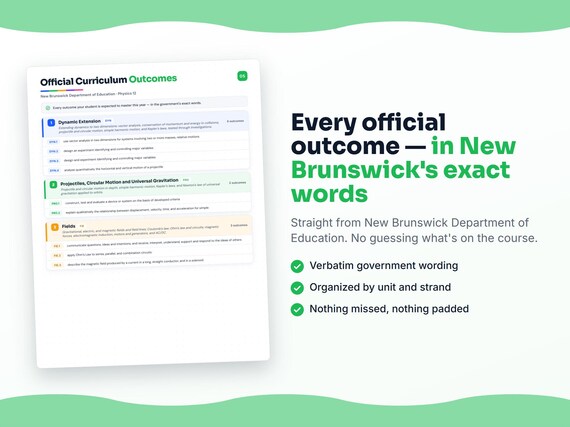

Printable workbook · A keepsake of the year
A Physics 12 workbook worth keeping
Built from the same official curriculum as this page. Before and after each skill above, your student colours in how sure they feel — so the two of you can see, on one page, what's clicking and what needs another look. It's a quiet way to follow how the year is really going.
By June it's full of their own handwriting: units worked through, confidence grown, a mid-year check-in, notes from parent-teacher night, and a certificate at the end. Less a worksheet, more a record of the year worth keeping on the shelf.
Instant download · see every page, reviews and the full description · five or more workbooks are $2.99 each
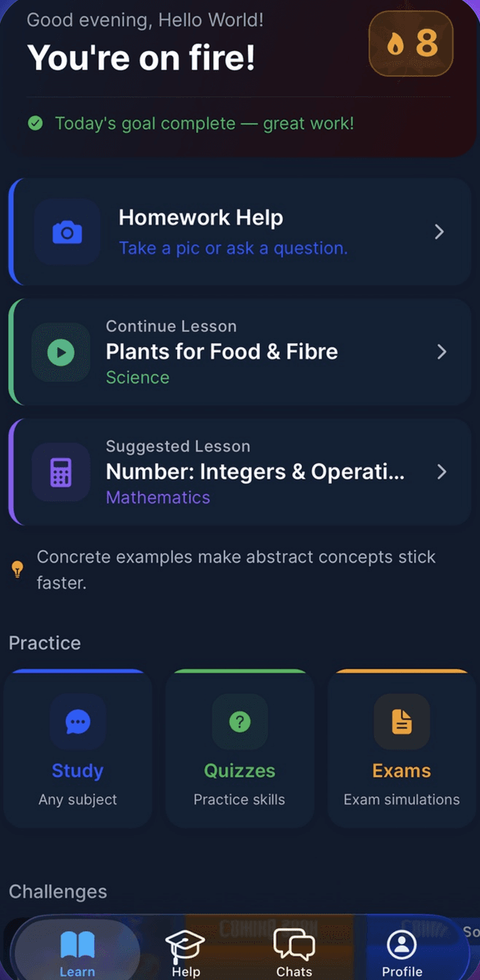
What it looks like in the app

Common questions
Can MapleMind help me with Physics 12?
Yes. MapleMind's AI tutor covers all 51 skills in New Brunswick's Physics 12 — you pick the exact skill, and the tutor teaches it step by step: a short lesson, a worked example, solving together, then a skill check to show it stuck.
Is MapleMind aligned to New Brunswick's official curriculum?
Yes. Every skill in this course maps to an official outcome code from New Brunswick's Grade 12 Science curriculum, and the ministry's own wording is quoted under each unit on this page — with the official government source linked so you can check it yourself.
What does MapleMind cost?
It's free to start — 5 tutoring chats and a practice quiz every day, no credit card. A Pro subscription ($9.99/month or $49.99/year CAD, 7-day free trial) unlocks unlimited tutoring, practice, and exam simulations.
What if I'm stuck on just one topic?
That's the point of skill-level tutoring: open Physics 12 in the app, tap the exact skill from the list on this page, and the tutor teaches just that — no wading through lessons you don't need.
Does MapleMind work in French or other languages?
Yes — 14 languages, including French. Both the app and the tutor's explanations switch to the language you choose.
Where can I see the official New Brunswick curriculum for Physics 12?
The official source is linked on this page — New Brunswick's official K-12 education resources. The outline here follows it: every MapleMind skill carries its official outcome code, and the ministry's own wording is quoted under each unit.
Keep exploring
Ready when you are
Pick a skill from this page and see it taught properly — free, in the browser, in under a minute.