Get help with Pre-Calculus 120A
Most tutoring makes you sit through material you already know. MapleMind flips that: pick the exact skill that's causing trouble — any of the 30 below — and the tutor teaches just that one, step by step, as many times as it takes. Ask questions in plain words, any time of day, in English, French, or 12 other languages.
The official New Brunswick Pre-Calculus 120A curriculum
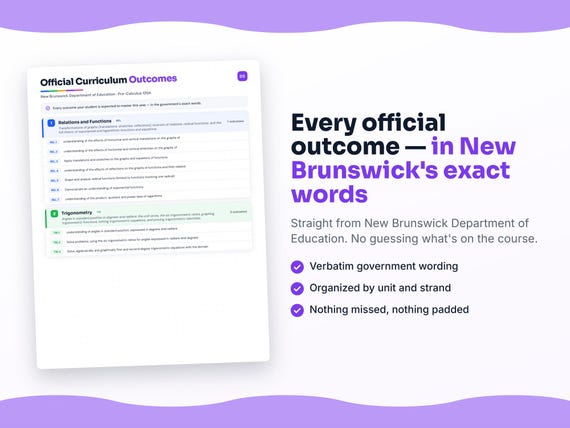
New Brunswick defines Pre-Calculus 120A by strands and outcomes. MapleMind teaches the same curriculum reorganized for one-skill-at-a-time tutoring — the table shows exactly where every official strand lands, and the ministry's own wording is quoted under each unit below.
Official source New Brunswick's official K-12 education resourcesRead it on the government site — www2.gnb.ca ↗| Official strand | Outcomes | Where MapleMind teaches it |
|---|---|---|
| Strand RF | 11 | Relations and Functions |
| Strand T | 6 | Trigonometry |
Every skill below, taught one on one.
 Try the first session free
How MapleMind teaches Pre-Calculus 120A — every unit, lesson, and skill
Every skill below runs as a short session: a plain-words lesson, a worked example, solving it together, then a five-question skill check that earns up to three stars. Guided Mode keeps it teaching instead of answer-handing — turning it off needs a parent's password.
Unit 1Relations and FunctionsOfficial strand · Strand RF
Transformations of graphs (translations, stretches, reflections), inverses of relations, radical functions, and the full theory of exponential and logarithmic functions and equations.
Translations of graphs
- Vertical translationsRF1 — Analyze how adding a constant to a function shifts its graph vertically and changes its equation.
- Horizontal translationsRF1 — Analyze how replacing x with (x - h) shifts a graph horizontally and why the direction appears reversed.
Stretches of graphs
- Vertical stretchesRF2 — Analyze how multiplying a function by a constant stretches or compresses its graph vertically.
- Horizontal stretchesRF2 — Analyze how the factor multiplying x stretches or compresses a graph horizontally by its reciprocal.
Combining transformations
- Applying combined translations and stretchesRF3 — Apply translations and stretches together to sketch the graph of y = a·f(b(x - h)) + k from a base function.
- Writing the equation of a transformed graphRF3 — Determine the parameters a, b, h, and k from a transformed graph and write its equation.
Reflections and inverses
- Reflections in the x- and y-axesRF4 — Analyze how negating outputs or inputs reflects a graph across the x-axis or the y-axis.
- Reflection in the line y = xRF4 — Analyze how reflecting a graph in the line y = x swaps its coordinates and previews the idea of an inverse.
- Inverses of relations and the y = x reflectionRF5 — Find the inverse of a relation by swapping x and y, and graph it as the reflection of the relation in the line y = x.
- When is the inverse a function?RF5 — Determine whether the inverse of a relation is a function and restrict the domain of a relation so its inverse becomes a function.
Radical functions
- Graphing and analyzing radical functionsRF6 — Graph a radical function of the form y = a√(b(x - h)) + k and determine its domain and range.
- Solving radical equations from the graphRF6 — Solve a radical equation graphically as the intersection of a radical function with another graph, and check for extraneous roots.
Exponential and logarithmic functions
- Understanding exponential functionsRF7 — Demonstrate an understanding of exponential functions, including growth and decay and the role of the base.
- Modelling growth and decay with exponentialsRF7 — Build an exponential model of a growth or decay situation and interpret the initial value and growth factor.
- Understanding logarithmsRF8 — Demonstrate an understanding of logarithms as the inverse of exponentiation, and convert between logarithmic and exponential form.
- Graphing exponential and logarithmic functionsRF9 — Graph and analyze exponential and logarithmic functions, including asymptotes, intercepts, domain, and range.
- Transformations of exponential and logarithmic graphsRF9 — Graph and analyze transformed exponential and logarithmic functions, tracking the movement of the asymptote.
Laws of logarithms and exponential/log equations
- Product, quotient, and power laws of logarithmsRF10 — Apply the product, quotient, and power laws of logarithms to expand and condense logarithmic expressions.
- Solving exponential and logarithmic equationsRF11 — Solve exponential and logarithmic equations using logarithms and the laws of logarithms.
The official wording — 11 outcomes in this unit
- RF1
understanding of the effects of horizontal and vertical translations on the graphs of
- RF2
understanding of the effects of horizontal and vertical stretches on the graphs of
- RF3
Apply translations and stretches to the graphs and equations of functions
- RF4
understanding of the effects of reflections on the graphs of functions and their related
- RF5
Demonstrate an understanding of inverses of relations
- RF6
Graph and analyze radical functions (limited to functions involving one radical)
- RF7
Demonstrate an understanding of exponential functions
- RF8
Demonstrate an understanding of logarithms
- RF9
Graph and analyze exponential and logarithmic functions
- RF10
understanding of the product, quotient and power laws of logarithms
- RF11
Solve problems that involve exponential and logarithmic equations
Unit 2TrigonometryOfficial strand · Strand T
Angles in standard position in degrees and radians, the unit circle, the six trigonometric ratios, graphing trigonometric functions, solving trigonometric equations, and proving trigonometric identities.
Angles and the unit circle
- Angles in standard position: degrees and radiansT1 — Represent angles in standard position in both degrees and radians, and convert between the two measures.
- Arc length and the meaning of a radianT1 — Interpret a radian as an arc-length ratio and compute arc length using s = rθ.
- The equation of the unit circleT2 — Develop the equation of the unit circle and use it to relate coordinates to the cosine and sine of an angle.
Trigonometric ratios and graphs
- Solving problems with the six trigonometric ratiosT3 — Solve problems using the six trigonometric ratios for angles expressed in radians and degrees.
- Exact values at special anglesT3 — Determine exact values of the trigonometric ratios at special angles using the unit circle and special triangles.
- Graphing sine, cosine, and tangentT4 — Graph and analyze the sine, cosine, and tangent functions, identifying amplitude, period, and asymptotes.
- Transformed sinusoidal graphs and modellingT4 — Graph transformed sinusoidal functions with amplitude, period, phase shift, and vertical shift, and use them to model periodic phenomena.
Trigonometric equations and identities
- Solving trigonometric equationsT5 — Solve first- and second-degree trigonometric equations algebraically and graphically over a stated domain in degrees and radians.
- Solving trigonometric equations graphicallyT5 — Solve trigonometric equations graphically by locating intersection points and interpreting solutions across periods.
- Proving reciprocal, quotient, and Pythagorean identitiesT6 — Prove trigonometric identities using the reciprocal, quotient, and Pythagorean identities.
- Proving with sum, difference, and double-angle identitiesT6 — Prove trigonometric identities using the sum, difference, and double-angle identities for sine, cosine, and tangent.
The official wording — 6 outcomes in this unit
- T1
understanding of angles in standard position, expressed in degrees and radians
- T2
Develop and apply the equation of the unit circle
- T3
Solve problems, using the six trigonometric ratios for angles expressed in radians and degrees
- T4
Graph and analyze the trigonometric functions sine, cosine and tangent to solve problems
- T5
Solve, algebraically and graphically, first and second degree trigonometric equations with the domain
- T6
Prove trigonometric identities, using reciprocal identities, quotient identities, Pythagorean identities
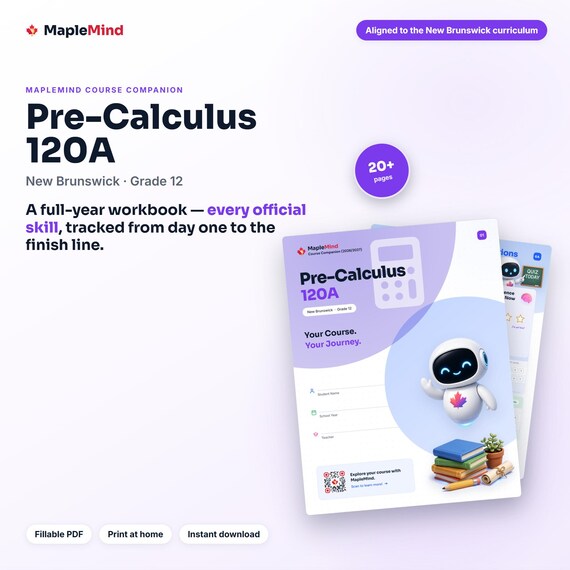
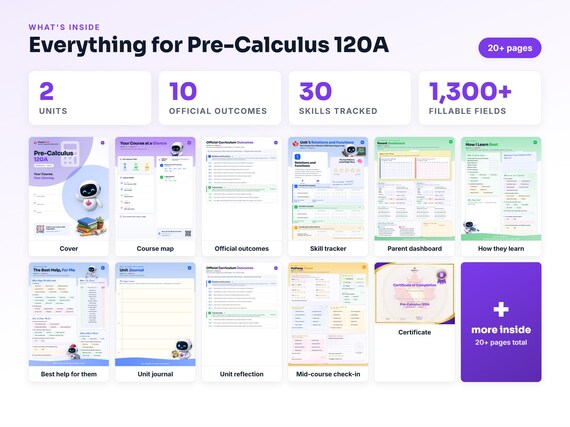
Printable workbook · A keepsake of the year
A Pre-Calculus 120A workbook worth keeping
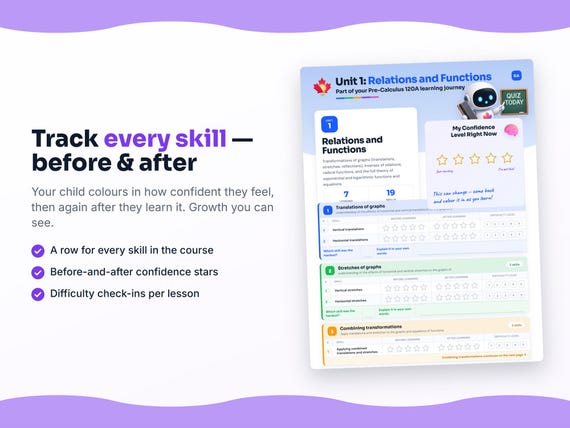
Built from the same official curriculum as this page. Before and after each skill above, your student colours in how sure they feel — so the two of you can see, on one page, what's clicking and what needs another look. It's a quiet way to follow how the year is really going.
By June it's full of their own handwriting: units worked through, confidence grown, a mid-year check-in, notes from parent-teacher night, and a certificate at the end. Less a worksheet, more a record of the year worth keeping on the shelf.
Instant download · see every page, reviews and the full description · five or more workbooks are $2.99 each
What it looks like in the app



Common questions
Can MapleMind help me with Pre-Calculus 120A?
Yes. MapleMind's AI tutor covers all 30 skills in New Brunswick's Pre-Calculus 120A — you pick the exact skill, and the tutor teaches it step by step: a short lesson, a worked example, solving together, then a skill check to show it stuck.
Is MapleMind aligned to New Brunswick's official curriculum?
Yes. Every skill in this course maps to an official outcome code from New Brunswick's Grade 12 Mathematics curriculum, and the ministry's own wording is quoted under each unit on this page — with the official government source linked so you can check it yourself.
What does MapleMind cost?
It's free to start — 5 tutoring chats and a practice quiz every day, no credit card. A Pro subscription ($9.99/month or $49.99/year CAD, 7-day free trial) unlocks unlimited tutoring, practice, and exam simulations.
What if I'm stuck on just one topic?
That's the point of skill-level tutoring: open Pre-Calculus 120A in the app, tap the exact skill from the list on this page, and the tutor teaches just that — no wading through lessons you don't need.
Does MapleMind work in French or other languages?
Yes — 14 languages, including French. Both the app and the tutor's explanations switch to the language you choose.
Where can I see the official New Brunswick curriculum for Pre-Calculus 120A?
The official source is linked on this page — New Brunswick's official K-12 education resources. The outline here follows it: every MapleMind skill carries its official outcome code, and the ministry's own wording is quoted under each unit.
Keep exploring
Ready when you are
Pick a skill from this page and see it taught properly — free, in the browser, in under a minute.