Get help with Financial and Workplace Mathematics 110
Most tutoring makes you sit through material you already know. MapleMind flips that: pick the exact skill that's causing trouble — any of the 30 below — and the tutor teaches just that one, step by step, as many times as it takes. Ask questions in plain words, any time of day, in English, French, or 12 other languages.
The official New Brunswick Financial and Workplace Mathematics 110 curriculum
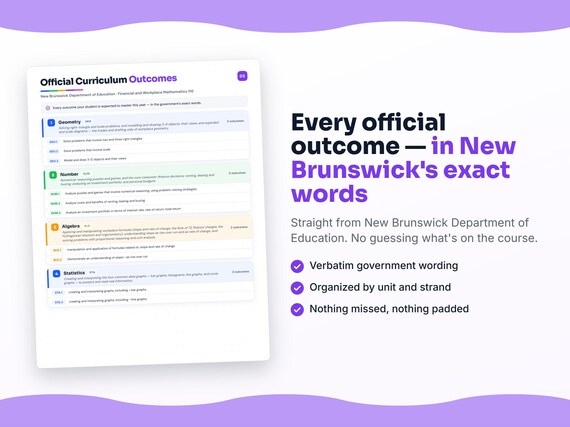
New Brunswick defines Financial and Workplace Mathematics 110 by strands and outcomes. MapleMind teaches the same curriculum reorganized for one-skill-at-a-time tutoring — the table shows exactly where every official strand lands, and the ministry's own wording is quoted under each unit below.
Official source New Brunswick's official K-12 education resourcesRead it on the government site — www2.gnb.ca ↗| Official strand | Outcomes | Where MapleMind teaches it |
|---|---|---|
| Strand G | 4 | Geometry |
| Strand N | 4 | Number |
| Strand A | 3 | Algebra |
| Strand S | 1 | Statistics |
Every skill below, taught one on one.
 Try the first session free
How MapleMind teaches Financial and Workplace Mathematics 110 — every unit, lesson, and skill
Every skill below runs as a short session: a plain-words lesson, a worked example, solving it together, then a five-question skill check that earns up to three stars. Guided Mode keeps it teaching instead of answer-handing — turning it off needs a parent's password.
Unit 1GeometryOfficial strand · Strand G
Solving right-triangle and scale problems, and modelling and drawing 3-D objects, their views, and exploded and scale diagrams — the trades and drafting side of workplace geometry.
Right-triangle problems on the job
- Solving a single right triangleG1 — Solve a single right-triangle problem using the Pythagorean theorem and the primary trigonometric ratios.
- Chaining two and three right trianglesG1 — Solve problems involving two or three right triangles that share a side, carrying a result from one triangle to the next.
- Angles of elevation and depressionG1 — Solve right-triangle problems involving angles of elevation and depression to find heights and distances.
Scale and proportion
- Working with scale drawingsG2 — Solve scale problems by converting between drawing measurements and actual measurements using a scale factor.
- Scale, area, and material estimatesG2 — Use a scale drawing to estimate actual areas and material quantities, accounting for how the scale factor affects area.
3-D objects, views, and exploded diagrams
- Modelling and drawing 3-D objects and their viewsG3 — Model a 3-D object and draw its top, front, and side views.
- Isometric drawings of 3-D objectsG3 — Model a 3-D object as an isometric drawing on isometric grid paper.
- Exploded views and scale diagramsG4 — Draw and describe exploded views, component parts, and scale diagrams of a simple 3-D object.
- Describing component parts for assemblyG4 — Identify and describe the component parts of an object and read assembly steps from an exploded diagram.
The official wording — 4 outcomes in this unit
- G1
Solve problems that involve two and three right triangles
- G2
Solve problems that involve scale
- G3
Model and draw 3-D objects and their views
- G4
Draw and describe exploded views, component parts and scale diagrams of simple 3-D objects
Unit 2NumberOfficial strand · Strand N
Numerical-reasoning puzzles and games, and the core consumer-finance decisions: renting, leasing and buying; analyzing an investment portfolio; and personal budgets.
Puzzles and games: numerical reasoning
- Finding a strategy in a number gameN1 — Use numerical reasoning to find and test a strategy for a puzzle or game.
- Explaining why a strategy worksN1 — Explain the numerical reasoning that makes a game or puzzle strategy work.
Renting, leasing, and buying
- Comparing the costs of renting, leasing, and buyingN2 — Calculate and compare the total costs of renting, leasing, and buying over a period.
- Making the rent-lease-buy decisionN2 — Weigh the non-cost benefits of renting, leasing, and buying to make and justify a decision.
Investments and budgets
- Analyzing an investment portfolioN3 — Analyze an investment portfolio by computing interest rate, rate of return, and total return.
- Comparing investments and weighing riskN3 — Compare the investments in a portfolio and weigh return against risk to judge overall performance.
- Building a personal budgetN4 — Build a personal budget from net income and categorized fixed and variable expenses.
- Adjusting a budget to reach a goalN4 — Adjust a personal budget to meet a savings goal or absorb an income or expense change.
The official wording — 4 outcomes in this unit
- N1
Analyze puzzles and games that involve numerical reasoning, using problem-solving strategies
- N2
Analyze costs and benefits of renting, leasing and buying
- N3
Analyze an investment portfolio in terms of interest rate, rate of return, total return
- N4
Solve problems that involve personal budgets
Unit 3AlgebraOfficial strand · Strand A
Applying and manipulating workplace formulas (slope and rate of change, the Rule of 72, finance charges, the Pythagorean theorem and trigonometry), understanding slope as rise over run and as rate of change, and solving problems with proportional reasoning and unit analysis.
Workplace formulas
- Slope and rate-of-change formulasA1 — Manipulate and apply the slope and rate-of-change formula to workplace problems.
- The Rule of 72A1 — Apply the Rule of 72 to estimate the doubling time of an investment or debt.
- Finance chargesA1 — Compute finance charges to find the true cost of using credit.
- Pythagorean and trigonometric formulasA1 — Manipulate and apply the Pythagorean theorem and trigonometric ratio formulas to solve for any quantity.
Slope and proportional reasoning
- Slope as rise over runA2 — Understand and compute slope as rise over run from a graph or two points.
- Slope as a rate of changeA2 — Interpret slope as a rate of change in a real workplace context and use it to solve problems.
- Solving problems with slope on cost graphsA2 — Solve problems from a linear cost graph, reading the slope as a per-unit rate and the intercept as a fixed cost.
- Proportional reasoning and unit analysisA3 — Solve workplace problems using proportional reasoning and unit analysis to convert and check units.
- Unit pricing and best-buy decisionsA3 — Use unit pricing to compare products of different sizes and identify the best buy.
The official wording — 3 outcomes in this unit
- A1
manipulation and application of formulas related to: slope and rate of change
- A2
Demonstrate an understanding of slope: • as rise over run
- A3
Solve problems by applying proportional reasoning and unit analysis
Unit 4StatisticsOfficial strand · Strand S
Creating and interpreting the four common data graphs — bar graphs, histograms, line graphs, and circle graphs — to present and read real information.
Bar graphs and histograms
- Creating and interpreting bar graphsS1 — Create and interpret bar graphs to compare data across categories.
- Creating and interpreting histogramsS1 — Create and interpret histograms to show how continuous data is distributed across intervals.
Line graphs and circle graphs
- Creating and interpreting line graphsS1 — Create and interpret line graphs to show change over time and read trends.
- Creating and interpreting circle graphsS1 — Create and interpret circle graphs to show the parts of a whole as percentages.
The official wording — 1 outcome in this unit
- S1
creating and interpreting graphs, including: • bar graphs

Printable workbook · A keepsake of the year
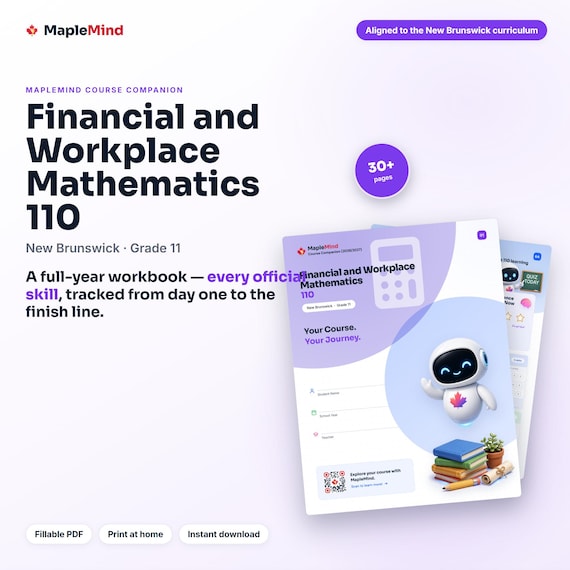
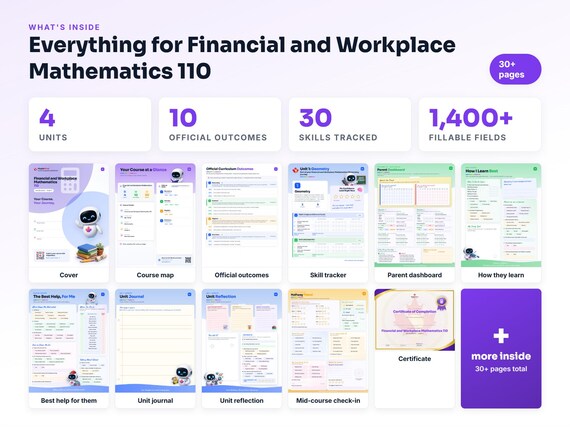
A Financial and Workplace Mathematics 110 workbook worth keeping
Built from the same official curriculum as this page. Before and after each skill above, your student colours in how sure they feel — so the two of you can see, on one page, what's clicking and what needs another look. It's a quiet way to follow how the year is really going.
By June it's full of their own handwriting: units worked through, confidence grown, a mid-year check-in, notes from parent-teacher night, and a certificate at the end. Less a worksheet, more a record of the year worth keeping on the shelf.
Instant download · see every page, reviews and the full description · five or more workbooks are $2.99 each
What it looks like in the app



Common questions
Can MapleMind help me with Financial and Workplace Mathematics 110?
Yes. MapleMind's AI tutor covers all 30 skills in New Brunswick's Financial and Workplace Mathematics 110 — you pick the exact skill, and the tutor teaches it step by step: a short lesson, a worked example, solving together, then a skill check to show it stuck.
Is MapleMind aligned to New Brunswick's official curriculum?
Yes. Every skill in this course maps to an official outcome code from New Brunswick's Grade 11 Mathematics curriculum, and the ministry's own wording is quoted under each unit on this page — with the official government source linked so you can check it yourself.
What does MapleMind cost?
It's free to start — 5 tutoring chats and a practice quiz every day, no credit card. A Pro subscription ($9.99/month or $49.99/year CAD, 7-day free trial) unlocks unlimited tutoring, practice, and exam simulations.
What if I'm stuck on just one topic?
That's the point of skill-level tutoring: open Financial and Workplace Mathematics 110 in the app, tap the exact skill from the list on this page, and the tutor teaches just that — no wading through lessons you don't need.
Does MapleMind work in French or other languages?
Yes — 14 languages, including French. Both the app and the tutor's explanations switch to the language you choose.
Where can I see the official New Brunswick curriculum for Financial and Workplace Mathematics 110?
The official source is linked on this page — New Brunswick's official K-12 education resources. The outline here follows it: every MapleMind skill carries its official outcome code, and the ministry's own wording is quoted under each unit.
Keep exploring
Ready when you are
Pick a skill from this page and see it taught properly — free, in the browser, in under a minute.