Get help with Financial and Workplace Mathematics 120
Most tutoring makes you sit through material you already know. MapleMind flips that: pick the exact skill that's causing trouble — any of the 30 below — and the tutor teaches just that one, step by step, as many times as it takes. Ask questions in plain words, any time of day, in English, French, or 12 other languages.
The official New Brunswick Financial and Workplace Mathematics 120 curriculum
New Brunswick defines Financial and Workplace Mathematics 120 by strands and outcomes. MapleMind teaches the same curriculum reorganized for one-skill-at-a-time tutoring — the table shows exactly where every official strand lands, and the ministry's own wording is quoted under each unit below.
Official source New Brunswick's official K-12 education resourcesRead it on the government site — www2.gnb.ca ↗| Official strand | Outcomes | Where MapleMind teaches it |
|---|---|---|
| Strand M | 1 | Measurement |
| Strand G | 3 | Geometry |
| Strand N | 2 | Number |
| Strand A | 1 | Algebra |
| Strand S | 2 | Statistics |
| Strand P | 1 | Probability |
| Strand RP | 1 | Mathematical Research Project |
Every skill below, taught one on one.
 Try the first session free
How MapleMind teaches Financial and Workplace Mathematics 120 — every unit, lesson, and skill
Every skill below runs as a short session: a plain-words lesson, a worked example, solving it together, then a five-question skill check that earns up to three stars. Guided Mode keeps it teaching instead of answer-handing — turning it off needs a parent's password.
Unit 1MeasurementOfficial strand · Strand M
Understanding the limitations of measuring instruments — precision, accuracy, uncertainty, and tolerance — and solving workplace problems within those limits.
Limits of measuring instruments
- Precision, accuracy, and uncertaintyM1 — Distinguish precision from accuracy and state the uncertainty in a measurement from the instrument used.
- Tolerance and solving problemsM1 — Use tolerance to decide whether a measured part is acceptable and solve problems within a tolerance range.
- Significant figures and reporting measurementsM1 — Report measurements and calculation results to a number of significant figures consistent with the instrument's limitation.
The official wording — 1 outcome in this unit
- M1
the limitations of measuring instruments, including precision, accuracy, uncertainty
Unit 2GeometryOfficial strand · Strand G
Solving problems with triangles, quadrilaterals and regular polygons; using the sine law and cosine law (excluding the ambiguous case); and understanding transformations of 2-D shapes and 3-D objects.
Triangles, quadrilaterals, and regular polygons
- Triangle and quadrilateral problemsG1 — Solve problems involving the angles, sides, and area of triangles and quadrilaterals.
- Regular polygon problemsG1 — Solve problems involving the interior angles and area of regular polygons.
- Perimeter and area of composite figuresG1 — Find the perimeter and area of composite figures made of triangles, quadrilaterals, and regular polygons.
Sine law and cosine law
- Solving triangles with the sine lawG2 — Use the sine law to solve oblique triangles in the unambiguous cases (excluding the ambiguous case).
- Solving triangles with the cosine lawG2 — Use the cosine law to solve triangles when two sides and the included angle, or all three sides, are known.
- Choosing and applying the right law in contextG2 — Decide whether the sine law or cosine law fits a real problem and solve multi-step oblique-triangle problems.
Transformations of shapes and objects
- Translations, rotations, and reflectionsG3 — Understand translations, rotations, and reflections of 2-D shapes and 3-D objects as rigid transformations.
- Dilations and resizingG3 — Understand dilations of 2-D shapes and 3-D objects as enlargements or reductions by a scale factor.
The official wording — 3 outcomes in this unit
- G1
Solve problems that involve triangles, quadrilaterals
- G2
Solve problems by using the sine law and cosine law, excluding the ambiguous case
- G3
transformations o a 2-D shape or a 3-D object, including translations, rotations, reflections
Unit 3NumberOfficial strand · Strand N
Analyzing puzzles and games that involve logical reasoning, and critiquing the viability of small-business options by weighing expenses, sales, and profit or loss.
Puzzles and games: logical reasoning
- Finding a logical strategy in a puzzle or gameN1 — Use logical reasoning to find and test a strategy for a puzzle or game.
- Justifying a logical strategyN1 — Explain and justify the logical reasoning behind a puzzle solution or game strategy.
Small-business viability
- Expenses, sales, and profit or lossN2 — Compute a small business's profit or loss from its expenses and sales.
- Break-even and critiquing viabilityN2 — Find a small business's break-even point and critique whether the option is viable.
- Comparing small-business optionsN2 — Compare two or more small-business options on expenses, sales, and profit to recommend the better choice.
The official wording — 2 outcomes in this unit
- N1
Analyze puzzles and games that involve logical reasoning, using problem-solving strategies
- N2
the viability of small business options by considering expenses, sales, profit or loss
Unit 4AlgebraOfficial strand · Strand A
Understanding linear relations by recognizing patterns and trends, graphing, creating tables of values, writing equations, and interpolating and extrapolating to solve problems.
Linear relations
- Patterns, trends, and tables of valuesA1 — Recognize a linear pattern or trend and organize it in a table of values.
- Graphing a linear relationA1 — Graph a linear relation from a table of values and read its slope and intercept.
- Writing the equation of a linear relationA1 — Write the equation of a linear relation from its pattern, table, or graph.
- Interpolating, extrapolating, and solving problemsA1 — Interpolate and extrapolate on a linear relation to predict values and solve problems.
The official wording — 1 outcome in this unit
- A1
Demonstrate an understanding of linear relations by recognizing patterns and trends, graphing, creating tables of values
Unit 5StatisticsOfficial strand · Strand S
Solving problems with measures of central tendency (mean, median, mode, weighted mean, trimmed mean) and analyzing and describing percentiles.
Measures of central tendency
- Mean, median, and modeS1 — Compute the mean, median, and mode and decide which best represents a data set.
- Weighted mean and trimmed meanS1 — Compute a weighted mean and a trimmed mean and explain when each is used.
- Choosing a measure and spotting misleading statisticsS1 — Choose the most representative measure of central tendency for a purpose and recognize when a statistic is misleading.
Percentiles
- Analyzing and describing percentilesS2 — Find and interpret percentiles and percentile rank to describe a value's standing in a data set.
- Quartiles and box plotsS2 — Find quartiles and use them to make and interpret a box plot describing a data set's spread.
The official wording — 2 outcomes in this unit
- S1
problems that involve measures of central tendency, including mean, median, mode
- S2
Analyze and describe percentiles
Unit 6ProbabilityOfficial strand · Strand P
Analyzing and interpreting problems that involve probability in real, consumer contexts.
Interpreting probability
- Computing and expressing probabilityP1 — Compute the probability of an event and express it as a fraction, percent, and odds.
- Interpreting probability in decisionsP1 — Interpret probabilities in real contexts to inform a decision and reason about likely outcomes.
The official wording — 1 outcome in this unit
- P1
Analyze and interpret problems that involve probability
Unit 7Mathematical Research ProjectOfficial strand · Strand RP
Researching and presenting on a historical event or an area of interest that involves mathematics — a staged inquiry project.
The mathematical research project
- Framing the research inquiryRP1 — Choose a historical event or area of interest involving mathematics, form a focused question, and plan sources.
- Researching and doing the mathematicsRP1 — Gather information and carry out the mathematics needed to answer the research question.
- Presenting the findingsRP1 — Prepare and deliver a clear presentation of the research findings and their mathematics.
The official wording — 1 outcome in this unit
- RP1
Research and give a presentation on a historical event or an area of interest that involves mathematics
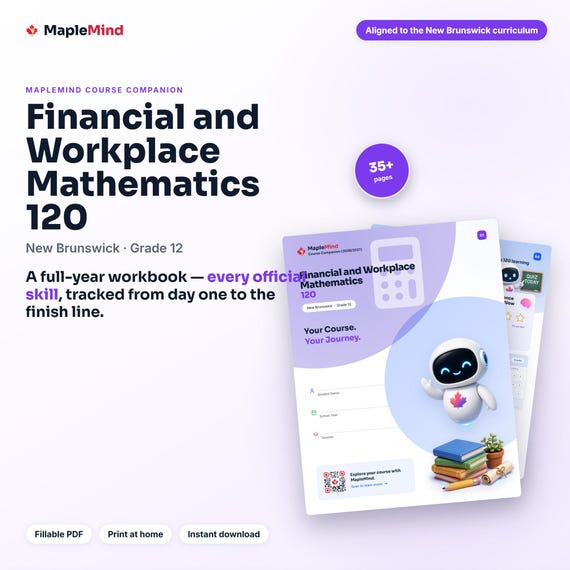
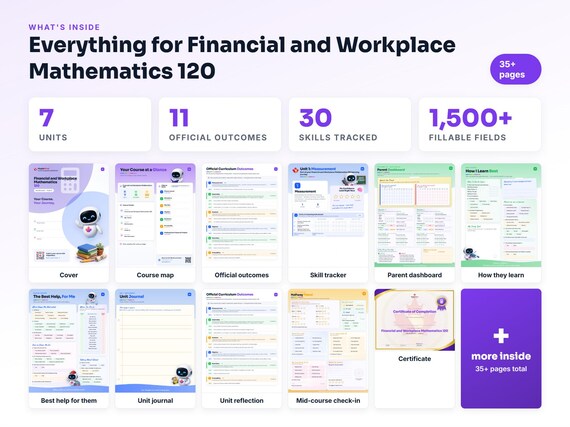
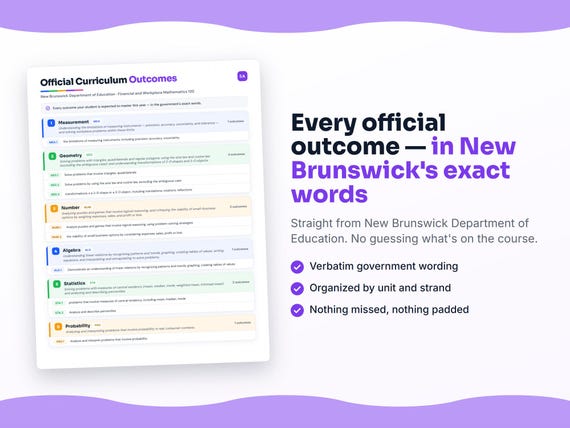
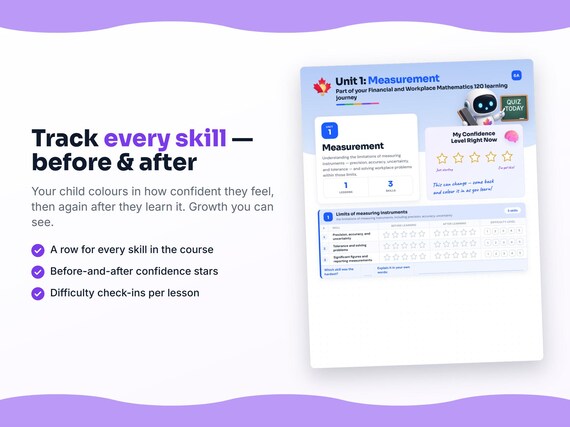
Printable workbook · A keepsake of the year
A Financial and Workplace Mathematics 120 workbook worth keeping
Built from the same official curriculum as this page. Before and after each skill above, your student colours in how sure they feel — so the two of you can see, on one page, what's clicking and what needs another look. It's a quiet way to follow how the year is really going.
By June it's full of their own handwriting: units worked through, confidence grown, a mid-year check-in, notes from parent-teacher night, and a certificate at the end. Less a worksheet, more a record of the year worth keeping on the shelf.
Instant download · see every page, reviews and the full description · five or more workbooks are $2.99 each
What it looks like in the app



Common questions
Can MapleMind help me with Financial and Workplace Mathematics 120?
Yes. MapleMind's AI tutor covers all 30 skills in New Brunswick's Financial and Workplace Mathematics 120 — you pick the exact skill, and the tutor teaches it step by step: a short lesson, a worked example, solving together, then a skill check to show it stuck.
Is MapleMind aligned to New Brunswick's official curriculum?
Yes. Every skill in this course maps to an official outcome code from New Brunswick's Grade 12 Mathematics curriculum, and the ministry's own wording is quoted under each unit on this page — with the official government source linked so you can check it yourself.
What does MapleMind cost?
It's free to start — 5 tutoring chats and a practice quiz every day, no credit card. A Pro subscription ($9.99/month or $49.99/year CAD, 7-day free trial) unlocks unlimited tutoring, practice, and exam simulations.
What if I'm stuck on just one topic?
That's the point of skill-level tutoring: open Financial and Workplace Mathematics 120 in the app, tap the exact skill from the list on this page, and the tutor teaches just that — no wading through lessons you don't need.
Does MapleMind work in French or other languages?
Yes — 14 languages, including French. Both the app and the tutor's explanations switch to the language you choose.
Where can I see the official New Brunswick curriculum for Financial and Workplace Mathematics 120?
The official source is linked on this page — New Brunswick's official K-12 education resources. The outline here follows it: every MapleMind skill carries its official outcome code, and the ministry's own wording is quoted under each unit.
Keep exploring
Ready when you are
Pick a skill from this page and see it taught properly — free, in the browser, in under a minute.