Get help with Law 120
Most tutoring makes you sit through material you already know. MapleMind flips that: pick the exact skill that's causing trouble — any of the 115 below — and the tutor teaches just that one, step by step, as many times as it takes. Ask questions in plain words, any time of day, in English, French, or 12 other languages.
The official New Brunswick Law 120 curriculum
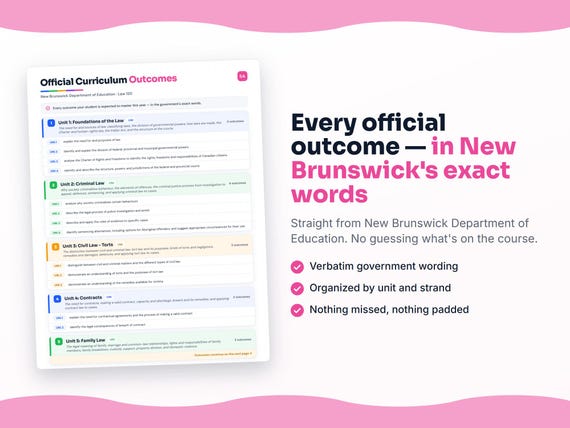
New Brunswick defines Law 120 by strands and outcomes. MapleMind teaches the same curriculum reorganized for one-skill-at-a-time tutoring — the table shows exactly where every official strand lands, and the ministry's own wording is quoted under each unit below.
Official source New Brunswick's official K-12 education resourcesRead it on the government site — www2.gnb.ca ↗| Official strand | Outcomes | Where MapleMind teaches it |
|---|---|---|
| Strand 1 | 11 | Unit 1: Foundations of the Law |
| Strand 2 | 14 | Unit 2: Criminal Law |
| Strand 3 | 11 | Unit 3: Civil Law - Torts |
| Strand 4 | 8 | Unit 4: Contracts |
| Strand 5 | 13 | Unit 5: Family Law |
| Strand 6 | 11 | Unit 6: Estate Law |
| Strand 7 | 7 | Unit 7: Environmental Law |
| Strand 8 | 4 | Unit 8: Consumer Law |
| Strand 9 | 6 | Unit 9: Aboriginal Peoples and Law |
| Strand 10 | 3 | Unit 10: International Law |
| Strand 11 | 5 | Unit 11: Labour Law |
| Strand 12 | 7 | Unit 12: Youth and the Law |
| Strand 13 | 9 | Unit 13: Human Rights |
| Strand 14 | 6 | Unit 14: Property Law |
Every skill below, taught one on one.
 Try the first session free
How MapleMind teaches Law 120 — every unit, lesson, and skill
Every skill below runs as a short session: a plain-words lesson, a worked example, solving it together, then a five-question skill check that earns up to three stars. Guided Mode keeps it teaching instead of answer-handing — turning it off needs a parent's password.
Unit 1Unit 1: Foundations of the LawOfficial strand · Strand 1
The need for and sources of law, classifying laws, the division of governmental powers, how laws are made, the Charter and human-rights law, the Indian Act, and the structure of the courts.
Law, Its Sources, and Types
- The need for and purposes of law1.1 — Explain the need for law in society and the purposes it serves - order, resolving disputes, protecting people and rights, and expressing shared values.
- Historical sources of our laws1.2 — Identify the historical sources of Canadian law - including common law, civil law traditions, and statute - and explain how law evolved and continues to change.
- Classifying laws by type1.3 — Classify laws by type - such as public versus private law, and substantive versus procedural law.
Government Powers and Making Laws
- Division of governmental powers1.4 — Identify and explain the division of federal, provincial, and municipal governmental powers over law-making.
- How laws are made in Canada1.5 — Describe and explain the process by which laws are made in Canada - from bill to statute through Parliament and royal assent.
Rights, Human Rights Law, and the Indian Act
- The Charter of Rights and Freedoms1.6 — Analyse the Canadian Charter of Rights and Freedoms to identify the rights, freedoms, and responsibilities of Canadian citizens.
- The NB Human Rights Act1.7 — Analyse the New Brunswick Human Rights Act to identify the rights, freedoms, and responsibilities of New Brunswick citizens.
- The structure of the Indian Act1.8 — Identify and describe the structure, powers, and jurisdiction of the Indian Act as a federal law affecting First Nations.
- Impact of the Indian Act on Aboriginal peoples1.8.1 — Assess the impact of the Indian Act on the rights, freedoms, and responsibilities of Aboriginal peoples, taught truthfully.
- Applying human rights law to cases1.9 — Apply an understanding of human rights law to specific cases, reasoning from the Charter and human-rights legislation.
The Structure of the Courts
- Structure of federal and provincial courts1.10 — Identify and describe the structure, powers, and jurisdictions of the federal and provincial courts in Canada.
The official wording — 11 outcomes in this unit
- 1.1
explain the need for and purposes of law
- 1.2
identify the historical sources of our laws and explain how our laws evolved and continue to change
- 1.3
classify laws by type
- 1.4
identify and explain the division of federal, provincial and municipal governmental powers
- 1.5
describe and explain the process by which laws are made in Canada
- 1.6
analyse the Charter of Rights and Freedoms to identify the rights, freedoms and responsibilities of Canadian citizens
- 1.7
analyse the NB Human Rights Act to identify the rights, freedoms and responsibilities of New Brunswick citizens
- 1.8
identify and describe the structure, powers and jurisdiction of the Indian Act
- 1.8.1
assess the impact of the Indian Act on the rights, freedoms and responsibilities of Aboriginal peoples
- 1.9
apply their understanding of human rights law to specific cases
- 1.10
identify and describe the structure, powers, and jurisdictions of the federal and provincial courts
Unit 2Unit 2: Criminal LawOfficial strand · Strand 2
Why society criminalizes behaviour, the elements of offences, the criminal justice process from investigation to appeal, defences, sentencing, and applying criminal law to cases.
Crime, Offences, and Parties
- Why society criminalizes behaviour2.1 — Analyse why society criminalizes certain behaviours - to protect people, property, and public order, and to express shared moral standards.
- Elements of a criminal offence2.2 — Identify and explain the elements of a criminal offence - the guilty act (actus reus) and the guilty mind (mens rea) - and of selected specific offences.
- Parties to an offence2.3 — Describe and explain the roles of the various parties to an offence - the principal, aiders, abettors, and accessories.
- Indictable and summary offences2.4 — Distinguish between indictable and summary conviction offences by seriousness, procedure, and penalty.
The Criminal Justice Process
- Police investigation and arrest2.5 — Describe the legal process of police investigation and arrest, including the rights of the person being arrested.
- Officers of the court2.6 — Identify and explain the roles of the various officers of the court - judge, Crown prosecutor, defence counsel, and others.
- Pre-trial and trial procedures2.7 — Identify and describe pre-trial and trial procedures - such as bail, disclosure, plea, and the conduct of a trial.
- The jury system2.8 — Describe and evaluate the jury system - its role, strengths, and weaknesses in criminal trials.
Evidence and Defences
- Rules of evidence2.9 — Describe and apply the rules of evidence to specific cases - what evidence is admissible and how it is weighed.
- Defences to criminal charges2.10 — Describe and analyse standard defences to criminal charges - such as self-defence, mistake, duress, and mental disorder.
Sentencing, Appeals, and Parole
- Sentencing alternatives2.11 — Identify sentencing alternatives, including options for Aboriginal offenders, and suggest appropriate circumstances for their use.
- Avenues of appeal2.12 — Identify and describe the different avenues of appeal available after a criminal trial.
- Parole eligibility2.13 — Demonstrate an understanding of parole eligibility - what parole is and how eligibility is determined.
- Applying criminal law to cases2.14 — Apply the criminal law to analyse, prosecute, defend, and decide specific cases.
The official wording — 14 outcomes in this unit
- 2.1
analyze why society criminalizes certain behaviours
- 2.2
identify and explain the elements of a criminal offence and of selected specific offences
- 2.3
describe and explain the roles of the various parties to an offence
- 2.4
distinguish between indictable and summary conviction offences
- 2.5
describe the legal process of police investigation and arrest
- 2.6
identify and explain the roles of the various officers of the court
- 2.7
identify and describe pre-trial and trial procedures
- 2.8
describe and evaluate the jury system
- 2.9
describe and apply the rules of evidence to specific cases
- 2.10
describe and analyze standard defences to criminal charges
- 2.11
identify sentencing alternatives, including options for Aboriginal offenders, and suggest appropriate circumstances for their use
- 2.12
identify and describe the different avenues of appeal
- 2.13
demonstrate an understanding of parole eligibility
- 2.14
apply the criminal law to analyze, prosecute, defend, and decide specific cases
Unit 3Unit 3: Civil Law - TortsOfficial strand · Strand 3
The distinction between civil and criminal law, tort law and its purposes, kinds of torts and negligence, remedies and damages, defences, and applying tort law to cases.
Civil Law and Its Procedures
- Civil vs criminal matters3.1 — Distinguish between civil and criminal matters and identify the different types of civil law.
- Civil court procedures3.2 — Describe civil court procedures and contrast them with criminal procedure.
Torts and Negligence
- Torts and the purposes of tort law3.3 — Demonstrate an understanding of torts and the purposes of tort law - to compensate victims and deter wrongful conduct.
- Kinds of torts and their elements3.4 — Demonstrate an understanding of the different kinds of torts and their elements.
- Intentional vs unintentional torts3.4.1 — Distinguish between intentional and unintentional torts.
- Negligence concepts3.4.2 — Explain the core negligence concepts - duty of care, standard of care, proximate cause, foreseeability, and the reasonable person standard.
Remedies, Damages, and Defences
- Remedies for victims3.5 — Demonstrate an understanding of the remedies available for victims of torts.
- Kinds of damages3.5.1 — Identify the different kinds of damages awarded in tort actions and the principles governing their application.
- Aboriginal litigants in tort actions3.5.2 — Identify the unique circumstances regarding tort actions brought by and against Aboriginal litigants and respondents.
- Defences to torts3.6 — Identify the specific defences to various torts, such as consent, self-defence, and contributory negligence.
- Applying tort law to cases3.7 — Apply an understanding of tort law to analyse specific cases.
The official wording — 11 outcomes in this unit
- 3.1
distinguish between civil and criminal matters and the different types of civil law
- 3.2
describe civil court procedures and contrast them with criminal procedure
- 3.3
demonstrate an understanding of torts and the purposes of tort law
- 3.4
demonstrate an understanding of the different kinds of torts and their elements
- 3.4.1
distinguish between intentional and unintentional torts
- 3.4.2
explain duty of care, standard care, proximate cause, foreseeability, and the reasonable person standard
- 3.5
demonstrate an understanding of the remedies available for victims
- 3.5.1
identify different kinds of damages which may be awarded in tortious actions and the principles governing their application
- 3.5.2
Identify the unique circumstances regarding tortious actions brought by and against Aboriginal litigants and respondents to litigation
- 3.6
identify the specific defences to various torts
- 3.7
apply their understanding of tort law to specific cases
Unit 4Unit 4: ContractsOfficial strand · Strand 4
The need for contracts, making a valid contract, capacity and discharge, breach and its remedies, and applying contract law to cases.
Making a Valid Contract
- The need for contracts and valid agreements4.1 — Explain the need for contractual agreements and the process of making a valid contract.
- Purpose, nature, and types of contracts4.1.1 — Explain the purpose, nature, and types of contracts.
- Making a valid contract4.1.2 — Describe the elements of, and the process for, making a valid contract.
- Limits and constraints of contracts4.1.3 — Identify the legal limitations and constraints of contracts for various individuals, such as contracts with minors.
- Discharging a contract4.1.4 — Explain how a contract may be discharged - by performance, agreement, frustration, or breach.
Breach and Remedies
- Breach of contract4.2 — Identify the legal consequences of breach of contract.
- Remedies for breach of contract4.3 — Identify the remedies available for breach of contract and demonstrate an understanding of their application.
- Applying contract law to cases4.4 — Apply an understanding of contract law to specific cases.
The official wording — 8 outcomes in this unit
- 4.1
explain the need for contractual agreements and the process of making a valid contract
- 4.1.1
explain the purpose, nature and types of contracts
- 4.1.2
describe the elements of and the process for making a valid contract
- 4.1.3
identify the legal limitations and constraints of contracts for various individuals
- 4.1.4
explain how a contract may be discharged
- 4.2
identify the legal consequences of breach of contract
- 4.3
identify the remedies available for breach of contract and demonstrate an understanding of their application
- 4.4
apply their understanding of contract law to specific cases
Unit 5Unit 5: Family LawOfficial strand · Strand 5
The legal meaning of family, marriage and common-law relationships, rights and responsibilities of family members, family breakdown, custody, support, property division, and domestic violence.
Family, Marriage, and Relationships
- What is a family in legal terms5.1 — Describe what is considered a family in legal terms.
- Changing trends in family structure5.1.1 — Demonstrate an understanding of changing trends in family structure.
- Legal requirements of marriage and common-law relationships5.1.2 — Identify the legal requirements of marriage and of common-law relationships, including same-sex partnerships.
- Rights and responsibilities of family members5.1.3 — Demonstrate an understanding of the legal rights and responsibilities of family members.
- Adoption5.1.4 — Identify and explain the legal requirements and process of adoption.
Family Breakdown
- Legal ramifications of family breakdown5.2 — Demonstrate an understanding of the legal ramifications of family breakdown.
- Separation, divorce, and annulment5.2.1 — Identify and explain the legal requirements and processes involved in separation, divorce, and annulment.
- Pre-nuptial and cohabitation agreements5.2.2 — Describe the purpose and legal requirements of pre-nuptial and cohabitation agreements.
- Deciding custody5.2.3 — Demonstrate an understanding of the legal principles applied when deciding custody.
- Deciding support5.2.4 — Demonstrate an understanding of the legal principles applied when deciding support issues.
- Dividing matrimonial property5.2.5 — Demonstrate an understanding of the legal principles applied when dividing matrimonial property.
Applying Family Law and Protecting Families
- Applying family law to cases5.3 — Apply an understanding of family law to specific cases.
- Domestic violence and abuse5.4 — Demonstrate an understanding of the causes and consequences of domestic violence and abuse, and the legal responses to it.
The official wording — 13 outcomes in this unit
- 5.1
describe what is considered a family in legal terms
- 5.1.1
demonstrate an understanding of changing trends in family structure
- 5.1.2
identify the legal requirements of marriage and of common law relationships, including same sex partnerships
- 5.1.3
demonstrate an understanding of the legal rights and responsibilities of family members
- 5.1.4
identify and explain the legal requirements and process of adoption
- 5.2
demonstrate an understanding of the legal ramifications of family breakdown
- 5.2.1
identify and explain the legal requirements and processes involved in separation, divorce and annulment
- 5.2.2
describe the purpose and legal requirements of pre-nuptial and cohabitation agreements
- 5.2.3
demonstrate an understanding of the legal principles applied when deciding custody
- 5.2.4
demonstrate an understanding of the legal principles applied when deciding support issues
- 5.2.5
demonstrate an understanding of the legal principles applied when dividing matrimonial property
- 5.3
apply their understanding of family law to specific cases
- 5.4
demonstrate an understanding of the causes and consequences of domestic violence and abuse
Unit 6Unit 6: Estate LawOfficial strand · Strand 6
Wills and their requirements, types of wills and testamentary capacity, executors, intestate succession, powers of attorney, and living wills.
Wills and Testaments
- The importance of a will6.1 — Demonstrate an understanding of the necessity for and importance of preparing a last will and testament.
- Making, changing, and executing a will6.2 — Identify and explain the legal requirements for making, changing, revoking, and executing a last will and testament.
- Types of wills6.2.1 — Identify the types and differences among the various types of last will and testaments.
- Legal capacity to make a will6.2.2 — Demonstrate an understanding of the legal capacity necessary to make a last will and testament.
- Required elements of a valid will6.2.3 — Identify the required elements of a valid last will and testament.
- Duties of the executor6.2.4 — Demonstrate an understanding of the duties and obligations of the executor of an estate.
Intestacy and Directives
- Intestate succession6.3 — Explain intestate succession and its consequences when a person dies without a will.
- Applying estate law to cases6.4 — Apply an understanding of estate law to specific cases.
- Power of attorney6.5 — Explain the legal requirements of, and the authority conferred by, a power of attorney.
- Living wills6.6 — Demonstrate an understanding of a living will and its role in health-care decisions.
- Living will vs last will and testament6.6.1 — Compare the enforceability of a living will to that of a last will and testament.
The official wording — 11 outcomes in this unit
- 6.1
demonstrate an understanding of the necessity for and importance of preparing a last will and testament
- 6.2
identify and explain the legal requirements for making, changing, revoking and executing a last will and testament
- 6.2.1
identify the types and differences among the various types of last will and testaments
- 6.2.2
demonstrate an understanding of the legal capacity necessary to make a last will and testament
- 6.2.3
identify the required elements of a valid last will and testament
- 6.2.4
demonstrate an understanding of the duties and obligations of the executor of an estate
- 6.3
explain intestate succession and its consequences
- 6.4
apply their understanding of estate law to specific cases
- 6.5
explain the legal requirements of and the authority conferred by a power of attorney
- 6.6
demonstrate an understanding of a living will
- 6.6.1
compare the enforceability of a living will to that of a last will and testament
Unit 7Unit 7: Environmental LawOfficial strand · Strand 7
The need for environmental law, its extent and effectiveness, sustainability, balancing economy and environment, the role of interest groups, and applying environmental law to cases.
The Need for and Extent of Environmental Law
- The need for environmental law7.1 — Identify the need for and purposes of environmental law.
- The extent of environmental protection laws7.2 — Research to identify the nature and extent of environmental protection laws locally, nationally, and internationally.
Effectiveness and Balance
- Effectiveness of environmental law7.3 — Evaluate the effectiveness of environmental law in protecting air, water, land, and endangered species locally, nationally, and internationally.
- Sustainability of resource use7.3.1 — Assess the extent to which current laws ensure the sustainability of resource use and environmental quality.
- Balancing economy and environment7.3.2 — Analyse current laws and evaluate the extent to which they balance economic development against environmental concerns.
Influence and Applying the Law
- Role of lobby and interest groups7.4 — Describe and assess the role of lobby, protest, and special-interest groups in making and changing environmental law.
- Applying environmental law to cases7.5 — Apply an understanding of environmental law to specific cases.
The official wording — 7 outcomes in this unit
- 7.1
identify the need for and purposes of environmental law
- 7.2
research to identify the nature and extent of environmental protection laws locally, nationally and internationally
- 7.3
evaluate the effectiveness of environmental law in protecting air, water, land and endangered species locally, nationally and internationally
- 7.3.1
assess the extent to which current laws ensure the sustainability of resource use and environmental quality
- 7.3.2
analyze current laws and evaluate the extent to which they balance economic development against environmental concerns
- 7.4
describe and assess the role of lobby, protest and special interest groups in making and changing environmental law
- 7.5
apply their understanding of environmental law to specific cases
Unit 8Unit 8: Consumer LawOfficial strand · Strand 8
Why consumer protection is needed, the protections legislation provides, conditions and warranties, and remedies for buyers and sellers.
Consumer Protection
- Why consumer protection is needed8.1 — Explain why consumer protection laws are needed.
- Protection provided by legislation8.2 — Describe the protection provided to consumers by legislation.
- Conditions and warranties8.3 — Distinguish between implied and express conditions and warranties in consumer transactions.
- Remedies for buyer and seller8.4 — Analyse specific cases to identify the remedies available to the buyer and seller.
The official wording — 4 outcomes in this unit
- 8.1
explain why consumer protection laws are needed
- 8.2
describe the protection provided to consumers by legislation
- 8.3
distinguish between implied and express conditions and warranties
- 8.4
analyze specific cases to identify remedies available to the buyer and seller
Unit 9Unit 9: Aboriginal Peoples and LawOfficial strand · Strand 9
Status and non-Status under the Indian Act, the Charter and Bill C-31, Aboriginal and Treaty Rights in the New Brunswick context, Aboriginal self-government, and Indigenous models of governance.
Status and the Indian Act
- Status and non-Status Indians under the Indian Act9.1 — Explain and differentiate between the definitions of Status and non-Status Indians under the Indian Act, taught accurately and respectfully.
- Rights of Status and non-Status Indians9.1.1 — Identify, compare, and contrast the rights, freedoms, and responsibilities afforded Status and non-Status Indians under the Indian Act.
- The Charter and Bill C-319.1.2 — Apply an understanding of the Canadian Charter of Rights and Freedoms to the changes made in the Indian Act through Bill C-31.
Aboriginal Rights and Self-Government
- Aboriginal Rights and Treaty Rights9.2 — Explain the differences between Aboriginal Rights and Treaty Rights, including the New Brunswick context.
- Aboriginal self-government9.3 — Apply an understanding of governance and human rights to the concept of Aboriginal self-government.
- Aboriginal vs parliamentary models of government9.4 — Compare and contrast Aboriginal models of government to the parliamentary democratic model.
The official wording — 6 outcomes in this unit
- 9.1
explain and differentiate between the definitions of Status and non-Status Indians under the Indian Act
- 9.1.1
identify, compare and contrast between the rights, freedoms and responsibilities afforded Status and non-Status Indians under the Indian Act
- 9.1.2
apply their understanding of the Canadian Charter of Rights and Freedoms to the changes made in the Indian Act through Bill C-31.
- 9.2
explain the differences between Aboriginal Rights and Treaty Rights
- 9.3
apply their understanding of governance and human rights to the concept of Aboriginal self-government
- 9.4
compare and contrast Aboriginal models of government to the parliamentary democratic model
Unit 10Unit 10: International LawOfficial strand · Strand 10
The nature of international law and how it is made, examples and their effectiveness, and applying international law to current issues.
International Law
- The nature of international law10.1 — Explain the nature of international law and how it is made.
- Examples of international law10.2 — Discuss specific examples of international laws and their application and effectiveness.
- Applying international law to current issues10.3 — Apply an understanding of aspects of international law to current or recent issues.
The official wording — 3 outcomes in this unit
- 10.1
explain the nature of international law and how it is made
- 10.2
discuss specific examples of international laws and their application and effectiveness
- 10.3
apply their understanding of aspects of international law to current/recent issues
Unit 11Unit 11: Labour LawOfficial strand · Strand 11
Rights and responsibilities in employment, employment contracts, federal and provincial labour legislation, unions, and collective bargaining.
Employment Rights and Contracts
- Rights and responsibilities in employment11.1 — Identify and explain the rights and responsibilities of employers and employees, and of principals and agents.
- Elements of employment contracts11.1.1 — Demonstrate an understanding of the elements of employment contracts.
- Federal and provincial labour legislation11.2 — Identify and explain the main provisions of federal and provincial labour legislation.
Unions and Collective Bargaining
- Formation and role of unions11.3 — Explain the formation and role of unions.
- Collective bargaining11.4 — Describe the process of collective bargaining and the roles of the parties involved.
The official wording — 5 outcomes in this unit
- 11.1
identify and explain the rights and responsibilities of employers and employees, principals and agents
- 11.1.1
demonstrate an understanding of the elements of employment contracts
- 11.2
identify and explain the main provisions of federal and provincial labour legislation
- 11.3
explain the formation and role of unions
- 11.4
describe the process of collective bargaining and the roles of the parties involved
Unit 12Unit 12: Youth and the LawOfficial strand · Strand 12
Changing attitudes toward young offenders, youth-justice legislation over time, the special rights and protections of young offenders, the rationale for differential treatment, and resources for young victims.
Youth Justice Over Time
- Changing attitudes toward young offenders12.1 — Discuss and explain changing attitudes toward the treatment of young offenders over time.
- Youth justice legislation over time12.1.1 — Compare the provisions of the Juvenile Delinquents Act, the Young Offenders Act, the Youth Criminal Justice Act, and current legislation.
Youth Rights and Treatment
- Special rights and protections for young offenders12.2 — Identify the special rights and protections currently provided to young offenders on arrest and detention, during trial, and with respect to dispositions and alternative measures.
- Treatment of adult and young offenders12.3 — Compare the treatment of adult and young offenders.
- Why special provisions for young offenders12.4 — Explain why there are special legal provisions for young offenders.
- Validity of treating youth differently12.5 — Assess the validity of treating young offenders differently from adults.
Resources for Young Victims
- Resources for young victims12.6 — Identify resources and contacts available to young victims and potential victims of crime.
The official wording — 7 outcomes in this unit
- 12.1
discuss and explain changing attitudes toward the treatment of young offenders over time
- 12.1.1
compare the provisions of the Juvenile Delinquents Act, the Young Offenders Act, the Youth Criminal Justice Act and current legislation
- 12.2
identify the special rights and protections currently provided to young offenders on arrest and detention, during trial and with respect to dispositions and alternative measures
- 12.3
compare the treatment of adult and young offenders
- 12.4
explain why there are special legal provisions for young offenders
- 12.5
assess the validity of treating young offenders differently
- 12.6
identify resources and contacts available to young victims and potential victims of crime
Unit 13Unit 13: Human RightsOfficial strand · Strand 13
The need to protect human rights, the major human-rights documents (UDHR, Bill of Rights, Charter, Human Rights Acts), rights and responsibilities under them, filing complaints, remedies, and effectiveness.
The Human Rights Documents
- Protecting human rights nationally and internationally13.1 — Explain the need for protection of human rights nationally and internationally.
- The UN Universal Declaration of Human Rights13.1.1 — Explain the background to and reasons for the adoption of the UN Universal Declaration of Human Rights.
- The Canadian Bill of Rights13.1.2 — Explain the background to and reasons for the adoption of the Canadian Bill of Rights.
- The Canadian Charter of Rights and Freedoms13.1.3 — Explain the background to and reasons for the adoption of the Canadian Charter of Rights and Freedoms.
- The Canadian and NB Human Rights Acts13.1.4 — Explain the background to and reasons for the adoption of the Canadian and New Brunswick Human Rights Acts.
Rights, Complaints, and Remedies
- Rights under human-rights documents13.2 — Describe your rights and responsibilities as a citizen of Canada and the world under the UDHR, the Canadian Bill of Rights, the Charter, and national and provincial Human Rights Acts.
- Filing a human-rights complaint13.3 — Describe and explain the process of filing and hearing a complaint under the UDHR, the Canadian Bill of Rights, the Charter, and national and New Brunswick Human Rights Acts.
- Remedies under human-rights law13.4 — Identify the remedies available to plaintiffs under the UDHR, the Canadian Bill of Rights, the Charter, and national and provincial Human Rights Acts.
- Effectiveness of human-rights legislation13.5 — Evaluate the effectiveness of current human-rights legislation.
The official wording — 9 outcomes in this unit
- 13.1
explain the need for protection of human rights nationally and internationally
- 13.1.1
explain the background to and reasons for the adoption of the UN Universal Declaration of Human Rights
- 13.1.2
explain the background to and reasons for the adoption of the Canadian Bill of Rights
- 13.1.3
explain the background to and reasons for the adoption of the Canadian Charter of Rights and Freedoms
- 13.1.4
explain the background to and reasons for the adoption of the Canadian and NB Human Rights Act
- 13.2
describe their rights and responsibilities as citizens of Canada and the world under the UN Universal Declaration of Human Rights, the Canadian Bill of Rights, the Canadian Charter of Rights and Freedoms and national and provincial Human Rights Acts
- 13.3
describe and explain the process of filing and hearing a complaint under the UN Universal Declaration of Human Rights, the Canadian Bill of Rights, the Canadian Charter of Rights and Freedoms and national and New Brunswick Human Rights Acts
- 13.4
identify the remedies available to plaintiffs under the UN Universal Declaration of Human Rights, the Canadian Bill of Rights, the Canadian Charter of Rights and Freedoms and national and provincial Human Rights Acts
- 13.5
evaluate the effectiveness of current human rights legislation
Unit 14Unit 14: Property LawOfficial strand · Strand 14
The purchase and sale of real property, the rights and responsibilities and limits of ownership, landlord and tenant relations, types of leases, and classes of tenancies.
Owning Property
- Purchase and sale of real property14.1 — Outline the procedures for the purchase and sale of real property.
- Rights and responsibilities of property owners14.2 — Identify and explain the rights and responsibilities of property owners.
- Limits on property ownership14.2.1 — Identify and explain the limits on the rights of property ownership.
Landlord and Tenant
- Rights and responsibilities of landlord and tenant14.3 — Identify and explain the rights and responsibilities of landlord and tenant.
- Types of leases14.3.1 — Identify and explain the essentials of various types of leases.
- Classes of tenancies14.3.2 — Identify and explain the essentials of the different classes of tenancies.
The official wording — 6 outcomes in this unit
- 14.1
outline the procedures for the purchase and sale of real property
- 14.2
identify and explain the rights and responsibilities of property owners
- 14.2.1
identify and explain the limits on the rights of property ownership
- 14.3
identify and explain the rights and responsibilities of landlord and tenant
- 14.3.1
identify and explain the essentials of various types of leases
- 14.3.2
identify and explain the essentials of the different classes of tenancies
Printable workbook · A keepsake of the year
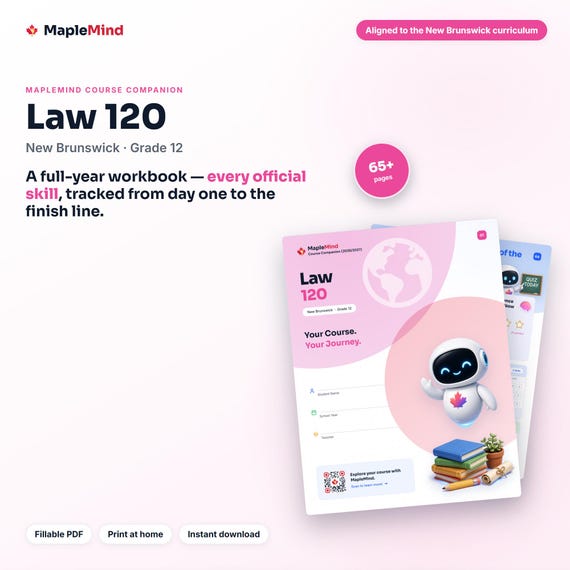
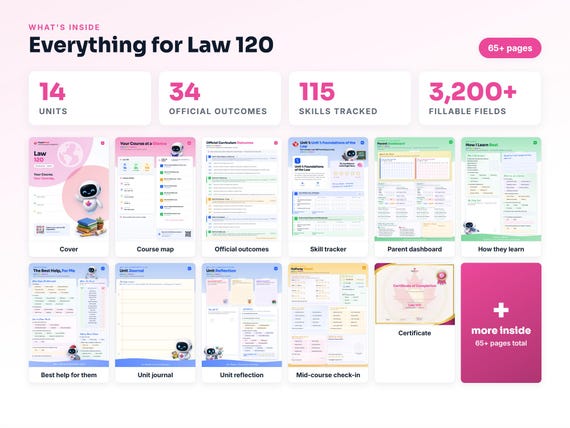
A Law 120 workbook worth keeping
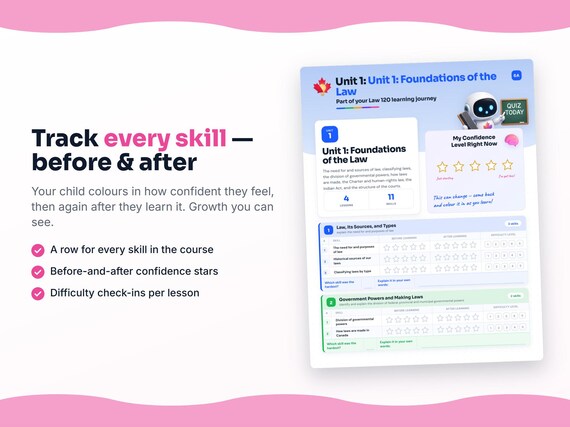
Built from the same official curriculum as this page. Before and after each skill above, your student colours in how sure they feel — so the two of you can see, on one page, what's clicking and what needs another look. It's a quiet way to follow how the year is really going.
By June it's full of their own handwriting: units worked through, confidence grown, a mid-year check-in, notes from parent-teacher night, and a certificate at the end. Less a worksheet, more a record of the year worth keeping on the shelf.
Instant download · see every page, reviews and the full description · five or more workbooks are $2.99 each
What it looks like in the app



Common questions
Can MapleMind help me with Law 120?
Yes. MapleMind's AI tutor covers all 115 skills in New Brunswick's Law 120 — you pick the exact skill, and the tutor teaches it step by step: a short lesson, a worked example, solving together, then a skill check to show it stuck.
Is MapleMind aligned to New Brunswick's official curriculum?
Yes. Every skill in this course maps to an official outcome code from New Brunswick's Grade 12 Social Studies curriculum, and the ministry's own wording is quoted under each unit on this page — with the official government source linked so you can check it yourself.
What does MapleMind cost?
It's free to start — 5 tutoring chats and a practice quiz every day, no credit card. A Pro subscription ($9.99/month or $49.99/year CAD, 7-day free trial) unlocks unlimited tutoring, practice, and exam simulations.
What if I'm stuck on just one topic?
That's the point of skill-level tutoring: open Law 120 in the app, tap the exact skill from the list on this page, and the tutor teaches just that — no wading through lessons you don't need.
Does MapleMind work in French or other languages?
Yes — 14 languages, including French. Both the app and the tutor's explanations switch to the language you choose.
Where can I see the official New Brunswick curriculum for Law 120?
The official source is linked on this page — New Brunswick's official K-12 education resources. The outline here follows it: every MapleMind skill carries its official outcome code, and the ministry's own wording is quoted under each unit.
Keep exploring
Ready when you are
Pick a skill from this page and see it taught properly — free, in the browser, in under a minute.