Get help with Modern History 11
Most tutoring makes you sit through material you already know. MapleMind flips that: pick the exact skill that's causing trouble — any of the 46 below — and the tutor teaches just that one, step by step, as many times as it takes. Ask questions in plain words, any time of day, in English, French, or 12 other languages.
The official New Brunswick Modern History 11 curriculum
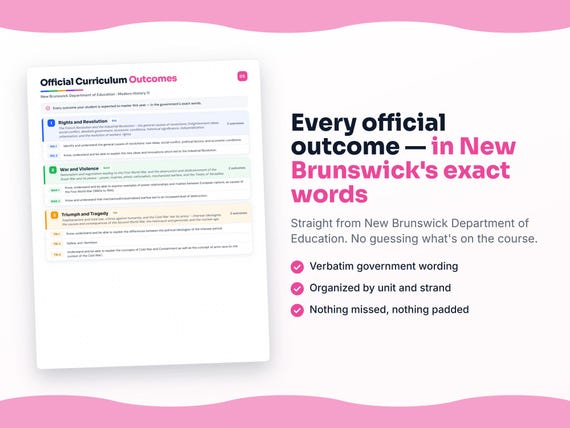
New Brunswick defines Modern History 11 by strands and outcomes. MapleMind teaches the same curriculum reorganized for one-skill-at-a-time tutoring — the table shows exactly where every official strand lands, and the ministry's own wording is quoted under each unit below.
Official source New Brunswick's official K-12 education resourcesRead it on the government site — www2.gnb.ca ↗| Official strand | Outcomes | Where MapleMind teaches it |
|---|---|---|
| Strand 1 | 15 | Rights and Revolution |
| Strand 2 | 10 | War and Violence |
| Strand 3 | 21 | Triumph and Tragedy |
Every skill below, taught one on one.
 Try the first session free
How MapleMind teaches Modern History 11 — every unit, lesson, and skill
Every skill below runs as a short session: a plain-words lesson, a worked example, solving it together, then a five-question skill check that earns up to three stars. Guided Mode keeps it teaching instead of answer-handing — turning it off needs a parent's password.
Unit 1Rights and RevolutionOfficial strand · Strand 1
The French Revolution and the Industrial Revolution - the general causes of revolutions, Enlightenment ideas, social conflict, absolute government, economic conditions, historical significance, industrialization, urbanization, and the evolution of workers' rights.
The French Revolution
- The general causes of revolutions112.1.1.1 — Identify and understand the general causes of revolutions - new ideas, social conflict, political factors, and economic conditions - as a framework for studying the French Revolution.
- The ideas of the Enlightenment112.1.1.2 — Explain the new ideas of the Enlightenment - reason, natural rights, the social contract, and popular sovereignty - and how they challenged absolute monarchy.
- Absolute government without consent112.1.1.4 — Explain how and why France's absolute government functioned without the consent of the governed, and why this became a political cause of revolution.
- Economic conditions of the Revolution112.1.1.5 — Comprehend the severity of the economic conditions - state bankruptcy, debt, taxation, and food shortages - as contributing factors to the French Revolution.
- Criteria for historical significance112.1.2.1 — Understand historians' criteria for measuring historical significance - such as depth, breadth, durability, and relevance of consequences.
- Assessing the significance of the French Revolution112.1.2.2 — Critically assess the historical significance of the French Revolution using the criteria - its impact on rights, the spread of revolutionary ideas, and its lasting legacy.
- Comparing the Revolution to modern events112.1.3.1 — Make connections comparing the French Revolution to other modern events in the context of rights and freedoms.
The Industrial Revolution
- Ideas and innovations of the Industrial Revolution112.2.1.1 — Explain the new ideas and innovations that led to the Industrial Revolution - mechanization, the factory system, steam power, and new sources of energy.
- How governments and workers responded112.2.1.3 — Explain how governments and workers responded to the issues of industrialization - factory laws, reform, and the rise of labour unions.
- Economic conditions of industrialization112.2.1.4 — Comprehend the economic conditions that led to industrialization and furthered its development - capital, resources, markets, and the profit motive.
- The impact of urbanization112.2.2.1 — Demonstrate understanding of the immediate and long-term impact of urbanization on society during the Industrial period - crowded cities, public-health problems, and new ways of life. (At the 113 modified level this same outcome is taught as a level note.)
- The evolution of workers' rights112.2.2.2 — Explain the evolution of workers' rights and the implications of these rights for workers then and now.
- Comparing the Industrial period to today112.2.3.1 — Compare and contrast one aspect of the Industrial period with a modern, evolving industrialized or post-industrial society.
The official wording — 15 outcomes in this unit
- 112.1.1.1
Identify and understand the general causes of revolutions: new ideas, social conflict, political factors, and economic conditions.
- 112.1.1.2
Know, understand and be able to explain the new ideas of The Enlightenment.
- 112.1.1.3
Analyze elements of social conflict in 18th century France.
- 112.1.1.4
Understand, and be able to explain, how and why France's Absolute Government functioned without the consent of the governed.
- 112.1.1.5
Comprehend the severity of economic conditions as contributing factors to the revolution.
- 112.1.2.1
Understand historians' criteria for measuring historical significance
- 112.1.2.2
Critically assess the significance of the French Revolution
- 112.1.3.1
Make connections to allow comparison of the French Revolution to other modern events in the context of rights and freedoms.
- 112.2.1.1
Know, understand and be able to explain the new ideas and innovations which led to the Industrial Revolution.
- 112.2.1.2
Analyze elements of social change/conflict during the Industrial period.
- 112.2.1.3
Understand, and be able to explain, how governments and workers responded to issues of industrialization.
- 112.2.1.4
Comprehend the economic conditions which led to industrialization and furthered its development.
- 112.2.2.1
Demonstrate their understanding of the immediate and long term impact of urbanization on society during the Industrial period.
- 112.2.2.2
Be able to explain the evolution of worker's rights, and the implications of these rights, for workers then and now.
- 112.2.3.1
Compare and contrast one aspect of the Industrial period with a modern, evolving industrialized society.
Unit 2War and ViolenceOfficial strand · Strand 2
Nationalism and negotiation leading to the First World War, and the destruction and disillusionment of the Great War and its peace - power, rivalries, ethnic nationalism, mechanized warfare, and the Treaty of Versailles.
Nationalism and Negotiation
- Power, rivalries, and the causes of the First World War112.3.1.1 — Express the power relationships and rivalries between European nations from the 1860s to 1914 as causes of the First World War - alliances, militarism, imperial competition, and nationalism.
- How power is exercised112.3.2.1 — Express how power is typically exercised on a continuum and how its exercise can have both intended and unintended consequences.
- The ingredients of power potential112.3.2.2 — Analyse the ingredients of national power potential - population, geography, resources, economy, military, and leadership.
- Ethnic nationalism and the exercise of power112.3.2.3 — Examine historical perspectives on ethnic nationalism and the role it played in the exercise of power by European nations from 1860 to 1945.
- Nationalism in modern conflict112.3.3.1 — Examine the role nationalism plays in a modern society involved in conflict, connecting the historical concept to the present.
Destruction and Disillusionment
- Mechanized warfare and destruction112.4.1.1 — Understand that mechanized and industrialized warfare in the First World War led to an unprecedented level of destruction. (At the 113 modified level this same outcome is taught as a level note.)
- The effects of war on individuals and societies112.4.1.2 — Comprehend the effects of war on individuals and societies - casualties, trauma, changed roles, and social upheaval. (At the 113 modified level this same outcome is taught as a level note.)
- Negotiating the treaties of 1919112.4.2.1 — Explain the points of view of those negotiating the treaties to end the Great War in 1919 - the differing aims of the victorious powers.
- The Treaty of Versailles and collective security112.4.2.2 — Demonstrate how the articles of the Treaty of Versailles were at odds with the stated goal of achieving collective security.
- Comparing the quest for collective security112.4.3.1 — Compare and contrast the 1919 quest for collective security with modern-day efforts such as the United Nations and international alliances.
The official wording — 10 outcomes in this unit
- 112.3.1.1
Know, understand and be able to express examples of power relationships and rivalries between European nations, as causes of the First World War (1860s to 1914).
- 112.3.2.1
Be able to express how power is typically exercised on a continuum and that the exercise of power can have both intended and unintended consequences.
- 112.3.2.2
Analyze the ingredients of power potential.
- 112.3.2.3
Examine historical perspectives to explain the concept of ethnic nationalism and the role it played in the exercise of power by European nations from 1860 to 1945.
- 112.3.3.1
Examine the role nationalism plays in a modern society involved in conflict.
- 112.4.1.1
Know and understand that mechanized/industrialized warfare led to an increased level of destruction.
- 112.4.1.2
Comprehend the effects of war on individuals and societies.
- 112.4.2.1
Understand and be able to explain the points of view of those negotiating the treaties to end the Great War in 1919.
- 112.4.2.2
Demonstrate how the articles of the Treaty of Versailles were at odds with the stated goal of achieving collective security.
- 112.4.3.1
Compare and contrast the quest for collective security in 1919 with that of modern day efforts.
Unit 3Triumph and TragedyOfficial strand · Strand 3
Totalitarianism and total war, crimes against humanity, and the Cold War 'war by proxy' - interwar ideologies, the causes and consequences of the Second World War, the Holocaust and genocide, and the nuclear age.
Totalitarianism and Total War
- Interwar political ideologies112.5.1.1 — Explain the differences between the political ideologies of the interwar period - liberal democracy, communism, fascism, and Nazism.
- Why some European governments failed112.5.1.2 — Express why some European governments failed during the 1920s and 1930s, allowing dictatorships to rise.
- The effects of totalitarian governance112.5.1.3 — Analyse the effects of totalitarian governance on social, political, and economic life. (At the 113 modified level this same outcome is taught as a level note.)
- The concept of total war112.5.2.1 — Explain the concept of total war - the mobilization of an entire society's people, economy, and resources for the war effort.
- The causes of the Second World War112.5.2.2 — Explain the general causes of the Second World War - the failures of Versailles, the Depression, aggressive expansion by the Axis powers, and appeasement. (At the 113 modified level this same outcome is taught as a level note.)
- Comparing the consequences of the two world wars112.5.2.3 — Evaluate and compare the consequences of the First World War and the Second World War - human, political, and global.
- Which world war was more significant for Canada112.5.3.1 — Analyse and explain which world war was more significant for Canada, weighing effects on nationhood, society, and Canada's place in the world. (At the 113 modified level this same outcome is taught as a level note.)
Crimes Against Humanity
- Defining anti-Semitism112.6.1.1 — Define anti-Semitism - hostility toward or prejudice against Jewish people - and recognize its long history and role in the Holocaust. (At the 113 modified level this same outcome is taught as a level note.)
- The progression of the Holocaust, 1933-1945112.6.1.2 — Explain the progression of the Holocaust from 1933 to 1945 - from discrimination and persecution to ghettos and the systematic murder of six million Jews and other targeted groups - taught truthfully and with care. (At the 113 modified level this same outcome is taught as a level note.)
- The international response to Jewish refugees112.6.1.3 — Examine the international response to Jewish refugees during and after the Second World War, including the failures - such as Canada's 'None is too many' policy - to offer refuge.
- Human-rights action after the Holocaust112.6.1.4 — Identify the international action and human-rights legislation that resulted from this period - the Nuremberg Trials, the UN, the Genocide Convention, and the Universal Declaration of Human Rights. (At the 113 modified level this same outcome is taught as a level note.)
- Investigating the Holocaust with sources112.6.2.1 — Investigate the Holocaust by examining and using primary and secondary sources, including survivor testimony, respectfully and critically. (At the 113 modified level this same outcome is taught as a level note.)
- Genocide beyond the Holocaust112.6.3.1 — Understand that genocide is not restricted to the Holocaust, recognizing other genocides in history and the meaning of the term. (At the 113 modified level this same outcome is taught as a level note.)
War by Proxy
- Cold War, containment, and the arms race112.7.1.1 — Explain the concepts of the Cold War and containment, and the arms race, as the framework of superpower rivalry after 1945. (At the 113 modified level this same outcome is taught as a level note.)
- The nuclear threat as the defining element112.7.1.2 — Demonstrate how the nuclear threat was the defining element of the Cold War - mutually assured destruction and the fear of nuclear war. (At the 113 modified level this same outcome is taught as a level note.)
- Western society's response to the nuclear threat112.7.1.3 — Understand Western society's response to the nuclear threat - civil defence, fear, and cultural reactions.
- The anti-nuclear and peace movement112.7.1.4 — Explain the growth of the anti-nuclear and peace movement that developed after 1945. (At the 113 modified level this same outcome is taught as a level note.)
- The Cuban Missile Crisis112.7.2.1 — Understand why the Cuban Missile Crisis was a significant Cold War event - the closest the world came to nuclear war. (At the 113 modified level this same outcome is taught as a level note.)
- McCarthyism and anti-communism112.7.3.1 — Examine anti-communism, particularly McCarthyism, as a Western phenomenon and its impact on societies - fear, blacklists, and civil-liberties concerns.
- Comparing McCarthyism and the 'war on terror'112.7.3.2 — Compare McCarthyism in the US with the modern-day 'war on terror', examining how fear can affect rights and freedoms.
- The nuclear threat after the Cold War112.7.3.3 — Understand that the nuclear threat did not disappear with the end of the Cold War, and continues through proliferation and modern risks.
The official wording — 21 outcomes in this unit
- 112.5.1.1
Know, understand and be able to explain the differences between the political ideologies of the interwar period.
- 112.5.1.2
Understand and be able to express why some European governments failed during the 1920's and 1930's.
- 112.5.1.3
Analyze and be able to explain the effects of totalitarian governance on social, political and economic life.
- 112.5.2.1
Understand and be able to explain the concept of Total War.
- 112.5.2.2
Recognize and be able to explain the general causes of the Second World War
- 112.5.2.3
Evaluate and compare the consequences of the First World War and the Second World War.
- 112.5.3.1
Analyze and explain which World War was more significant for Canada.
- 112.6.1.1
Define: anti-Semitism
- 112.6.1.2
Know, understand and be able to explain the progression of the Holocaust from 1933 until 1945
- 112.6.1.3
Examine international response to Jewish refugees during and after the Second World War
- 112.6.1.4
Identify international action and human rights legislation resulting from this period
- 112.6.2.1
Investigate the Holocaust by examining and utilizing primary and secondary sources
- 112.6.3.1
Understand and be able to explain that genocide is not restricted to the Holocaust
- 112.7.1.1
Understand and be able to explain the concepts of Cold War and Containment as well as the concept of arms race (in the context of the Cold War).
- 112.7.1.2
Know, understand and be able to demonstrate how the nuclear threat was the defining element of the Cold War
- 112.7.1.3
Understand western society's response to the nuclear threat
- 112.7.1.4
Know, understand and be able to explain the growth of the anti-nuclear/peace movement that developed after 1945
- 112.7.2.1
Know and understand why the Cuban Missile Crisis was a significant Cold War event.
- 112.7.3.1
Examine anti-communism (McCarthyism) as a Western phenomenon and its impact on societies
- 112.7.3.2
Compare McCarthyism in the US with the modern day war on terror
- 112.7.3.3
Understand that the nuclear threat did not disappear with the end of the Cold War
Printable workbook · A keepsake of the year
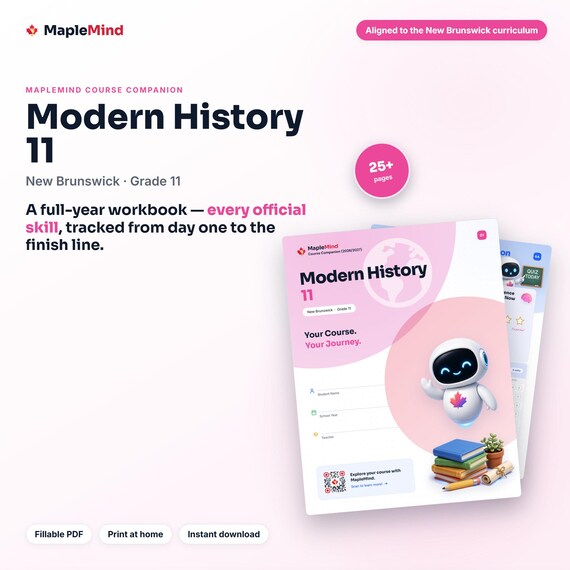
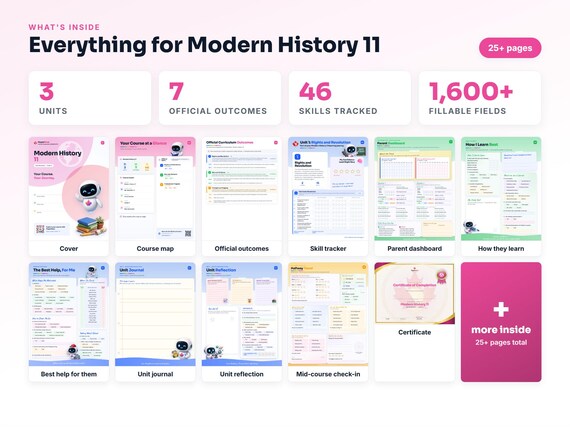
A Modern History 11 workbook worth keeping
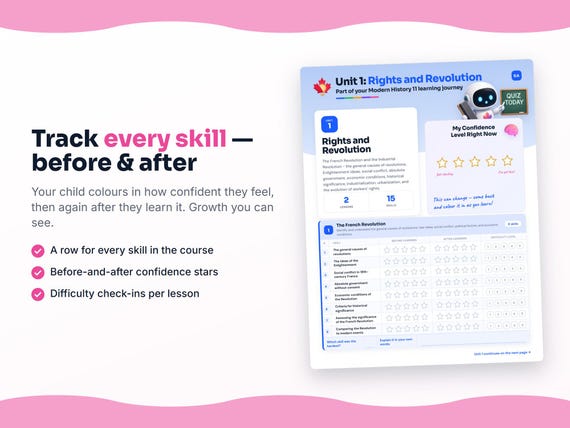
Built from the same official curriculum as this page. Before and after each skill above, your student colours in how sure they feel — so the two of you can see, on one page, what's clicking and what needs another look. It's a quiet way to follow how the year is really going.
By June it's full of their own handwriting: units worked through, confidence grown, a mid-year check-in, notes from parent-teacher night, and a certificate at the end. Less a worksheet, more a record of the year worth keeping on the shelf.
Instant download · see every page, reviews and the full description · five or more workbooks are $2.99 each
What it looks like in the app



Common questions
Can MapleMind help me with Modern History 11?
Yes. MapleMind's AI tutor covers all 46 skills in New Brunswick's Modern History 11 — you pick the exact skill, and the tutor teaches it step by step: a short lesson, a worked example, solving together, then a skill check to show it stuck.
Is MapleMind aligned to New Brunswick's official curriculum?
Yes. Every skill in this course maps to an official outcome code from New Brunswick's Grade 11 Social Studies curriculum, and the ministry's own wording is quoted under each unit on this page — with the official government source linked so you can check it yourself.
What does MapleMind cost?
It's free to start — 5 tutoring chats and a practice quiz every day, no credit card. A Pro subscription ($9.99/month or $49.99/year CAD, 7-day free trial) unlocks unlimited tutoring, practice, and exam simulations.
What if I'm stuck on just one topic?
That's the point of skill-level tutoring: open Modern History 11 in the app, tap the exact skill from the list on this page, and the tutor teaches just that — no wading through lessons you don't need.
Does MapleMind work in French or other languages?
Yes — 14 languages, including French. Both the app and the tutor's explanations switch to the language you choose.
Where can I see the official New Brunswick curriculum for Modern History 11?
The official source is linked on this page — New Brunswick's official K-12 education resources. The outline here follows it: every MapleMind skill carries its official outcome code, and the ministry's own wording is quoted under each unit.
Keep exploring
Ready when you are
Pick a skill from this page and see it taught properly — free, in the browser, in under a minute.