

Get help with Civics 10
Most tutoring makes you sit through material you already know. MapleMind flips that: pick the exact skill that's causing trouble — any of the 11 below — and the tutor teaches just that one, step by step, as many times as it takes. Ask questions in plain words, any time of day, in English, French, or 12 other languages.
The official New Brunswick Civics 10 curriculum
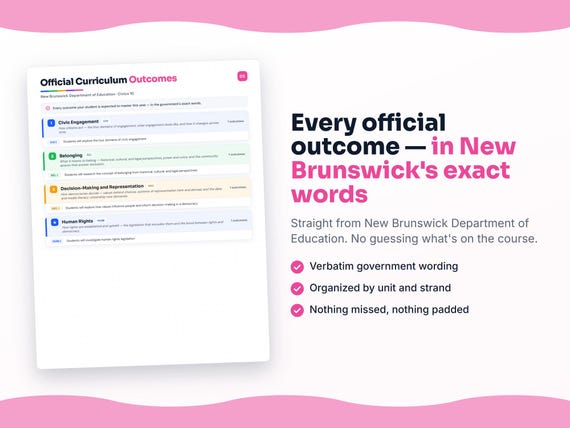
New Brunswick defines Civics 10 by strands and outcomes. MapleMind teaches the same curriculum reorganized for one-skill-at-a-time tutoring — the table shows exactly where every official strand lands, and the ministry's own wording is quoted under each unit below.
Official source New Brunswick's official K-12 education resourcesRead it on the government site — www2.gnb.ca ↗| Official strand | Outcomes | Where MapleMind teaches it |
|---|---|---|
| Strand G1 | 3 | Civic Engagement |
| Strand G2 | 3 | Belonging |
| Strand G3 | 3 | Decision-Making and Representation |
| Strand G4 | 2 | Human Rights |
Every skill below, taught one on one.
 Try the first session free
How MapleMind teaches Civics 10 — every unit, lesson, and skill
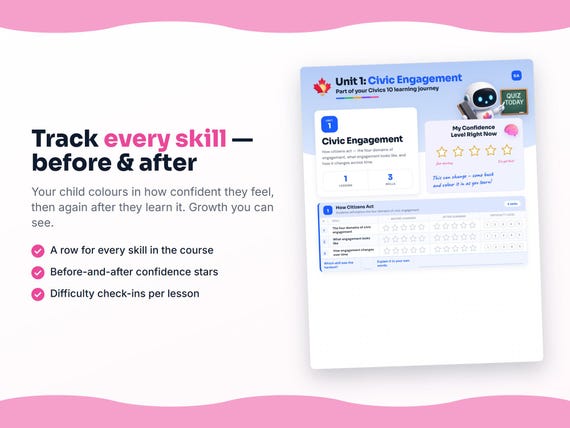
Every skill below runs as a short session: a plain-words lesson, a worked example, solving it together, then a five-question skill check that earns up to three stars. Guided Mode keeps it teaching instead of answer-handing — turning it off needs a parent's password.
Unit 1Civic EngagementOfficial strand · Strand G1
How citizens act — the four domains of engagement, what engagement looks like, and how it changes across time.
How Citizens Act
- The four domains of civic engagementCIV10-1.1 — Explore the four domains of civic engagement — participating as an individual, working together as a group, building public support, and working through the political system.
- What engagement looks likeCIV10-1.2 — Examine what civic engagement looks like in practice — inside and outside the formal political system.
- How engagement changes over timeCIV10-1.3 — Research how civic engagement changes over time — movements, methods, and the arrival of digital participation.
The official wording — 3 outcomes in this unit
- CIV10-1.1
Students will explore the four domains of civic engagement
- CIV10-1.2
Students will examine what civic engagement looks like
- CIV10-1.3
Students will research how civic engagement changes over time
Unit 2BelongingOfficial strand · Strand G2
What it means to belong — historical, cultural, and legal perspectives, power and voice, and the community spaces that answer exclusion.
What Belonging Means
- Belonging across history, culture, and lawCIV10-2.1 — Research the concept of belonging from historical, cultural, and legal perspectives — including citizenship law, cultural identity, and the Wabanaki nations' relationship to this territory.
- Power, voice, and belongingCIV10-2.2 — Consider issues of power, voice, and belonging — who gets heard, who decides, and how exclusion operates.
- Community spaces answering exclusionCIV10-2.3 — Investigate community spaces that respond to issues of belonging — the places and organizations built to include.
The official wording — 3 outcomes in this unit
- CIV10-2.1
Students will research the concept of belonging from historical, cultural, and legal perspectives
- CIV10-2.2
Students will consider issues of power, voice, and belonging
- CIV10-2.3
Students will investigate community spaces that respond to issues of belonging
Unit 3Decision-Making and RepresentationOfficial strand · Strand G3
How democracies decide — values behind choices, systems of representation here and abroad, and the data and media literacy citizenship now demands.
How Democracies Decide
- Values behind democratic decisionsCIV10-3.1 — Explore how values influence people and inform decision-making in a democracy.
- Representation in Canada and beyondCIV10-3.2 — Investigate the different ways citizens are represented within Canada and around the world.
- Data and media literacy for civic lifeCIV10-3.3 — Use data and media literacy to respond to issues of civic importance — testing sources, reading statistics, and spotting manipulation.
The official wording — 3 outcomes in this unit
- CIV10-3.1
Students will explore how values influence people and inform decision-making in a democracy
- CIV10-3.2
Students will investigate different ways that citizens are represented within Canada and around the world
- CIV10-3.3
Students will use data and media literacy to respond to issues of civic importance
Unit 4Human RightsOfficial strand · Strand G4
How rights are established and upheld — the legislation that encodes them and the bond between rights and democracy.
Rights and Democracy
- Human rights legislationCIV10-4.1 — Investigate human rights legislation — from the Universal Declaration to the Charter and New Brunswick's Human Rights Act.
- The rights-democracy relationshipCIV10-4.2 — Examine the relationship between human rights and democracy — how each depends on and defends the other.
The official wording — 2 outcomes in this unit
- CIV10-4.1
Students will investigate human rights legislation
- CIV10-4.2
Students will examine the relationship between human rights and democracy
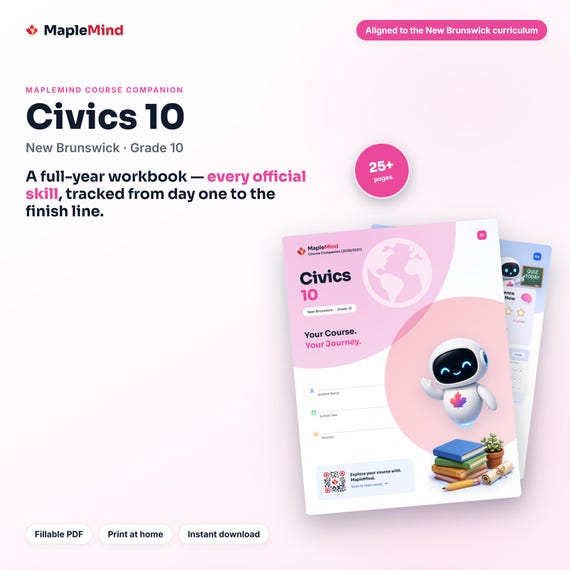
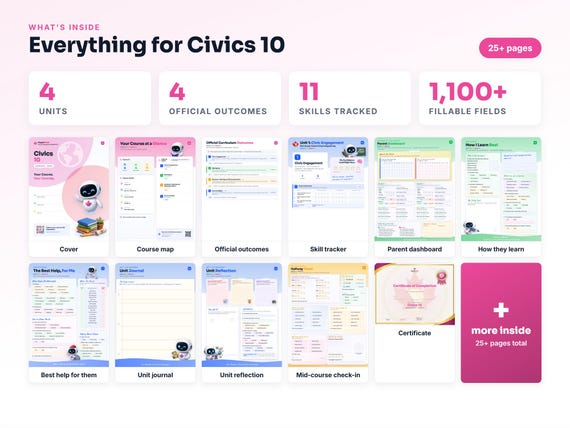
Printable workbook · A keepsake of the year
A Civics 10 workbook worth keeping
Built from the same official curriculum as this page. Before and after each skill above, your student colours in how sure they feel — so the two of you can see, on one page, what's clicking and what needs another look. It's a quiet way to follow how the year is really going.
By June it's full of their own handwriting: units worked through, confidence grown, a mid-year check-in, notes from parent-teacher night, and a certificate at the end. Less a worksheet, more a record of the year worth keeping on the shelf.
Instant download · see every page, reviews and the full description · five or more workbooks are $2.99 each
What it looks like in the app



Common questions
Can MapleMind help me with Civics 10?
Yes. MapleMind's AI tutor covers all 11 skills in New Brunswick's Civics 10 — you pick the exact skill, and the tutor teaches it step by step: a short lesson, a worked example, solving together, then a skill check to show it stuck.
Is MapleMind aligned to New Brunswick's official curriculum?
Yes. Every skill in this course maps to an official outcome code from New Brunswick's Grade 10 Social Studies curriculum, and the ministry's own wording is quoted under each unit on this page — with the official government source linked so you can check it yourself.
What does MapleMind cost?
It's free to start — 5 tutoring chats and a practice quiz every day, no credit card. A Pro subscription ($9.99/month or $49.99/year CAD, 7-day free trial) unlocks unlimited tutoring, practice, and exam simulations.
What if I'm stuck on just one topic?
That's the point of skill-level tutoring: open Civics 10 in the app, tap the exact skill from the list on this page, and the tutor teaches just that — no wading through lessons you don't need.
Does MapleMind work in French or other languages?
Yes — 14 languages, including French. Both the app and the tutor's explanations switch to the language you choose.
Where can I see the official New Brunswick curriculum for Civics 10?
The official source is linked on this page — New Brunswick's official K-12 education resources. The outline here follows it: every MapleMind skill carries its official outcome code, and the ministry's own wording is quoted under each unit.
Keep exploring
Ready when you are
Pick a skill from this page and see it taught properly — free, in the browser, in under a minute.