New Brunswick · For parents

What your child learns in Grade 10 in New Brunswick

Every subject, unit by unit, from New Brunswick’s curriculum: 174 skills in plain words.

Subjects
5
Skills
174
Provincial exams
6
Official curriculum
gnb.ca

Math in Grade 10

2 courses. Choose the one your child takes.

Geometry, Measurement and Finance 10

4 units · 31 skills

  1. Unit 1

    Algebra

    A formula can be rearranged to solve for any variable in it.

    • Perimeter, area, volume and capacity formulas
    • Pythagorean and trigonometric formulas
    • Income and currency-exchange formulas
    1 more skill
    • Interest and finance-charge formulas
  2. Unit 2

    Number

    Unit price is total price divided by the number of units — it lets you compare different sizes.

    • Unit pricing and currency exchange
    • Wages, salary and contracts
    • Commission and piecework
    7 more skills
    • Gross and net pay
    • Banking accounts and transaction services
    • Fees and managing an account
    • Calculating compound interest
    • Comparing simple and compound interest
    • Credit cards and their cost
    • Loans and comparing credit options
  3. Unit 3

    Geometry

    Spatial reasoning means picturing, rotating, and fitting shapes in the mind.

    • Analyzing spatial puzzles and games
    • Recognizing and verifying the Pythagorean theorem
    • Applying the Pythagorean theorem to solve problems
    6 more skills
    • Similarity and trig ratios in right triangles
    • Applying the primary trigonometric ratios
    • Solving problems with trigonometry
    • Angles from parallel, perpendicular and transversal lines
    • Drawing, replicating and bisecting angles
    • Solving problems with angles
  4. Unit 4

    Measurement

    SI prefixes (kilo, centi, milli) scale a base unit by powers of ten.

    • SI units and their relationships
    • Imperial units and their relationships
    • Solving linear measurement problems
    5 more skills
    • Area of regular, composite and irregular shapes
    • Surface area and volume of prisms
    • Surface area and volume of cylinders
    • Surface area and volume of cones and pyramids
    • Surface area and volume of spheres

Number, Relations and Functions 10

2 units · 28 skills

  1. Unit 1

    Algebra and Number

    Every whole number factors uniquely into primes.

    • Prime factors, GCF and LCM
    • Square roots and cube roots
    • Identifying and simplifying irrational numbers
    7 more skills
    • Ordering irrational numbers
    • Powers with integral exponents
    • Powers with rational exponents
    • Multiplying a monomial by a polynomial
    • Multiplying binomials and trinomials
    • Factoring out common factors
    • Factoring trinomials
  2. Unit 2

    Relations and Functions

    A graph's shape shows how one quantity changes with another.

    • Interpreting graphs and data
    • Matching graphs to situations
    • Distinguishing relations and functions
    15 more skills
    • Domain and range of a relation
    • Slope as rise over run and rate of change
    • Slopes of parallel and perpendicular lines
    • Representing linear relations many ways
    • Intercepts, slope, domain and range of a line
    • Slope-intercept and general form
    • Slope-point form
    • Equation from a graph
    • Equation from a point and slope, or two points
    • Equation from a parallel or perpendicular line
    • Equation from a scatter plot
    • Distance and midpoint of a segment
    • Using function notation
    • Solving systems graphically
    • Solving systems algebraically

Science in Grade 10

Science, Grade 10

6 units · 23 skills

  1. Unit 1

    Power, Work & Energy

    Energy is the ability to do work or cause change.

    • Power, work, and energy
    • Energy stores and pathways
    • Types of energy and conservation
  2. Unit 2

    Electricity and Electrification

    Electric charge comes from electrons, which are negatively charged.

    • Static electricity and charge
    • Ohm's law
    • Series and parallel circuits
    1 more skill
    • Electrification and power generation
  3. Unit 3

    Nuclear Technology

    A physical change changes form but not the substance (ice melting).

    • Physical, chemical, and nuclear changes
    • Atomic theory and models of the atom
    • The periodic table and isotopes
    1 more skill
    • Radiation and radioactivity
  4. Unit 4

    Chemistry Foundations

    A pure substance has one kind of particle (an element or a compound).

    • Classifying matter
    • Chemical bonding
    • Chemical changes and reactions
    2 more skills
    • Balancing equations and the mole
    • Representing molecules and chemical changes with models
  5. Unit 5

    Sustainable Development Design Challenge

    • A community SDG design challenge
  6. Unit 6

    Learning and Living Sustainably

    Chemicals are used throughout society, but their use and reactions can cause problems.

    • Use of chemicals: causes, consequences, solutions
    • Power generation and electrification
    • Earth's energy budget and global warming
    3 more skills
    • Chemistry of the hydrosphere: pH and electrolytes
    • Ionic phenomena: acid rain and eutrophication
    • Biosphere chemistry: combustion and the carbon cycle

English in Grade 10

English 10

3 units · 40 skills

  1. Unit 1

    Speaking and Listening

    Examining an idea means doing something to it: restating it, testing it against a case, or asking what it needs to be true.

    • Examining others' ideas to extend your own
    • Constructing ideas through questions and responses
    • Presenting a personal viewpoint to a group
    8 more skills
    • Listening critically to form and refine opinions
    • Formal and informal speech
    • Adapting a message to the listener
    • Precise instructions, directions and answers
    • Physical qualities and language choices in speech
    • Respectful active listening and analysing positions
    • The power of spoken language
    • Varieties of language and speech events
  2. Unit 2

    Reading and Viewing

    A familiar genre is where you read fastest and learn least, so comfort is the signal to move on.

    • Reading a wide variety of print texts
    • Viewing a wide variety of media and visual texts
    • Seeking meaning with reading strategies
    15 more skills
    • Clearing up confusion and adjusting reading rate
    • The impact of literary devices and media techniques
    • Researching, selecting and integrating information
    • Supporting a personal response to a text
    • Questioning, connecting, evaluating and extending
    • Thematic connections across texts and media
    • Considering more than one interpretation
    • Aspects of texts that shape meaning
    • Inferences, conclusions and supported responses
    • Language, genre, purpose and audience
    • Recognizing literary and media devices
    • Discussing the characteristics of texts and genres
    • Responding critically to print and media texts
    • How texts reveal and produce ideologies
    • How media texts portray groups of people
  3. Unit 3

    Writing and Representing

    Exploring in writing is aimed, not aimless: you start from a question you cannot yet answer and stop when the page says something you did not know.

    • Writing to explore and reflect
    • Note-making to reconstruct knowledge
    • Imaginative language choices
    8 more skills
    • Writing for different audiences and purposes
    • Structure, form and style for a purpose
    • Using others' responses to my work
    • Knowing which processes work for me
    • Conventions in final products
    • Experimenting with technology to communicate
    • Commitment to crafting
    • Materials that clarify for an audience
See the course: English 10

French in Grade 10

Post-Intensive French, Grade 10

3 units · 41 skills

  1. Unit 1

    Unité 1: Le grand écran – Le cinéma

    Film vocabulary: 'un film', 'un genre', 'le realisateur' (director), 'les acteurs'.

    • Talking about favourite films
    • Explaining your point of view on special effects
    • Commenting on the efficiency of special effects (speaking)
    14 more skills
    • Talking about film genres and the values they portray
    • Judging the value of commercialization in films
    • Expressing opinions on commercialization in films
    • Providing a critical analysis of a film (speaking)
    • Reading about films
    • Reading about special effects in films
    • Reading about genres of films
    • Reading about commercialization of films
    • Writing about favourite films
    • Explaining your point of view on special effects in writing
    • Commenting on the efficiency of special effects (writing)
    • Writing about film genres and the values they portray
    • Explaining and expressing opinions on commercialization in films
    • Providing a critical analysis of a film (writing)
  2. Unit 2

    Unité 2: L’impact des TIC dans la vie quotidienne

    Vocabulary: 'les TIC' (ICT), 'la technologie', 'les reseaux sociaux', 'les ecrans'.

    • Providing opinions on the use of IT (speaking)
    • Making observations from a graph (speaking)
    • Explaining the consequences of an activity
    6 more skills
    • Reading about technology's forms and uses
    • Reading a graph on technology use
    • Reading about consequences of excessive technology use
    • Providing opinions on the use of IT (writing)
    • Making observations from a graph (writing)
    • Explaining in detail the consequences of technology use
  3. Unit 3

    Unité 3: Les relations personnelles chez les ados

    Casual register with friends: 'tu', 'salut', 'ca va?', 'a plus'.

    • Communicating in friendly situations
    • Expressing the moral qualities of a friend
    • Explaining the characteristics of friendship
    12 more skills
    • Reflecting on good and bad decisions
    • Expressing characteristics of uncomfortable situations
    • Giving advice to resolve conflict
    • Giving advice to improve relationships
    • Reading about friendly interactions
    • Reading and inferring qualities of friends and friendships
    • Reading about giving and receiving feedback
    • Writing about friendly situations
    • Writing about qualities and characteristics of friendship
    • Writing a reflection on uncomfortable situations and decisions
    • Proposing a plan to resolve conflict
    • Proposing a solution to improve relationships

Social studies in Grade 10

Civics 10

4 units · 11 skills

  1. Unit 1

    Civic Engagement

    Domain 1 — individual participation: grassroots work.

    • The four domains of civic engagement
    • What engagement looks like
    • How engagement changes over time
  2. Unit 2

    Belonging

    Legal belonging: citizenship, permanent residency, status under law.

    • Belonging across history, culture, and law
    • Power, voice, and belonging
    • Community spaces answering exclusion
  3. Unit 3

    Decision-Making and Representation

    Values drive positions: liberty, equality, security, tradition, sustainability.

    • Values behind democratic decisions
    • Representation in Canada and beyond
    • Data and media literacy for civic life
  4. Unit 4

    Human Rights

    The layers: Universal Declaration (1948) → Charter (1982) → Canadian Human Rights Act → NB Human Rights Act.

    • Human rights legislation
    • The rights-democracy relationship
See the course: Civics 10

Provincial exams in Grade 10

MapleMind

See Grade 10 in MapleMind

Real screens from the app your child would use.

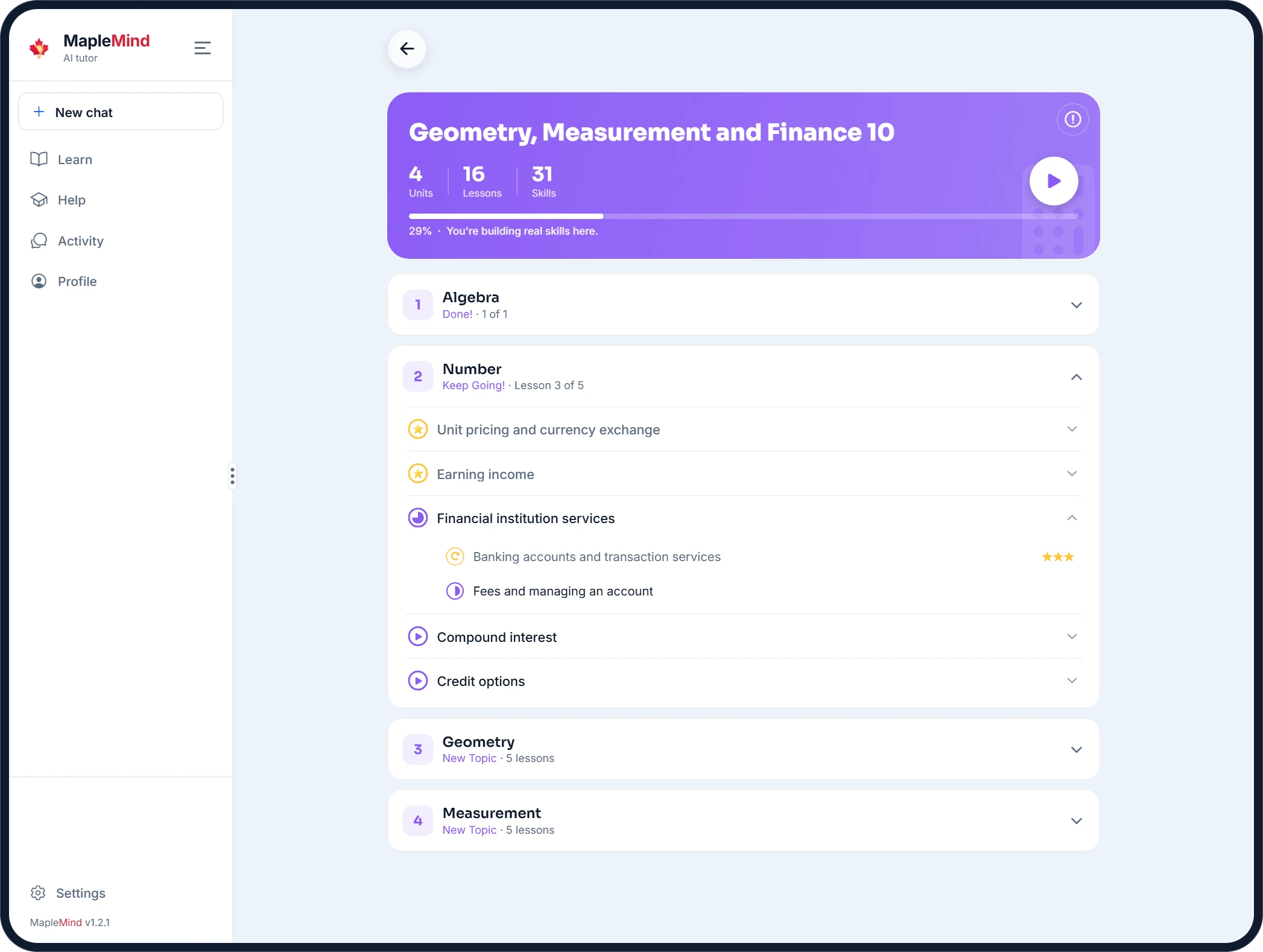
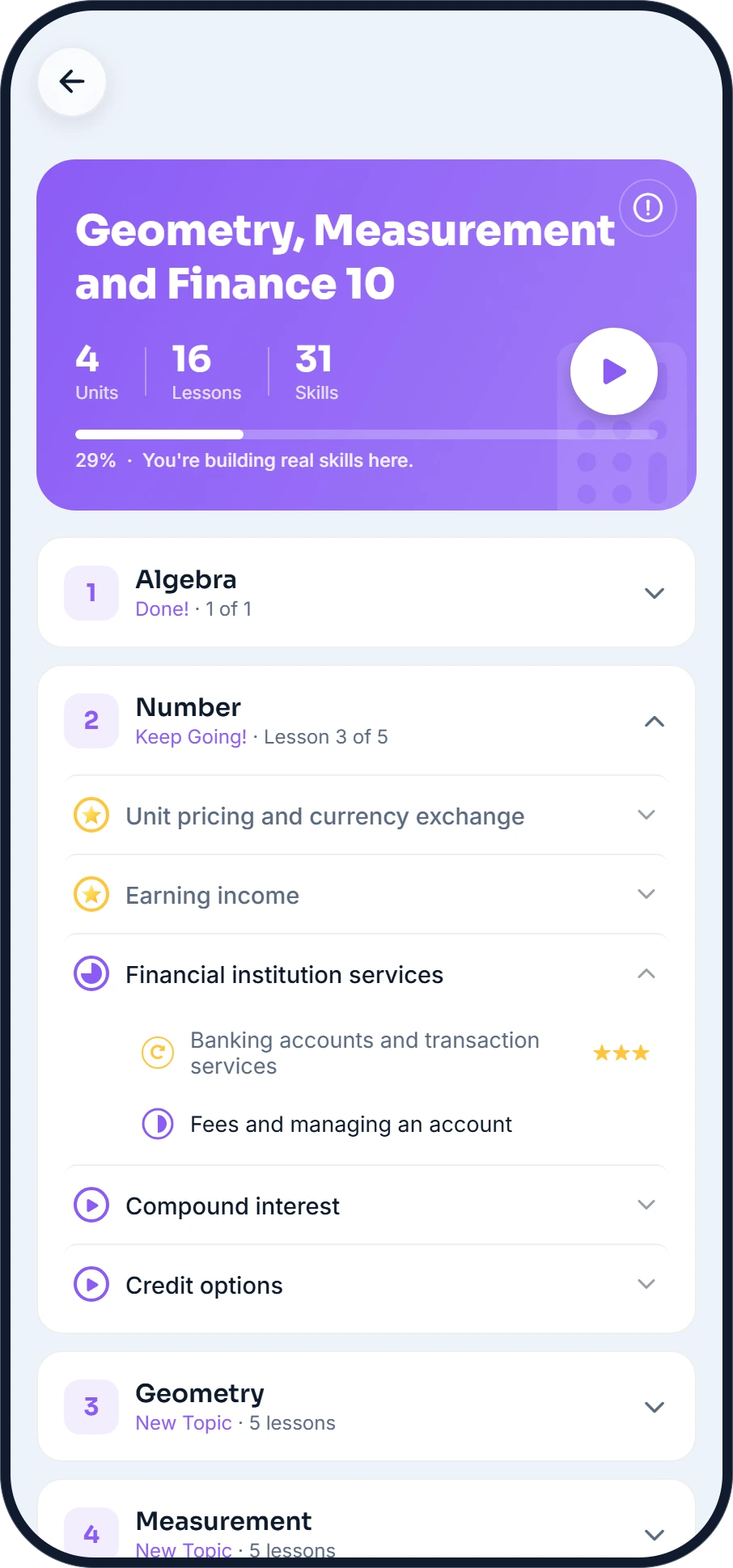
Geometry, Measurement and Finance 10 in MapleMind on a tablet: its units and lessons in order, a student partway through.Geometry, Measurement and Finance 10 in MapleMind on a phone: its units and lessons in order, a student partway through.
Their course, unit by unit, the way New Brunswick teaches it.Shown: Geometry, Measurement and Finance 10
Homework Help on a tablet: a photo of a worksheet, the tutor’s worked example of a two-step equation, and a question back to the student.Homework Help on a phone: a photo of a worksheet, the tutor’s worked example of a two-step equation, and a question back to the student.
Homework Help: they take a photo of the question, and the tutor works through it with them.
The Parent Dashboard on a tablet: a student’s days studied, streak, lessons, quiz average and recent activity.The Parent Dashboard on a phone: a student’s days studied, streak, lessons, quiz average and recent activity.
The Parent Dashboard: how each child’s week went, in lessons, quizzes and days studied.
A Grade 9 provincial mathematics exam on a tablet: a readiness score, the exam’s time and its next sitting.A Grade 9 provincial mathematics exam on a phone: a readiness score, the exam’s time and its next sitting.
A provincial exam: a practice sitting under the real time, and how ready they are.
The Learn tab on a tablet: a four-day streak, the week’s days, Homework Help, the next lesson and a review.The Learn tab on a phone: a four-day streak, the week’s days, Homework Help, the next lesson and a review.
The Learn tab: their week so far, and the next thing to do.

Help at home

Questions parents ask

What will my child learn in Grade 10 in New Brunswick?

Math: Geometry, Measurement and Finance 10 and Number, Relations and Functions 10. Science: Science, Grade 10. English: English 10. French: Post-Intensive French, Grade 10. Social studies: Civics 10. That’s 174 skills in all, from New Brunswick’s curriculum.

When is the English Language Proficiency Assessment?

It’s written January 18, 2027 to January 29, 2027.

Where does this list come from?

From New Brunswick’s official curriculum, the documents its education ministry publishes for each course. Each skill here is one of their expectations, written in plain words.

Can MapleMind help my child in Grade 10?

Yes. Every course on this page is in MapleMind, with lessons, practice and a tutor that works through each step with them. A free account gets 30 messages and 4 activities a day.

Help with Grade 10, one skill at a time.

Every course on this page is in MapleMind, free with daily limits.