New Brunswick · For parents

What your child learns in Grade 3 in New Brunswick

Every subject, unit by unit, from New Brunswick’s curriculum: 117 skills in plain words.

Subjects
4
Skills
117
Provincial exams
2
Official curriculum
gnb.ca

Math in Grade 3

Mathematics, Grade 3

4 units · 40 skills

  1. Unit 1

    Number

    Counting by 100s changes the hundreds digit each jump.

    • Skip-counting by 5s, 10s, and 100s
    • Skip-counting by 3s, 4s, and 25s
    • Showing numbers to 1000
    18 more skills
    • Comparing and ordering to 1000
    • Estimating quantities to 1000
    • Hundreds, tens, and ones
    • Adding two 2-digit numbers mentally
    • Subtracting two 2-digit numbers mentally
    • Estimating sums and differences
    • Adding numbers to 1000
    • Subtracting numbers to 1000
    • Doubles and making 10 for facts
    • The commutative and zero properties
    • Thinking addition to subtract
    • Multiplication as equal groups and arrays
    • Multiplication facts to 5 by 5
    • Division as sharing and grouping
    • Relating division to multiplication
    • A fraction is part of a whole
    • Where fractions are used
    • Comparing fractions with the same bottom number
  2. Unit 2

    Patterns and Relations

    An increasing pattern grows by the same amount each step.

    • Increasing patterns
    • Decreasing patterns
    • Missing-number addition equations
    1 more skill
    • Missing-number subtraction equations
  3. Unit 3

    Shape and Space

    Some activities take minutes, some take hours or days.

    • Relating time to activities
    • Seconds, minutes, and days
    • Choosing referents for cm and m
    9 more skills
    • How centimetres and metres relate
    • Estimating length
    • Measuring and recording length
    • Measuring mass (g and kg)
    • Perimeter of regular shapes
    • Perimeter of irregular shapes
    • Describing 3-D objects by their faces
    • Counting edges and vertices
    • Sorting polygons by their sides
  4. Unit 4

    Statistics and Probability

    Tally marks count each response, grouping by fives.

    • Organizing data with tallies and line plots
    • Organizing data with charts and lists
    • Building and reading bar graphs

Science in Grade 3

Science, Grade 3

4 units · 14 skills

  1. Unit 1

    Weather and Climate

    A cycle is a pattern that repeats again and again.

    • Natural cyclical events
    • Seasonal weather conditions
    • Weather hazards
    1 more skill
    • The Sun provides energy
  2. Unit 2

    Habitats

    An ecosystem is all the living and non-living things in an area, together.

    • Introduction to ecosystems
    • Energy flow in a habitat
    • Populations and communities
    1 more skill
    • Physical characteristics of a habitat
  3. Unit 3

    Plants

    Plants have roots, a stem, leaves, and often flowers.

    • Characteristics and structures of local plants
    • What plants need
    • Uses of local plants
  4. Unit 4

    Animals

    Animals have body parts (structures) that help them survive.

    • Characteristics and structures of local animals
    • What animals need
    • Uses of local animals

English in Grade 3

English Language Arts, Grade 3

3 units · 44 skills

  1. Unit 1

    Speaking and Listening

    Describing gives details; discussing means going back and forth with others.

    • Sharing and discussing thoughts and experiences
    • Asking and answering questions to explore problems
    • Expressing and explaining opinions
    8 more skills
    • Listening critically to others' ideas
    • Participating in group discussion
    • Adapting voice and expression to the occasion
    • Giving and following instructions
    • Engaging with and responding to presentations
    • Using courtesies of conversation
    • Noticing unfair language and speaking with respect
    • Matching language to different situations
  2. Unit 2

    Reading and Viewing

    Good text choices match your interest AND your reading level.

    • Selecting texts for interests and needs
    • Reading widely across children's literature
    • Using text features to locate information
    14 more skills
    • Using cueing systems and monitoring reading
    • Word-solving and self-correcting strategies
    • Comprehension and response strategies
    • Describing your own reading process
    • Before-reading (previewing) strategies
    • During-reading strategies
    • After-reading strategies
    • Generating research questions and needs
    • Using sources and reflecting on research
    • Making personal connections to texts
    • Explaining opinions about texts and authors
    • Questioning information in texts
    • Recognizing text types and conventions
    • Responding critically to texts
  3. Unit 3

    Writing and Other Ways of Representing

    Writing can generate and organize your language and ideas.

    • Writing to explore ideas and express feelings
    • Writing to record experiences and learning
    • Exploring ways to make notes
    13 more skills
    • Experimenting with language in imaginative writing
    • Creating texts in a variety of forms
    • Showing awareness of purpose and audience
    • Using readers' responses to assess and extend work
    • Prewriting and drafting strategies
    • Revising and editing strategies
    • Publishing and presenting strategies
    • Conventions: punctuation and capitalization
    • Conventions: language structure
    • Conventions: spelling strategies
    • Engaging deeply with writing
    • Using technology in writing and representing
    • Selecting and combining information from sources

Social studies in Grade 3

Social Studies, Grade 3

3 units · 19 skills

  1. Unit 1

    Place

    Our province sits inside bigger places: the Atlantic region, Canada, North America, and the world.

    • Locating our province in relation to other places
    • Comparing size with simple scales
    • Landforms and bodies of water
    3 more skills
    • Climate and vegetation
    • Urban and rural communities
    • Why people live where they do
  2. Unit 2

    Peoples

    Our province is made up of many diverse peoples.

    • Identifying the diverse peoples of our province
    • How diversity changed over time
    • Expressing culture beyond food and fashion
    4 more skills
    • Language and keeping culture alive
    • Working together and its benefits
    • Understanding stereotyping
    • Making an action plan
  3. Unit 3

    Citizenship

    The purpose of an elected government is to represent the people who elected it and make decisions for them.

    • Our provincial government
    • Municipal and First Nation governments
    • Active citizens and their characteristics
    3 more skills
    • Rights and responsibilities in a democracy
    • Majority vote and consensus
    • How decisions cause change

Provincial exams in Grade 3

MapleMind

See Grade 3 in MapleMind

Real screens from the app your child would use.

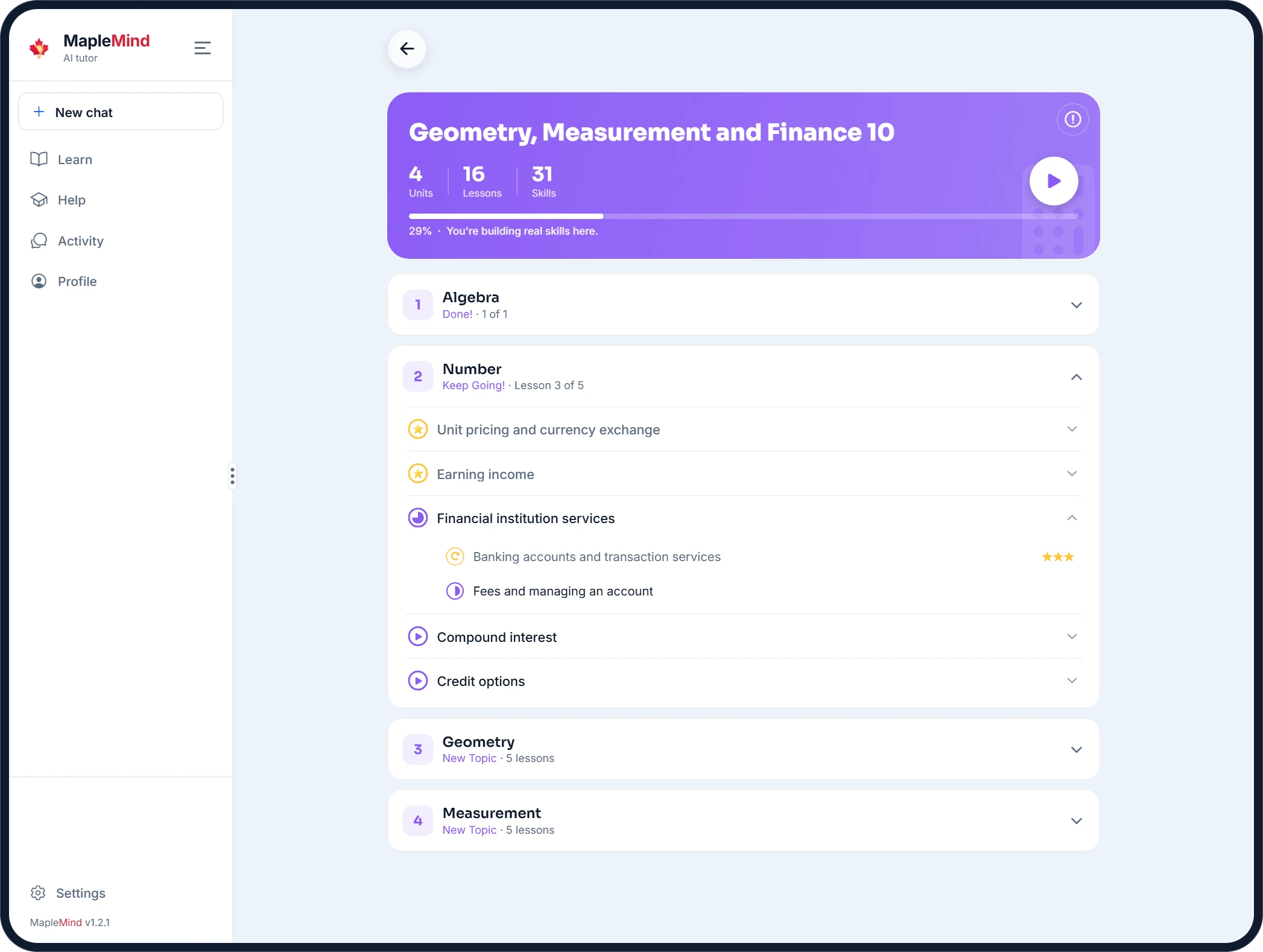
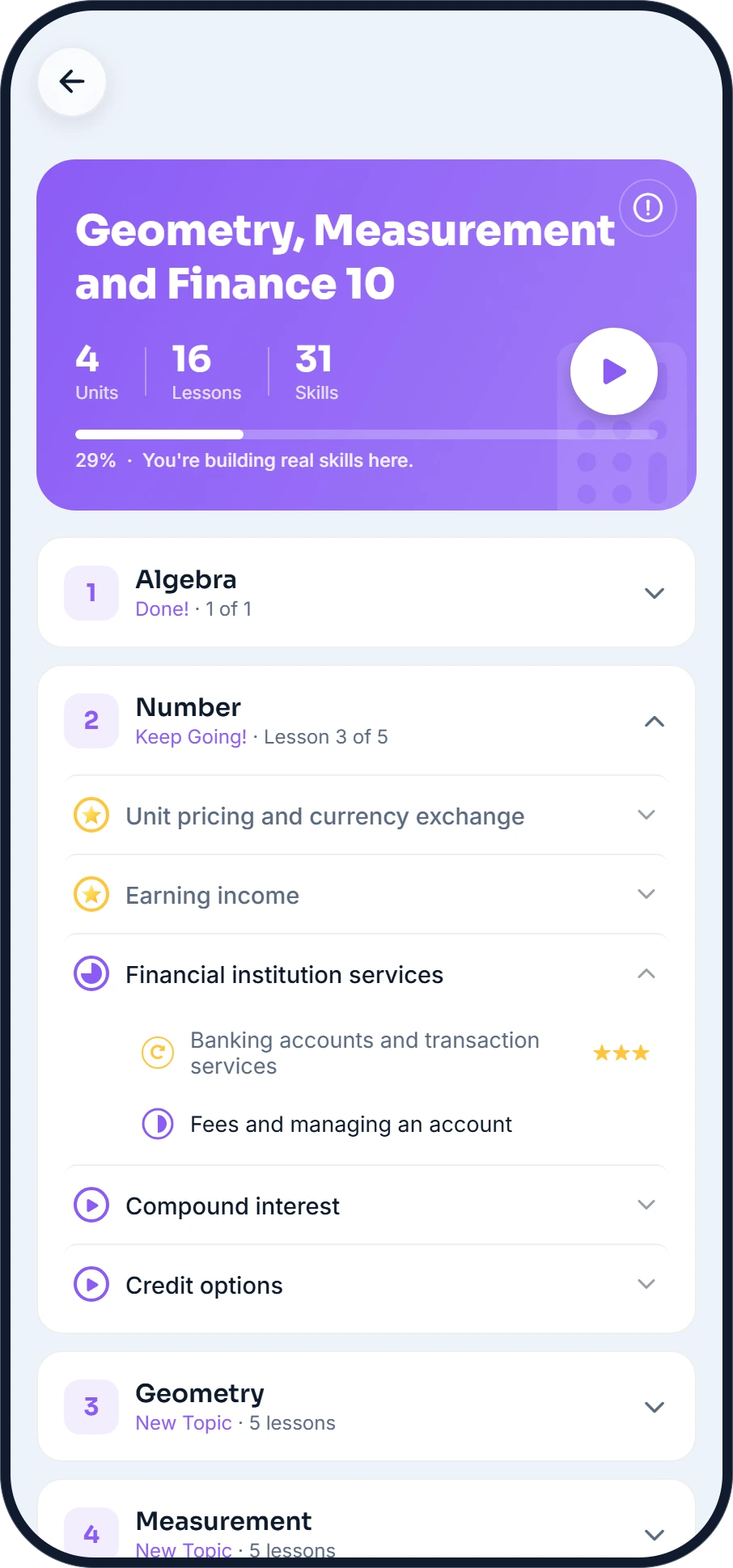
Geometry, Measurement and Finance 10 in MapleMind on a tablet: its units and lessons in order, a student partway through.Geometry, Measurement and Finance 10 in MapleMind on a phone: its units and lessons in order, a student partway through.
Their course, unit by unit, the way New Brunswick teaches it.Shown: Geometry, Measurement and Finance 10
Homework Help on a tablet: a photo of a worksheet, the tutor’s worked example of a two-step equation, and a question back to the student.Homework Help on a phone: a photo of a worksheet, the tutor’s worked example of a two-step equation, and a question back to the student.
Homework Help: they take a photo of the question, and the tutor works through it with them.
The Parent Dashboard on a tablet: a student’s days studied, streak, lessons, quiz average and recent activity.The Parent Dashboard on a phone: a student’s days studied, streak, lessons, quiz average and recent activity.
The Parent Dashboard: how each child’s week went, in lessons, quizzes and days studied.
A Grade 9 provincial mathematics exam on a tablet: a readiness score, the exam’s time and its next sitting.A Grade 9 provincial mathematics exam on a phone: a readiness score, the exam’s time and its next sitting.
A provincial exam: a practice sitting under the real time, and how ready they are.
The Learn tab on a tablet: a four-day streak, the week’s days, Homework Help, the next lesson and a review.The Learn tab on a phone: a four-day streak, the week’s days, Homework Help, the next lesson and a review.
The Learn tab: their week so far, and the next thing to do.

Help at home

Questions parents ask

What will my child learn in Grade 3 in New Brunswick?

Math: Mathematics, Grade 3. Science: Science, Grade 3. English: English Language Arts, Grade 3. Social studies: Social Studies, Grade 3. That’s 117 skills in all, from New Brunswick’s curriculum.

When is the New Brunswick francophone provincial exam: Lecture 3e année?

It’s written April 27, 2027, and April 28, 2027, and April 29, 2027.

Where does this list come from?

From New Brunswick’s official curriculum, the documents its education ministry publishes for each course. Each skill here is one of their expectations, written in plain words.

Can MapleMind help my child in Grade 3?

Yes. Every course on this page is in MapleMind, with lessons, practice and a tutor that works through each step with them. A free account gets 30 messages and 4 activities a day.

Help with Grade 3, one skill at a time.

Every course on this page is in MapleMind, free with daily limits.