Get help with English Language Arts, Grade 3
Most tutoring makes your child sit through material your child already knows. MapleMind flips that: pick the exact skill that's causing trouble — any of the 44 below — and the tutor teaches just that one, step by step, as many times as it takes. Ask questions in plain words, any time of day, in English, French, or 12 other languages.
The official New Brunswick English Language Arts, Grade 3 curriculum
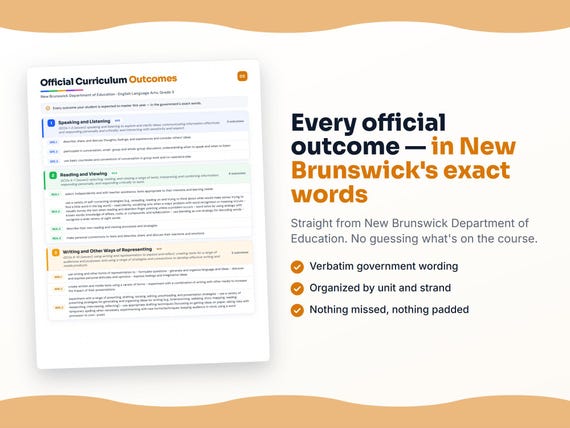
New Brunswick defines English Language Arts, Grade 3 by strands and outcomes. MapleMind teaches the same curriculum reorganized for one-skill-at-a-time tutoring — the table shows exactly where every official strand lands, and the ministry's own wording is quoted under each unit below.
Official source New Brunswick's official K-12 education resourcesRead it on the government site — www2.gnb.ca ↗| Official strand | Outcomes | Where MapleMind teaches it |
|---|---|---|
| Strand SL | 11 | Speaking and Listening |
| Strand RV | 13 | Reading and Viewing |
| Strand WR | 11 | Writing and Other Ways of Representing |
Every skill below, taught one on one.
 Try the first session free
How MapleMind teaches English Language Arts, Grade 3 — every unit, lesson, and skill
Every skill below runs as a short session: a plain-words lesson, a worked example, solving it together, then a five-question skill check that earns up to three stars. Guided Mode keeps it teaching instead of answer-handing — turning it off needs a parent's password.
Unit 1Speaking and ListeningOfficial strand · Strand SL
GCOs 1-3 (woven): speaking and listening to explore and clarify ideas; communicating information effectively and responding personally and critically; and interacting with sensitivity and respect.
Exploring ideas through speaking and listening (GCO 1)
- Sharing and discussing thoughts and experiencesNB-ELA-3.1.1 — Describe, share, and discuss thoughts, feelings, and experiences and consider others' ideas.
- Asking and answering questions to explore problemsNB-ELA-3.1.2 — Ask and respond to questions to clarify information and to explore possibilities or solutions to problems.
- Expressing and explaining opinionsNB-ELA-3.1.3 — Express and explain opinions and respond to the questions and reactions of others.
- Listening critically to others' ideasNB-ELA-3.1.4 — Listen critically to others' ideas and opinions.
Communicating clearly and effectively (GCO 2)
- Participating in group discussionNB-ELA-3.2.1 — Participate in conversation and small-group and whole-group discussion, understanding when to speak and when to listen.
- Adapting voice and expression to the occasionNB-ELA-3.2.2 — Adapt volume, projection, facial expression, gestures, and tone of voice to the speaking occasion.
- Giving and following instructionsNB-ELA-3.2.3 — Give and follow instructions and respond to questions and directions.
- Engaging with and responding to presentationsNB-ELA-3.2.4 — Engage in and respond to a variety of oral presentations and other texts.
Interacting with sensitivity and respect (GCO 3)
- Using courtesies of conversationNB-ELA-3.3.1 — Use basic courtesies and conventions of conversation in group work and co-operative play.
- Noticing unfair language and speaking with respectNB-ELA-3.3.2 — Identify some forms of oral language that are unfair to particular individuals and cultures and use vocabulary that shows respect for all people.
- Matching language to different situationsNB-ELA-3.3.3 — Demonstrate a growing awareness that different kinds of language are appropriate to different situations.
The official wording — 11 outcomes in this unit
- NB-ELA-3.1.1
describe, share, and discuss thoughts, feelings, and experiences and consider others’ ideas
- NB-ELA-3.1.2
ask and respond to questions to clarify information and to explore possibilities or solutions to problems
- NB-ELA-3.1.3
express and explain opinions and respond to the questions and reactions of others
- NB-ELA-3.1.4
listen critically to others’ ideas and opinions
- NB-ELA-3.2.1
participate in conversation, small- group and whole-group discussion, understanding when to speak and when to listen
- NB-ELA-3.2.2
adapt volume, projection, facial expression, gestures, and tone of voice to the speaking occasion
- NB-ELA-3.2.3
give and follow instructions and respond to questions and directions
- NB-ELA-3.2.4
engage in and respond to a variety of oral presentations and other texts
- NB-ELA-3.3.1
use basic courtesies and conventions of conversation in group work and co-operative play
- NB-ELA-3.3.2
identify some forms of oral language that are unfair to particular individuals and cultures and use vocabulary that shows respect for all people
- NB-ELA-3.3.3
demonstrate a growing awareness that different kinds of language are appropriate to different situations
Unit 2Reading and ViewingOfficial strand · Strand RV
GCOs 4-7 (woven): selecting, reading, and viewing a range of texts; interpreting and combining information; responding personally; and responding critically to texts.
Selecting and reading a range of texts (GCO 4, part 1)
- Selecting texts for interests and needsNB-ELA-3.4.1 — Select, independently and with teacher assistance, texts appropriate to their interests and learning needs.
- Reading widely across children's literatureNB-ELA-3.4.2 — Read widely and experience a variety of children's literature.
- Using text features to locate informationNB-ELA-3.4.3 — Use pictorial, typographical, and organizational features of written text to determine content, locate topics, and obtain information.
- Using cueing systems and monitoring readingNB-ELA-3.4.4 — Use and integrate the various cueing systems and a range of strategies to construct meaning, predicting and cross-checking cues to monitor reading.
Reading strategies: solving words and understanding (GCO 4, part 2)
- Word-solving and self-correcting strategiesNB-ELA-3.4.5 — Use a variety of self-correcting and word-solving strategies such as rereading, silent reading, analogy, affixes, syllabication, blending, and sight-word recognition.
- Comprehension and response strategiesNB-ELA-3.4.5 — Use comprehension strategies such as identifying main idea and details, order in text, figurative language, character understanding, empathy, and story elements.
Reading processes and finding information (GCOs 4-5)
- Describing your own reading processNB-ELA-3.4.6 — Describe their own reading and viewing processes and strategies.
- Before-reading (previewing) strategiesNB-ELA-3.4.7 — Use prereading/previewing strategies such as predicting from title and pictures, making connections, setting purposes, and asking questions.
- During-reading strategiesNB-ELA-3.4.7 — Use during-reading strategies such as verifying and adjusting predictions and visualizing characters, settings, and situations.
- After-reading strategiesNB-ELA-3.4.7 — Use after-reading/viewing strategies such as reflecting, responding through talk or writing, and asking questions about the text.
- Generating research questions and needsNB-ELA-3.5.1 — Identify their own information needs and generate their own questions as a guide for research.
- Using sources and reflecting on researchNB-ELA-3.5.1 — Use a range of print and non-print materials, basic reference materials, and a database or electronic search to meet information needs, and reflect on the research process.
Responding personally and critically to texts (GCOs 6-7)
- Making personal connections to textsNB-ELA-3.6.1 — Make personal connections to texts and describe, share, and discuss their reactions and emotions.
- Questioning information in textsNB-ELA-3.7.1 — Question information presented in print and visual texts, using a personal knowledge base as a frame of reference.
- Recognizing text types and conventionsNB-ELA-3.7.2 — Identify different types of print and media texts, recognizing their language conventions and characteristics and how these help understanding.
- Responding critically to textsNB-ELA-3.7.3 — Respond critically to texts by formulating questions, identifying point of view and whose voices are and are not expressed, discussing from their own reality, and identifying prejudice, bias, and stereotyping.
The official wording — 13 outcomes in this unit
- NB-ELA-3.4.1
select, independently and with teacher assistance, texts appropriate to their interests and learning needs
- NB-ELA-3.4.2
read widely and experience a variety of children’s literature
- NB-ELA-3.4.3
use pictorial, typographical, and organizational features of written text to determine content, locate topics, and obtain information
- NB-ELA-3.4.4
use and integrate, with support, the various cueing systems (pragmatic, semantic, syntactic, and graphophonic) and a range of strategies to construct meaning - predict on the basis of what would make sense, what would sound right, and what the print suggests (semantics, syntax, graphophonics) - monitor reading by cross- check- ing the various cues
- NB-ELA-3.4.5
use a variety of self-correcting strategies (e.g., rereading, reading on and trying to think about what would make sense, trying to find a little word in the big word) - read silently, vocalizing only when a major problem with word recognition or meaning occurs - visually survey the text when reading and abandon finger pointing unless a problem occurs - word solve by using analogy with known words; knowledge of affixes, roots, or compounds; and syllabication - use blending as one strategy for decoding words - recognize a wide variety of sight words
- NB-ELA-3.4.6
describe their own reading and viewing processes and strategies
- NB-ELA-3.4.7
use prereading/previewing strate- gies, such as . predicting what the text will be about based on its title and pictures, as well as their personal experiences with the topic . making connections between what they read and their own experiences and knowledge . setting their own purposes for reading/viewing . asking themselves questions about what they want to find out
- NB-ELA-3.5.1
answer, with assistance, their own questions and those of others by seeking information from a variety of texts - identify their own personal and learning needs for information - generate their own questions as a guide for research
- NB-ELA-3.6.1
make personal connections to texts and describe, share, and discuss their reactions and emotions
- NB-ELA-3.6.2
express and explain opinions about texts and types of texts, and the work of authors and illustrators, demonstrating an increasing awareness of the reasons for their opinions
- NB-ELA-3.7.1
question information presented in print and visual texts - use a personal knowledge base as a frame of reference
- NB-ELA-3.7.2
identify some different types of print and media texts - recognize some of their language conventions and text charac- teristics - recognize that these conventions and characteristics help them understand what they read and view
- NB-ELA-3.7.3
respond critically to texts - formulate questions as well as understandings - identify the point of view in a text and demonstrate awareness of whose voices/positions are and are not being expressed - discuss the text from the perspectives of their own realities and experiences - identify instances of prejudice, bias, and stereotyping
Unit 3Writing and Other Ways of RepresentingOfficial strand · Strand WR
GCOs 8-10 (woven): using writing and representation to explore and reflect; creating texts for a range of audiences and purposes; and using a range of strategies and conventions to develop effective writing and media products.
Writing and representing to explore and learn (GCO 8)
- Writing to explore ideas and express feelingsNB-ELA-3.8.1 — Use writing and other forms of representation to formulate questions, generate and organize language and ideas, and discover and express personal attitudes, opinions, feelings, and imaginative ideas.
- Writing to record experiences and learningNB-ELA-3.8.1 — Use writing and other forms of representation to record experiences and explore how and what they learn.
- Exploring ways to make notesNB-ELA-3.8.2 — Explore, with assistance, ways for making their own notes.
- Experimenting with language in imaginative writingNB-ELA-3.8.3 — Experiment with language choices in imaginative writing and other ways of representing.
Creating texts for audiences and purposes (GCO 9)
- Creating texts in a variety of formsNB-ELA-3.9.1 — Create written and media texts using a variety of forms, experimenting with combining writing and other media to increase impact.
- Showing awareness of purpose and audienceNB-ELA-3.9.2 — Demonstrate some awareness of purpose and audience, making choices about form and recognizing that shared work needs editing.
- Using readers' responses to assess and extend workNB-ELA-3.9.3 — Consider their readers', listeners', and viewers' questions, comments, and responses in assessing their work and extending their learning.
The writing process and conventions (GCO 10)
- Prewriting and drafting strategiesNB-ELA-3.10.1 — Experiment with prewriting and drafting strategies, using prewriting to generate and organize ideas and drafting to get ideas on paper.
- Revising and editing strategiesNB-ELA-3.10.1 — Use revision techniques to make writing clear and editing strategies to check punctuation, usage, and spelling.
- Publishing and presenting strategiesNB-ELA-3.10.1 — Use appropriate techniques for publishing and presenting, such as word processing, adding illustrations and diagrams, and sharing work.
- Conventions: punctuation and capitalizationNB-ELA-3.10.2 — Use conventions of punctuation and capitalization: capitals for names and sentence starts, periods, commas, apostrophes, and question, exclamation, and quotation marks.
- Conventions: language structureNB-ELA-3.10.2 — Use conventions of language structure: subject-verb agreement, simple paragraphing, varied sentence structures, and pronouns.
- Conventions: spelling strategiesNB-ELA-3.10.2 — Use spelling conventions: meaning and syntax patterns, sound cues, a range of spelling strategies, and editing for spelling.
- Engaging deeply with writingNB-ELA-3.10.3 — Demonstrate engagement with the creation of pieces of writing and representation, working for sustained periods, revising willingly, and showing pride and ownership.
- Using technology in writing and representingNB-ELA-3.10.4 — Experiment with technology in writing and other forms of representing, such as word processing, drawing programs, and using databases and the Internet with assistance.
- Selecting and combining information from sourcesNB-ELA-3.10.5 — Select, organize, and combine relevant information, with assistance, from at least two sources without copying verbatim, to construct and communicate meaning.
The official wording — 11 outcomes in this unit
- NB-ELA-3.8.1
use writing and other forms of representation to - formulate questions - generate and organize language and ideas - discover and express personal attitudes and opinions - express feelings and imaginative ideas
- NB-ELA-3.8.2
explore, with assistance, ways for making their own notes
- NB-ELA-3.8.3
experiment with language choices in imaginative writing and other ways of representing
- NB-ELA-3.9.1
create written and media texts using a variety of forms - experiment with a combination of writing with other media to increase the impact of their presentations
- NB-ELA-3.9.2
demonstrate some awareness of purpose and audience - make choices about form for a specific purpose/audience - realize that work to be shared with an audience needs editing
- NB-ELA-3.9.3
consider their readers’/ listeners’/ viewers’ questions, comments, and other responses in assessing their work and extending their learning
- NB-ELA-3.10.1
experiment with a range of prewriting, drafting, revising, editing, proofreading, and presentation strategies - use a variety of prewriting strategies for generating and organizing ideas for writing (e.g., brainstorming, webbing, story mapping, reading, researching, interviewing, reflecting) - use appropriate drafting techniques (focussing on getting ideas on paper, taking risks with temporary spelling when necessary, experimenting with new forms/techniques, keeping audience in mind, using a word processor to com- pose)
- NB-ELA-3.10.2
use some conventions of written language - punctuation and capitalization . use capitals for proper names, titles, places, days, months, holidays, beginning of sentences . use periods at the ends of sentences and for abbreviations . use commas in a series, and in dates . use apostrophes for possessives and contractions . use question marks, exclamation marks, and quotation marks
- NB-ELA-3.10.3
demonstrate engagement with the creation of pieces of writing and other representation - engage in writing/ representing activities for sustained periods of time - work willingly on revising and editing for an audience - demonstrate pride and sense of ownership in writing/ representing efforts
- NB-ELA-3.10.4
experiment with technology in writing and other forms of represent- ing - use a simple word processing program to draft, revise, edit, and publish - use a drawing program (computer software) - with assistance, use a database, CD-ROM, and the Internet as resources for finding information (prewriting strategy)
- NB-ELA-3.10.5
select, organize, and combine relevant information with assist- ance, from at least two sources, without copying verbatim, to construct and communicate meaning
Printable workbook · A keepsake of the year
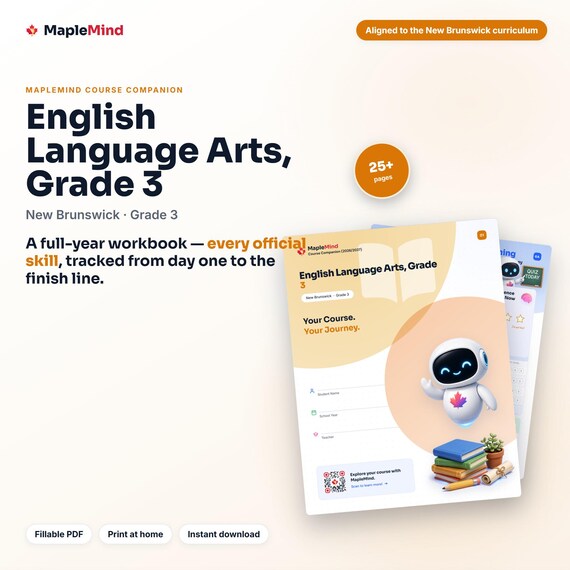
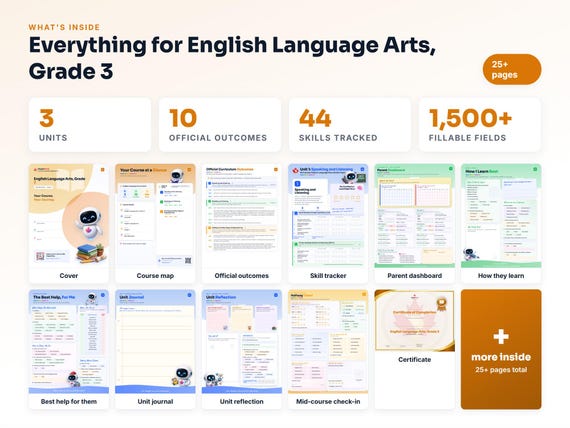
A English Language Arts, Grade 3 workbook worth keeping
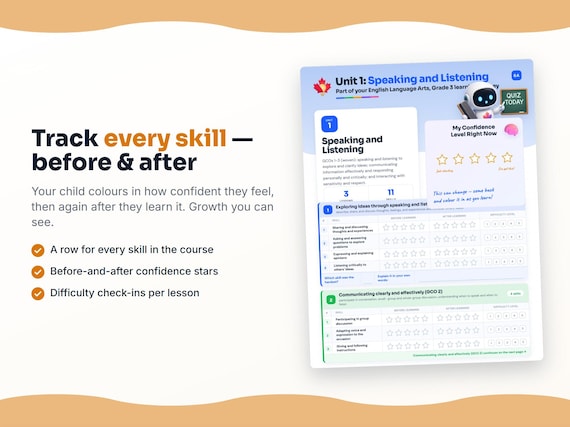
Built from the same official curriculum as this page. Before and after each skill above, your student colours in how sure they feel — so the two of you can see, on one page, what's clicking and what needs another look. It's a quiet way to follow how the year is really going.
By June it's full of their own handwriting: units worked through, confidence grown, a mid-year check-in, notes from parent-teacher night, and a certificate at the end. Less a worksheet, more a record of the year worth keeping on the shelf.
Instant download · see every page, reviews and the full description · five or more workbooks are $2.99 each
What it looks like in the app



Common questions
Can MapleMind help my child with English Language Arts, Grade 3?
Yes. MapleMind's AI tutor covers all 44 skills in New Brunswick's English Language Arts, Grade 3 — your child picks the exact skill, and the tutor teaches it step by step: a short lesson, a worked example, solving together, then a skill check to show it stuck.
Is MapleMind aligned to New Brunswick's official curriculum?
Yes. Every skill in this course maps to an official outcome code from New Brunswick's Grade 3 English Language Arts curriculum, and the ministry's own wording is quoted under each unit on this page — with the official government source linked so you can check it yourself.
What does MapleMind cost?
It's free to start — 5 tutoring chats and a practice quiz every day, no credit card. A Pro subscription ($9.99/month or $49.99/year CAD, 7-day free trial) unlocks unlimited tutoring, practice, and exam simulations.
What if my child is stuck on just one topic?
That's the point of skill-level tutoring: open English Language Arts, Grade 3 in the app, tap the exact skill from the list on this page, and the tutor teaches just that — no wading through lessons your child doesn't need.
Does MapleMind work in French or other languages?
Yes — 14 languages, including French. Both the app and the tutor's explanations switch to the language your child chooses.
Where can I see the official New Brunswick curriculum for English Language Arts, Grade 3?
The official source is linked on this page — New Brunswick's official K-12 education resources. The outline here follows it: every MapleMind skill carries its official outcome code, and the ministry's own wording is quoted under each unit.
Keep exploring
Ready when you are
Pick a skill from this page and see it taught properly — free, in the browser, in under a minute.